DTCIC(601001)

Search documents
煤炭行业2026年度投资策略:遇火生辉
Changjiang Securities· 2025-12-24 11:41
Core Insights - In 2025, coal prices significantly declined, leading to a return of sector profitability to the lowest levels in the past decade. However, the outlook for 2026 suggests potential demand improvement and limited supply capacity utilization, which may lead to a recovery in coal price levels [2][5][6]. - The report emphasizes that with a clear supply-demand improvement and the presence of both defensive and offensive investment opportunities, the likelihood of success for selected stocks is high. If demand is strong and coal prices improve beyond expectations, attention should be given to currently undervalued stocks with low liquidity and lower profit margins [2][7]. Industry Overview - The coal industry faced a challenging year in 2025, with thermal coal prices dropping from 855 CNY/ton in 2024 to 697 CNY/ton, an 18% decrease. The profitability of the sector fell to the 30th percentile of the past decade due to weak demand driven by warm weather and sluggish manufacturing electricity consumption [5][16]. - Coking coal prices also saw a significant decline, dropping 26% from 2024's 2022 CNY/ton to 1502 CNY/ton, with profitability at the 10th percentile of the past decade. This was primarily due to strong supply, with a 1.5% year-on-year increase in coking coal supply in the first three quarters of 2025 [5][16]. Demand and Supply Dynamics - For thermal coal in 2026, demand improvement is anticipated, with limited supply growth expected. The report identifies three key questions regarding market resilience: whether negative growth in thermal power will become the norm, if domestic supply can be controlled, and whether rising coal prices will increase imports [6][30]. - The report suggests that the central government's focus on controlling "involution" competition will continue to limit supply growth in 2026, despite some new production capacity coming online. Long-term resource depletion may also exert upward pressure on domestic coal prices [6][30]. Investment Recommendations - The report advocates for investment in the coal sector in 2026, highlighting the potential for a bottom reversal. It suggests that the timing for investment should align with capital flows, particularly in the first quarter when there is often a demand for increased allocation to dividend-paying sectors [7][30]. - Recommended stocks include Yanzhou Coal Mining Company and China Shenhua Energy, which are expected to benefit from a recovery in coal prices to a range of 750-800 CNY/ton. Additionally, stocks with significant growth potential and low valuations, such as Huayang Co. and Jinkong Coal Industry, are highlighted as potential targets if demand and price improvements exceed expectations [7][30].


煤价有底,预计26年开启需求上行周期
Haitong Securities International· 2025-12-22 07:01
Investment Rating - The report maintains a positive investment outlook for the coal sector, recommending a focus on key players such as China Shenhua Energy, Shaanxi Coal and Chemical Industry, and China Coal Energy, while also keeping an eye on Yanzhou Coal Mining and Jinneng Holding [3]. Core Insights - The coal price is expected to stabilize, with a bottom range projected between 680-700 RMB/ton. The demand is currently at a median level compared to the past five years, and port inventories are showing a downward trend. The report anticipates a rebound in coal prices to over 800 RMB/ton by November [3][4]. - The coal sector is believed to have reached a cyclical bottom in Q2 2025, with a reversal in supply-demand dynamics. A new upward cycle for coal and downstream thermal power demand is expected to begin in the second half of 2026 [3][4]. Summary by Sections Coal Price Trends - As of December 19, 2025, the price of Q5500 coal at Huanghua Port is 721 RMB/ton, down 42 RMB/ton (-5.5%) from the previous week. The price of Q5000 coal at the same port is 620 RMB/ton, also down 42 RMB/ton (-6.3%) [6][12]. - Domestic coal prices are generally declining, while international prices are mixed, with Newcastle coal prices showing a slight increase [41][49]. Supply and Demand Dynamics - Domestic coal supply remains stable, with imports expected to decrease. The report notes that the demand for coal is improving significantly during the off-peak season, with Q3 profits anticipated to rebound [3][4]. - As of December 19, 2025, the total inventory of coking coal at three major ports is 279.7 million tons, down 7.1% from the previous week [58]. Long-term Contracts and Pricing - The annual long-term contract price for Q5500 coal at Northern Ports is 694 RMB/ton, reflecting a month-on-month increase of 10 RMB/ton (1.5%) [34]. - The report indicates that the long-term contract prices for coking coal have remained stable compared to the previous week [59]. Key Market Events - The report highlights significant developments in coal transportation infrastructure in Inner Mongolia, which is expected to enhance coal logistics efficiency and capacity [81]. - It also notes that coal prices have continued to decline in early December, with various types of coal experiencing price drops [81].




澳大利亚煤电需扩能两倍以支撑2050年电力需求增长
GOLDEN SUN SECURITIES· 2025-12-22 03:25
Investment Rating - The industry investment rating is "Buy" for several companies including China Coal Energy, China Shenhua, and Jinneng Holding Coal Industry [3][8]. Core Viewpoints - Australia's electricity demand is projected to double by 2050, necessitating a twofold increase in coal power capacity to ensure supply during the transition period. Total electricity demand is expected to rise from 205 billion kWh to 389 billion kWh by the fiscal year 2049-50, with significant contributions from high-energy industries such as industrial electrification and data centers [2][3]. - Current coal power capacity in Australia has decreased from approximately 30,000 MW to about 21,000 MW, with aging units averaging over 40 years of operation. Non-scheduled outages are expected to reach 7% of total operating time from 2027 to 2035, indicating a critical need for coal power to maintain grid stability during the transition to renewable energy [3][8]. Summary by Sections Industry Overview - The report highlights a significant decline in Australia's coal power capacity and the urgent need for expansion to meet future electricity demands. The transition to renewable energy sources is progressing but faces substantial gaps in implementation [2][3][8]. Key Companies - Recommended companies include: - Yancoal Australia (Buy) - Jinneng Holding Coal Industry (Buy) - China Coal Energy (Buy) - China Shenhua (Buy) - Shaanxi Coal and Chemical Industry (Buy) - Huainan Mining (Buy) - China Qinfa (Buy) [3][8]. Price Trends - Coal prices have shown mixed trends, with Newcastle coal prices at $105 per ton, down by $2.75 per ton (-2.55%), while European ARA coal prices increased slightly to $96.21 per ton, up by $0.64 per ton (+0.67%) [1][3][36].
晋控煤业跌2.01%,成交额9359.91万元,主力资金净流出1152.10万元
Xin Lang Cai Jing· 2025-12-22 02:36
Core Viewpoint - Jinko Coal Industry's stock price has experienced a decline of 2.01% on December 22, with a current price of 13.68 CNY per share and a total market capitalization of 22.896 billion CNY. The company has seen a year-to-date stock price increase of 5.92%, but a recent decline over the past five days of 5.33% [1] Group 1: Financial Performance - For the period from January to September 2025, Jinko Coal Industry reported a revenue of 9.325 billion CNY, representing a year-on-year decrease of 16.99%. The net profit attributable to shareholders was 1.277 billion CNY, down 40.65% compared to the previous year [2] - Since its A-share listing, Jinko Coal Industry has distributed a total of 6.083 billion CNY in dividends, with 3.640 billion CNY distributed over the last three years [3] Group 2: Shareholder and Market Activity - As of November 20, 2025, the number of shareholders for Jinko Coal Industry was 53,000, a decrease of 8.62% from the previous period. The average number of circulating shares per person increased by 9.43% to 31,579 shares [2] - The top ten circulating shareholders include notable entities such as Guotai Junan CSI Coal ETF, which holds 33.2232 million shares, an increase of 20.2405 million shares from the previous period. Other significant shareholders have seen changes in their holdings, with some reducing their positions [3]
煤价分化炼焦煤企稳向上,神华千亿收购提升价值
ZHONGTAI SECURITIES· 2025-12-20 11:51
Investment Rating - The report maintains an "Overweight" rating for the coal industry [2][5]. Core Views - The coal market is expected to stabilize as supply tightens and demand rebounds, driven by seasonal factors and production adjustments [7][8]. - China Shenhua's acquisition of significant assets is projected to enhance its coal production capacity and resource reserves substantially [8]. - The investment strategy suggests a focus on undervalued stocks with high dividend yields and growth potential in the coal sector [8]. Summary by Sections 1. Industry Overview - The coal industry comprises 37 listed companies with a total market capitalization of 1,875.44 billion yuan and a circulating market value of 1,839.35 billion yuan [2]. 2. Coal Price Tracking - Recent trends indicate a divergence in coal prices, with coking coal stabilizing upwards while thermal coal prices are under pressure due to weak demand [7][8]. - As of December 19, 2025, the price of thermal coal at the port was 708 yuan/ton, reflecting a week-on-week decrease of 42 yuan/ton [8]. 3. Supply and Demand Dynamics - Coal production in November 2025 was 42,679 million tons, a year-on-year decrease of 0.5% but a month-on-month increase of 4.93% [7]. - The report highlights that the demand for electricity coal has been affected by warmer weather, leading to a decrease in daily coal consumption [7]. 4. Key Company Insights - China Shenhua's acquisition plan involves purchasing multiple coal and energy assets for a total consideration of 1,335.98 billion yuan, significantly increasing its coal production capacity by approximately 230 million tons per year [8]. - Other companies such as Yancoal Energy and Shanxi Coking Coal are also highlighted for their growth potential and dividend policies [13]. 5. Investment Recommendations - The report recommends a strategy of buying undervalued stocks with strong dividend yields, such as China Shenhua, Zhongmei Energy, and Xinji Energy, while also focusing on companies with significant production capacity growth [8][13].


晋控煤业(601001) - 晋能控股山西煤业股份有限公司2025年第二次临时股东会会议资料
2025-12-19 08:30
附件 8:对外捐赠管理制度 .................................130 目 录 晋能控股山西煤业股份有限公司二〇二五年第二次临时股东会会议资料 晋能控股山西煤业股份有限公司 二○二五年第二次临时股东会会议资料 二○二五年十二月 晋能控股山西煤业股份有限公司二〇二五年第二次临时股东会会议资料 | 一、会议须知 | 1 | | --- | --- | | 二、会议议程 | 3 | | 三、会议议案 | | | 议案 | 1:关于取消监事会并修订《公司章程》的议案 5 | | 议案 | 2:关于修订《股东会议事规则》的议案 7 | | 议案 | 3:关于修订《董事会议事规则》的议案 8 | | 议案 | 4:关于修订公司相关治理制度的议案 9 | | 议案 | 5:关于审议公司与晋能控股集团财务公司签署《金融服务协议》 | | 的议案 | 10 | | 议案 | 6:关于预计 2026 年度日常关联交易的议案 12 | | 四、会议附件 | | | 附件 | 1:章程修订对照表 20 | | 附件 | 2:股东会议事规则 61 | | 附件 | 3:董事会议事规则 72 | | 附件 ...
11月供需双弱,“反内卷”交易再度升温,重申美国能源领域投资机会
GOLDEN SUN SECURITIES· 2025-12-18 09:21
Investment Rating - The report maintains a "Buy" rating for the coal mining industry, emphasizing potential investment opportunities in the U.S. energy sector driven by AI and market dynamics [5][40]. Core Insights - The report highlights a dual weakness in supply and demand for coal in November 2025, with a year-on-year decline in raw coal production of 0.5% and a projected annual increase in thermal coal production to approximately 3.88 billion tons, albeit with a narrowing growth rate of 1.4% [1][13]. - Coal imports in November 2025 decreased by 19.9% year-on-year, totaling 44.05 million tons, with an expected annual import level of around 38 million tons, reflecting a 6.4% decline [2][19]. - The report notes a 4.2% year-on-year decline in thermal power generation in November, contrasting with a 2.7% increase in overall industrial power generation [3][22]. - The U.S. coal market is anticipated to experience a historic reversal due to low inventory levels, explosive demand growth, and a rigid supply decline, with coal demand driven primarily by electricity generation [41]. Summary by Sections Production - In November 2025, the raw coal production was 430 million tons, showing a 0.5% year-on-year decline, while the daily average production was 14.23 million tons [1][13][12]. - For the first eleven months of 2025, the cumulative raw coal production reached 4.4 billion tons, reflecting a 1.4% year-on-year increase [1][13]. Imports - Coal imports in November 2025 were 44.05 million tons, down 19.9% from the previous year, with a total of 431.68 million tons imported from January to November, marking a 12.0% decline [2][19][20]. Demand - The report indicates a 4.2% year-on-year decrease in thermal power generation in November, with total industrial power generation increasing by 2.7% [3][22]. - The crude steel production in November 2025 was 6.987 million tons, down 10.88% year-on-year [3][32]. Investment Recommendations - The report emphasizes the importance of focusing on investment opportunities in the energy sector driven by AI, recommending companies such as China Shenhua, China Coal Energy, and Yanzhou Coal Mining [40][8]. - It also highlights the potential for significant growth in U.S. coal demand due to the increasing electricity needs of data centers, predicting a compound annual growth rate of 21% from 2024 to 2030 [41].
晋控煤业涨2.02%,成交额1.33亿元,主力资金净流入178.85万元
Xin Lang Zheng Quan· 2025-12-18 06:01
Core Viewpoint - Jin Energy Holdings Co., Ltd. has experienced fluctuations in stock performance, with a year-to-date increase of 9.49% but a recent decline in the last five and twenty trading days [1][2]. Group 1: Stock Performance - On December 18, Jin Energy's stock rose by 2.02%, reaching 14.14 CNY per share, with a trading volume of 133 million CNY and a turnover rate of 0.57%, resulting in a total market capitalization of 23.666 billion CNY [1]. - The stock has seen a decrease of 2.48% over the last five trading days and 5.42% over the last twenty trading days, while it has increased by 0.21% over the last sixty days [1]. Group 2: Financial Performance - For the period from January to September 2025, Jin Energy reported operating revenue of 9.325 billion CNY, a year-on-year decrease of 16.99%, and a net profit attributable to shareholders of 1.277 billion CNY, down 40.65% year-on-year [2]. - The company has distributed a total of 6.083 billion CNY in dividends since its A-share listing, with 3.640 billion CNY distributed over the last three years [3]. Group 3: Shareholder Information - As of November 20, 2025, the number of shareholders for Jin Energy was 53,000, a decrease of 8.62% from the previous period, with an average of 31,579 circulating shares per shareholder, an increase of 9.43% [2]. - The second-largest circulating shareholder is the Guotai CSI Coal ETF, holding 33.2232 million shares, an increase of 2.024 million shares from the previous period [3].
煤炭板块业绩改善+高股息名单揭晓
2 1 Shi Ji Jing Ji Bao Dao· 2025-12-17 23:29
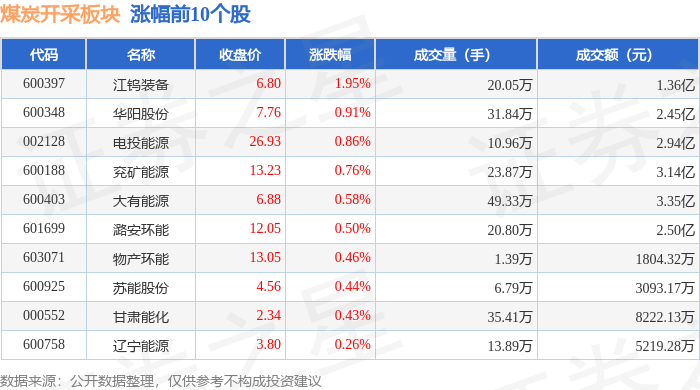
Core Viewpoint - The coal prices have risen unexpectedly since the fourth quarter, with October thermal power generation increasing by 7.3% year-on-year, and inventory levels remaining lower than the same period last year, indicating a strong demand outlook for the coal sector into 2026 [1] Group 1: Industry Outlook - The coal price is expected to maintain a steady yet strong trend towards the end of the year and into 2026, driven by seasonal demand increases starting from late November [1] - The coal industry is entering a "dividend + cycle" phase, with high-quality coal companies benefiting from resource endowments and cost advantages, leading to robust profitability and high cash flow [1] - The anticipated exit of over 100 million tons of pre-approved production capacity by 2026 will lead to a contraction in domestic supply, while demand for thermal coal is expected to rebound [1] Group 2: Investment Strategy - Investment strategies suggested by Zhongtai Securities include focusing on high-dividend, low-valuation coal stocks, particularly those with strong dividend attributes [1] - Companies with growth in production capacity and significant profit elasticity should be prioritized, especially those showing resonance between alpha and beta [1] - Attention should be given to coking coal stocks that are expected to reverse from difficulties, as coal prices stabilize and profitability improves [1] Group 3: Performance Metrics - Among coal stocks, 22 have a dividend yield (TTM) exceeding 2%, with Jizhong Energy leading at 10.20%, followed by China Shenhua and Pingmei Shenma, both above 7% [1] - Despite a decline in performance for most coal stocks in the first three quarters, 14 stocks showed a quarter-on-quarter net profit increase in Q3, with SuNeng Co. nearly doubling its net profit [2][3] - Notable performers in Q3 include Jizhong Energy with a net profit of 0.59 billion and a 102.69% increase, and China Shenhua with a net profit of 144.11 billion and a 13.54% increase [3]


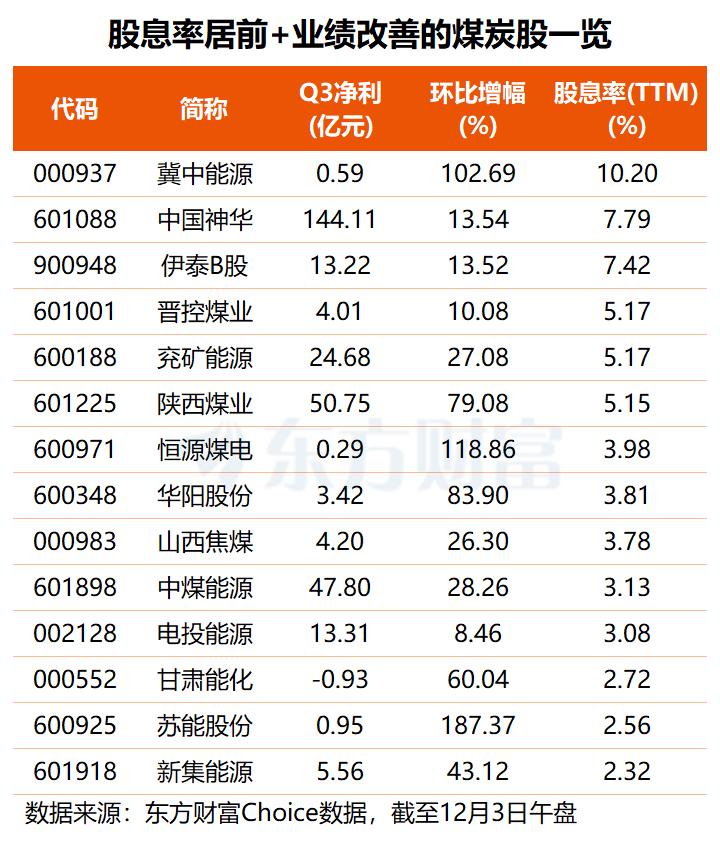
煤炭开采板块12月17日跌0.27%,晋控煤业领跌,主力资金净流出6517.29万元
Zheng Xing Xing Ye Ri Bao· 2025-12-17 09:14
Group 1 - The coal mining sector experienced a decline of 0.27% on December 17, with Jin控煤业 leading the drop [1] - The Shanghai Composite Index closed at 3870.28, up 1.19%, while the Shenzhen Component Index closed at 13224.51, up 2.4% [1] - Key stocks in the coal mining sector showed varied performance, with Jiangxi Tungsten Equipment closing at 6.80, up 1.95%, and Jin控煤业 closing at 13.86, down 2.12% [2] Group 2 - The coal mining sector saw a net outflow of 65.17 million yuan from main funds, while retail investors had a net inflow of 22.2 million yuan [2] - The trading volume and turnover for major coal stocks varied, with Shaanxi Coal Industry recording a turnover of 606 million yuan [2] - The main fund inflow for Jiangxi Tungsten Equipment was 27.76 million yuan, while Jin控煤业 saw a net outflow of 17.05 million yuan [3]