
NJBK(601009)

Search documents
中小微企业贷款贴息、民间投资专项担保……财政部连发五项重要政策
Sou Hu Cai Jing· 2026-01-21 03:12
Group 1 - The Ministry of Finance and other departments have released five policy documents aimed at optimizing financial support for personal consumption loans, equipment updates, private investment guarantees, service industry loans, and small and micro enterprise loans [1][9][29] - The personal consumption loan subsidy policy has been extended until December 31, 2026, with adjustments to the subsidy standards and an expanded range of supported financial institutions [4][5][6] - The equipment update loan subsidy policy includes a 1.5% subsidy on fixed asset loans for equipment updates, applicable for up to two years, and has been expanded to include various sectors such as construction, aviation, and digital technology [10][11][12] Group 2 - The private investment guarantee plan has a total quota of 500 billion yuan, to be implemented over two years, focusing on supporting small and micro enterprises in various sectors including technology upgrades and service industry enhancements [17][18] - The plan includes a risk-sharing mechanism where banks will bear at least 20% of the loan risk, while the government guarantee fund will cover up to 80% [19] - The government will also reduce guarantee fees and increase the compensation limit for the guarantee fund to enhance support for private investments [20] Group 3 - The service industry loan subsidy policy has been extended to December 31, 2026, with an increased subsidy cap of 10 million yuan per loan and a 1% annual subsidy rate [23][24] - The policy now includes additional sectors such as digital, green, and retail industries, expanding the scope of financial support [24][25] - The implementation of these policies will involve streamlined processes for fund allocation and enhanced collaboration among financial institutions and regulatory bodies [26][28]








信用卡分期纳入贴息支持范围,年贴息比例1%
2 1 Shi Ji Jing Ji Bao Dao· 2026-01-20 12:00
Core Viewpoint - The recent upgrades to multiple loan interest subsidy policies signal a shift in government strategy from relying solely on large-scale infrastructure investment to a more balanced approach that encourages consumer spending and reduces financing costs for micro and small enterprises [1][4]. Group 1: Policy Upgrades - The Ministry of Finance has optimized existing interest subsidy policies for personal consumption loans, service industry loans, and equipment upgrade loans, extending their terms to the end of 2026 [1]. - The personal consumption loan subsidy now includes credit card installment payments, with an annual subsidy rate of 1% [3]. - The subsidy cap for new service industry loans has increased from 1 million to 10 million yuan per borrower [6]. Group 2: Support for Micro and Small Enterprises - A new interest subsidy policy for micro and small enterprises has been introduced, targeting key industry chains and their upstream and downstream sectors [11]. - The subsidy for eligible fixed asset loans for micro and small enterprises will be 1.5% annually, with a maximum loan amount of 50 million yuan per borrower [12]. Group 3: Expanded Coverage and Financial Institutions - The range of financial institutions eligible to provide these subsidies has been expanded to include city commercial banks, rural cooperative financial institutions, foreign banks, and consumer finance companies [4][7]. - The policy aims to enhance the accessibility of financial services in rural and grassroots markets, thereby stimulating consumption [4]. Group 4: Specific Sector Support - The updated policies now include support for digital, green, and retail sectors, alongside the previously established eight categories [6][7]. - The equipment upgrade loan subsidy has been raised to 1.5%, covering a wider range of sectors including high-end, intelligent, and green technologies [8].





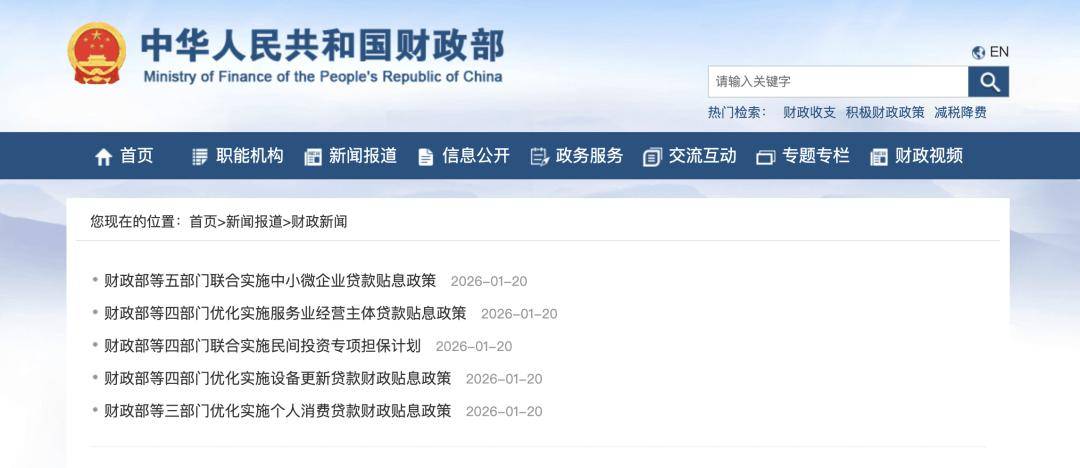
财政部连发多份重要文件,事关贷款贴息、民间投资贷款担保等 一揽子政策全文公布
Sou Hu Cai Jing· 2026-01-20 09:03
Group 1 - The core viewpoint of the news is the implementation of a financial subsidy policy for equipment renewal loans to support businesses in reducing financing costs and promoting effective investment [3][4][5] - The policy includes a 1.5% interest subsidy on fixed asset loans for equipment renewal projects, applicable for a maximum of two years, and is effective until December 31, 2026 [3][4] - The scope of support has been expanded to include various sectors such as construction, aviation, digital technology, and green energy, emphasizing high-end, intelligent, and digital equipment updates [4][6] Group 2 - A total of 26 banks are designated as eligible for processing the interest subsidy loans, including major national banks and several regional banks [4][5] - The subsidy process has been optimized to include a "pre-allocation + settlement" method, streamlining the application and approval process for banks and provincial financial departments [5][6] - The policy aims to enhance the experience of businesses by ensuring timely communication regarding subsidy payments through modern technology [6][7] Group 3 - The policy for small and micro enterprises includes a 1.5% interest subsidy on fixed asset loans, with a maximum loan amount of 50 million yuan, effective from January 1, 2026 [8][9] - The targeted sectors for this subsidy include new energy vehicles, medical equipment, and various service industries, aiming to stimulate investment and production [9][10] - The operational mechanism involves a "total-to-total" model for coordination between financial institutions and fiscal departments to ensure efficient processing of subsidy funds [11][12] Group 4 - The service industry loan subsidy policy has been extended until December 31, 2026, with an increased maximum loan amount of 10 million yuan and a 1% interest subsidy for one year [16][17] - New sectors such as digital, green, and retail have been added to the support scope, enhancing the policy's relevance to current economic trends [17][18] - The funding allocation process has been refined to improve efficiency and reduce redundancy in the approval process [18][19] Group 5 - A special guarantee plan for private investment has been introduced with a total quota of 500 billion yuan over two years, aimed at supporting small and micro enterprises [22][24] - The plan includes risk-sharing mechanisms where banks bear at least 20% of the loan risk, while the government guarantee fund covers up to 80% [24][25] - The initiative encourages innovative financing models and aims to enhance the capital strength of the government guarantee fund to support private investments effectively [26][27]
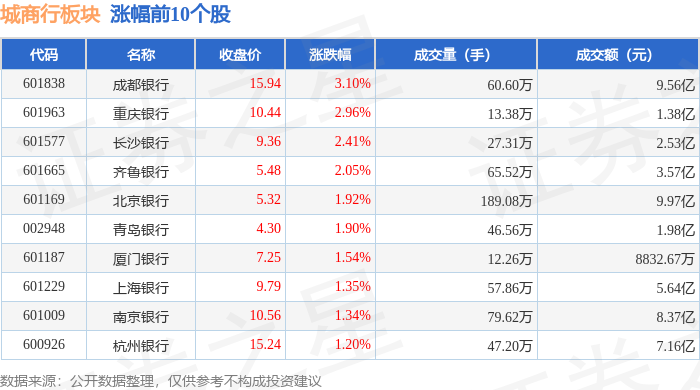
城商行板块1月20日涨1.35%,成都银行领涨,主力资金净流入2.66亿元
Zheng Xing Xing Ye Ri Bao· 2026-01-20 08:56
Core Insights - The city commercial bank sector experienced a rise of 1.35% on January 20, with Chengdu Bank leading the gains [1] - The Shanghai Composite Index closed at 4113.65, down 0.01%, while the Shenzhen Component Index closed at 14155.63, down 0.97% [1] Stock Performance - Chengdu Bank (601838) closed at 15.94, up 3.10% with a trading volume of 606,000 shares and a transaction value of 9.56 billion [1] - Chongqing Bank (601963) closed at 10.44, up 2.96% with a trading volume of 133,800 shares and a transaction value of 138 million [1] - Other notable performers include: - Changsha Bank (601577): closed at 9.36, up 2.41% [1] - Qilu Bank (601665): closed at 5.48, up 2.05% [1] - Beijing Bank (601169): closed at 5.32, up 1.92% [1] - Qingdao Bank (002948): closed at 4.30, up 1.90% [1] - Xiamen Bank (601187): closed at 7.25, up 1.54% [1] - Shanghai Bank (601229): closed at 9.79, up 1.35% [1] - Nanjing Bank (601009): closed at 10.56, up 1.34% [1] - Hangzhou Bank (600926): closed at 15.24, up 1.20% [1] Capital Flow - The city commercial bank sector saw a net inflow of 266 million from institutional investors, while retail investors experienced a net outflow of 42.84 million [1] - Detailed capital flow for selected banks includes: - Shanghai Bank (601229): net inflow of 1.051 billion from institutional investors, with net outflows from retail and speculative investors [2] - Hangzhou Bank (600926): net inflow of 90.48 million from institutional investors, with significant outflows from retail and speculative investors [2] - Nanjing Bank (601009): net inflow of 26.57 million from institutional investors, with outflows from retail investors [2] - Other banks also showed varying levels of net inflows and outflows [2]

国泰海通:预计2025年银行利息净收入增速转正 息差阶段性企稳
Zhi Tong Cai Jing· 2026-01-20 06:20
Core Viewpoint - The report from Guotai Junan predicts that the revenue and net profit growth rate for listed banks in 2025 will be 1.5% and 2.2% respectively, benefiting from stable interest margins and declining credit costs [1][2] Revenue and Profit Forecast - The expected revenue and net profit growth rates for the sample banks (26 listed banks) in 2025 are 1.5% and 2.2%, which represent an increase of 0.3 percentage points compared to the first three quarters of 2025 [2] - The net interest income growth is projected to turn positive, with an expected annual growth rate of 0.3%, improving from a negative growth of -0.6% in the first three quarters of 2025 [1][2] Asset Growth - For Q4 2025, the growth rates of interest-earning assets and loans are expected to be 9.04% and 8.07% respectively, showing a slight decline from Q3 2025 [2] - By the end of December 2025, the growth rates for loans and bond investments are projected to be 6.9% and 16.4%, respectively, both lower than the end of September 2025 [2] Interest Margin - The interest margin for 2025 is expected to stabilize at 1.40%, with the net interest income growth projected to improve to 0.3% for the year [2] - The stability in interest margin is attributed to the repricing of high-cost long-term deposits and a stable Loan Prime Rate (LPR) [2] Non-Interest Income - The growth rate for non-interest income is expected to be 4.8% in 2025, a decrease of 2.8 percentage points compared to the first three quarters of 2025 [3] - The attractiveness of dividend insurance products is expected to drive growth in fee income through the bancassurance channel [3] Asset Quality - The credit cost for 2025 is projected to be 0.58%, a decrease of 8 basis points compared to the first three quarters of 2025 [4] - The non-performing loan (NPL) ratio is expected to remain stable at 1.21%, with a slight decrease in the provision coverage ratio to 239.1% [4] Investment Recommendations - For 2026, the investment focus in the banking sector includes identifying banks with potential for growth, recommending Ningbo Bank, China Merchants Bank, and Nanjing Bank [4] - Emphasis on banks with convertible bond expectations, recommending Chongqing Bank and Changshu Bank [4] - Continuation of dividend strategies is anticipated, recommending Bank of Communications, Jiangsu Bank, and others [4]

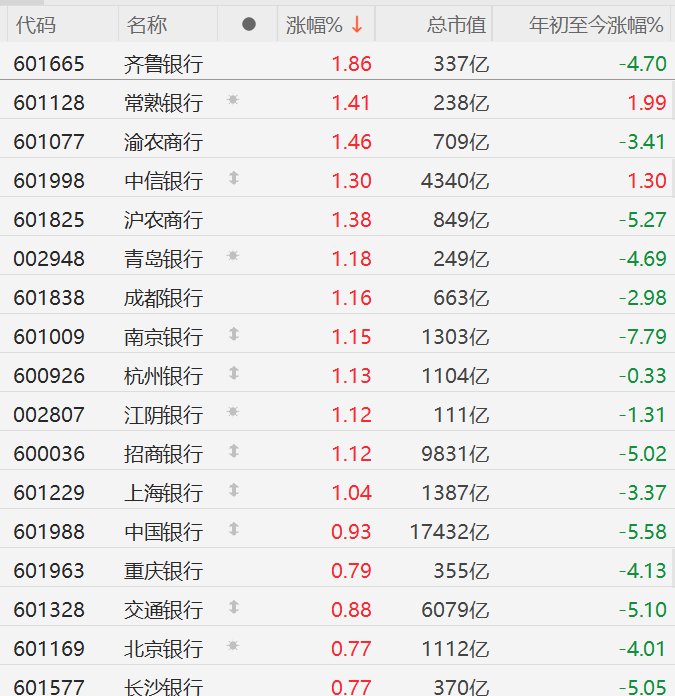
银行股逆势普涨,齐鲁银行涨近2%
Ge Long Hui· 2026-01-20 03:06
Group 1 - The A-share market saw a significant increase in bank stocks, with Qilu Bank rising nearly 2% and several other banks, including Changshu Bank and Chongqing Rural Commercial Bank, increasing by over 1% [1] - The total market capitalization of Qilu Bank is 33.7 billion, while Changshu Bank has a market cap of 23.8 billion [2] - Year-to-date performance shows that Qilu Bank has decreased by 4.70%, while Changshu Bank has increased by 1.99% [2] Group 2 - Other banks that experienced gains include Yunnan Rural Commercial Bank (1.46%), CITIC Bank (1.30%), and Shanghai Bank (1.04%) [2] - The total market capitalization of CITIC Bank is 434 billion, and it has a year-to-date performance of 1.30% [2] - Despite the gains, many banks still show negative year-to-date performance, such as Shanghai Bank (-3.37%) and China Bank (-5.58%) [2]


开年高管密集增持!银行股"吸金"能否延续?
Zheng Quan Shi Bao· 2026-01-19 14:47
Group 1 - The core viewpoint of the article highlights a trend of significant share buybacks by executives and institutional shareholders in several listed banks at the beginning of 2026, indicating a positive signal for stock price support [1][4] - In 2025, over half of the A-share listed banks experienced share buybacks from institutional shareholders or executives, reflecting a strong interest in the banking sector as a low-valuation area [1][4] - The performance of bank stocks has been strong over the past two years, but the market style shift in the second half of 2025 put pressure on bank stock performance, raising questions about the sustainability of this trend in 2026 [1][4] Group 2 - Several banks, including Changshu Bank and Chongqing Rural Commercial Bank, have seen their executives increase their holdings, with specific examples of share purchases and the number of shares involved [2][3] - Notably, Nanjing Bank received significant institutional shareholder support, with a major shareholder increasing their stake by 1.23 billion shares, raising their ownership from 13.02% to 14.02% [3] - The trend of share buybacks is a continuation of the previous year's activities, with 26 banks showing significant buyback actions, and 17 of them reported net increases in holdings [5][6] Group 3 - The article notes that the banking sector's performance has been mixed, with a 7% increase in bank stocks in 2025, significantly lower than other sectors like metals and electronics [9] - Analysts predict that the banking sector will continue to attract long-term and risk-averse capital in 2026, with expectations of improved net interest income growth due to narrowing interest margins [10] - The investment focus for 2026 is expected to shift towards banks with strong performance growth or those with convertible bond expectations, as well as a potential internal differentiation within the banking sector [10]
开年高管密集增持!银行股“吸金”能否延续?
券商中国· 2026-01-19 13:53
Core Viewpoint - The article highlights a trend of significant share buybacks by executives and institutional shareholders in various listed banks at the beginning of 2026, indicating a positive signal for stock price recovery and reflecting confidence in the banking sector's value and growth prospects [1][4]. Group 1: Recent Buybacks - In early 2026, several banks, including Changshu Bank and Chongqing Rural Commercial Bank, saw executives and institutional shareholders actively increase their holdings [2][3]. - Changshu Bank's executives purchased a total of 120,000 shares at an average price of 6.96 yuan per share, with the stock price rising by 1.58% to 7.08 yuan [2]. - Chongqing Rural Commercial Bank's management team collectively bought 192,000 shares within a price range of 6.36 to 6.42 yuan per share [3]. Group 2: Overall Buyback Trends - In 2025, over half of A-share listed banks experienced share buybacks from institutional shareholders or executives, continuing into 2026 [1][4]. - A total of 26 banks had significant buyback actions, with 17 banks showing net increases in holdings, while 8 banks had reductions [6]. - Nanjing Bank was the top performer in buybacks, with institutional shareholders acquiring approximately 674 million shares, corresponding to a market value increase of about 7.378 billion yuan [6]. Group 3: Market Performance and Outlook - The banking sector has shown a recovery in valuation, with a notable 34.39% increase in 2024, but the growth slowed to only 7% in 2025, underperforming compared to other sectors [9]. - Analysts express mixed views on the sustainability of bank stocks attracting long-term and risk-averse capital in 2026, with expectations of improved net interest income growth and a focus on wealth management [10]. - The banking sector is anticipated to experience further internal differentiation, with larger banks and those focused on wealth management likely to outperform [10].

南京银行合作伙伴江苏悦达纺织成功入选全球“灯塔工厂”
Jin Rong Jie· 2026-01-19 11:23
Group 1 - The World Economic Forum (WEF) recently announced a new batch of "Lighthouse Factories," with only 23 companies globally selected, including Jiangsu Yueda Textile Group Co., Ltd., which is the first in the cotton textile industry to receive this honor [1] - Since 2014, Nanjing Bank has provided comprehensive financial services to Yueda Textile, focusing on traditional credit, order financing, and fund management, supporting its intelligent production line upgrades and green low-carbon system construction [1] - The "Lighthouse Factory" designation is recognized as representing the highest level of global smart manufacturing, and Yueda Textile's selection highlights its strong capabilities in this field, marking a significant breakthrough for China's cotton textile industry in the global Industry 4.0 process [1]
银行资负跟踪20260119:降准降息还有空间
GF SECURITIES· 2026-01-19 04:26
Investment Rating - The industry investment rating is "Buy" [3] Core Viewpoints - The report indicates that there is still room for further cuts in reserve requirement ratios and interest rates, with a focus on structural monetary policy support for high-quality economic development [15][19] - The central bank has implemented a reduction of 0.25 percentage points in various structural monetary policy tool rates, signaling a supportive monetary policy stance [15][19] - The report emphasizes the importance of timing for future policy implementations, particularly in relation to government bond issuance peaks and the maturity schedule of high-interest bank deposits [15] Summary by Sections 1. Monetary Policy Adjustments - The report notes a reduction of 0.25 percentage points in structural monetary policy tool rates, with a focus on supporting key areas through increased re-lending [15] - Future attention is directed towards December economic data and January LPR [22] 2. Central Bank Dynamics and Market Rates - The central bank conducted a total of 9,515 billion yuan in 7-day reverse repos at an interest rate of 1.40%, with a net injection of 9,741 billion yuan [16] - The report highlights that the funding rates remained stable, with expectations of slight increases due to tax payments and government bond net repayments [16] 3. Bank Financing Tracking - The report indicates that the total outstanding amount of interbank certificates of deposit (CDs) is 19.09 trillion yuan, with an average issuance rate of 1.65% [20] - The report also notes that there were no commercial bank bond issuances during the period, with a total outstanding commercial bank bond size of 3.38 trillion yuan [20]
