Changshu Bank(601128)

Search documents
前三季度42家上市银行非利息收入同比增长5%
Zheng Quan Ri Bao· 2025-11-03 15:48
Core Insights - Non-interest income is a crucial component of banks' revenue structure, especially under pressure on net interest income, reflecting operational resilience [1] - In the first three quarters of this year, 42 listed banks in A-shares reported a total non-interest income of 1.22 trillion yuan, an increase of 58.3 billion yuan, or 5% year-on-year [1] - The growth in non-interest income is driven by the performance of wealth management businesses and the overall market activity, although investment income has been affected by fluctuations in the bond market [1][6] Non-Interest Income Growth - Among the 42 listed banks, 18 reported a year-on-year increase in non-interest income, with 16 banks seeing an increase in the proportion of non-interest income in total revenue [1][2] - Notably, Zijin Bank, Changshu Bank, and Zhangjiagang Bank, all from Jiangsu, showed remarkable growth rates of 54%, 35%, and 22% respectively, contributing significantly to their total revenues [2] - State-owned banks demonstrated strong growth in non-interest income, with Agricultural Bank, Postal Savings Bank, Bank of China, China Construction Bank, and Industrial and Commercial Bank reporting double-digit growth rates [2][3] Fee and Commission Income - The total fee and commission income for the 42 listed banks reached 578.2 billion yuan, a year-on-year increase of 4.6%, with over 60% of banks reporting growth [4][5] - Notable increases in fee and commission income were observed in Changshu Bank and Ruifeng Bank, with growth rates exceeding 364% and 162% respectively [4] - State-owned banks also reported growth in fee and commission income, with major banks like China Merchants Bank seeing a 0.9% increase, driven by significant growth in various subcategories of income [5] Investment Income Trends - The investment net income for the 42 listed banks totaled 477 billion yuan, reflecting a year-on-year growth of 21%, although this growth rate has slowed compared to the previous year [6] - The fluctuations in the bond market have particularly impacted the investment income of smaller banks, such as city commercial banks and rural commercial banks [6] - Analysts suggest that differences in client bases and operational strategies between state-owned and smaller banks are influencing their respective non-interest income growth [3][6]





42上市银行信披考评出炉:5家升级1家降级
2 1 Shi Ji Jing Ji Bao Dao· 2025-11-03 12:08
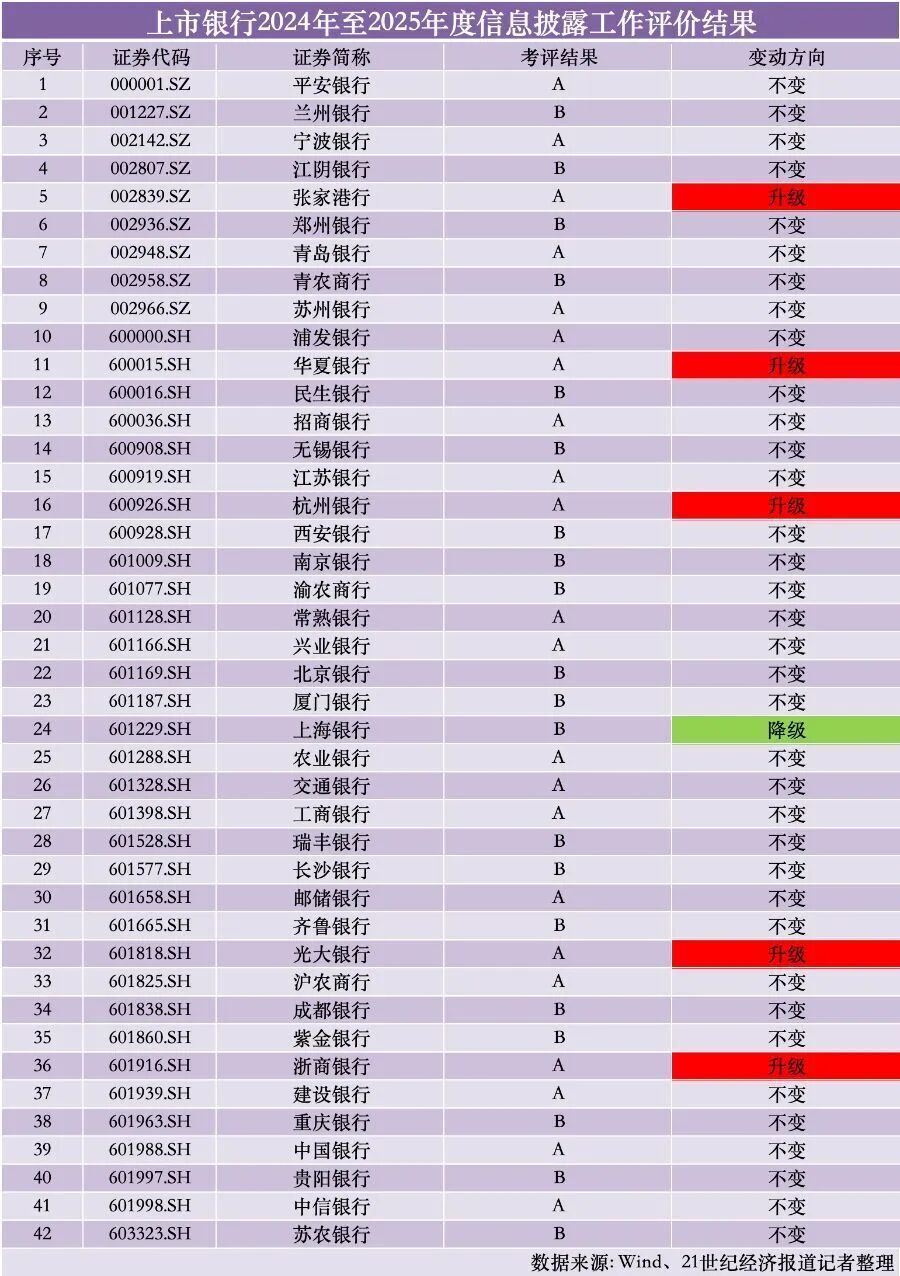
Core Viewpoint - The quality of information disclosure is a crucial indicator of the quality of listed companies and serves as an important basis for investors' decision-making. The Shanghai and Shenzhen Stock Exchanges have emphasized the importance of this quality and have set higher requirements for listed companies in their recent evaluation guidelines [1][3]. Summary by Sections Information Disclosure Evaluation - In 2024-2025, 42 A-share listed banks received ratings of B or above for their information disclosure, with 22 banks rated A. The ratings remained consistent with the previous year for most banks, with only six experiencing changes [1][2][6]. Evaluation Criteria - The evaluation of information disclosure quality includes eight main aspects: compliance, effectiveness, investor relations management, return to investors, social responsibility disclosure, penalties and regulatory measures, support for exchange operations, and other factors recognized by the exchange [3][5]. Impact on Financing and Mergers - The evaluation results are considered in the review of refinancing and mergers and acquisitions. Companies rated A will receive various supports, such as exemptions from post-review for certain disclosures and prioritized training opportunities [6][7]. Bank Responses and Commitments - Several banks, including Hangzhou Bank and Citic Bank, have publicly committed to enhancing their information disclosure quality following their A ratings. They emphasize transparency, effective communication, and adherence to regulations as key components of their strategies [9][10][11].






上市银行信披考评出炉:光大、华夏、浙商提级,上海银行降级
2 1 Shi Ji Jing Ji Bao Dao· 2025-11-03 10:57
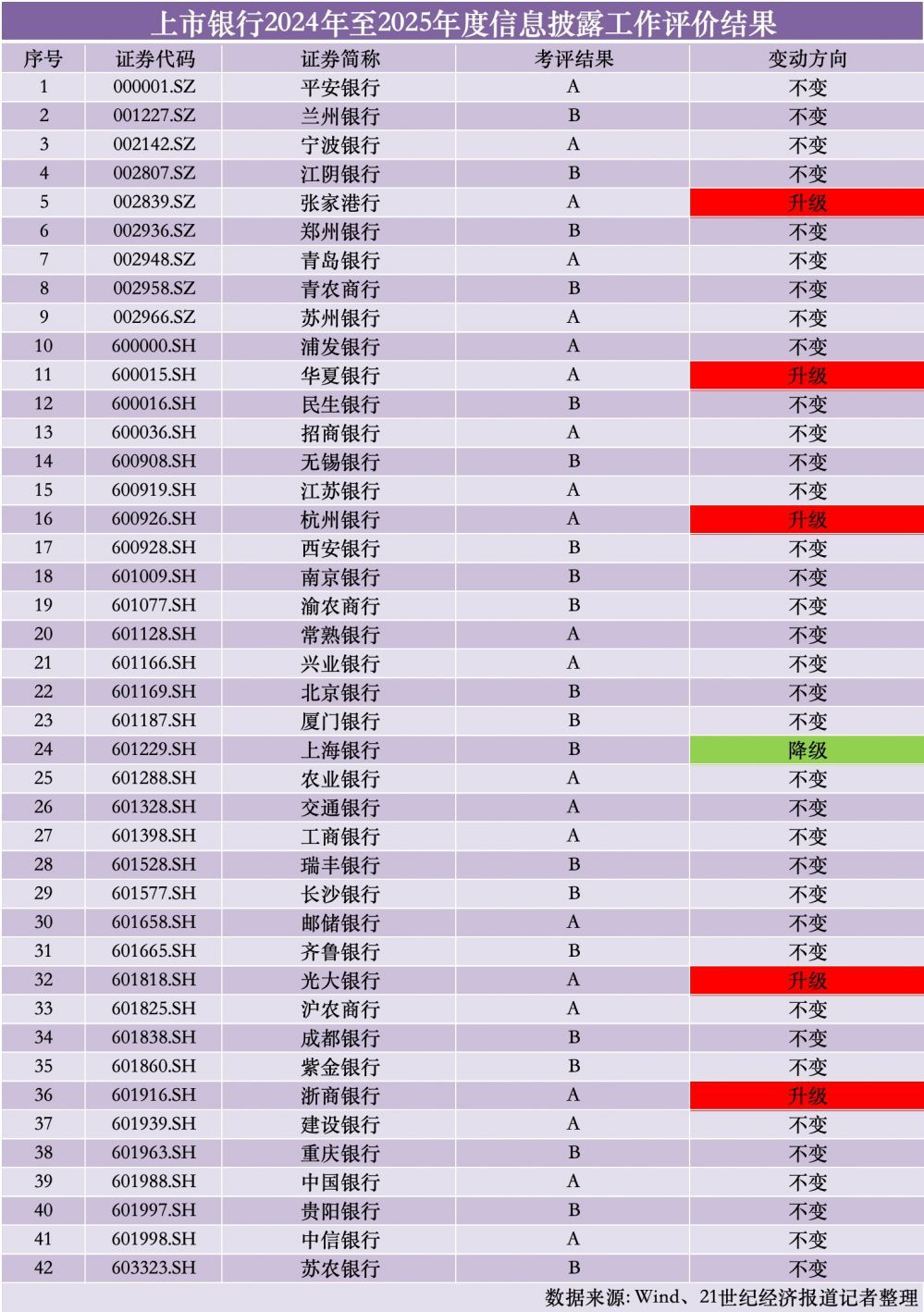
Core Viewpoint - The quality of information disclosure is a crucial indicator of the quality of listed companies and serves as an important basis for investors' decision-making. The Shanghai and Shenzhen Stock Exchanges have emphasized the importance of information disclosure quality and have implemented comprehensive evaluations of listed companies' disclosure practices [1][3]. Group 1: Regulatory Framework - In March, the Shanghai and Shenzhen Stock Exchanges released guidelines focusing on enhancing information disclosure regulation, punishing financial fraud, strengthening cash dividend supervision, and promoting the enhancement of investment value for listed companies [1][3]. - The evaluation criteria for information disclosure quality include eight aspects: normative disclosure, effective disclosure, investor relations management, return to investors, social responsibility disclosure, penalties and regulatory measures, support for exchange work, and other factors recognized by the exchange [3][5]. Group 2: Evaluation Results - Among the 42 A-share listed banks, all received ratings of B or above, with 22 banks rated A. Most banks maintained their ratings from the previous year, with only six experiencing changes [3][6]. - The banks rated A include major state-owned banks such as Industrial and Commercial Bank of China, Agricultural Bank of China, and China Bank, as well as several joint-stock and city commercial banks [6][7]. Group 3: Impact on Capital Activities - The evaluation results of information disclosure will influence the review of refinancing and mergers and acquisitions for listed banks, establishing a strong market incentive and constraint mechanism [5][8]. - Both the Shanghai and Shenzhen Stock Exchanges provide various supports and conveniences for companies rated A, such as exemptions from post-review for temporary reports and reduced inquiry rounds for restructuring audits [8][9]. Group 4: Commitment to Improvement - Several banks, including Hangzhou Bank and China CITIC Bank, have publicly committed to further enhancing their information disclosure quality following their A ratings, emphasizing transparency, effective communication, and governance [10][11]. - China CITIC Bank has highlighted its commitment to investor rights protection, having distributed over RMB 170 billion in cash dividends and planning to increase its mid-term dividend payout ratio [11].



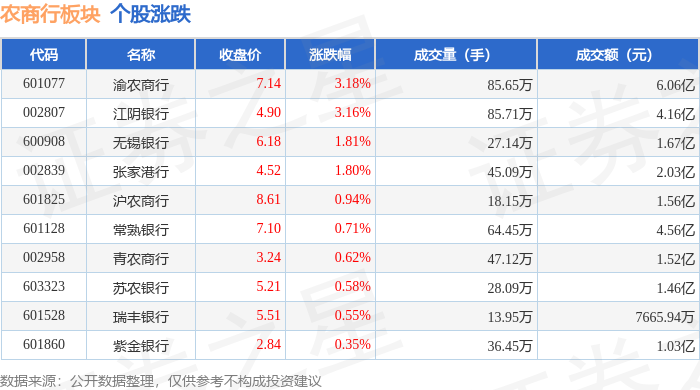
农商行板块11月3日涨1.58%,渝农商行领涨,主力资金净流出4308.08万元
Zheng Xing Xing Ye Ri Bao· 2025-11-03 08:43
Market Performance - The rural commercial bank sector increased by 1.58% on November 3, with Chongqing Rural Commercial Bank leading the gains [1] - The Shanghai Composite Index closed at 3976.52, up 0.55%, while the Shenzhen Component Index closed at 13404.06, up 0.19% [1] Individual Stock Performance - Chongqing Rural Commercial Bank (601077) closed at 7.14, up 3.18% with a trading volume of 856,500 shares and a transaction value of 606 million yuan [1] - Jiangyin Bank (002807) closed at 4.90, up 3.16% with a trading volume of 857,100 shares and a transaction value of 416 million yuan [1] - Wuxi Bank (600908) closed at 6.18, up 1.81% with a trading volume of 271,400 shares and a transaction value of 167 million yuan [1] - Other notable performances include Zhangjiagang Bank (002839) up 1.80% and Shanghai Rural Commercial Bank (601825) up 0.94% [1] Capital Flow Analysis - The rural commercial bank sector experienced a net outflow of 43.08 million yuan from institutional investors, while retail investors saw a net inflow of 35.81 million yuan [1] - The table indicates that Chongqing Rural Commercial Bank had a net inflow of 13.38 million yuan from institutional investors but a net outflow of 64.68 million yuan from retail investors [2] - Jiangyin Bank had a net inflow of 2.47 million yuan from retail investors despite a net outflow from institutional and speculative investors [2]


42家上市银行信披考评出炉:22家获A,光大、华夏和浙商银行提级
2 1 Shi Ji Jing Ji Bao Dao· 2025-11-03 08:21
Core Insights - The recent disclosure evaluation results for listed banks in China for the 2024-2025 period show that all listed banks received ratings of B or above, with 22 banks rated A, indicating a strong performance in information disclosure [1] Summary by Category Overall Ratings - All listed banks achieved a rating of B or higher, with 22 banks rated A, reflecting consistent performance compared to the previous year [1] - Only six banks experienced rating changes, with five banks improving their ratings and one bank, Shanghai Bank, experiencing a downgrade [1] Banks with Rating Changes - The following banks improved their ratings: - Zhangjiagang Bank - Hangzhou Bank - Huaxia Bank - Everbright Bank - Zhejiang Commercial Bank [1] - Shanghai Bank was the only bank to see a downgrade in its rating [1] Detailed Ratings - A selection of banks and their ratings includes: - Ping An Bank: A - Ningbo Bank: A - Agricultural Bank of China: A - Industrial and Commercial Bank of China: A - Shanghai Bank: B (downgraded) [2]

常熟银行(601128):息差边际企稳,拨备水平小幅下行
Ping An Securities· 2025-11-03 07:34
Investment Rating - The investment rating for the company is "Strong Buy" (maintained) [1][12]. Core Views - The company achieved an operating income of 9.05 billion yuan in the first three quarters of 2025, representing a year-on-year growth of 8.2%, and a net profit attributable to shareholders of 3.36 billion yuan, up 12.8% year-on-year [4]. - The bank's total asset scale grew by 10.9% year-on-year, with loan and deposit scales increasing by 7.1% and 9.7% respectively [4]. - The bank's net interest margin stabilized at 2.57% as of the end of the third quarter, with a narrowing year-on-year decline [7]. - The bank's non-interest income saw a year-on-year increase of 35.3%, although it experienced a decline in growth compared to the first half of the year [7]. - The bank maintains a high provision coverage ratio of 463% and a non-performing loan (NPL) ratio of 0.76%, indicating strong asset quality [7]. Summary by Sections Financial Performance - The company reported a net interest income growth of 2.4% year-on-year in the first three quarters of 2025 [7]. - The projected earnings per share (EPS) for 2025-2027 are 1.33, 1.52, and 1.73 yuan respectively, with corresponding profit growth rates of 15.3%, 15.0%, and 13.7% [9]. - The company’s total assets are expected to reach 400.06 billion yuan by 2025, with a loan total of 261.13 billion yuan [10]. Asset Quality - The NPL ratio is projected to decrease to 0.75% in 2025, with a provision coverage ratio of 491% [10]. - The bank's credit impairment losses are expected to be 1.735 billion yuan in 2025, reflecting a proactive approach to risk management [10]. Market Position - The bank focuses on the "three rural issues and two small" market positioning, emphasizing inclusive finance and differentiated development strategies [9]. - The bank's retail and small micro-business segments are expected to benefit from the recovery in demand from small enterprises and retail customers [9].
寻找绩优股:2026年银行业年度策略
GUOTAI HAITONG SECURITIES· 2025-11-03 05:20
Investment Rating - The report indicates a cautious outlook on the credit growth rate, suggesting a shift towards quality improvement, with expectations for a recovery in corporate loan increments by 2026 [5][9]. Core Insights - Credit growth is expected to slow significantly starting in 2024, but the decline in growth rate is anticipated to moderate by 2026, with corporate loans likely to see a year-on-year increase [7][9]. - The relationship between credit growth and economic growth is weakening, emphasizing the need to optimize credit structure and reduce idle financial resources [9]. - The report highlights that the banking sector's total asset growth will outpace loan growth in 2025, driven by government bond supply and fiscal policies [9]. Summary by Sections Credit Growth Forecast - New RMB loans are projected at 21.3 trillion, 23.6 trillion, and 18.9 trillion yuan for 2022, 2023, and 2024 respectively, with a further estimate of 14.7 trillion yuan for the first three quarters of 2025 [9]. - For 2026, new loans are expected to be between 17.2 trillion and 17.7 trillion yuan, corresponding to a growth rate of 6.3% to 6.5% [9]. Loan Composition - In 2023, the total RMB loans are expected to reach 237.59 trillion yuan, with a year-on-year growth rate of 10.6% [8]. - Retail loans are projected to grow from 80.10 trillion yuan in 2023 to 82.84 trillion yuan in 2024, reflecting a growth rate decline from 5.7% to 3.4% [8]. - Corporate loans are anticipated to increase from 157.07 trillion yuan in 2023 to 171.01 trillion yuan in 2024, with a growth rate of 12.7% [8]. Regional Performance - Regions such as Jiangsu, Zhejiang, Sichuan, and Shandong are expected to continue outperforming the national average in loan growth due to strong economic performance and support from new policy financial tools [12]. Banking Sector Dynamics - The report notes that state-owned banks are expected to maintain a competitive edge due to lower funding costs and capital injections from the Ministry of Finance [12]. - The net interest margin is in a downward trend, but the rate of decline is expected to slow starting in 2025, with some smaller banks potentially stabilizing their margins by 2026 [13][17]. Asset Quality - As of Q2 2025, the non-performing loan (NPL) ratio for listed banks is reported at 1.25%, indicating a stable asset quality despite pressures on retail credit [37]. - The report emphasizes that while retail loan NPLs have increased since 2021, corporate loan clearances have improved significantly, providing a buffer against retail risks [37].




三季度社保基金动向曝光 重仓哪些个股?
Zhong Guo Jing Ji Wang· 2025-11-03 02:36
Group 1 - The core viewpoint of the article highlights the investment trends of social security funds in the third quarter, showing a significant presence in various sectors, particularly machinery, electronics, and pharmaceuticals [1][2] - As of the end of the third quarter, social security funds were listed among the top ten shareholders of 617 companies, with new investments in 188 companies and increased holdings in 156 companies [1][2] - The largest holdings by social security funds were in Sany Heavy Industry, with a market value of 4.142 billion yuan, followed closely by BYD at 4.037 billion yuan [1][2] Group 2 - In terms of shareholding quantity, 23 companies had over 100 million shares held by social security funds at the end of the third quarter, with the highest being Focus Media at 333 million shares [2] - The most significant new investment by social security funds was in China Metallurgical Group, with 100.36 million shares acquired [2] - Social security funds have maintained long-term holdings in several companies, with the longest being in Zhongnan Media since Q1 2012, indicating a preference for stable growth stocks [2] Group 3 - The National Social Security Fund Council reported an investment income of 218.418 billion yuan for 2024, with an investment return rate of 8.10% [3] - Since its establishment, the average annual investment return rate of social security funds has been 7.39%, with a cumulative investment income of 1.9 trillion yuan [3]




掘金银行三季报:险资继续“扫货”
Jing Ji Wang· 2025-11-03 02:21
Core Insights - The A-share listed banking sector experienced a significant decline of over 13% in the third quarter of 2025, following a strong performance in the previous year, while insurance funds continued to increase their holdings in bank stocks [1][6] Group 1: New Shareholder Dynamics - In the third quarter, six insurance companies entered the top ten shareholders of six A-share listed banks, indicating a growing presence of insurance capital in the banking sector [1] - China Life Insurance Company entered the top ten shareholders of Industrial and Commercial Bank of China (ICBC) with 757 million shares, representing 0.21% of the bank's total shares [2] - Other banks such as Wuxi Bank, Nanjing Bank, and Changshu Bank also saw new insurance capital entering their top ten shareholder lists [2] Group 2: Continued Investment by Insurance Funds - Several insurance companies that had already entered the top ten shareholders of listed banks continued to increase their holdings in the third quarter, with some seeking board seats [4] - For instance, Dajia Life Insurance increased its stake in Industrial Bank by 62.12 million shares, raising its holding to 3.38% [4] - China Life Insurance and Guomin Pension Insurance also increased their stakes in Suzhou Bank, reaching 3.4% and 2.76% respectively by the end of September [4] Group 3: Major Shareholder Concentration - By the end of the third quarter, at least two insurance companies were listed among the top ten shareholders of 12 A-share listed banks, highlighting a trend of concentration of insurance capital [6] - Zheshang Bank had four insurance shareholders, while banks like Industrial Bank and Changsha Bank had three [6] - The top five shareholders of Industrial Bank collectively held over 50% of the bank's shares, indicating strong institutional support [6] Group 4: Investment Strategy Insights - Insurance asset management institutions are focusing on companies with strong fundamentals and stable dividend growth potential for their core holdings [7]
晨会纪要:2025年第186期-20251103
Guohai Securities· 2025-11-03 01:39
Group 1 - The report highlights that Fengshen Co., the only centrally controlled tire listed company in China, has entered a growth phase with a 168% year-on-year increase in net profit for Q3 2025 [2][6][7] - The company achieved a revenue of 5.543 billion yuan for the first three quarters of 2025, representing a 13.58% increase year-on-year, despite a decline in net profit [6][8] - The average selling price of products increased by 7.88% year-on-year to 1198 yuan per tire, contributing to improved profitability [8][10] Group 2 - Dongfang Tower benefited from the potassium fertilizer boom, reporting a 77.57% increase in net profit for Q3 2025, with a revenue of 3.392 billion yuan [16][17] - The company’s gross profit margin increased by 10.23 percentage points to 40.53% due to rising potassium prices [17][19] - The average price of potassium chloride reached 3269 yuan per ton in Q3 2025, up 773 yuan per ton year-on-year [17][19] Group 3 - Longbai Group's net profit decreased by 34.68% year-on-year in Q3 2025, impacted by falling titanium dioxide prices, with a revenue of 6.105 billion yuan [23][24] - The average price of titanium dioxide fell by 2018 yuan per ton year-on-year, leading to a significant profit squeeze [25][27] - The company is pursuing a strategic acquisition of Venator UK's titanium dioxide assets to enhance its global presence [27][29] Group 4 - Shanmei International reported a 30.20% decline in revenue for the first three quarters of 2025, with a net profit drop of 49.74% [32][33] - The company’s coal production increased by 8.73% year-on-year, while trade coal sales fell by 28.50% [35][36] - The average selling price of self-produced coal decreased by 24.72% year-on-year, affecting overall profitability [36][37] Group 5 - Fenhong Media achieved a total revenue of 9.607 billion yuan in the first three quarters of 2025, reflecting a 3.73% year-on-year growth [38][39] - The company’s gross profit margin improved significantly, reaching 74.1% in Q3 2025 [40][41] - The company plans to distribute a cash dividend of 0.5 yuan per share, indicating a commitment to shareholder returns [41][42] Group 6 - Yunnan Rural Commercial Bank reported a 0.67% increase in revenue for the first three quarters of 2025, with a net profit growth of 3.74% [43][44] - The bank's non-performing loan ratio decreased to 1.12%, reflecting improved asset quality [44]