
INDUSTRIAL BANK(601166)

Search documents
天津发展附属认购8500万元兴业银行结构性存款
Zhi Tong Cai Jing· 2025-12-24 09:59
天津发展(00882)发布公告,于2025年12月24日,力生制药(002393)(公司间接非全资附属公司)与兴业 银行订立第12份兴业银行理财协议,以本金金额人民币8500万元(相当于约港币9340.66万元)认购另一项 结构性存款。 ...


天津发展(00882)附属认购8500万元兴业银行结构性存款
智通财经网· 2025-12-24 09:57
Group 1 - The company Tianjin Development (00882) announced a financial agreement with Industrial Bank for a structured deposit [1] - The agreement involves a principal amount of RMB 85 million, equivalent to approximately HKD 93.41 million [1]
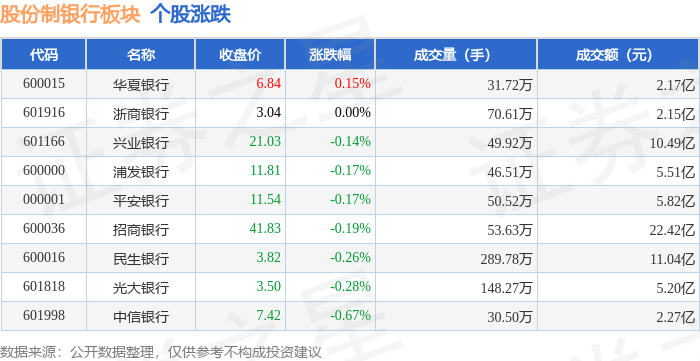
股份制银行板块12月24日跌0.22%,中信银行领跌,主力资金净流出2.53亿元
Zheng Xing Xing Ye Ri Bao· 2025-12-24 09:10
证券之星消息,12月24日股份制银行板块较上一交易日下跌0.22%,中信银行领跌。当日上证指数报收 于3940.95,上涨0.53%。深证成指报收于13486.42,上涨0.88%。股份制银行板块个股涨跌见下表: | 代码 | 名称 | 收盘价 | 涨跌幅 | 成交量(手) | 成交额(元) | | --- | --- | --- | --- | --- | --- | | 600015 | 华夏银行 | 6.84 | 0.15% | 31.72万 | 2.17亿 | | 601916 | 浙商银行 | 3.04 | 0.00% | 70.61万 | 2.15亿 | | 601166 | 兴业银行 | 21.03 | -0.14% | 49.92万 | 10.49 乙 | | 600000 | 浦发银行 | 11.81 | -0.17% | - 46.51万 | 5.51亿 | | 000001 | 平安银行 | 11.54 | -0.17% | 50.52万 | 5.82亿 | | 600036 | 招商银行 | 41.83 | -0.19% | 53.63万 | 22.42 乙 | | 600016 | ...





东海基金管理有限责任公司关于以通讯方式召开东海润兴债券型证券投资基金基金份额持有人大会的公告
Shang Hai Zheng Quan Bao· 2025-12-23 19:45
一、召开会议基本情况 根据《中华人民共和国证券投资基金法》(以下简称"《基金法》")、《公开募集证券投资基金运作管 理办法》(以下简称"《运作办法》")等法律法规的规定和《东海润兴债券型证券投资基金基金合同》 (以下简称"《基金合同》"或"基金合同")的有关约定,东海润兴债券型证券投资基金(以下简称"本 基金")的基金管理人经与本基金的基金托管人兴业银行股份有限公司协商一致,决定以通讯方式召开 本基金的基金份额持有人大会,审议《关于东海润兴债券型证券投资基金持续运作的议案》。会议的具 体安排如下: 1、会议召开方式:通讯方式。 2、会议投票表决起止时间:自2025年12月30日起,至2026年1月30日17:00止(投票表决时间以表决票 收件人收到表决票时间为准)。 3、会议计票日:2026年2月2日 4、纸质表决票将送达至本基金管理人,具体地址和联系方式如下: 收件人:东海基金管理有限责任公司客服 地址:上海市浦东新区世纪大道1528号陆家嘴基金大厦15楼 联系电话:4009595531(免国内长途话费) 邮政编码:200122 请在信封表面注明:"东海润兴债券型证券投资基金基金份额持有人大会投票专用"。 ...
英大基金管理有限公司关于增加兴业银行股份有限公司为旗下部分开放式基金销售机构的公告
Shang Hai Zheng Quan Bao· 2025-12-23 19:00
Group 1 - The core point of the announcement is that from December 24, 2025, Industrial Bank will act as a sales agent for several funds managed by Yingda Fund Management Co., Ltd. [1] - The funds included in the sales agreement are various types of securities investment funds, including mixed funds, bond funds, and funds of funds (FOF) [1] - Investors can perform various transactions such as account opening, subscription, redemption, and regular investment through Industrial Bank [2] Group 2 - The announcement provides contact information for both Yingda Fund Management Co., Ltd. and Industrial Bank, including customer service phone numbers and websites [3] - It is noted that certain funds are currently in a closed period and are not available for subscription or transfer [2] - There are fee discount activities available for investors who subscribe or regularly invest in the mentioned funds through the sales institution [4]
法国兴业银行认为日元干预面临“颇具吸引力”的有利情境
Xin Lang Cai Jing· 2025-12-23 15:26
Group 1 - The current environment presents a "strong intervention backdrop," increasing the likelihood of the Japanese government successfully preventing yen depreciation compared to usual circumstances [1][3] - The rationale for intervention is clear: year-end market liquidity shortages provide an opportunity, and market participants are struggling to justify current price levels, indicating a higher chance of successful intervention [1][3] - Long-term interest rate differentials and volatility indicators suggest that the euro/yen and dollar/yen exchange rates should have peaked by the end of 2023; however, both pairs have continued to rise, with euro/yen reaching a record high near 184 and dollar/yen hovering around 162 [1][3] Group 2 - There has been a dramatic decoupling of dollar/yen and euro/yen exchange rates from interest rate differentials since spring, described as a disorderly state [2][4] - Intervention is expected to curb the upward momentum of dollar/yen and euro/yen, but the likelihood of a significant reversal in the yen's weakening trend is low due to generally weak Asian currencies and ongoing concerns about economic growth and an aging population [2][4] - A correction similar to the one seen in 2014 after the sharp rise in dollar/yen and euro/yen is still possible; in the long term, this could pull dollar/yen back to the 140 level and euro/yen down to the 160 level [2][4]

兴业银行取得文件导出方法专利
Sou Hu Cai Jing· 2025-12-23 11:33
来源:市场资讯 天眼查资料显示,兴业银行股份有限公司,成立于1988年,位于福州市,是一家以从事货币金融服务为 主的企业。企业注册资本2077419.0751万人民币。通过天眼查大数据分析,兴业银行股份有限公司共对 外投资了11家企业,参与招投标项目3681次,财产线索方面有商标信息592条,专利信息443条,此外企 业还拥有行政许可114个。 兴业数字金融服务(上海)股份有限公司,成立于2015年,位于上海市,是一家以从事其他金融业为主 的企业。企业注册资本25500万人民币。通过天眼查大数据分析,兴业数字金融服务(上海)股份有限 公司共对外投资了3家企业,参与招投标项目246次,财产线索方面有商标信息81条,专利信息394条, 此外企业还拥有行政许可11个。 声明:市场有风险,投资需谨慎。本文为AI基于第三方数据生成,仅供参考,不构成个人投资建议。 国家知识产权局信息显示,兴业银行股份有限公司、兴业数字金融服务(上海)股份有限公司取得一项 名为"文件导出方法、装置、计算机设备和存储介质"的专利,授权公告号CN116644096B,申请日期为 2023年5月。 ...
专访兴业银行首席经济学家鲁政委:多措并举推动城乡居民增收,“投资于人”趋势将加强
Zhong Guo Jing Ying Bao· 2025-12-23 08:31
Core Insights - The central economic work conference has prioritized the "Urban and Rural Residents' Income Increase Plan" as a key task to strengthen domestic demand and build a robust domestic market [2][3] - The plan aims to effectively boost residents' income, thereby enhancing consumption capacity and expanding domestic demand, which is crucial for the internal economic cycle [2][4] Group 1: Policy Significance - The introduction of a dedicated income increase plan marks a significant shift from previous policies that focused primarily on industrial or supply-side planning [3] - The plan sets clear medium- to long-term goals, linking labor remuneration to productivity, which is expected to stabilize prices in the long run [3] Group 2: Relationship Between Income and Consumption - Increasing residents' income is essential for supporting consumption, which is a fundamental aspect of expanding domestic demand [4] - The average wage growth for urban non-private and private sector employees is projected to be 2.8% and 1.7% respectively in 2024, indicating a decline in income growth [4] Group 3: Differentiated Income Increase Strategies - The income structure shows that wage and operational income account for over 70% of total income, necessitating targeted employment policies to support youth and other key demographics [6] - Fiscal policies should enhance transfer income, which constitutes about 18% of disposable income, through measures like family-based income tax assessments and increased social security benefits [6] Group 4: Specific Pathways for Different Demographics - For agricultural workers, raising the minimum purchase price for grain can stabilize income, as historical data shows a positive correlation between agricultural income and grain prices [7] - For stable employment groups, a dynamic adjustment mechanism for minimum wage standards is essential to ensure fair income distribution [7] - The plan emphasizes the inclusion of gig economy workers in minimum wage protections and the establishment of a comprehensive social security network for unemployed individuals [8]

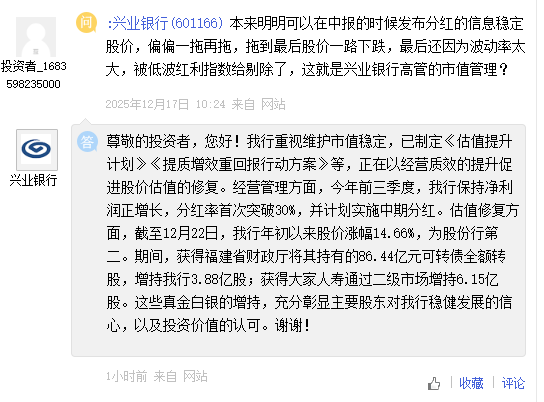
兴业银行:重视维护市值稳定,正在以经营质效的提升促进股价估值的修复
Xin Lang Cai Jing· 2025-12-23 07:59
12月23日金融一线消息,近日有投资者在互动平台询问兴业银行市值管理问题,兴业银行对此回应称: 该行重视维护市值稳定,已制定《估值提升计划》《提质增效重回报行动方案》等,正在以经营质效的 提升促进股价估值的修复。 兴业银行指出,经营管理方面,今年前三季度,该行保持净利润正增长,分红率首次突破30%,并计划 实施中期分红。估值修复方面,截至12月22日,该行年初以来股价涨幅14.66%,为股份行第二。期 间,获得福建省财政厅将其持有的86.44亿元可转债全额转股,增持该行3.88亿股;获得大家人寿通过二 级市场增持6.15亿股。 兴业银行表示,这些真金白银的增持,充分彰显主要股东对该行稳健发展的信心,以及投资价值的认 可。 责任编辑:王馨茹 12月23日金融一线消息,近日有投资者在互动平台询问兴业银行市值管理问题,兴业银行对此回应称: 该行重视维护市值稳定,已制定《估值提升计划》《提质增效重回报行动方案》等,正在以经营质效的 提升促进股价估值的修复。 兴业银行指出,经营管理方面,今年前三季度,该行保持净利润正增长,分红率首次突破30%,并计划 实施中期分红。估值修复方面,截至12月22日,该行年初以来股价涨幅1 ...
前海开源兴和债券型证券投资基金基金份额发售公告
Zhong Guo Zheng Quan Bao - Zhong Zheng Wang· 2025-12-23 06:43
Fund Overview - The fund is named Qianhai Kaiyuan Xinghe Bond Fund, registered with the China Securities Regulatory Commission (CSRC) on July 5, 2025 [1] - The fund is a contract-based open-end bond investment fund managed by Qianhai Kaiyuan Fund Management Co., Ltd. and custodied by Industrial Bank Co., Ltd. [1][11] Fundraising Details - The initial fundraising cap is set at 5 billion RMB, excluding interest accrued during the fundraising period [2] - If the total effective subscription amount exceeds 5 billion RMB, the fund manager will implement a proportional confirmation method to control the scale [2][3] - The fundraising period is from December 31, 2025, to March 30, 2026, with the possibility of adjustments based on subscription conditions [1][12] Subscription Regulations - The minimum subscription amount for both initial and additional subscriptions is 10 RMB, including subscription fees [2] - There is no limit on the cumulative subscription amount for individual investors, but no single investor can hold more than 50% of the fund's shares [3][11] - The fund allows multiple subscriptions during the fundraising period, and subscription fees will be calculated separately for each application [22] Investment Strategy - The fund will invest in various securities, including asset-backed securities and government bond futures, which may introduce additional risks [6][7] - The fund may also invest in stocks listed on the Hong Kong Stock Exchange under the Stock Connect mechanism, facing unique risks associated with this market [7] Fund Management and Operations - The fund management will adhere to principles of diligence, honesty, and prudence, but does not guarantee profits or minimum returns [6] - The fund's performance may be influenced by the performance of other funds it invests in, as well as the management quality of those funds [8] Investor Information - Investors can contact the fund management company for subscription inquiries and assistance [4] - The fund's detailed information, including the prospectus and fund contract, will be available on the fund management company's website and the CSRC's electronic disclosure website [3]