PING AN OF CHINA(601318)

Search documents
开门红!5家上市险企集体暴走,新华太保再破纪录!
Sou Hu Cai Jing· 2026-01-06 02:46
Group 1 - The core viewpoint is that listed insurance companies have achieved significant gains, with New China Life and China Pacific Insurance reaching historical highs, indicating strong market confidence in the industry [1][3][5] - The five major listed insurance companies, including New China Life and China Pacific, have all seen stock price increases exceeding 5%, with New China Life and China Pacific setting new historical highs [2][3] - The recent performance of these companies is seen as a "good start" for the insurance industry in 2026, reflecting improved liability quality and proactive capital market strategies [6][8] Group 2 - Analysts predict a new round of interest rate cuts in 2026, which may impact the predetermined interest rates for life insurance products [10][15] - The introduction of a dynamic adjustment mechanism for predetermined interest rates in 2025 has led to a recent asymmetric reduction, with expectations for further declines in 2026 [11][13] Group 3 - Investment in capital markets by insurance companies is expected to increase, with the total investment balance exceeding 37 trillion yuan, marking a historical high [17] - The stock investment amount reached 3.6 trillion yuan, reflecting a year-on-year increase of approximately 1.3 trillion yuan, with a growth rate exceeding 55% [17] - All insurance companies will begin implementing new accounting standards in 2026, which may enhance profitability if capital markets perform well [19][21] Group 4 - The development of participating insurance products is accelerating, with premiums surpassing 700 billion yuan and a year-on-year growth of over 10% [24] - The competitive landscape in the insurance sector is intensifying, particularly in the bancassurance channel, which has seen significant growth in premium income [26] Group 5 - New regulations related to asset-liability management and product innovation are expected to promote industry transformation, with a focus on high-quality development [27][35] - The introduction of new health insurance products and the revision of existing regulations are anticipated to enhance the overall quality and accessibility of insurance offerings [30][33]






保险证券ETF(515630)涨超2.8%,个险开门红数据表现亮眼
Xin Lang Cai Jing· 2026-01-06 02:37
Group 1 - The China Securities and Insurance Index (CSI 800) has shown a strong increase of 2.82%, with significant gains in individual stocks such as Hualin Securities (up 9.99%) and Huaxia Securities (up 9.26%) [1] - Major insurance companies like China Life, Ping An, Taikang, and Xinhua reported a new individual insurance premium growth rate of 40-60% as of January 1, 2026, indicating a robust performance in the insurance sector [1] - The insurance sector continues its strong performance from the previous year, with Xinhua Insurance and China Taikang reaching historical highs, while China Ping An and China Life Insurance achieved multi-year highs [1] Group 2 - Everbright Securities noted that the investment asset scale of listed insurance companies is steadily growing, with a high stock asset ratio of 9.3% as of mid-2025, the highest in nearly a decade, which is expected to enhance investment returns [2] - The future increase in OCI stock allocation and high dividend strategies will help insurance companies solidify their net investment income safety net, especially if long-term interest rates stabilize [2] - The insurance securities ETF closely tracks the CSI 800 Securities and Insurance Index, providing investors with diversified investment options within the securities insurance sector [2] Group 3 - As of December 31, 2025, the top ten weighted stocks in the CSI 800 Securities and Insurance Index include China Ping An, Dongfang Wealth, and CITIC Securities, collectively accounting for 64.71% of the index [3]
中国平安新年2日累涨近9%,股价创逾5年新高
Ge Long Hui A P P· 2026-01-06 02:25
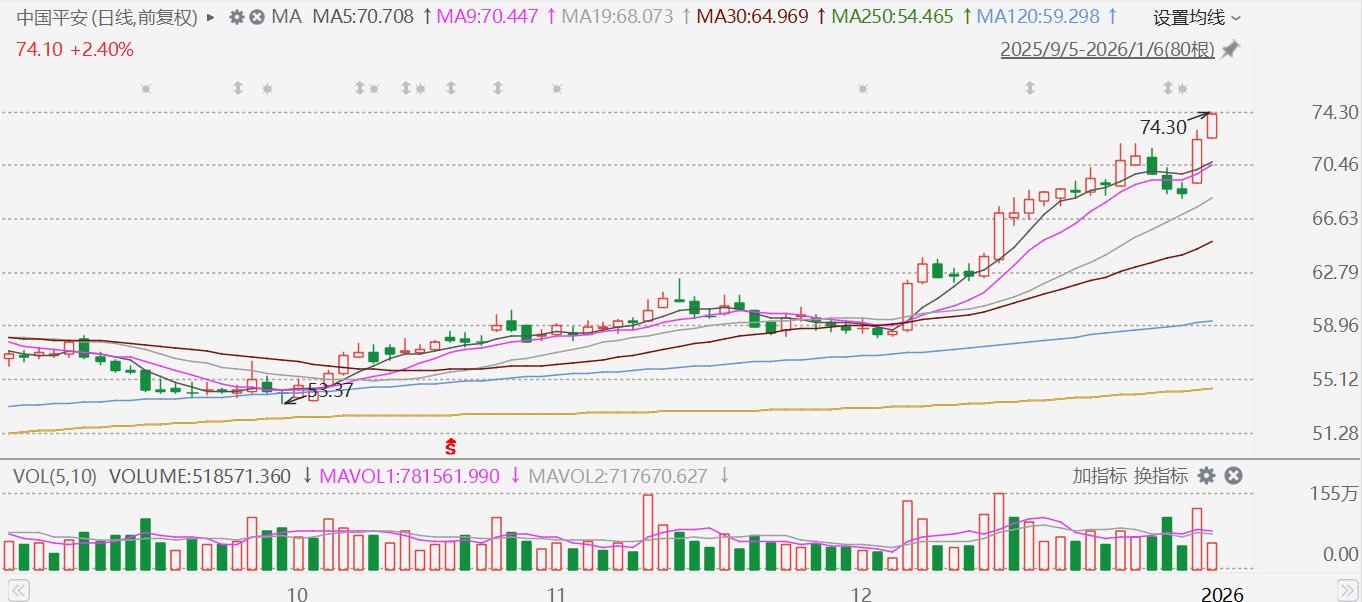
Core Viewpoint - The insurance sector, particularly China Ping An, is experiencing a strong upward trend, with significant stock price increases indicating a potential value reassessment in the industry [1] Group 1: Stock Performance - China Ping An's A-shares rose over 2% to 74.3 yuan, marking a new high since November 2020, with a cumulative increase of nearly 9% over the first two trading days of the new year [1] - The H-shares of China Ping An increased by over 3% to 71.2 Hong Kong dollars, reaching a new high since April 2021 [1] Group 2: Analyst Predictions - Shenwan Hongyuan Research has raised its earnings forecast for China Ping An, maintaining a "buy" rating and setting a target price of 93.8 yuan per share for A-shares [1] - The research highlights that China Ping An, due to its business characteristics, is a high-dividend stock that can be both offensive and defensive [1]
2026年首个交易日保险板块涨幅居首 新华保险、中国太保股价创新高
Shang Hai Zheng Quan Bao· 2026-01-06 02:11
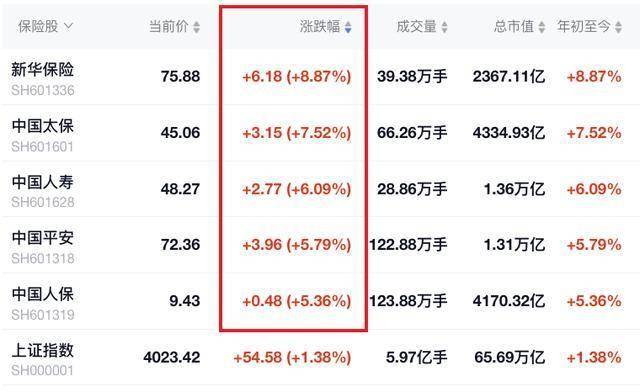
Group 1 - The A-share insurance sector rose by 6.17%, leading the Shenwan secondary industry classification, with notable individual stock performances including New China Life up 8.87% and China Pacific Insurance up 7.52%, both reaching new highs [1] - Analysts attribute the positive performance of the insurance sector since December 2025 to supportive policies, including adjustments to risk factors for stocks held by insurance companies and the introduction of the draft Asset-Liability Management Measures for insurance companies, aimed at optimizing asset-liability matching [1][2] - The insurance sector's growth is also driven by favorable earnings expectations and market liquidity, with the sector experiencing a 26.42% increase throughout 2025 [1] Group 2 - On the liability side, measures such as lowering the preset interest rate and promoting dividend insurance have alleviated cost pressures for insurance companies, with insurance products becoming increasingly important for residents' asset allocation [2] - On the asset side, policies have been relaxed to encourage long-term investments, including increasing the proportion of equity investments and expanding investment channels, which has led to significant investment returns for insurance companies [2] - The first three quarters of 2025 saw the five major listed insurance companies in A-shares achieve a record net profit of approximately 426.04 billion yuan [2]
欺骗投保人等,平安人寿济宁中支两家县支公司被处罚
Qi Lu Wan Bao· 2026-01-06 01:59
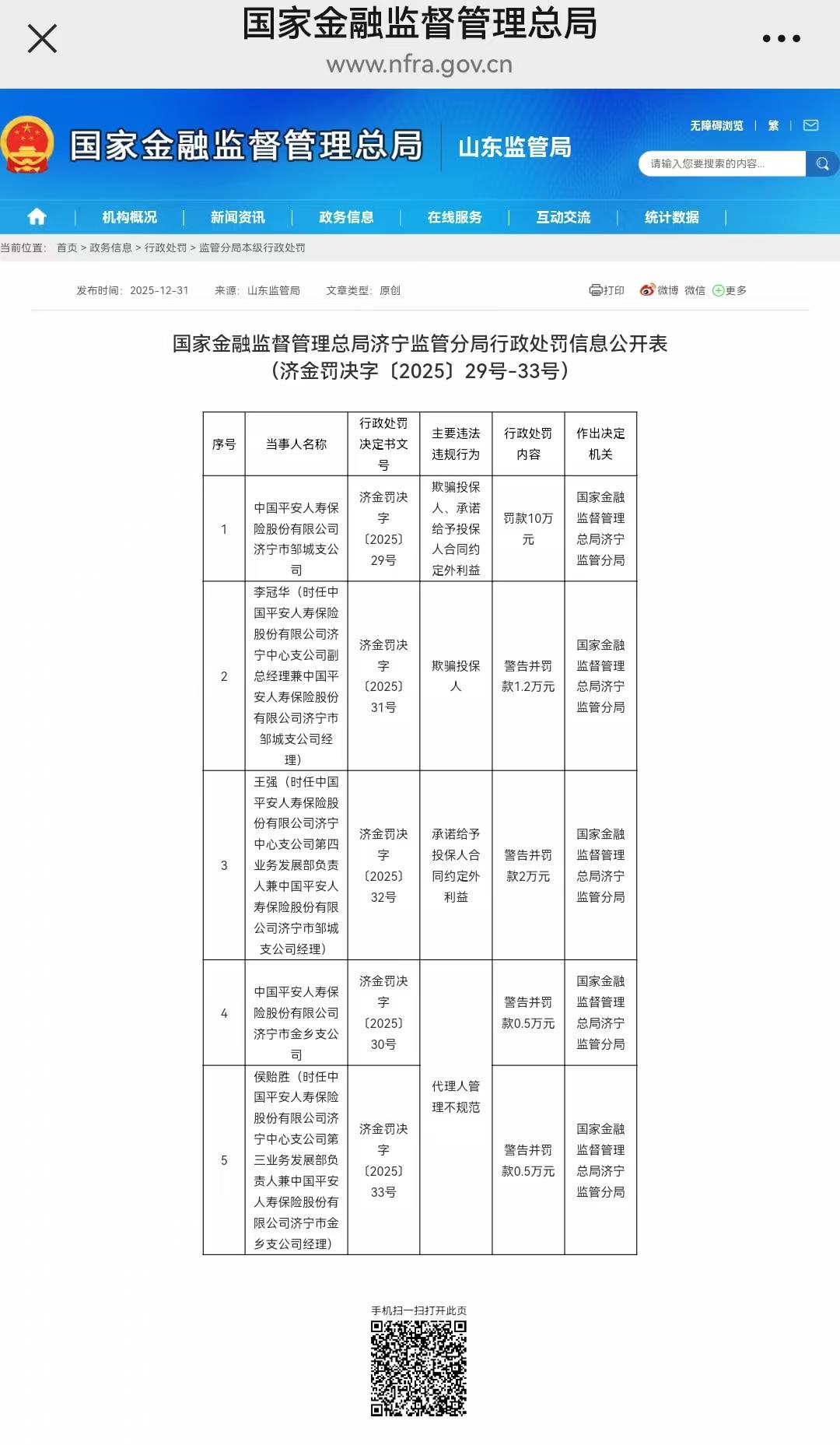
Core Viewpoint - The recent penalties imposed on China Ping An Life Insurance Company highlight ongoing compliance issues and regulatory scrutiny within the company, particularly in its sales practices and agent management [5][6][7]. Group 1: Penalties and Violations - China Ping An Life Insurance's subsidiaries in Jining were fined a total of 142,000 yuan for multiple violations, including misleading sales practices and improper agent management [1][5]. - The Jining Zoucheng branch was fined 100,000 yuan for "deceiving policyholders and promising benefits outside of the insurance contract" [5]. - Two responsible individuals from the Zoucheng branch received warnings and fines of 12,000 yuan and 20,000 yuan, respectively, for similar violations [5][6]. Group 2: Nature of Violations - The violations primarily involved misleading sales tactics, such as exaggerating product benefits and using improper incentives to induce purchases, which infringe on consumer rights [5][6]. - The Jining Jinxiang branch faced penalties for "improper management of agents," which is directly linked to compliance risks and misleading sales practices [5][6]. Group 3: Historical Context - The recent penalties are not isolated incidents but rather a recurrence of previous compliance failures, as evidenced by a significant fine of 461,000 yuan imposed in May 2023 for similar violations, including financial misrepresentation and agent misconduct [6][7]. - The issues of agent management and sales misconduct have persisted for at least two years, indicating systemic problems within the company's internal controls and compliance culture [6][7]. Group 4: Implications for the Company - The penalties reflect deeper issues within Ping An Life's internal management and compliance culture, suggesting a need for a shift from a performance-driven approach to a more compliance-focused strategy [7]. - The company is urged to learn from these penalties and to prioritize regulatory compliance and consumer protection to avoid further scrutiny and penalties in the future [7].
2026年首个交易日保险板块涨幅居首 新华保险、中国太保股价创新高
Shang Hai Zheng Quan Bao· 2026-01-05 18:28
Core Viewpoint - The insurance sector in A-shares has shown strong performance, with a 6.17% increase, driven by supportive policies and positive market sentiment towards insurance companies [2] Group 1: Market Performance - The insurance sector index rose by 6.17%, leading the Shenwan secondary industry classification [2] - Individual stocks such as New China Life Insurance increased by 8.87%, China Pacific Insurance by 7.52%, and China Life by 6.09%, all reaching new highs [2] - The overall increase in the insurance sector for 2025 was 26.42% [2] Group 2: Policy Impact - Supportive policies include adjustments to risk factors for insurance company investments and the introduction of the "Insurance Company Asset-Liability Management Measures (Draft for Comments)" aimed at optimizing asset-liability matching [2][3] - The reduction in liability costs through measures like lowering the preset interest rate and promoting dividend insurance has eased pressure on insurance companies [3] Group 3: Investment Opportunities - The increase in equity asset investment ratios and the relaxation of stock investment risk factors have opened up new avenues for insurance capital investments [3] - The first three quarters of 2025 saw the five major listed insurance companies achieve a combined net profit of approximately 426.04 billion yuan, marking a historical high for the same period [3] Group 4: Future Outlook - Market analysts expect continued policy support for insurance companies to enhance asset-liability management, alongside sustained enthusiasm for insurance products from residents [3] - The anticipated "Davis Double Play" effect from earnings growth and valuation increases is likely to keep the insurance sector in focus for investors [3]

银行-保险-券商年度策略
2026-01-05 15:42
Summary of Conference Call Records Industry Overview - **Insurance Industry**: The insurance sector is expected to continue its recovery in 2026, with concerns over interest margin losses easing. Regulatory adjustments have lowered the preset interest rates, and the return on universal insurance products has decreased. Investment returns for insurance stocks are projected to exceed 5%, surpassing the intrinsic value assumptions, indicating a turning point for interest margin losses [1][4]. - **Brokerage Sector**: The brokerage industry is anticipated to benefit from the migration of household deposits, increased market activity, and relaxed regulatory policies. It is expected that the return on equity (ROE) for brokerages will enter an upward cycle from 2025 to 2026, driven by wealth management, investment banking, and international derivatives [1][10]. Key Insights and Arguments - **Investment in A-shares**: Insurance companies are expected to allocate 30% of new premiums to the A-share market annually, resulting in an influx of approximately 300-400 billion yuan, which will support capital market growth and enhance investment returns [1][4]. - **Property Insurance**: The top three property insurance companies maintain a stable market share, with auto insurance being a core growth area. The penetration rate of new energy vehicles is expected to drive an increase in average premiums. China Pacific Insurance anticipates a growth rate of over 4% in auto insurance business, aligning with GDP growth [1][5]. - **Non-auto Insurance Growth**: The non-auto insurance sector is benefiting from increased health insurance coverage, with premium growth expected to approach 10% in 2026 as certain low-base businesses recover. The comprehensive cost ratio for leading insurance companies is projected to stabilize around 97% [1][7]. - **Brokerage Performance Drivers**: Key performance drivers for brokerages include robust growth in wealth management, a recovering investment banking sector, and active proprietary trading. The anticipated improvement in ROE for brokerages could reach 9% under neutral conditions and exceed 10% in optimistic scenarios by 2027 [2][14]. Additional Important Points - **Market Dynamics**: The trend of household deposits moving away from traditional savings products is creating a competitive advantage for participating insurance products, which offer higher returns compared to fixed deposits [1][4]. - **Valuation Recovery**: The insurance sector's valuation is expected to recover significantly, with a potential P/EV (price-to-embedded value) ratio reaching 1.0 in the medium term. The average insurance stock in A-shares has about 40% room for recovery based on 2026 dynamic PEV estimates [8]. - **Recommended Companies**: Key insurance companies to watch include China Ping An, New China Life, China Taiping, China Life, and China Pacific Insurance, with China Ping An being highlighted for its diversified business model and high dividend characteristics [9]. - **Banking Sector Changes**: The banking sector is expected to undergo significant changes driven by policy adjustments, improved fundamentals, and favorable funding conditions, which will support valuation recovery [16]. - **Investment Recommendations**: In the current market environment, it is advisable to focus on stable high-dividend stocks and quality core assets, including major state-owned banks and leading commercial banks [17].
开门红!5家上市险企集体暴走,新华太保再破纪录!展望2026年的保险业...
13个精算师· 2026-01-05 14:53
Core Viewpoint - The insurance sector is experiencing a strong start in 2026, with major companies like Xinhua and China Pacific reaching historical highs, indicating market confidence and potential for growth [2][4]. Group 1: Market Performance - Five listed insurance companies have seen significant stock price increases, with Xinhua Insurance and China Pacific reaching historical highs, while China Life and China Ping An also achieving near five-year highs [3][4]. - The overall market sentiment is positive, as the insurance sector's performance reflects improved asset and liability management, alongside a favorable demographic trend [4]. Group 2: Interest Rate and Regulatory Changes - Analysts predict a new round of interest rate cuts in 2026, which may impact the predetermined interest rates for life insurance products [5][12]. - The introduction of a dynamic adjustment mechanism for predetermined interest rates has begun, with potential further reductions expected in 2026 [8][10]. Group 3: Investment Strategies - Insurance companies are expected to increase their investment in capital markets, with the total investment balance exceeding 37 trillion yuan, marking a historical high [15]. - The stock investment amount reached 3.6 trillion yuan, showing a year-on-year increase of approximately 1.3 trillion yuan, with a growth rate exceeding 55% [15][16]. Group 4: Product Development - The development of participating insurance products is accelerating, with premiums surpassing 700 billion yuan and a year-on-year growth of over 10% [21]. - The shift towards "guaranteed + floating return" products is becoming a focus, as these products are expected to yield better returns compared to traditional insurance products [21][27]. Group 5: Channel Adjustments - The insurance distribution channels are undergoing transformation, with a focus on enhancing the quality of individual agent channels and expanding the bancassurance channel [23]. - In the first half of 2025, the bancassurance channel generated approximately 1 trillion yuan in premium income, reflecting a growth rate of 9.4% [23]. Group 6: Regulatory Developments - New regulations regarding asset-liability management and product innovation are expected to be implemented in 2026, promoting high-quality development in the insurance industry [29][30]. - The introduction of the fourth life table and the implementation of health insurance guidelines are anticipated to drive innovation in personal insurance products [27].

恒生指数上涨0.03% 恒生科技指数上涨0.09%
Xin Hua Cai Jing· 2026-01-05 12:04
成交额前三的个股中,阿里巴巴涨2.55%,成交超156亿港元;腾讯控股涨0.24%,成交超124亿港元; 中芯国际涨1.86%,成交超99亿港元。 (文章来源:新华财经) 整体来看,多数板块上涨,生物医药、芯片、房地产、电力、券商等股多为上涨,科网、新消费、煤 炭、有色金属等股有涨有跌,银行、新能源汽车、石油与天然气等股多有下跌。 个股方面,快手涨11.09%,小米集团跌2.33%,中国平安涨2.69%,美团涨0.76%,中国海洋石油跌 3.29%,华虹半导体涨3.32%,中国人寿涨3.40%,石药集团涨4.83%,壁仞科技跌3.66%,诺比侃涨 21.60%,英诺赛科跌9.42%,小鹏汽车跌4.60%,周大福涨5.13%,工商银行跌2.05%。 5日,港股主要指数高开后震荡整理,截至收盘,恒生指数上涨0.03%至26347.24点,恒生科技指数上涨 0.09%至5741.63点,国企指数下跌0.22%至9148.47点。 当日恒指高开22.97点,开报26361.44点,开盘上行,午前回落至开盘价附近,午后开盘在26351点附近 震荡,最终恒指涨8.77点,主板成交超2834亿港元。当日,港股通(南向)净流 ...




平安产险福建分公司:首单研发费用损失险落地南平 风险分担机制护航科技创新
Zhong Jin Zai Xian· 2026-01-05 11:37
Group 1 - The core viewpoint of the news is that Ping An Property & Casualty Insurance has signed the first technology project research and development expense loss insurance in Fujian province, providing 10.58 million yuan risk protection for a national high-tech enterprise's diabetes drug intermediate research project, marking a significant step in financial support for technological innovation [1][3][6]. Group 2 - The technology project research and development expense loss insurance directly addresses the core risks faced by high-tech enterprises, compensating for funding losses due to technical route errors, small-scale trial failures, or unmet acceptance standards [3]. - The insurance mechanism is designed to alleviate financial pressure on enterprises caused by research and development risks, integrating a comprehensive solution of "pre-risk prevention + in-process control + post-loss compensation" [3][6]. - The company has established a multi-layered technology insurance product system, responding to diverse needs of technology enterprises, and has provided over 100 billion yuan in technology risk protection for high-tech enterprises across the province [6][7]. Group 3 - The company aims to become a reliable partner for technology enterprises, ensuring that insurance serves as a support for technological innovation rather than a cost burden [7]. - Future plans include deepening collaboration with provincial technology departments, financial institutions, and research institutes to replicate and promote the "Fujian model" of technology insurance [7].