
NCI(601336)

Search documents
金融行业周报(2025、09、28):险资配置动作活跃,看好银行股中长期修复空间-20250928
Western Securities· 2025-09-28 08:20
Investment Rating - The report maintains a positive outlook on the insurance sector, suggesting it is a growth area within the financial industry due to supply-side reforms and benefits from rising equity assets [2][17] - The securities sector is viewed as relatively undervalued with high growth potential, particularly in light of ongoing industry improvements and potential mergers and acquisitions [3][19] - The banking sector is expected to see a medium to long-term valuation recovery, with limited downside risk due to strong fundamentals [4][20] Core Insights - The non-bank financial index experienced a slight decline of -0.09%, underperforming the CSI 300 index by 1.16 percentage points [1][11] - The insurance sector has made significant progress in cost reduction, achieving a cumulative cost reduction of 350 billion yuan since 2024, with the lowest comprehensive cost and expense ratios in nearly a decade for property insurance [2][14] - The securities sector is projected to achieve a net profit of 67 billion yuan in Q3 2025, reflecting an 86% year-on-year increase, supported by a favorable market environment [3][19] - The banking sector's price-to-book (PB) ratio stands at 0.53, indicating substantial room for valuation recovery, with a focus on banks with high growth and low non-performing loans [4][20] Summary by Sections Insurance Sector - The insurance sector's index rose by 0.46%, but still underperformed the CSI 300 index by 0.61 percentage points [2][14] - The sector is benefiting from regulatory support and a focus on cost efficiency, with significant reductions in operational costs [2][15] - Investment recommendations include China Pacific Insurance (A+H), New China Life Insurance (A+H), and Ping An Insurance (A) [2][17] Securities Sector - The securities index fell by 0.18%, underperforming the CSI 300 index by 1.25 percentage points [3][18] - The sector is characterized by ongoing digital transformation and potential for mergers, with a projected net profit of 67 billion yuan for Q3 2025 [3][19] - Recommended stocks include Huatai Securities (A+H), GF Securities (A+H), and Dongfang Securities (A+H) [3][19] Banking Sector - The banking index declined by 0.48%, underperforming the CSI 300 index by 1.55 percentage points [4][20] - The banking sector's PB ratio is at 0.53, indicating a favorable valuation environment for long-term investments [4][20] - Investment focus should be on banks with diversified operations and stable performance, such as Hangzhou Bank and China CITIC Bank (H) [4][21]




上半年银保新单保费占比64% 预计年底将达70%
2 1 Shi Ji Jing Ji Bao Dao· 2025-09-28 08:11
Core Insights - The insurance premium from bank-insurance cooperation accounted for 64% of the new insurance premiums in the first half of the year, expected to approach 70% by year-end, indicating a solidified channel structure dominated by bank-insurance partnerships [1] - The relationship between banks and insurance companies has evolved from merely sharing profits to a comprehensive strategic collaboration across various sectors including ecology, deposits, bonds, custody, and technology [1] Group 1: Trends in Bank-Insurance Cooperation - Four major trends in bank-insurance cooperation have been identified: the establishment of a bank-insurance dominated sales channel, an increase in complex insurance products, the growing importance of ecological services, and the empowerment of the entire bank-insurance operation chain through digital technology [1] - The bank-insurance cooperation is crucial for banks as it serves as a significant source of non-interest income, helping to alleviate the pressure from narrowing net interest margins [2] Group 2: Policy Impact on Growth - The substantial growth of bank-insurance channels is closely linked to recent policy changes, such as the "Report and Action Integration" policy, which encourages a shift from fee-driven models to customer service-centered value creation [3] - The cancellation of the "1+3" cooperation limit allows banks to partner with more insurance companies, thereby expanding collaboration opportunities [3] Group 3: Shift Towards Complex Products - The demand for complex insurance products is increasing, driven by macro trends such as aging population and declining interest rates, with customers showing a preference for long-term savings and protection products [4] - The sales of floating yield products like dividend insurance have been actively promoted by listed insurance companies to reduce rigid liability costs and alleviate long-term interest spread pressure [4]
内险股集体上扬 新华保险涨超3% 机构看好险企投资收益继续改善
Zhi Tong Cai Jing· 2025-09-27 11:36
Group 1: Market Performance - The insurance stocks collectively rose, with New China Life Insurance increasing by 3.04% to HKD 43.4, China Pacific Insurance up by 2.34% to HKD 30.64, and China Life Insurance rising by 0.66% to HKD 21.4 [2] - The overall market sentiment appears positive, as indicated by the upward movement in stock prices across major insurance companies [2] Group 2: Industry Insights - Huaxi Securities noted that the continuous reduction in life insurance preset interest rates and the promotion of unified reporting and sales channels are expected to lower liability costs, potentially leading to stable growth in the new business value (NBV) of listed insurance companies by 2025 [2] - The property and casualty insurance sector is also expected to see improvements in underwriting profits due to ongoing efforts in channel integration and refined expense management [2] - Guosen Securities highlighted that the industry's transformation in liability channels, products, and costs is showing significant improvement, with high demand for asset allocation in insurance funds expected to continue [2] - The focus on long-term bonds and high-dividend assets is likely to persist, suggesting a favorable environment for companies with strong business models and relatively low valuations, such as China Ping An and China Pacific Insurance [2]

险资青睐高股息股票 背后藏着什么秘密?
经济观察报· 2025-09-27 05:07
Core Viewpoint - The implementation of the new accounting standards in the insurance industry by 2026 will drive insurance funds to increase their allocation of stocks under the FVOCI category, enhancing the stability of profit reports for insurance companies [2][6]. Group 1: FVOCI Accounting Category - FVOCI (Fair Value Through Other Comprehensive Income) allows insurance companies to measure financial assets at fair value without affecting their profit and loss statements, thus stabilizing profit reports [2][6]. - As of June 2023, several listed insurance companies have seen significant increases in their FVOCI equity asset holdings, with Xinhua Insurance's FVOCI equity assets rising from 30.64 billion to 37.47 billion yuan, and China Life's FVOCI stock holdings reaching 140.26 billion yuan, accounting for 22.6% of its total stock investments [2][6]. Group 2: Investment Strategies - Insurance companies are focusing on high-dividend stocks, particularly in sectors benefiting from policies aimed at reducing competition and improving cash flow amid inflation [4][8]. - The shift towards FVOCI is also a strategy to address the mismatch in asset-liability durations, as many insurance companies face a duration gap of 4-7 years, significantly higher than the 1-2 years seen in markets like Japan and Germany [8][9]. Group 3: Long-term Investment Logic - The increasing allocation of equities to FVOCI is prompting insurance companies to adjust their investment logic from short-term capital gains to a focus on stable stock price fluctuations and sustainable dividend income [14]. - The dual effect of this strategy is that while it stabilizes profit reports, it also requires insurance companies to maintain a long-term perspective on their investments, which aligns with the regulatory environment favoring long-term assessments [12][14].



险资青睐高股息股票 背后藏着什么秘密?
Jing Ji Guan Cha Wang· 2025-09-26 14:37
Core Viewpoint - The insurance industry is increasingly adopting FVOCI accounting for high dividend stocks to stabilize profit reports and enhance long-term dividend income [2][5][10] Group 1: FVOCI Accounting Adoption - FVOCI accounting allows insurance companies to measure financial assets at fair value without impacting annual profit reports, thus stabilizing profit volatility [2][5] - As of June 2023, major insurance companies have significantly increased their FVOCI equity asset holdings, with Xinhua Insurance's FVOCI equity assets rising from 30.64 billion to 37.47 billion yuan and China Life's FVOCI stock holdings reaching 140.26 billion yuan, accounting for 22.6% of its total stock investments [2][3] - The implementation of new accounting standards in 2026 is expected to further drive the allocation of insurance capital into FVOCI stocks [2][4] Group 2: Investment Strategies - Insurance companies are focusing on high dividend stocks, particularly in sectors benefiting from policies aimed at reducing competition and improving cash flow amid inflation [3][6] - The strategy includes identifying stocks with improved cash flow and dividend potential through bottom-up research methods [3][6] - The shift towards FVOCI is also aimed at addressing the mismatch between asset and liability durations, with many companies experiencing a duration gap of 4-7 years [6][10] Group 3: Market Dynamics and Challenges - The rise of FVOCI has led to a "double-edged sword" effect, where significant unrealized gains from FVOCI assets do not appear on profit statements, potentially obscuring the true performance of insurance companies [9][10] - This shift in accounting practices allows for a more stable assessment of insurance companies' core business performance, enhancing investor confidence [10] - The focus on long-term dividend income is changing the investment logic of insurance companies, moving away from short-term capital gains to a more stable income approach [10]

10月金股报告:市场预计维持震荡,科技关注性价比
ZHONGTAI SECURITIES· 2025-09-26 13:12
Group 1: Market Overview - The macroeconomic environment remains supportive with expectations of further easing from the Federal Reserve, which has already lowered rates by 25 basis points in September, with projections for additional cuts by the end of the year [2] - A-shares are experiencing a high level of trading activity, with average daily turnover exceeding 2.45 trillion yuan in September, up from 2.31 trillion yuan in August, indicating strong market liquidity [2] - The technology sector continues to show strength, with the Wande Technology Index accounting for 40.8% of total A-share trading volume, reflecting ongoing liquidity inflows into this sector [2] Group 2: Sector Analysis - The technology sector is characterized by a clear differentiation between high and low performers, with previous leaders like optical modules and communication equipment seeing lower gains in September, while semiconductor materials and energy storage stocks have shown significant recovery [2][3] - Cyclical and dividend-paying stocks remain weak due to poor economic data, with various sectors underperforming compared to technology [3] - The current risk premium for A-shares is low, with the risk premium for the CSI 300 index at 5.19%, close to historical lows, suggesting limited downside potential [3] Group 3: Investment Strategy - The report recommends focusing on technology stocks with a strong price-performance ratio, particularly those that have lagged behind in previous rallies, to enhance potential returns [5] - There is an emphasis on upstream materials related to energy storage and semiconductor industries, such as lithium and cobalt, which are expected to benefit from ongoing demand growth in electric vehicles and semiconductor manufacturing [5] - The October stock selection includes a diverse range of sectors, highlighting companies in innovative pharmaceuticals, electronics, automotive, and communications, indicating a strategic approach to capitalize on sectoral strengths [10][11]


保险行业8月保费:寿险单月保费强势增长,财险非车业务短期承压
Soochow Securities· 2025-09-26 12:45
Investment Rating - The report maintains an "Overweight" rating for the insurance industry [1] Core Insights - In August, the life insurance sector experienced a strong premium growth of 49.7% year-on-year, significantly up from July's growth rate [4] - The report anticipates a gradual decline in premium growth rates post-September, as the surge in August is attributed to the "stop炒" effect of old products amid a backdrop of lowered preset interest rates [4] - The health insurance sector's premium growth remained stable at 2.6% year-on-year in August, with a long-term growth potential identified through the integration of health management and insurance services [4] - The property insurance sector saw a modest premium growth of 0.9% in August, primarily impacted by a decline in non-auto insurance premiums [4] - The report highlights that leading insurance companies maintain robust growth and quality in their business, particularly in auto insurance, where lower loss ratios enhance profitability [4] - The valuation of the insurance sector remains at historical lows, with expected PEV ratios between 0.57-0.85 and PB ratios between 1.02-2.16 for 2025, indicating significant upside potential [4] Summary by Sections Life Insurance - August's life insurance premiums reached CNY 4,645 billion, marking a 49.7% year-on-year increase, with a cumulative premium of CNY 37,999 billion for the first eight months of 2025, up 11.3% year-on-year [4] - The report notes a shift towards dividend insurance products as a response to the changing interest rate environment [4] Health Insurance - Health insurance premiums in August grew by 2.6%, with a cumulative growth of 2.4% for the first eight months of 2025 [4] - The report emphasizes the potential for health insurance to expand through a comprehensive health ecosystem [4] Property Insurance - Property insurance premiums in August increased by 0.9%, with a cumulative growth of 4.7% for the first eight months of 2025 [4] - The report indicates that the growth in auto insurance premiums is supported by the rising penetration of new energy vehicles [4] Market Outlook - The report suggests that both liability and asset sides of the insurance companies are improving, with a favorable outlook for the industry as a whole [4] - The anticipated recovery in long-term interest rates could alleviate pressure on investment yields for insurance companies [4]
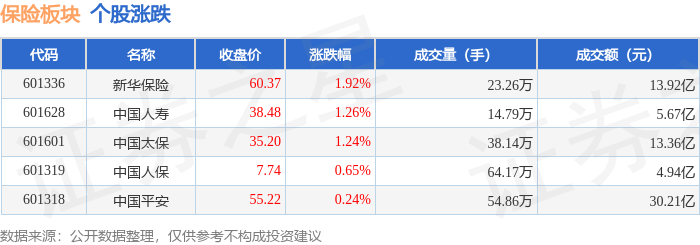
保险板块9月26日涨0.91%,新华保险领涨,主力资金净流入8232.58万元
Zheng Xing Xing Ye Ri Bao· 2025-09-26 08:48
Group 1 - The insurance sector increased by 0.91% on September 26, with Xinhua Insurance leading the gains [1] - The Shanghai Composite Index closed at 3828.11, down 0.65%, while the Shenzhen Component Index closed at 13209.0, down 1.76% [1] - Key individual stock performances in the insurance sector included Xinhua Insurance at 60.37 (+1.92%), China Life at 38.48 (+1.26%), and China Pacific Insurance at 35.20 (+1.24%) [1] Group 2 - The net inflow of main funds in the insurance sector was 82.33 million yuan, while retail investors saw a net outflow of 209 million yuan [1] - Xinhua Insurance had a main fund net inflow of 140 million yuan, but a retail net outflow of 76.98 million yuan [2] - China Life experienced a net inflow of 59.89 million yuan from main funds, but also a retail net outflow of 39.32 million yuan [2]
港股异动 | 内险股集体上扬 新华保险(01336)涨超3% 机构看好险企投资收益继续改善
智通财经网· 2025-09-26 06:44
国信证券认为,行业深化负债端渠道、产品、成本等领域的转型,产品转型及渠道质态得到显著改善。 资产端方面,预计险资资产配置需求仍高,对应长债及高分红类资产配置行情或将延续,建议关注商业 模式具备"护城河"优势的中国财险,及估值相对偏低的中国平安、中国太保。 智通财经APP获悉,内险股集体上扬,截至发稿,新华保险(01336)涨3.04%,报43.4港元;中国人保 (01339)涨2.84%,报6.51港元;中国太保(02601)涨2.34%,报30.64港元;中国人寿(02628)涨0.66%,报 21.4港元。 华西证券指出,负债端,寿险预定利率持续压降、渠道推进报行合一降低负债成本,有望推动上市险企 2025年全年NBV实现稳健增长;财险持续推进渠道报行合一及费用精细化管理,承保利润有望继续改 善。资产端,保险资金规模快速增长,在"慢牛"行情与中长期入市政策推动下,险企投资收益有望继续 改善。 ...

保险板块震荡走高,中国人寿、新华保险、中国太保涨超1%
Mei Ri Jing Ji Xin Wen· 2025-09-26 06:09
Core Viewpoint - The insurance sector experienced a notable increase on September 25, with major companies such as China Life, New China Life, and China Pacific Insurance rising over 1% [1] Company Summary - China Life saw a significant rise in its stock price, contributing to the overall positive trend in the insurance sector [1] - New China Life also reported an increase in its stock value, aligning with the upward movement in the industry [1] - China Pacific Insurance's stock rose by more than 1%, reflecting investor confidence in the company [1] - China Insurance and Ping An Insurance followed suit, also showing gains in their stock prices [1]