
SCS(601555)

Search documents
东吴证券:2026年财政可能有两个超预期
Sou Hu Cai Jing· 2026-01-05 04:11
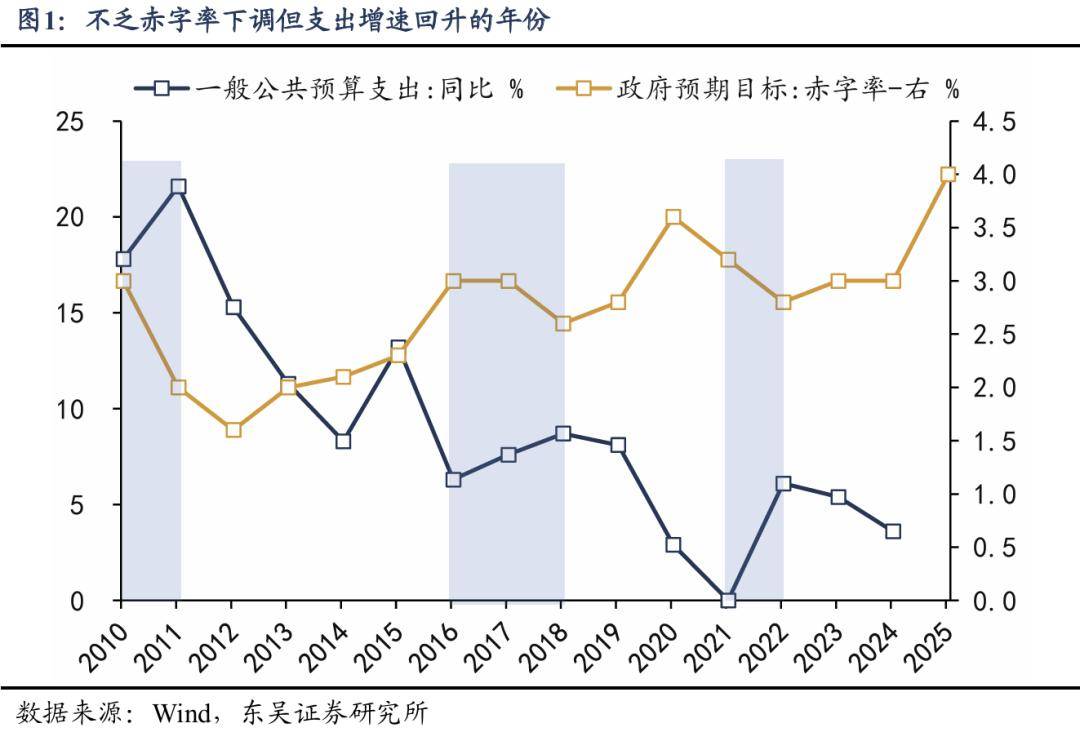
Core Viewpoint - Despite the market's general expectation that the marginal increase in fiscal funds may slow down in 2026, fiscal spending could still exceed expectations due to two main factors: a rebound in prices leading to increased fiscal revenue and a significant amount of unspent fiscal funds from 2025 that can be carried over to the next year [1][2][3] Group 1: Fiscal Spending Dynamics - The fiscal deficit rate may not increase, yet the growth rate of fiscal spending can still rise. Historical data shows instances where the deficit rate did not increase, but spending growth rebounded significantly [1][5][6] - The potential for "no increase in deficit and accelerated spending" may arise from two unexpected sources: a rebound in price growth leading to increased fiscal revenue and unspent funds from 2025 forming a substantial carryover [2][11] Group 2: Revenue from Price Rebound - A rebound in price growth could lead to an increase in tax revenue by approximately 260 billion yuan. The indirect tax system in China is highly sensitive to price fluctuations, with major tax channels such as VAT, additional taxes, corporate income tax, and resource tax accounting for nearly 67% of total tax revenue [2][23] - Historical experience indicates that a 1 percentage point increase in PPI typically results in a 0.5-0.8 percentage point increase in tax revenue growth, suggesting that a projected 1.8 percentage point rebound in PPI could yield around 260 billion yuan in additional tax revenue [2][23] Group 3: Fiscal Surplus from Unspent Funds - The fiscal surplus for 2025 is expected to exceed 500 billion yuan, with a cumulative increase in fiscal deposits reaching 2.04 trillion yuan in the first eleven months, marking a historical high [3][25][27] - The slow progress of fiscal spending in 2025, particularly in infrastructure-related areas, has contributed to this surplus. The focus on debt replacement and settling government debts has limited direct investment in traditional infrastructure projects [3][27]


保险Ⅱ行业深度报告:低利率时代的重逢——中国分红险发展的前世今生-东吴证券
Sou Hu Cai Jing· 2026-01-05 01:09
Group 1 - The core viewpoint of the articles is that dividend insurance is transitioning to become a key focus in the life insurance industry, driven by regulatory encouragement and market demand in a low-interest-rate environment [1][2][12]. - Dividend insurance is characterized as a floating income product that combines protection and investment attributes, with dividends derived from positive surpluses generated by interest rate differences, mortality differences, and expense differences, with at least 70% of these surpluses distributed to policyholders [1][2][21]. - The development of dividend insurance in mainland China has experienced several phases, including a peak in the early 2010s when it accounted for 75% of industry premiums, followed by a decline from 2013 to 2023 due to market reforms, and a resurgence since 2024 as regulatory policies have favored floating income products [1][2][8][12]. Group 2 - The current transformation of dividend insurance has shown significant results, with over 50% of new policies in the first half of 2025 being dividend insurance, and China Pacific Insurance exceeding 90% [2][12]. - The core logic behind this transformation is that dividend insurance has lower rigid costs, stronger stability under new accounting standards, and shorter effective liability durations, which can effectively alleviate interest rate loss pressures [2][12]. - The expected increase in the proportion of dividend insurance in new policies will enhance the reliability of life insurance embedded value (EV) and gradually increase the proportion of equity allocation in insurance funds, benefiting from long-term stock market returns [2][12]. Group 3 - In overseas markets, floating income products dominate, particularly in mature markets like Europe and the U.S., where the focus has shifted towards universal and investment-linked insurance, while in Hong Kong, dividend insurance remains a core product with significant market share [2][12][4]. - The experience from overseas markets suggests that in a low-interest-rate environment, there are substantial growth opportunities for floating income products, and dividend insurance is seen as a more suitable solution for domestic investors in China [2][12]. - The industry faces challenges such as long-term interest rate declines, equity market volatility, and pressure on new policy premiums, but the shift towards dividend insurance is expected to reshape the liability structure of the industry and promote high-quality development [2][12].

金融机构高管新年展望 共绘高质量发展新蓝图
Shang Hai Zheng Quan Bao· 2026-01-04 22:31
4 1 11 100 6395 r 626- (Cir (56- (0 ed 陈亮 : . , . 111- ( = ) Ma 刘健 t the O T . 4. Jh 顾伟 0 l P t . t . 范力 钱文海 黄德良 王海河 陈戈 张东 钟文岳 刘宗治 高云程 王庆 中金公司党委书记、董事长陈亮: 坚守初心 奋力谱写一流投行建设新篇章 2026年是"十五五"规划开局之年,我国经济长期向好的坚实基础和积极态势将持续巩固,中央经济工作 会议为今年工作指明了方向,助力"十五五"稳健开篇。在这一关键时期,资本市场肩负着服务国家战 略、赋能实体经济的重要使命,金融作为国之重器,更需要在应对外部挑战、维护经济金融安全稳定中 展现更大担当。 2025年恰逢中金公司成立三十周年。三十年来,中金公司始终与国家发展同频共振,以专业服务助力资 本市场建设。站在新的历史起点上,中金公司将坚定不移围绕金融强国建设目标,以打造"让党放心、 让人民满意的国际一流投行"为愿景,积极贡献专业力量。 我们将着力打造"财富投行"与"资产投行",把握居民财富多元配置趋势,努力做大社会财富"蛋糕",服 务扩大内需、提振市场信心;深耕"产业投行 ...


证券Ⅱ行业:公募销售费改平稳落地,框架完善兼顾市场关切
GF SECURITIES· 2026-01-04 07:24
Investment Rating - The report assigns a "Buy" rating for the securities industry, indicating an expected stock performance that will exceed the market by more than 10% over the next 12 months [9]. Core Insights - The public fund sales fee reform has been smoothly implemented, with a focus on benefiting investors and addressing market concerns. The reform is expected to save approximately 51 billion CNY in investment costs annually, with a comprehensive fee rate reduction of about 20% [5]. - The new rules on redemption fees have been established to protect market liquidity while benefiting investors. The differentiation in redemption fees is aimed at encouraging long-term investment practices [5]. - The classification of products and supporting policies have been upgraded to create a more refined fee rate regulatory system, promoting the development of index funds and equity funds [5]. - The report emphasizes the importance of wealth management institutions' service capabilities in the context of the growing equity fund market, suggesting a focus on companies like Huatai Securities, CICC, Guotai Junan, and CITIC Securities [5]. Summary by Sections Regulatory Changes - The China Securities Regulatory Commission (CSRC) issued new regulations on public fund sales fees, effective from January 1, 2026, marking the completion of a three-phase fee reduction process [5]. - The third phase of the reform is projected to provide approximately 30 billion CNY in annual benefits to investors [5]. Product Classification - The new regulations simplify redemption fee structures into three tiers and allow flexible arrangements for different types of funds, particularly benefiting individual investors in index funds [5]. - The maximum subscription fee rates have been refined, with specific caps for different fund types, encouraging the growth of index funds [5]. Investment Recommendations - The report suggests focusing on companies that are well-positioned to benefit from the reforms and the anticipated growth in the equity fund market, including Huatai Securities (AH), CICC (H), Guotai Junan (AH), and CITIC Securities (AH) [5].



数字人民币2.0:“计息数字货币”的机制与技术创新
Hua Er Jie Jian Wen· 2026-01-01 08:06
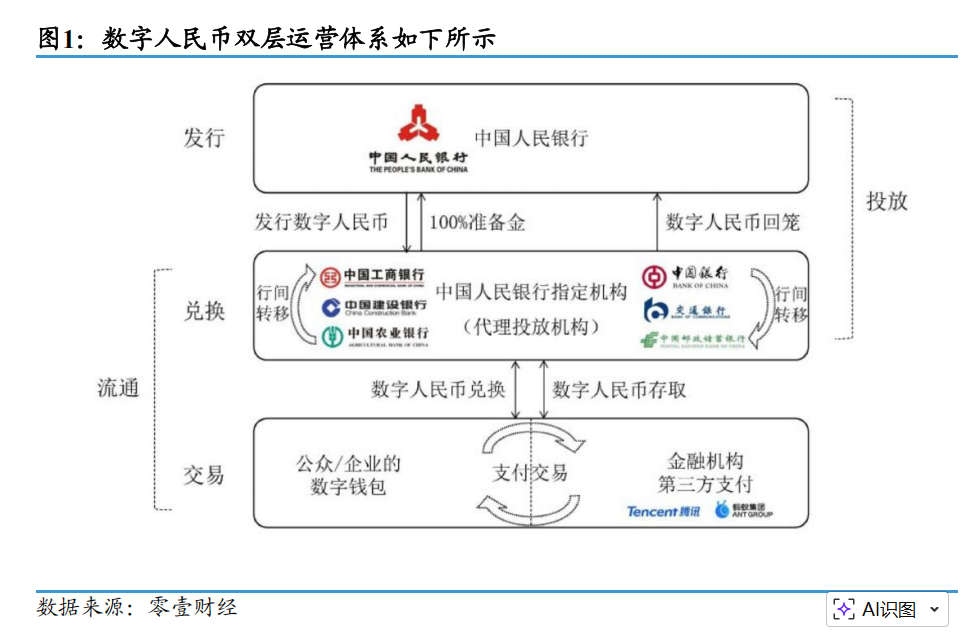
Core Viewpoint - The People's Bank of China is officially transitioning the digital yuan from a "cash-type 1.0" to a "deposit currency type 2.0," introducing a historical transformation that enhances its functionality as a financial asset with value storage capabilities [1][2]. Group 1: Mechanism Innovation - The core mechanism innovation of version 2.0 is characterized by the redefinition of liability attributes and the incorporation of a macro framework, allowing digital yuan balances in commercial banks to be classified as "account-based commercial bank liabilities" [3][6]. - The cancellation of the "non-interest" policy for digital yuan enables liquidity to flow directly into the electronic wallet system, marking the end of the cash era [3][6]. - The new framework enhances user willingness to hold and use digital yuan while providing banks with a manageable asset-liability space [6]. Group 2: Technical Architecture - The technical architecture features three major innovations: an account system, a currency string, and smart contracts, which facilitate a digital path for the digital yuan [7]. - The upgrade maintains compliance with existing bank account rules while introducing a "currency string" for value transfer and offline circulation, enhancing verification and system resilience [7]. - Smart contracts embedded in the funding flow can trigger conditions and automate verification in various scenarios, reducing misuse risks and compliance costs [7]. Group 3: Cross-Border Applications - The transition to "digital deposit currency" is reshaping the liquidity foundation and settlement efficiency of the multilateral central bank digital currency bridge (mBridge) [11]. - As of November 2025, digital yuan holds a dominant position in mBridge operations, accounting for 95.3% of transactions, with a total of 4,047 cross-border payments amounting to 387.2 billion yuan [14]. - The introduction of deposit insurance significantly lowers the risk costs for foreign participants holding digital yuan, enabling more robust fund position management [14].


【一起逐梦】东吴汽车团队2026年最新分工
东吴汽车黄细里团队· 2025-12-31 19:07
Core Insights - The article reflects on the evolution and growth of the Dongwu Automotive team over the past decade, emphasizing the journey of self-discovery and the establishment of a cohesive team [2][4][6]. Group 1: First Decade (2013-2022) - The first decade was characterized by a process of self-exploration and trial-and-error, navigating through the SUV boom and the rise of electric vehicles, ultimately leading to a clearer direction for the team [2]. - The team achieved recognition as the second-best automotive analyst in the New Fortune awards in 2022, marking a significant milestone in their growth [2]. Group 2: Transition Period (2023-2025) - The years 2024-2025 are anticipated to bring further accolades, with expectations of being recognized as the top automotive analyst, although the team acknowledges that this success is not built on a solid competitive advantage but rather on luck [4]. - The team aims to embrace a new goal of "seeking common ground while allowing for differences," recognizing the balance between personal growth and team development [4]. Group 3: Second Decade (2026-2035) - Starting in 2026, the team will focus on each member's journey of self-discovery and contribution, with a vision to witness the global rise of the Chinese automotive industry and serve the capital market [6]. - The team's philosophy emphasizes independent thinking, objectivity, and foresight, with a flexible framework that encourages innovation and iteration [6]. - The team plans to release an updated division of labor annually to better serve the capital market and the automotive industry, inviting collaboration and internships [6]. Group 4: Team Structure and Expertise - The team is structured into three main segments: smart automotive full industry chain, large vehicles (electrification & globalization), and automotive parts & robotics, each led by experienced analysts [7][9][13][18][20]. - Analysts within the team focus on various aspects of the automotive industry, including technology iteration, market demand, and investment opportunities, ensuring a comprehensive approach to research and analysis [9][11][18][20].

中国证券业协会公布2025年券商投行等三项业务排名
Sou Hu Cai Jing· 2025-12-31 13:07
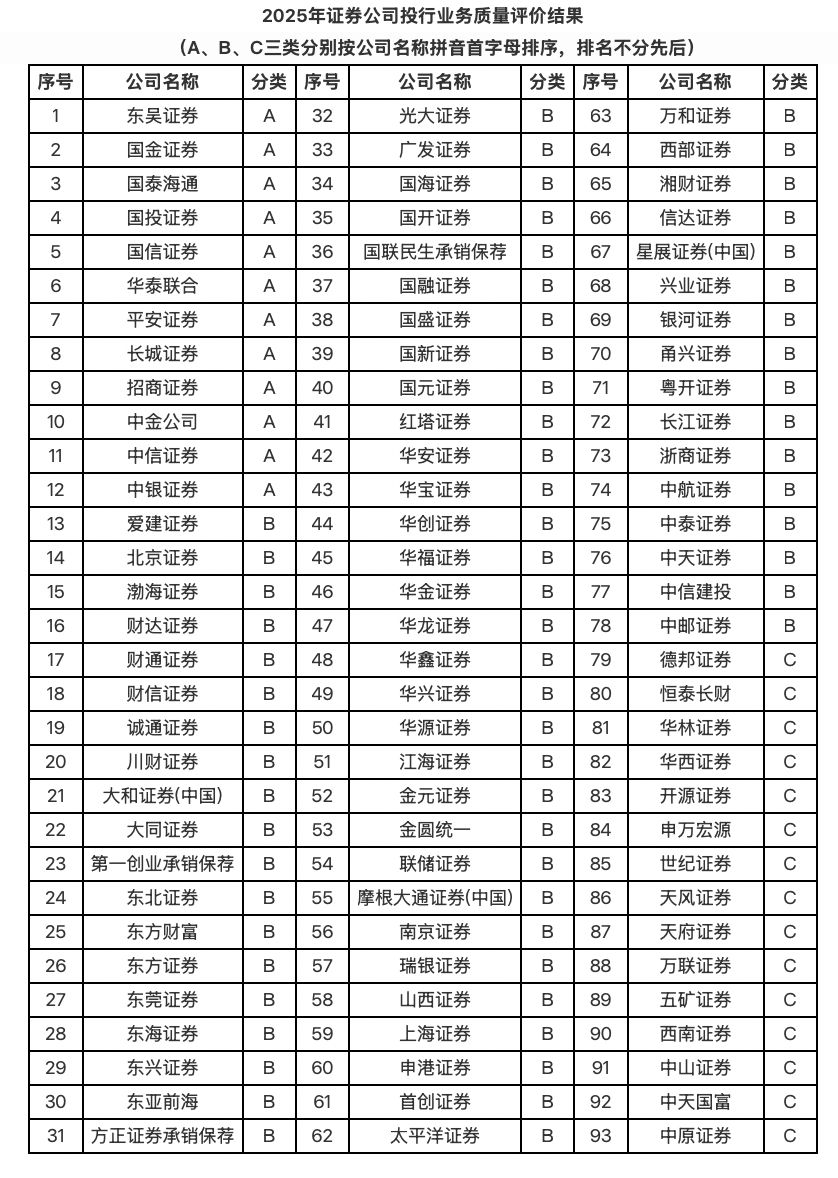
Core Insights - The China Securities Association released the rankings for securities firms in 2025, reflecting their performance in investment banking, financial advisory, and bond business quality [1][2] Group 1: Evaluation Results - A total of 93 securities firms were evaluated for their investment banking quality, with 12 classified as A, 66 as B, and 15 as C [2][5] - The A-rated firms include Dongwu Securities, Guojin Securities, Guotai Junan, Guotou Securities, Guoxin Securities, Huatai United, Ping An Securities, Changcheng Securities, China Merchants Securities, CICC, CITIC Securities, and Bank of China Securities [6][11] Group 2: Financial Advisory Evaluation - The financial advisory business evaluation included 30 firms, with 5 rated A, 19 rated B, and 6 rated C [6][7] - A-rated financial advisory firms are Huatai United, Galaxy Securities, CICC, CITIC Jianan, and CITIC Securities [7] Group 3: Bond Business Evaluation - The bond business evaluation involved 95 firms, resulting in 14 rated A, 62 rated B, and 19 rated C [10][11] - A-rated bond firms include Caixin Securities, Dongwu Securities, Guojin Securities, Guotai Junan, Guoxin Securities, Ping An Securities, and others [10] Group 4: Future Directions - The China Securities Association aims to guide firms to enhance their professional capabilities and service quality, shifting from price competition to value competition [11]




又见首席跳槽 于明明加盟东吴证券
Xin Lang Cai Jing· 2025-12-31 08:01
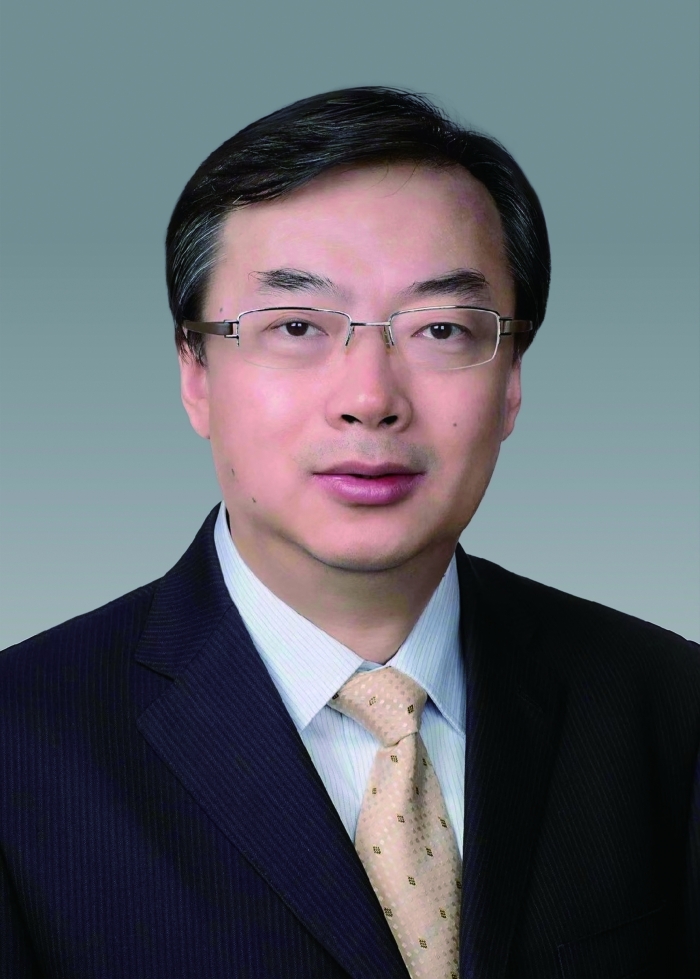
Group 1 - The core viewpoint of the article highlights the frequent talent movement within the brokerage research industry in 2025, with significant changes in personnel across various firms [1][5] - Yu Mingming, the former deputy director of the research institute at Xinda Securities, has joined Dongwu Securities as the head of quantitative investment, indicating a trend of high-profile analysts changing firms [1][5] - By the end of 2025, over 300 analysts changed their professional institutions, involving more than 60 brokerages, with 220 analysts transferring in the first half of the year alone [4][8] Group 2 - The total number of registered analysts in the industry surpassed 6,162 by September 2025, marking a historical high, which contrasts with the ongoing talent flow [4][8] - Notable changes in core talent include at least 14 chief economists from various brokerages, such as the transfer of Xun Yugen from Guotai Junan to Guoxin Securities, reflecting significant shifts in leadership roles [4][9] - The movement of analysts is driven by factors such as brokerage mergers leading to job overlaps, adjustments in business positioning, differences in compensation mechanisms, and career development opportunities [3][4] Group 3 - The phenomenon of "team migration" is prevalent, with over 25 top analysts from popular sectors like consumption, new energy, and TMT changing platforms, indicating a trend of collective movement within teams [9] - The overall analysis of 2025 suggests that the talent flow is a manifestation of the "Matthew effect" due to declining commission rates, as well as a necessary transition from traditional sell-side services to integrated research and comprehensive financial services [4][9] - Xinda Securities has established a three-tier research system covering 25 core industries, focusing on key sectors aligned with national industrial upgrading trends, and is advancing the integration of research and investment [3][7]


券商投行年度评级洗牌:腰部逆袭巨头掉队 罚单成“胜负手”
2 1 Shi Ji Jing Ji Bao Dao· 2025-12-31 07:17
Core Insights - The annual evaluation results for the investment banking business in China reveal a shift in the competitive landscape, with non-traditional top firms making significant gains while established leaders face setbacks due to regulatory penalties [1][3][4] Group 1: Overall Evaluation Results - The China Securities Association published comprehensive evaluations covering investment banking, bond business, and financial advisory services for the year 2024, with 93 firms participating [3][5] - Among the evaluated firms, 12 were rated A-class, 66 B-class, and 15 C-class, representing 12.90%, 70.97%, and 16.13% of the total respectively [3] - Notably, half of the A-class firms are not traditional top revenue earners, indicating a diversification in the quality of investment banking services [1][3] Group 2: Bond Business Evaluation - The bond business evaluation included 95 firms, with 14 rated A-class, 62 B-class, and 19 C-class, corresponding to 14.74%, 65.26%, and 20.00% respectively [6] - Major firms like CITIC Securities and Huatai Securities, despite high underwriting volumes, did not achieve A-class ratings due to regulatory issues, while lower-ranked firms like Caixin Securities did [1][6][10] Group 3: Financial Advisory Services Evaluation - The financial advisory services evaluation was limited to 30 firms, with only 5 achieving A-class ratings, all of which are top-tier institutions [2][11] - The evaluation reflects a high concentration of resources among leading investment banks, with a significant disparity between A-class and lower-rated firms [2][12] - The evaluation criteria for financial advisory services differ from those for investment banking, focusing solely on M&A performance, which allows firms like CITIC Jinpu to excel despite lower overall ratings in other categories [12][13] Group 4: Regulatory Impact - Regulatory penalties have a substantial impact on the evaluation outcomes, with firms like CITIC Jinpu receiving multiple penalties that affected their ratings, while others like Shenwan Hongyuan faced scrutiny without major violations [4][5][9] - The evaluation process considers not only the performance during the evaluation period but also significant violations that occur afterward, indicating a long-term view on compliance [10] Group 5: Market Dynamics - The evaluations signal a shift in the investment banking landscape, where compliance and internal control quality are becoming more critical than mere scale, reshaping competition and market dynamics [2][3] - The concentration of top-tier firms in financial advisory services suggests a growing trend towards specialization and expertise in high-stakes areas like M&A [12][16]


东吴证券:AI算力产业链2026年迎多重机遇 国产化与技术创新成核心动力
智通财经网· 2025-12-31 03:41
Group 1: Cloud Computing Power - The AI computing power industry chain is expected to see significant performance growth by 2026, with domestic GPUs entering a period of performance realization, emphasizing the importance of industry chain collaboration [1][2] - Domestic computing chip leaders are anticipated to enter a performance realization phase, benefiting from capacity release due to advanced process expansion [2] - AIASIC service providers are expected to play a crucial role in the supply chain as domestic computing enters a super node era, testing both GPU manufacturers' capabilities and the localization level of Switch chips [2] Group 2: Edge Computing Power - The hybrid architecture of edge and cloud computing is expected to empower AI applications, with edge AI benefiting from innovations and the release of 3D DRAM [3] - The first half of 2026 may see consumer upstream companies facing pressure from rising storage prices, but the second half is expected to present opportunities from new wearable AIoT products [3] - 2026 is projected to be a pivotal year for NPU deployment, with companies like Rockchip and Amlogic being relevant players [3] Group 3: 3D DRAM - 2026 is anticipated to be a year of significant demand for 3D DRAM, driven by the deployment of AI hardware across various fields [4] - The demand for high bandwidth and low-cost 3D DRAM is expected to rise, particularly in robotics, AIoT, and automotive sectors [4] - The introduction of multiple NPU tape-outs will provide diverse application scenarios for 3D DRAM, with mobile and cloud inference also gradually adopting this technology [4] Group 4: AI Models and Ecosystem - By 2026, cloud models are expected to enhance their complex planning capabilities through data quality and post-training optimization, while edge models will leverage cloud capabilities through distillation [5] - The ecosystem will see terminal manufacturers controlling the OS and system-level entry points, while super apps will create closed loops for application agents [5] Group 5: AI Terminals - 2026 marks the beginning of a new era for AI terminal innovations, with major companies like Meta, Apple, Google, and OpenAI launching new products [6] - New terminal forms, such as smart glasses and AI pins, are expected to emerge, driven by model iterations and application scenario development [6] - Key components such as SoC, batteries, and communication technologies will be crucial for the development of these new terminals [6] Group 6: Longxin Chain - Longxin's focus on 3D technology is expected to drive continuous capacity expansion, benefiting its supply chain partners [7] - The expansion of Longxin's production capacity will create opportunities for equipment and testing companies [7] Group 7: Wafer Foundry - The advanced logic foundry capacity is expected to double, maintaining a favorable outlook for the foundry industry [8] - The supply of advanced processes, especially at 7nm and below, is currently insufficient, with significant expansion anticipated in 2026 [9] Group 8: PCB Industry - The demand for high-speed signal integrity and low dielectric performance in AI servers is driving a comprehensive upgrade cycle in PCB materials [10] - M9 CCL is becoming a key substrate for AI servers and high-speed communication systems, expected to significantly increase the value of the PCB industry [10] Group 9: Optical-Copper Interconnection - The growth of commercial GPUs in 2026 will lead to large-scale deployment of CSPASIC, with a surge in demand for optical and copper interconnections [11] - The dual resonance of copper and optical technologies is expected to drive both volume and price increases in interconnection demand [11] Group 10: Server Power Supply - The rising power density in AI data centers is making HVDC power supply architecture a core focus, with significant upgrades across the supply chain [12] - The technology upgrades in server power supplies are expected to enhance the value of PCB components significantly [12] Group 11: Recommended Companies - Companies to watch in cloud computing power include Cambricon, Haiguang Information, and Zhaoxin [13] - In edge computing power, relevant companies include Amlogic, Rockchip, and Hengxuan Technology [13] - For storage, companies like GigaDevice and Longsys are noteworthy [13] - In AI terminals, companies such as Luxshare Precision and Sunny Optical are recommended [13] - For wafer foundry, companies like SMIC and Hua Hong Semiconductor are relevant [13] - In the PCB industry, companies such as Shennan Circuits and Unimicron Technology are highlighted [13] - For optical-copper interconnection, companies like Long光华芯 and Huafeng Technology are suggested [13] - In HVDC, companies like Eurotech and Megmeet are recommended [13]