
China Life(601628)

Search documents
中国人寿旗下基金等投资成立创投基金,出资额10亿元
Zheng Quan Shi Bao Wang· 2025-09-02 06:09
Core Insights - Shenzhen Yuan Zhi Xing Chen Venture Capital Fund Partnership (Limited Partnership) has been established with a capital contribution of 1 billion yuan, focusing on private equity investment, investment management, and asset management activities [1] Company Overview - The new fund is co-funded by China Life Insurance (601628) through its subsidiary Guo Shou (Shenzhen) Technology Innovation Private Equity Investment Fund Partnership (Limited Partnership) and Shenzhen Capital Operation Group Co., Ltd [1]

五险企净赚1782亿,拟分红293亿
21世纪经济报道· 2025-09-02 06:06
Core Viewpoint - The five major A-share listed insurance companies in China reported a total revenue of 1.33 trillion yuan for the first half of 2025, reflecting a year-on-year growth of 4.89%, while the net profit attributable to shareholders increased by 3.72% to 178.19 billion yuan, with a mixed performance in net profit among the companies [1][3][4]. Revenue and Profit Summary - The total revenue for the five insurance companies reached 1.33 trillion yuan, with a year-on-year increase of 4.89% [3][4]. - China Ping An led with a revenue of 500.08 billion yuan, a growth of 1.03% [3][4]. - China Life and China Pacific Insurance both exceeded 200 billion yuan in revenue, with growth rates of 2.14% and 3.01% respectively [3][4]. - New China Life achieved the fastest revenue growth at 25.99%, totaling 70.04 billion yuan [3][4]. - The net profit attributable to shareholders was 178.19 billion yuan, with a year-on-year increase of 3.72% [3][4]. Individual Company Performance - China Ping An's net profit was 68.05 billion yuan, down 8.81% year-on-year [4][5]. - China Life reported a net profit of 40.93 billion yuan, up 6.93% [6]. - China Pacific Insurance's net profit was 27.89 billion yuan, reflecting a growth of 10.95% [6]. - China Property & Casualty Insurance achieved a net profit of 26.53 billion yuan, up 16.94% [6]. - New China Life's net profit was 14.80 billion yuan, with a significant increase of 33.53% [6]. Investment Strategies - The five insurance companies are increasing their allocation to equity assets in response to a low-interest-rate environment [8][10]. - China Life has added over 150 billion yuan to its equity asset allocation in the first half of 2025 [10]. - China Property & Casualty Insurance has seen a 26.1% increase in its A-share investment assets [11]. - New China Life is focusing on high-dividend stocks to provide stable cash flow and net investment returns [11][13]. Dividend Plans - Four of the five companies have announced mid-term dividend plans, totaling approximately 29.34 billion yuan [15][16]. - China Ping An plans to distribute 0.95 yuan per share, totaling 17.20 billion yuan [16]. - China Life intends to distribute 0.238 yuan per share, amounting to 6.73 billion yuan [16]. - New China Life will distribute 0.67 yuan per share, totaling about 2.09 billion yuan [17]. - China Property & Casualty Insurance has not yet announced its mid-term dividend plan but emphasizes sustainable dividend policies [17].




东吴证券:保险业分红转型缓解利差压力 增配OCI股票提升投资韧性
智通财经网· 2025-09-02 06:01
Core Viewpoint - The insurance industry is experiencing continuous improvement in both liabilities and assets, with significant upward valuation potential remaining. The market's savings demand remains strong, and with regulatory guidance and proactive transformation by insurance companies, liability costs are expected to gradually decrease, alleviating pressure from interest margin losses [1] Group 1: Profitability Indicators - The combined net profit of A-share listed insurance companies grew by 4.4% in the first half of 2025, with Q2 growth improving sequentially, primarily driven by increased investment income. Notably, New China Life Insurance saw a year-on-year increase of 34% due to greater elasticity in equity investments [1] - The net assets of five A-share insurance companies increased by 1.1% compared to the beginning of the year, while the embedded value (EV) grew by 5.7% [1] - Mid-term dividends have generally increased rapidly, with stable payout ratios; New China Life's dividends rose by 24% year-on-year, outpacing peers [1] Group 2: Life Insurance - New business value (NBV) maintained rapid growth, with significant contributions from the bancassurance channel. In Q2, new single premium growth improved sequentially, with over 90% of new business from Taiping being participating insurance [2] - The average NBV of listed insurance companies increased by 31% year-on-year, with notable growth from PICC Life and New China Life at 72% and 58%, respectively [2] - The average value rate of listed insurance companies improved by 4.3 percentage points, driven by factors such as the reduction of preset interest rates and the deepening of integrated operations [2] Group 3: Property Insurance - Property insurance premiums showed steady growth, with a 4% year-on-year increase in premiums for listed insurance companies, and Ping An recorded the highest growth rate at 7% [3] - The average combined cost ratio improved to 96.1%, a year-on-year improvement of 1.5 percentage points, attributed to reduced disaster claims and better expense management [3] - PICC achieved a combined cost ratio of 95.3%, marking the best level for the same period in nearly a decade [3] Group 4: Investment - The investment asset scale of the five listed insurance companies grew by 7.5% compared to the beginning of the year [4] - The average net investment yield for listed insurance companies decreased by 0.2 percentage points year-on-year, primarily due to declining interest rates, while the total investment yield (excluding Taiping) increased by 0.1 percentage points, driven by a recovery in the stock market [4] - There was a significant increase in equity investments, with the average proportion of FVOCI stocks rising by 7.2 percentage points to approximately 41% [4]


日赚9.84亿元!五大上市险企上半年成绩亮眼
Sou Hu Cai Jing· 2025-09-02 02:40
Core Insights - The five major insurance companies in A-shares reported a strong performance in the first half of 2025, with a total net profit attributable to shareholders of 178.19 billion yuan, representing a year-on-year growth of 3.7% [1][2] Group 1: Net Profit Performance - Among the five companies, Xinhua Insurance showed the highest growth rate with a year-on-year increase of over 30%, while China Ping An experienced a decline of 8.8% [2] - The net profit figures for the five companies in the first half of 2025 are as follows: China Ping An (68.05 billion yuan), China Life (40.93 billion yuan), China Pacific Insurance (27.88 billion yuan), China Reinsurance (26.53 billion yuan), and Xinhua Insurance (14.80 billion yuan) [2] Group 2: New Business Value Growth - The new business value, which reflects the expected future earnings from newly sold policies, saw significant growth across the board, with all companies achieving over 20% increases [3] - Xinhua Insurance achieved a new business value of 6.18 billion yuan, up 58.4% year-on-year, while China Ping An's new business value grew by 39.8% [3] Group 3: Cost Ratio Improvement - The comprehensive cost ratios for the "old three" property insurance companies (China Re, Ping An Property, and China Pacific Property) generally decreased, leading to improved underwriting profits [5] - China Re's comprehensive cost ratio was 95.3%, the best level in nearly a decade, while Ping An Property's ratio was 95.2%, down 2.6 percentage points year-on-year [5] Group 4: Investment Income - As of June 30, 2025, the total investment assets of the five major insurance companies reached 19.73 trillion yuan, a year-on-year increase of 7.52% [7] - The total investment return rates showed divergence, with China Pacific and China Life experiencing declines of 0.4 and 0.3 percentage points, respectively, while Xinhua Insurance and China Re saw increases of 1.1 and 1 percentage points [7] Group 5: Market Outlook - Looking ahead, companies are optimistic about the A-share market and plan to focus on sectors such as technology innovation, consumer manufacturing, and advanced manufacturing for investment opportunities [8] - The emphasis will be on high-dividend stocks to provide stable cash flow and enhance long-term returns [8]

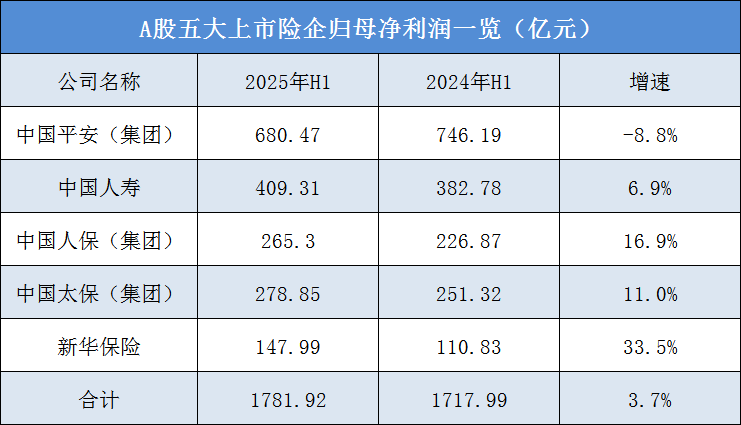
人身险预定利率下调分红险产品“挑大梁”
Zhong Guo Zheng Quan Bao· 2025-09-02 00:01
Core Viewpoint - The recent adjustment of the predetermined interest rates for life insurance products has led to a shift in focus towards dividend insurance products, which are expected to become a key sales priority for insurance companies [1][3]. Group 1: Product Changes - As of September 1, the predetermined interest rates for life insurance products have been officially lowered, with ordinary insurance products now at 2.0% and dividend insurance products at 1.75% [2]. - The adjustment marks the first decrease since the establishment of a dynamic adjustment mechanism linking predetermined rates to market rates [2]. - Many insurance companies have already launched new products, although the overall number of new offerings remains limited [2]. Group 2: Market Dynamics - The reduction in predetermined interest rates is seen as both an opportunity and a challenge for dividend insurance products, potentially enhancing their competitive edge while also increasing sales difficulty [3]. - Companies are expected to strengthen their focus on dividend insurance sales as part of their strategies to improve efficiency and meet customer needs in a low-interest-rate environment [3][5]. Group 3: Training and Development - Insurance companies are enhancing training for sales personnel to better equip them for selling dividend insurance products, which are perceived as more complex and requiring higher expertise [4]. - The transition to new products has prompted companies to initiate or intensify training programs for agents to ensure they can effectively communicate product details to clients [4]. Group 4: Strategic Initiatives - Companies like China Life are forming specialized teams to drive the transformation towards dividend insurance sales, indicating a strategic shift in their product offerings [5]. - There is a recognition of the need for innovation in technology, risk management, and product development to meet the evolving demands of the market [5].

人身险预定利率下调 分红险产品“挑大梁”
Zhong Guo Zheng Quan Bao· 2025-09-01 23:20
Core Viewpoint - The recent adjustment of the predetermined interest rates for life insurance products has led to a significant shift in the insurance market, with a focus on dividend insurance products becoming more prominent due to their competitive advantages following the rate cuts [1][2][3]. Product Changes - As of September 1, the predetermined interest rates for ordinary insurance products have been reduced to 2.0%, and for dividend insurance products to 1.75%, marking the first adjustment since the dynamic adjustment mechanism was established [2][3]. - Many insurance companies have launched new products, but the overall number of new offerings remains limited [2][3]. Market Dynamics - The reduction in predetermined interest rates is expected to enhance the appeal of dividend insurance products, prompting insurance companies to shift their sales focus towards these products [3][4]. - The competitive landscape for dividend insurance may face short-term challenges, but the narrowing gap between dividend and traditional insurance rates could ultimately benefit the overall business structure and risk management [3][5]. Training and Development - Insurance companies are increasing training efforts for sales personnel to better understand and sell dividend insurance products, which are perceived as more complex compared to previous offerings [4][5]. - Companies are establishing specialized teams to facilitate the transition towards dividend insurance sales, indicating a strategic shift in their product offerings [5].

人身险预定利率今起下调!险企或主推这类产品
Zhong Guo Zheng Quan Bao· 2025-09-01 15:13
Core Viewpoint - The adjustment of the predetermined interest rates for insurance products has led to the discontinuation of several existing products, with a focus on launching new products, particularly dividend insurance, which is expected to become a key sales focus for insurance companies [1][4][5]. Group 1: Product Adjustments - As of September 1, the predetermined interest rates for life insurance products have been officially lowered, with ordinary insurance products now at 2.0% and dividend insurance at 1.75% [1][3]. - Many insurance companies are in the process of launching new products and training their sales personnel to adapt to the changes in interest rates [3][6]. Group 2: Market Response - There has been a noticeable increase in customer inquiries and purchases leading up to the interest rate adjustment, particularly on August 31 [3]. - The overall number of new products being launched remains limited, but several major insurance companies are actively introducing new offerings [3][6]. Group 3: Focus on Dividend Insurance - Industry experts indicate that dividend insurance products will gain a competitive edge following the interest rate adjustments, making them a focal point for sales strategies [4][5]. - The adjustment presents both opportunities and challenges for dividend insurance, as it may initially reduce competitiveness but ultimately enhance its relative advantages [5][6]. Group 4: Strategic Initiatives - Insurance companies are preparing for the new product landscape by enhancing their product reserves, system infrastructure, and training for sales personnel [6]. - Companies like China Life and Ping An are emphasizing the importance of dividend insurance in their strategies to improve efficiency and meet customer needs in a low-interest-rate environment [6].
科技赛道秀“肌肉”,头部险企还将打造这些硬实力
Bei Jing Shang Bao· 2025-09-01 14:43
Core Insights - The insurance industry is undergoing a significant transformation driven by technological innovations, particularly AI, with companies like DeepSeek leading the charge [1] - Major insurance firms are accelerating their strategic deployment in the AI sector, indicating a new phase in digital transformation and intelligent upgrades [1][2] - AI is expected to reshape the entire insurance value chain, enhancing operational efficiency and user experience while leading to market differentiation among firms [1][4] Group 1: Company Developments - China Ping An reported having a vast database with 30 trillion bytes of data and over 650 applications utilizing its AI model, with 818 million calls made in the first half of 2025 [2] - China Life is focusing on deep integration of financial technology and enhancing its digital service matrix through its life insurance app [2] - China Pacific Insurance is implementing AI solutions across sales, operations, and risk control, aiming to establish 2,700 digital equivalent labor units by the end of the year [2][6] Group 2: Industry Trends - The insurance sector is increasingly adopting digital finance and technology finance, with companies like China Life and China Insurance emphasizing their commitment to AI and digital transformation [3][7] - The competition in the insurance industry is intensifying, prompting firms to accelerate their technological layouts to meet customer demands for personalized services [3][4] - The emergence of AI is seen as a critical factor in optimizing insurance processes and enhancing production efficiency, marking a pivotal shift in the industry [2][3] Group 3: Strategic Directions - China Life has outlined three core development directions for the second half of the year, including enhancing technological capabilities [6] - China Ping An's AI strategy, termed "Five Intelligence," aims for comprehensive AI integration across its value chain [6] - China Pacific Insurance plans to leverage AI to reshape processes and upgrade models across various operational aspects [6][7] Group 4: Challenges and Solutions - The insurance industry faces challenges such as a shortage of tech-savvy talent, data security concerns, and the need for cultural transformation [7][8] - Experts suggest that companies should focus on talent development, data protection, and strategic technology investments to navigate these challenges effectively [8]
中报业绩表现强势,看好板块后续弹性空间
Changjiang Securities· 2025-09-01 14:42
Investment Rating - The report maintains a "Positive" investment rating for the investment banking and brokerage industry [7] Core Insights - The report highlights strong mid-year performance from 42 listed brokerages, with total revenue and net profit attributable to shareholders reaching CNY 251.89 billion and CNY 103.61 billion, respectively, reflecting year-on-year increases of 11.3% and 65.6% [2][4] - The insurance sector's mid-year disclosures confirm trends of deposit migration, increased equity allocation, and improved new policy costs, enhancing the certainty of long-term ROE improvement and potential valuation recovery [4] - Recommendations include focusing on high-performing stocks such as New China Life, China Life, Hong Kong Exchanges and Clearing, CITIC Securities, Eastmoney, Tonghuashun, and Jiufang Zhitu Holdings based on performance elasticity and valuation levels [4] Summary by Sections Industry Overview - The non-bank financial index decreased by 0.8% this week, underperforming the CSI 300 by 3.5%, ranking 23rd out of 31 sectors [5] - Year-to-date, the non-bank financial index has increased by 13.5%, with a relative underperformance of 0.8% against the CSI 300, ranking 19th out of 31 sectors [5] Market Performance - Market activity has shown signs of recovery, with average daily trading volume across both exchanges reaching CNY 298.31 billion, up 15.29% week-on-week [5][36] - The margin financing balance increased to CNY 2.24 trillion, reflecting a week-on-week rise of 4.52% [5][42] Brokerage Data Tracking - The report notes a recovery in trading activity, with the average daily trading volume exceeding the 2024 average, indicating a gradual improvement in brokerage business profitability [36] - The report emphasizes the importance of monitoring the stock and bond market fluctuations for brokerage self-operated income [40] Insurance Sector Insights - The insurance industry reported a cumulative premium income of CNY 420.85 billion in July 2025, marking a year-on-year increase of 6.75% [20][21] - The total assets of the insurance sector reached CNY 39.59 trillion, with a month-on-month increase of 0.95% [25][26] Investment Banking Activity - In July 2025, equity financing decreased significantly to CNY 53.38 billion, down 90.2% month-on-month, while bond financing totaled CNY 783 billion, down 11.3% [44] - The report anticipates an increase in stock underwriting scale due to the advancement of refinancing regulations [47] Asset Management and Derivatives - The report indicates a decline in new issuance of collective asset management products, with July 2025 issuance at 5.489 billion units, down 43.6% [49] - The futures market saw a significant increase in trading volume, with July 2025 transactions reaching CNY 62.23 trillion, up 34.02% [54]


中国人寿(601628):2025年中报点评:银保驱动增长,增配权益资产
Changjiang Securities· 2025-09-01 14:42
Investment Rating - The report maintains a "Buy" rating for China Life Insurance [2][8]. Core Views - The report suggests that with the increase in equity allocation, the long-term interest spread in the industry is expected to improve. The demand on the liability side remains robust, and the market is concentrated, indicating a positive outlook for the industry's long-term profitability and valuation re-evaluation. In the short term, the asset side presents the main challenges for the industry. As a pure life insurance company, China Life is positioned in the first tier of the industry in terms of sensitivity and elasticity, making it a quality beta asset for allocation. The current valuation stands at 0.78 times PEV [2][12]. Summary by Sections Financial Performance - In the first half of 2025, China Life achieved a net profit attributable to shareholders of 40.93 billion yuan, representing a year-on-year increase of 6.9%. The comparable new business value was 28.55 billion yuan, up 20.3% year-on-year [6][12]. Investment Strategy - The company has increased its equity allocation by 1.12 percentage points to 8.7% and its fund allocation by 0.28 percentage points to 4.92%, reflecting a commitment to long-term capital market responsibilities [12]. New Business Growth - The new business value for the first half of 2025 was 28.55 billion yuan, with a year-on-year growth of 20.3%. The improvement in value rate was a significant factor, with new single premiums slightly increasing by 0.6% year-on-year [12]. Individual Insurance and Bancassurance - The individual insurance long-term new single premium was 64.25 billion yuan, down 24.2% year-on-year, primarily due to the transformation of dividend insurance. The bancassurance long-term new single premium reached 35.67 billion yuan, a strong increase of 112.4% year-on-year, indicating a significant trend of "deposit migration" [12].