GWMOTOR(601633)

Search documents
新春走基层|政策暖风频吹,新能源车加速“下沉”
2 1 Shi Ji Jing Ji Bao Dao· 2026-02-16 07:35
Core Insights - The Chinese automotive market is experiencing a surge in consumer interest, particularly in the context of the Spring Festival and the implementation of new national subsidy policies for electric vehicles [1][5][9] - There is a notable shift in the location of car dealerships, with brands moving into shopping malls to enhance visibility and compete more effectively for consumer attention [3][4] - The acceptance of electric vehicles (EVs) is increasing in rural areas, driven by government initiatives and the growing availability of charging infrastructure [7][8][9] Group 1: Market Trends - The implementation of the new national subsidy policy has led to increased foot traffic and sales in car dealerships, especially for models priced between 60,000 to 100,000 yuan [1] - The competition among automotive brands is intensifying, with companies like Li Auto and BYD adopting innovative marketing strategies, including the use of social media to reach younger consumers [3][4] - The demand for electric vehicles is rising, particularly in lower-tier cities, as evidenced by the increasing presence of brands like BYD and Wuling in these markets [7][9] Group 2: Consumer Behavior - Price remains a decisive factor for consumers in third and fourth-tier cities, with dealerships focusing on highlighting discounts and pricing to attract buyers [3][5] - There is a growing trend of consumers upgrading to electric vehicles, with many expressing interest in models that offer spacious interiors and advanced features [5][8] - Concerns about charging infrastructure persist, with consumers indicating a preference for electric vehicles if charging facilities are adequate; otherwise, they may opt for hybrid models [8] Group 3: Infrastructure Development - The construction of charging facilities is accelerating, with projections indicating that by the end of 2025, there will be approximately 20.09 million charging points in China, marking a 49.7% year-on-year increase [8][9] - The government of Henan province plans to build 29,000 new public charging stations by 2025, significantly exceeding its annual target and addressing range anxiety for EV owners [9] - The market for electric vehicles in rural areas is expected to grow substantially, with predictions indicating that by 2030, the number of vehicles per thousand people in rural regions could reach 160, resulting in a market size of approximately 500 billion yuan [7][9]




春晚合作公司名单来了
新华网财经· 2026-02-16 06:53
Group 1 - The 2026 Spring Festival Gala has announced over 20 partners across various sectors, including smart mobility, artificial intelligence, and liquor [1] - Notable partners in the smart ecosystem include companies like ZhiMi Group and Huawei's Mate 80 series as strategic partners [2] - In the smart mobility sector, Jianghuai Automobile and Great Wall Motors are highlighted as key partners, with Jianghuai collaborating with Huawei on a flagship vehicle [2] Group 2 - The artificial intelligence and robotics sector features partnerships with companies such as Volcano Engine and Yushu Technology, emphasizing a strong technological presence at the gala [3] - Eight listed companies are among the partners, including Wuliangye, Yanghe, and Great Wall Motors, indicating significant market representation [3] - The gala's collaboration with ByteDance's Volcano Engine and the large model company Doubao showcases the integration of advanced AI technologies [3]






官宣!2026年央视春晚节目单发布,合作伙伴超20家知名公司
第一财经· 2026-02-16 06:49
Core Viewpoint - The 2026 Spring Festival Gala, organized by the China Central Television (CCTV), will feature a diverse lineup of performances and collaborations with over 20 partners from various industries, emphasizing technological innovation and cultural celebration [3][26]. Group 1: Event Details - The gala will be broadcast live on multiple platforms, including 10 television channels and 9 radio frequencies, as well as 6 new media platforms, reaching a global audience through 3500 media outlets in over 200 countries [15]. - The event is scheduled for February 16, 2026, at 8 PM [4][15]. Group 2: Host and Performance Lineup - The main hosts for the Beijing venue include Ren Luyu, Sa Beining, and others, with regional hosts for various sub-venues [16]. - The performance lineup includes a variety of acts such as songs, dances, and comedy skits, featuring well-known artists and groups from different regions [5][8][12]. Group 3: Partnerships and Collaborations - The gala has partnered with over 20 companies across sectors like artificial intelligence, smart transportation, and traditional industries, including notable brands such as Wuliangye and Great Wall Motors [26]. - Among the partners, 8 are publicly listed companies, indicating a significant intersection between the event and the stock market [26].

春晚合作公司名单曝光,覆盖智能出行、人工智能机器人、白酒等领域
Ge Long Hui· 2026-02-16 05:00
Group 1 - The core viewpoint of the article highlights that the 2026 Spring Festival Gala has announced over 20 partners across various sectors, including smart mobility, artificial intelligence, and liquor [1] - In the robotics and AI sector, notable partners include Yushu Technology, Volcano Engine, Galaxy General, Songyan Power, Magic Atom, and Zhuimi Technology [1] - ByteDance's AI company, Volcano Engine, and its large model Doubao have also partnered with the 2026 Spring Festival Gala [1] Group 2 - Among the announced partners, eight are publicly listed companies, including Wuliangye, Yanghe, Gujing Gongjiu, Great Wall Motors, JAC Motors, Kuaishou-W, Bilibili-W, and Miniso [1] - The listed companies consist of three liquor firms, two automotive companies, two video platforms, and one trendy toy company [1]


1月轻卡市场同比增8% 福田摘冠 江淮前二 远程/东风领涨
第一商用车网· 2026-02-16 04:05
Core Viewpoint - In January 2026, China's commercial vehicle industry experienced a 23% year-on-year growth in overall sales, with the truck market growing by 28%, indicating a strong start to the year [1][3]. Group 1: Truck Market Performance - The truck market sold a total of 323,500 units in January 2026, showing a 10% decrease from December 2025 but a 28% increase year-on-year [3]. - The light truck market, which includes light trucks, small trucks, and pickups, sold 159,500 units in January 2026, reflecting a 20% month-on-month decline and an 8% year-on-year growth [3][5]. - The light truck market's 8% year-on-year growth is significantly lower than the overall truck market's growth, making it the only segment to underperform compared to the market average [5]. Group 2: Historical Context and Market Dynamics - The January 2026 light truck sales of 159,500 units rank as the fourth highest in the past decade, with the average sales for January typically around this figure [5]. - The performance in January 2026 is considered moderate, attributed to the absence of the Spring Festival impact that affected January 2025 sales [5][16]. Group 3: Company Performance and Market Share - Five companies sold over 10,000 light trucks in January 2026, with Foton leading at 36,300 units, followed by JAC, Dongfeng, Great Wall, and Jiangling [8][9]. - The top ten companies in the light truck market accounted for 88.4% of total sales, with the top five companies alone holding 62.7% of the market share [8]. - Among the top ten companies, eight experienced sales growth compared to the previous year, with Dongfeng and Farizon showing significant increases of 61% and 91%, respectively [12][14]. Group 4: Market Outlook - The light truck market in 2026 is expected to be competitive, with various companies vying for market share and performance improvements [16].



春晚,合作上市公司曝光!科技新星登场
Xin Lang Cai Jing· 2026-02-16 00:24
Core Insights - The 2026 Spring Festival Gala will feature a diverse range of corporate partners, reflecting the evolution of China's commercial landscape over the past four decades [1][8] - The event serves as a significant platform for brand recognition and influence, with a history of successful partnerships, particularly in the tech and consumer goods sectors [3][8] Company Partnerships - Eight listed companies have been confirmed as partners for the 2026 Spring Festival Gala, including three liquor companies, two automotive companies, two video platforms, and one toy company [3][8] - Wuliangye will be the exclusive interactive partner for the "Harmony and Goodness" segment, marking its fourth appearance at the gala [5][10] - Yanghe Dream Blue M6+ will serve as the exclusive timekeeping partner for the seventh consecutive year, while Gujing Gongjiu celebrates its 11th year of partnership [5][10] Automotive Collaborations - Huawei and JAC Motors have launched the Zun Jie S800, which will be the flagship partner for smart travel at the gala [4][9] - Great Wall Motors will again be the designated vehicle for new media coverage of the gala, featuring its flagship models [4][9] Technological Innovations - The 2026 gala will emphasize technological advancements, with partnerships from companies like Yushutech, Volcano Engine, and Galaxy General, focusing on robotics and AI [6][11] - Volcano Engine will engage in program production and online interaction, while Yushutech will showcase cutting-edge robotics technology [6][11] Cultural and Emotional Engagement - MINISO has partnered with the gala to launch a series of cultural toys, reflecting a shift from material to cultural consumption [6][11] - The collaboration aims to enhance emotional engagement and cultural relevance in consumer products [6][11]

说什么,也要让车开进春晚
汽车商业评论· 2026-02-15 23:04
Core Viewpoint - The article discusses the evolving role of the automotive industry in the context of the CCTV Spring Festival Gala, highlighting how automotive brands have increasingly integrated into this national event as a marketing platform over the years [4][19]. Group 1: Historical Context and Evolution - The CCTV Spring Festival Gala has been a significant platform for advertising since its inception in 1984, with the first automotive advertisement appearing in 2004 [4][13]. - Initially, the automotive industry was not a major sponsor of the gala, with the focus shifting from household appliances to internet companies in the 2010s [13][19]. - The first major automotive sponsorship occurred in 2014, marking a turning point for automotive brands in leveraging the gala for marketing [15][19]. Group 2: Current Automotive Brands and Their Strategies - In 2026, several automotive brands, including Jiangqi Group's high-end model Zun Jie S800, Geely's Lynk & Co 900, and Great Wall's Wei brand, are confirmed to participate in the gala, showcasing their flagship models [11][12]. - The article emphasizes that these brands represent the core strength of the Chinese automotive industry, with their participation symbolizing a significant leap in brand image and technology [11][12]. - The integration of automotive brands into the gala reflects a broader trend of showcasing "Chinese manufacturing" and technological advancements [19][26]. Group 3: Marketing Strategies and Audience Engagement - The article outlines various methods of automotive brand integration into the gala, including background branding, vehicle displays, and product placements in skits [21][22]. - The 2024 gala saw innovative marketing strategies, such as Xiaomi's car model being prominently displayed among guests, indicating a shift towards more creative advertising approaches [21][22]. - Experts suggest that the gala remains a valuable platform for automotive brands to build consensus and emotional connections with consumers, particularly during the family-oriented Lunar New Year celebrations [30][32].


崔东树:1月汽车出口走强带动厂家销量相对较好 新能源车走势平稳
智通财经网· 2026-02-15 03:59
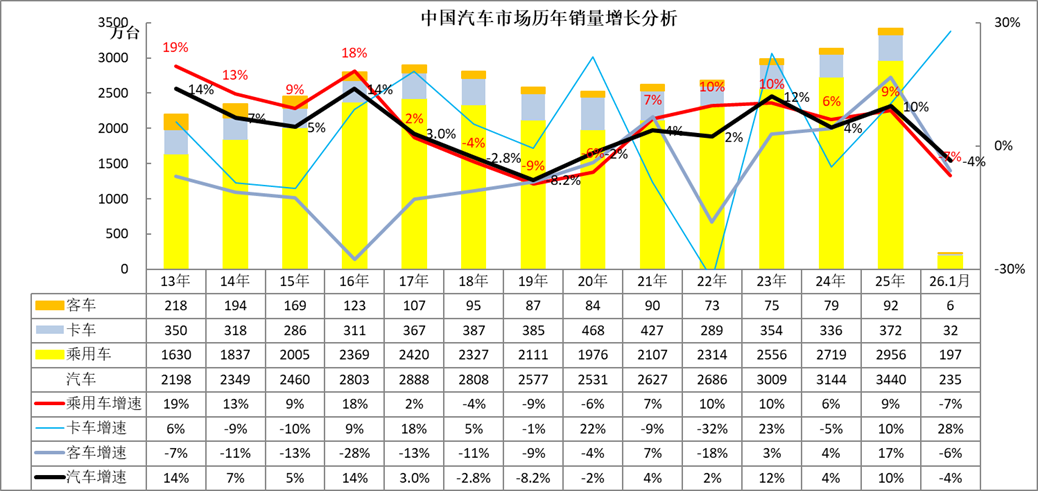
Group 1 - The automotive market in China is expected to maintain strong growth in 2025, driven by government policies promoting consumption, with significant recovery in both truck and bus markets [1] - In January 2026, the commercial vehicle market is anticipated to experience structural growth due to equipment upgrade subsidies, particularly in the electrification of logistics and transportation [1][4] - The overall automotive sales in 2025 are projected to reach 34.392 million units, with a cumulative growth rate of 9%, while January 2026 saw a decline of 4% year-on-year in total automotive sales [6][21] Group 2 - The differentiation between passenger and commercial vehicles has become more pronounced in recent years, with passenger vehicle consumption improving and commercial vehicle sales weakening [4][11] - In January 2026, the sales of new energy passenger vehicles totaled 870,000 units, reflecting a 2% year-on-year decline, influenced by policy adjustments and market pressures [21] - The competitive landscape among traditional fuel passenger vehicle manufacturers is shifting, with domestic brands gaining strength against joint ventures, particularly in the context of declining sales for traditional fuel vehicles [27] Group 3 - The truck market is showing robust growth, with January 2026 sales reaching 320,000 units, marking a 28% year-on-year increase, indicating a strong demand for logistics and transportation solutions [34][36] - The bus market is expected to remain stable, with head manufacturers performing well, primarily driven by demand for light and micro commercial vehicles [30][32] - The overall automotive industry is experiencing significant differentiation in growth rates among manufacturers, with private enterprises increasingly replacing state-owned enterprises as industry leaders [11][18]




车企“比惨大会”召开!全是特朗普惹的祸?
电动车公社· 2026-02-14 16:05
Core Insights - The global automotive landscape is undergoing significant changes due to the rise of new energy vehicles, with Chinese automakers emerging as top competitors while traditional giants face strategic transformation challenges [1][2]. Group 1: Tesla - Tesla's 2025 financial report shows total revenue of $94.827 billion, a 3% year-over-year decline, marking the first revenue drop in its history [7]. - The company delivered 1.636 million vehicles in 2025, an 8.6% decrease from 2024, leading to a 10% drop in automotive revenue, which constitutes over 70% of total income [9]. - Despite record revenue from energy generation and storage, Tesla's overall revenue decline remains unmitigated [10]. - R&D investment surged by 41% to $6.411 billion, focusing on autonomous driving and humanoid robots, indicating a shift in strategic priorities [14]. Group 2: General Motors - General Motors reported 2025 revenue of $185 billion, down 1.3%, with net profit falling 55.1% to $2.697 billion due to a $7.9 billion charge for strategic restructuring [17][19]. - The company maintains strong cash flow of $10.6 billion despite the profit drop, attributed to one-time restructuring costs and market adjustments [20]. - GM's outlook for 2026 is optimistic, expecting net profit between $10.3 billion and $11.7 billion, supported by a solid market position in the U.S. and new product launches in China [24]. Group 3: Ford - Ford's 2025 revenue reached $187.3 billion, a 1% increase, but it reported a net loss of $8.2 billion, primarily due to a $19.5 billion charge related to electric vehicle restructuring [26][30]. - The company faces challenges similar to GM, with traditional vehicles performing well while electric vehicle strategies require adjustment [32]. Group 4: Hyundai - Hyundai's 2025 revenue was 186.3 trillion KRW (approximately 888.7 billion RMB), a 6.3% increase, but operating profit fell 19.5% to 11.47 trillion KRW [34]. - The decline in profit is largely due to increased tariffs on exports to the U.S., despite a reduction in tariffs effective November 2025 [38]. - The company is also navigating the transition to electric vehicles, which requires adjustments to its product lineup [39]. Group 5: Volvo - Volvo's 2025 revenue was 357.3 billion SEK (approximately 278.8 billion RMB), down 11%, with operating profit plummeting 99% [42]. - The decline is attributed to tariffs, weak demand, and price pressures, prompting a cost-cutting plan involving layoffs [45]. - Despite challenges, Volvo's electric vehicle offerings are performing well, particularly in the Chinese market [48]. Group 6: Great Wall Motors - Great Wall Motors reported 2025 revenue of 222.79 billion RMB, a 10.19% increase, but net profit fell 21.71% to 9.912 billion RMB [52]. - The company achieved record sales of 1.3237 million vehicles, indicating strong growth despite profit declines due to increased investments in new technologies and marketing [54]. - The focus on electric vehicle development, particularly through its premium brand WEY, is expected to enhance growth potential [56]. Group 7: GAC Group - GAC Group's 2025 sales fell 14.06% to 1.72 million vehicles, with a projected loss of 8-9 billion RMB [58]. - The decline is linked to poor performance in traditional fuel vehicles and slower growth in its electric vehicle segment [59]. - The company is pursuing deep collaborations with local suppliers to accelerate its electrification strategy [60]. Group 8: Toyota - Toyota's revenue for the first three quarters of the 2026 fiscal year was 38.09 trillion JPY (approximately 1.72 trillion RMB), a 6.8% increase, but net profit dropped 26.1% to 3.03 trillion JPY [63]. - The profit decline is primarily due to the impact of U.S. tariff policies, despite a 10.5% profit increase in the Chinese market [66][68]. - Toyota is implementing a company-wide plan to reduce its breakeven point and improve operational efficiency [71].




【月度排名】2026年1月厂商销量排名快报
乘联分会· 2026-02-14 08:39
Core Viewpoint - The domestic narrow passenger car market in China experienced a retail sales decline of 13.9% year-on-year in January 2026, with sales reaching 1.544 million units, attributed to the end of the 12-year new energy vehicle purchase tax exemption policy, leading to a temporary dip in demand [2][4]. Sales Data Summary Wholesale Sales Rankings (January 2026) - Geely Automobile led with 270,167 units sold, a 1.3% increase, capturing 13.7% market share - BYD Automobile followed with 205,518 units, down 30.7%, holding 10.4% market share - Chery Automobile sold 193,969 units, down 12.0%, with a 9.8% market share - Volkswagen sold 128,001 units, down 1.7%, with a 6.5% market share - SAIC Passenger Vehicle sales increased by 53.6% to 77,421 units, capturing 3.9% market share [6]. Retail Sales Rankings (January 2026) - Geely Automobile again led with 209,661 units sold, down 12.6%, holding 13.6% market share - Volkswagen sold 132,300 units, down 3.5%, with an 8.6% market share - BYD's retail sales dropped significantly by 53.0% to 94,176 units, capturing 6.1% market share - SAIC Volkswagen sold 89,600 units, down 9.3%, with a 5.8% market share - Changan Automobile's sales decreased by 33.5% to 81,074 units, holding 5.2% market share [7]. New Energy Vehicle (NEV) Wholesale Sales Rankings (January 2026) - BYD led NEV sales with 205,518 units, down 30.7%, capturing 23.8% market share - Geely followed with 124,252 units, up 2.6%, holding 14.4% market share - Tesla China sold 69,129 units, up 9.3%, with an 8.0% market share - Chery sold 46,802 units, down 14.9%, with a 5.4% market share - SAIC Passenger Vehicle saw a significant increase of 576.9% to 28,179 units, capturing 3.3% market share [9]. New Energy Vehicle (NEV) Retail Sales Rankings (January 2026) - BYD again led with 94,176 units sold, down 53.0%, holding 15.8% market share - Geely sold 92,135 units, down 21.6%, with a 15.5% market share - Hongmeng Zhixing saw a significant increase of 65.5% to 57,915 units, capturing 9.7% market share - SAIC's sales increased by 83.3% to 40,016 units, holding 6.7% market share - Xiaomi Automobile sold 39,002 units, up 70.3%, with a 6.5% market share [10].