SRCB(601825)

Search documents
涓婃捣鍐滃晢琛屾嫆2涓囨灇纭甯佸厬鎹 閾惰屽洖搴斿㈡埛鏃犳硶璇存槑纭甯佹潵婧
Zhong Guo Jing Ji Wang· 2025-07-08 08:09
Group 1 - The article discusses the recent developments in the industry, highlighting a significant increase in operational efficiency and productivity [1][6] - It mentions that the company has achieved a notable milestone with a revenue of 140 million, indicating a strong performance in the current market [1][4] - The report outlines the strategic initiatives taken by the company to enhance its operational framework and improve service delivery [1][7] Group 2 - The article emphasizes the importance of technological advancements in driving growth within the industry, particularly in the context of operational processes [3][6] - It notes that the company is focusing on sustainable practices and innovation to maintain its competitive edge in the market [4][7] - The report also highlights the company's commitment to improving customer satisfaction through enhanced service offerings and operational improvements [6][7]


上海农商行拒2万枚硬币兑换,银行回应客户无法说明硬币来源
Bei Ke Cai Jing· 2025-07-07 13:05
Core Viewpoint - A customer, Mr. Lu, faced refusal from Shanghai Rural Commercial Bank to exchange over 20,000 one-jiao coins, weighing more than 140 pounds, which he claims are damaged and should be exchanged under the People's Bank of China's regulations on damaged currency [1][2][4]. Group 1: Customer's Situation - Mr. Lu brought a total of over 20,000 one-jiao coins, amounting to over 2,000 yuan, to the bank for exchange [2]. - The coins were sourced from a waste incineration power plant and were used for payment in his business of recycling tobacco and alcohol gifts [4]. - He has previously exchanged similar coins at over ten banks without issue, but Shanghai Rural Commercial Bank repeatedly refused [4]. Group 2: Bank's Justification - The bank refused the exchange due to concerns about the source of such a large quantity of damaged currency, citing anti-money laundering regulations that require verification of funds' origins [5]. - Mr. Lu provided a document claiming the coins' source, but the bank found it insufficient as the company name was omitted, preventing proper verification [5]. - The bank's staff indicated that the varying condition of the coins and their large quantity made it impractical for local branches to process the exchange [9]. Group 3: Legal and Regulatory Context - According to the People's Bank of China's regulations, financial institutions must exchange damaged currency if it meets certain criteria, including being recognizable and having at least 75% of the original note [4]. - Mr. Lu has filed a complaint with the People's Bank of China and is considering legal action to resolve the issue [9].

上海农商行拒2万枚硬币兑换,警方验证后仍无果
Guan Cha Zhe Wang· 2025-07-07 10:18
截图来自陆先生社交媒体 7月3日当天,银行工作人员以"硬币来源可疑"为由报警,警方到场核实后确认硬币无假币嫌疑且来源合法,但银行仍拒绝兑换,并要求陆先生签署"自愿放 弃兑换"声明。陆先生表示:"警方已证明合法性,银行仍拒收,这让我难以理解。" 7月3日,上海市民陆先生携带约140斤(约2万枚)1角硬币至上海农商银行总行营业部办理兑换业务时,遭遇工作人员拒绝。尽管警方介入验证硬币来源合 法性,但银行仍以"清点困难""系统故障"等理由未完成受理。 据陆先生陈述,其从事烟酒礼品回收生意,此次携带的硬币系某生活垃圾焚烧发电厂通过焚烧炉灰筛选所得,用于支付货款。自2024年起,他已陆续向十余 家银行兑换硬币,多数机构正常受理,但上海农商银行多次拒收。 截图来自媒体报道 银行业内人士指出,根据《现金管理暂行条例实施细则》,金融机构可与储户协商清点时间,但不得拒绝受理。此外,银行未提供系统故障的具体证明,且 现金业务系统升级属内部管理范畴,不应成为拒收理由。 据悉,硬币清点依赖人工或专用设备,而基层网点硬币清点机的覆盖率有限。老式设备仅支持整卷硬币清点,散币需人工分拣,效率较低。以1角硬币为 例,清点2万枚需2-3名员工工 ...

投资面再讨论银行周期属性:银行股:从“顺周期”到“弱周期”
ZHONGTAI SECURITIES· 2025-07-06 12:39
Investment Rating - The report maintains an "Overweight" rating for the banking sector [2] Core Insights - The banking sector is transitioning from a "pro-cyclical" model to a "weak cyclical" model, indicating a shift in operational dynamics [2][4] - The report emphasizes the stability of bank dividend yields, which are expected to remain attractive even as risk-free interest rates decline [2][4] - The influx of non-freely circulating funds, such as from state-owned enterprises and insurance capital, is expected to provide a stable source of investment in bank stocks [2][4] Summary by Sections From the Perspective of Risk-Free Interest Rates - Bank dividend yields are characterized by strong certainty and sustainability, with interest margins expected to decline more slowly than risk-free rates [5][12] - The correlation between banks and fiscal policies has strengthened, providing a safety net for core assets [12] - If risk-free interest rates decline, the attractiveness of stable bank dividends will increase, especially in a context of economic weak recovery and asset scarcity [8][18] From the Perspective of Funding Allocation to Bank Stocks - Major funding sources for bank stocks include non-freely circulating funds from fiscal authorities, state-owned enterprises, and insurance capital [5][12] - Non-freely circulating market capitalization accounts for approximately 70% of the banking sector, providing a stabilizing effect [5][12] - Insurance capital is projected to significantly increase its allocation to bank stocks, with an estimated annual inflow exceeding 350 billion [5][12] Investment Recommendations - The report continues to recommend the banking sector, particularly focusing on banks with regional advantages and strong dividend yields [4][12] - Specific recommendations include regional banks in areas like Jiangsu, Shanghai, and Chengdu, as well as major banks such as Agricultural Bank of China, China Construction Bank, and Industrial and Commercial Bank of China [4][12]






银行业周报(20250630-20250706):CIPS规则修订,为何改?改了什么?-20250706
Huachuang Securities· 2025-07-06 12:16
Investment Rating - The report maintains a "Recommended" investment rating for the banking sector, expecting the sector index to outperform the benchmark index by more than 5% in the next 3-6 months [24]. Core Insights - The report highlights the recent revisions to the CIPS (Cross-border Interbank Payment System) rules, which aim to enhance the management of participants and adapt to the growing cross-border e-commerce trade, projected to reach approximately 2.71 trillion yuan in 2024, a 14% year-on-year increase [3][4]. - The CIPS system processed 8.2169 million transactions amounting to 175.49 trillion yuan in 2024, reflecting a significant year-on-year growth of 42.60% [3]. - The report emphasizes the flexibility introduced in the new CIPS rules, allowing financial market infrastructure participants to open CIPS accounts based on business needs rather than strict management requirements [4]. Summary by Sections CIPS Overview - CIPS is a clearing system for cross-border payments in RMB, distinct from SWIFT's messaging system, and has seen a substantial increase in participation, with 174 direct participants and 1,509 indirect participants across 120 countries [2][3]. Recent Developments - The new rules include relaxed entry conditions for system participants, allowing for a more flexible approach to participant management [4]. - The rules specify that foreign direct participants must select domestic direct participants as fund custodians, as foreign banks lack CNAPS accounts [4]. Risk Management Enhancements - The updated regulations detail business processing and risk management requirements, mandating that participants establish robust risk management frameworks and adhere to international anti-money laundering standards [4]. Market Performance - The banking sector index rose by 3.77% during the reporting period, outperforming the CSI 300 index by 2.23 percentage points [8]. - The report suggests a focus on banks with high dividend yields and strong asset quality, recommending major state-owned banks and select regional banks for investment [9]. Company Forecasts - Key banks such as Ningbo Bank, Jiangsu Bank, and China Merchants Bank are highlighted with positive earnings forecasts and investment ratings, indicating strong potential for returns [10].


本周聚焦:5月重点省市信贷投放情况如何?
GOLDEN SUN SECURITIES· 2025-07-06 09:34
Investment Rating - The report indicates a positive outlook for the banking sector, suggesting that certain stocks may benefit from policy catalysts and cyclical recovery [3]. Core Viewpoints - The report highlights that while tariff policies may cause short-term impacts on exports, long-term domestic policies aimed at stabilizing the real estate market, promoting consumption, and enhancing social welfare are expected to support economic growth [3]. - The banking sector is anticipated to benefit from these policies, with specific banks such as Ningbo Bank, Postal Savings Bank, China Merchants Bank, and Changshu Bank being recommended for investment [3]. - The report also emphasizes the potential for continued dividends from banks like Shanghai Bank, China Merchants Bank, Jiangsu Bank, and Chongqing Bank, which are showing positive fundamental changes [3]. Summary by Sections Credit Growth - As of the end of May 2025, the overall loan growth rate in China was 6.6%, with household and corporate loans growing at 3.0% and 8.5% respectively [1]. - Provinces such as Sichuan, Jiangsu, and Anhui led in credit growth, with growth rates exceeding 9% [1][2]. - Corporate loans in Sichuan, Jiangsu, and Shandong showed impressive growth rates of 13.8%, 13.6%, and 13.4% respectively [2]. Key Data Tracking - The average daily trading volume in the stock market was 14,415.38 billion yuan, a decrease of 453.04 billion yuan from the previous week [4]. - The balance of margin financing and securities lending increased by 1.12% to 1.85 trillion yuan [5]. - The issuance of non-monetary funds decreased significantly, with a total of 53.28 billion yuan issued this week, down 273.46 billion yuan from the previous week [5]. Interest Rate Market Tracking - The issuance scale of interbank certificates of deposit was 2,435.10 billion yuan, a decrease of 4,828.40 billion yuan from the previous week [6]. - The average interest rate for interbank certificates of deposit was 1.62%, down 2 basis points from the previous week [10]. - The average yield on 10-year government bonds remained stable at 1.64% [10]. Sector Performance - The banking sector's performance is closely monitored, with specific stocks showing varying degrees of growth and decline [30]. - The report includes detailed charts tracking the performance of various financial stocks and their respective movements [30][36].



★A股主要股指"含科量"提升 更有效表征企业转型升级
Shang Hai Zheng Quan Bao· 2025-07-03 01:56
Group 1 - The core viewpoint of the news is the recent adjustments in index sample stocks by major exchanges, which aim to enhance the representation and investment value of indices, particularly in the context of increasing long-term capital inflows into the market [1][2] - The adjustments have led to a significant increase in the scale of ETFs linked to major indices, with an estimated total scale of approximately 1.7 trillion yuan by April 2025, representing a nearly fourfold increase since the end of 2021 [1] - The adjustments are expected to optimize index representation, trigger structural capital flows, and potentially have a positive impact on the stock prices of newly included stocks, especially those in mainstream indices [1][3] Group 2 - The recent index adjustments have increased the weight of technology stocks, reflecting a trend towards high-tech and advanced manufacturing in listed companies [2] - The adjustments in the CSI 300 index included an increase of 2 technology stocks, raising its weight by 0.18%, while the CSI 500 index saw an increase of 12 technology stocks, raising its weight by 1.82% [2] - The adjustments are likely to enhance the investment value of the North Exchange's indices, aligning with its focus on specialized and innovative companies [2][3] Group 3 - The selection criteria for index adjustments typically emphasize market capitalization and liquidity, with newly included stocks often experiencing increased buying pressure post-adjustment [3] - The recent adjustment of the CSI 300 index involved the removal of stocks from sectors like power equipment and construction materials, while adding stocks from banking, artificial intelligence, and military sectors, consistent with the current market style [3] - Historical data indicates that index adjustments lead to positive price impacts for included stocks, particularly in larger indices where passive trading can significantly influence stock prices [3][4] Group 4 - The adjustments by international index providers like MSCI are also noteworthy, with recent changes including the addition of five A-shares to the MSCI China Index, which saw immediate price increases for the newly included stocks [4]


一日惊魂之后,如何看待当前的银行股行情?
3 6 Ke· 2025-07-02 01:16
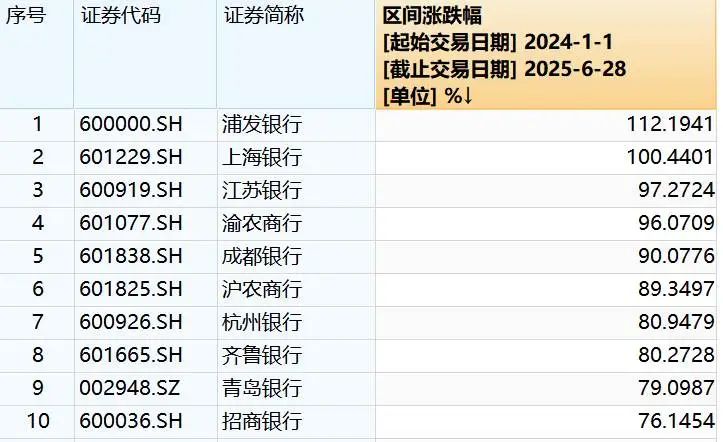
Core Viewpoint - The banking sector in A-shares has seen significant growth, with various banks experiencing substantial increases in stock prices despite a declining fundamental performance [1][3]. Group 1: Stock Performance - Since early 2025, shares of joint-stock banks, rural commercial banks, and city commercial banks have surged nearly 20%, leading the markets in Shanghai, Shenzhen, and Beijing [1]. - From 2024 onwards, specific banks like Shanghai Pudong Development Bank and Shanghai Bank have seen stock price increases exceeding 100%, while others like Jiangsu Bank and Chongqing Rural Commercial Bank have risen over 90% [1][2]. - Even the "Big Four" banks have shown over 50% growth, continuously reaching new historical highs [1]. Group 2: Fundamental Analysis - As of Q1 2025, the 42 listed banks in A-shares reported a year-on-year decline in revenue and net profit attributable to shareholders by 1.7% and 1.2%, respectively [3][5]. - The net interest margin for commercial banks hit a record low of 1.43% in Q1 2025, below the acceptable level of 1.8% as indicated by the central bank [5][3]. - The non-performing loan ratio stood at 1.51%, indicating ongoing challenges in the banking sector [5]. Group 3: Market Dynamics - The rally in bank stocks began around the end of 2023, driven by state-owned entities ("national team") actively stabilizing the market and encouraging other funds to invest in banks [9][12]. - By the end of 2024, the "national team" held over 1 trillion yuan in A-share ETFs, significantly increasing their market presence [9][12]. - The influx of funds into ETFs, particularly those weighted heavily in banking stocks, has contributed to the sector's performance [10][11]. Group 4: Future Outlook - Despite the current bullish trend, the fundamental decline in bank performance suggests that the upward trajectory may not be sustainable, leading to potential valuation corrections [15][16]. - The banking sector's price-to-book ratio (PB) is currently at 0.71, with some banks exceeding a PB of 1, indicating a potential for overvaluation [15][16]. - Future investment strategies may focus on selecting city commercial banks with growth potential and lower bad debt ratios, while avoiding poorly performing smaller banks [16][17].



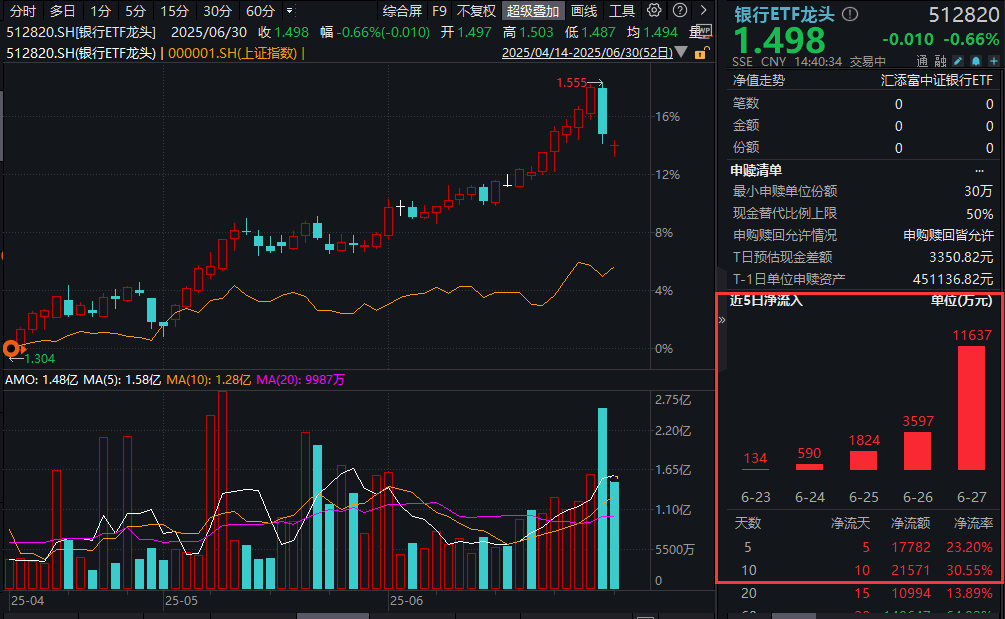
银行股进入密集分红期,银行ETF龙头(512820)获资金逢跌布局,单日净流入1.16亿元,融资客入场!中信证券:机构投资者仍有增配银行股空间
Sou Hu Cai Jing· 2025-06-30 07:15
Core Viewpoint - The banking ETF leader (512820) is experiencing a decline, but there is a notable trend of capital inflow during dips, with over 100 million yuan raised in the last trading day [1][5]. Group 1: Market Performance - As of June 30, 2025, the banking ETF leader (512820) fell by 0.66%, with the latest price at 1.498 yuan [1]. - The underlying index, the CSI Bank Index (399986), decreased by 0.39%, with mixed performance among constituent stocks [3]. - Notable gainers include Shanghai Pudong Development Bank (600000) up by 2.58%, and Industrial and Commercial Bank of China (601398) up by 1.33% [3]. Group 2: Financing and Investment Trends - There has been a strong entry of leveraged funds into the banking ETF leader, with net purchases for three consecutive days, peaking at 557.50 thousand yuan in a single day, leading to a record financing balance of 21.88 million yuan [2]. - Institutional investors are expected to increase their allocation to bank stocks, with a significant rise in the scale of passive funds and a steady increase in active fund holdings [5]. Group 3: Dividend Distribution - As of June 27, 2024, 26 banks have implemented cash dividend distributions, totaling 427.38 billion yuan, indicating a strong commitment to shareholder returns [5]. - Among 42 A-share listed banks, 39 have announced cash dividends exceeding the previous year, with an overall increase of 18.6 billion yuan in dividend payouts [5].



银行分红高峰已至!超半数A股上市银行实施年度分红
券商中国· 2025-06-29 23:21
Core Viewpoint - The peak period for cash dividend distribution among listed banks has arrived, with a significant increase in total cash dividends for 2024 compared to the previous year [1][2][3]. Summary by Sections Cash Dividend Distribution - As of June 27, 2024, 26 banks have implemented their cash dividend distribution plans, totaling 427.38 billion yuan [2][4]. - The total cash dividends for A-share listed banks are projected to reach 631.96 billion yuan in 2024, an increase of nearly 20 billion yuan from the previous year, representing a growth rate of 3.03% [3]. Dividend Increase - Nearly half of the A-share listed banks have advanced their dividend actions, with 14 banks completing both mid-term and year-end dividends by June 27 [4]. - A total of 39 out of 42 listed banks are expected to increase their cash dividends in 2024, with an overall increase of 18.6 billion yuan [5]. Major Contributors - The six major state-owned banks are the primary contributors to the dividend payouts, with total dividends exceeding 420 billion yuan [5]. - Industrial and Commercial Bank of China and China Construction Bank each have cash dividends exceeding 100 billion yuan, at 109.77 billion yuan and 100.75 billion yuan respectively [5][6]. Dividend Ratios - 14 banks have a cash dividend ratio exceeding 30% for 2024, with a slight decrease in the number of banks compared to 2023 [10]. - Notably, Ningbo Bank's cash dividend ratio increased by 6.3 percentage points to 21.91%, while Hu'nong Commercial Bank's ratio rose from 30.10% to 33.91% [10]. Mid-term Dividends - 23 A-share listed banks have implemented mid-term dividend plans, distributing a total of 257.71 billion yuan [8]. - Some banks, like Hu'nong Commercial Bank, have already proposed mid-term dividend plans for 2025 [9]. Challenges - Despite the increase in dividend frequency and ratios, the banking industry faces challenges such as narrowing interest margins and slowing revenue growth [12].