Bank of Chengdu(601838)

Search documents
成都银行(601838) - 成都银行股份有限公司2024年年度股东大会会议材料
2025-06-13 09:00
成都银行股份有限公司 2024 年年度股东大会会议材料 成都银行股份有限公司 2024年年度股东大会会议材料 (股票代码:601838) 2025 年 6 月 25 日 成都银行股份有限公司 2024 年年度股东大会会议材料 文件目录 | 会议议程………………………………………………… 3 | | | | --- | --- | --- | | 会议须知…………………………………………………….4 | | | | 关于《成都银行股份有限公司 年度董事会 1 2024 | 议案 | | | 工作报告》的议案………………………………………………7 | | | | 关于《成都银行股份有限公司 年度监事会工作报 2 | 议案 | 2024 | | 告》的议案……………………………………………………14 | | | | 议案3 关于成都银行股份有限公司2024年度财务决算报告及 | | | | 年度财务预算方案的议案………………………………22 | 2025 | | | 4 关于成都银行股份有限公司 年度利润分配预案的 | 议案 | 2024 | | 议案……………………………………………………………26 | | | ...
银行股持续走强 多只银行可转债触发强赎
Zheng Quan Ri Bao· 2025-06-12 16:40
Core Viewpoint - The recent announcements from Nanjing Bank and other banks regarding the triggering of conditional redemption clauses for convertible bonds indicate a significant trend in the banking sector, driven by the recovery of bank stock valuations in a low-interest-rate environment [1][2][3]. Group 1: Triggering of Redemption Clauses - Nanjing Bank announced that its "Nanjing Convertible Bond" has triggered the conditional redemption clause, with the stock price exceeding 130% of the conversion price for 15 out of 19 trading days [2]. - Other banks, including Hangzhou Bank and Suzhou Bank, have also triggered similar redemption clauses for their convertible bonds this year [2][3]. - The trend of triggering redemption clauses is attributed to the strong performance of bank stocks, which have been bolstered by a focus on absolute returns and low volatility strategies attracting long-term capital [3]. Group 2: Supply Constraints in the Market - The supply of new convertible bonds is expected to remain low due to stringent regulatory requirements and the financial health of banks, with many banks currently trading below their net asset value [5]. - The low willingness of bondholders to convert their bonds into equity further complicates the situation, making forced redemption a crucial mechanism for banks to enhance their core Tier 1 capital [4][5]. - As a result, the market for bank convertible bonds is likely to experience a slowdown in issuance and a reduction in overall scale, while existing bonds may attract significant investor interest due to their scarcity [5].




银行股持续上扬!可转债频现强赎,资本补充再提速
Bei Jing Shang Bao· 2025-06-12 13:30
Group 1 - The core viewpoint of the articles highlights the strong performance of bank stocks, with several banks experiencing significant price increases, driven by valuation recovery and policy support [1][3][4] - On June 12, 34 out of 42 listed bank stocks saw price increases, with Qingdao Bank leading at a 3.5% rise, followed by Xi'an Bank and Nanjing Bank at 3.08% and 2.63% respectively [3][4] - The net inflow of funds into the banking sector on June 12 was 988 million yuan, with Agricultural Bank receiving the highest net inflow of 178 million yuan [3] Group 2 - Since 2025, bank stocks have shown strong performance due to high dividend yields, macro policy support, and valuation recovery, despite a narrowing net interest margin [4][6] - The implementation of asymmetric interest rate cuts and effective liquidity management by the People's Bank of China has helped stabilize banks' interest margins [4][6] - The trend of strong redemption in convertible bonds is linked to rising bank stock prices, which enhances banks' capital strength and reduces interest expenses [5][6][7] Group 3 - Several banks, including Nanjing Bank and Hangzhou Bank, have triggered strong redemption clauses for their convertible bonds due to stock prices exceeding specified thresholds [5][6] - The conversion of convertible bonds into equity enhances banks' core tier one capital, providing a solid foundation for future growth and profitability [6][7] - The overall economic environment and policy encouragement are leading to increased investor interest in bank stocks, accelerating capital replenishment processes [7]



股权财政启航下银行业战略配置机遇
HUAXI Securities· 2025-06-12 00:20
Investment Rating - The report maintains a positive outlook on bank stocks, suggesting a "Buy" rating for the sector, with expectations that bank stocks will outperform the Shanghai Composite Index by 15% or more within the next six months [86]. Core Viewpoints - The current rally in bank stocks is primarily driven by state-owned capital, with significant investments from central financial institutions and a shift in foreign capital's stance towards net inflows [30][12]. - The report emphasizes the importance of state-owned capital in stabilizing the banking sector and preventing systemic risks, as well as the potential for bank stocks to provide stable returns for investors seeking income [34][39]. - The anticipated recovery in bank stock valuations is supported by improved asset quality due to policies aimed at stabilizing the housing market and addressing local government debt [60][62]. Summary by Sections 1. State-Owned Capital as the Engine of Bank Stock Rally - The rally began with state-owned banks leading the market, followed by a broader participation from various types of banks in 2024 and 2025 [10][31]. - In 2023, net inflows from ETFs, state-owned capital, and financing funds were significant, while foreign and insurance funds experienced net outflows [12][30]. 2. Restructuring Logic of Equity Finance - The report highlights that state-owned capital's investment in bank stocks serves to stabilize financial markets and provide a reliable income source amid declining land transfer revenues [42][44]. - Bank stocks are viewed as a safe investment due to their high dividend yields and stable performance, with many banks offering yields above 4% compared to lower yields on government bonds [42][44]. 3. Funding Landscape - Long-term Capital as a Stabilizing Force - The report anticipates that insurance and public funds will continue to support bank stocks, with a focus on long-term liquidity [47][51]. - Insurance funds are expected to increase their allocation to bank stocks due to regulatory changes and the need for higher returns in a low-interest-rate environment [51][54]. 4. Fundamental Improvements - Policies aimed at stabilizing the housing market and addressing local government debt are expected to enhance the asset quality of banks, leading to a revaluation of bank stocks [60][62]. - The introduction of new credit tools and technological advancements are seen as catalysts for further growth in the banking sector [60][66]. 5. Policy Environment - Interest Margins Expected to Rebound - The report notes that recent asymmetric interest rate cuts signal a turning point in the excessive benefits provided to the real economy, suggesting a potential rebound in interest margins [70][73]. - Regulatory oversight is focused on maintaining the health of the banking sector while balancing support for economic growth [73]. 6. Investment Recommendations - The report recommends focusing on bank stocks with high dividend yields and strong growth potential, particularly those with robust operational efficiency [80]. - Specific banks highlighted as beneficiaries include China Merchants Bank, Changshu Bank, Chengdu Bank, and Hangzhou Bank [80].


股权财政启航下银行业战略配置机遇:预期破冰,徐徐图之
HUAXI Securities· 2025-06-11 15:12
Investment Rating - The report maintains a positive outlook on bank stocks, recommending a "Buy" rating for the sector, with expectations that stock prices will outperform the Shanghai Composite Index by 15% or more within the next six months [86]. Core Insights - The current rally in bank stocks is primarily driven by state-owned capital, with significant investments from central financial institutions and a shift in foreign capital's stance towards net inflows [30][12]. - The report highlights a strategic opportunity for bank stocks due to their stable performance, high dividends, and the backing of national credit, positioning them as a key asset class in the market [44][42]. - The anticipated recovery in bank stock valuations is supported by policies aimed at stabilizing the real estate market and addressing local government debt, which are expected to enhance asset quality [60][62]. Summary by Sections 1. State-Owned Capital as the Engine of Bank Stock Rally - The bank stock market has seen a continuous rise since 2023, with state-owned banks leading the charge, followed by a broader rally in various bank types in 2024 and 2025 [10][30]. - In 2023, net inflows from ETFs, state-owned capital, and financing funds were significant, while foreign and insurance funds experienced net outflows [12][30]. 2. Restructuring Logic of Equity Finance - The report discusses how state-owned capital's investment in bank stocks serves to stabilize financial markets and provide a buffer against systemic risks, with bank stocks representing over 14% of the A-share market [36][34]. - The focus on equity finance is seen as a means to supplement declining land transfer revenue, with high dividend yields making bank stocks attractive compared to low-yield government bonds [42][44]. 3. Funding Landscape - Long-term Capital as a Stabilizing Force - The report anticipates that insurance and public funds will continue to support bank stocks, with a projected influx of over 1 trillion yuan from insurance capital into the A-share market [54][51]. - The shift in insurance capital from net outflows to inflows in early 2025 indicates a growing interest in bank stocks as a viable investment [52][54]. 4. Fundamental Improvements - Policies aimed at stabilizing the real estate market and addressing local government debt are expected to enhance the asset quality of banks, leading to a revaluation of bank stocks [60][62]. - Innovations in credit expansion and technology are anticipated to provide new growth opportunities for the banking sector [63][66]. 5. Policy Environment - Interest Margins Expected to Rebound - The report notes that recent asymmetric interest rate cuts signal a turning point in the excessive benefits provided to the real economy, suggesting a potential rebound in interest margins [70][73]. - Regulatory measures are being implemented to ensure the health of the banking sector while balancing support for economic growth [73][74]. 6. Investment Recommendations - The report suggests a focus on bank stocks with high dividend yields and strong operational efficiency, highlighting specific banks such as China Merchants Bank, Changshu Bank, Chengdu Bank, and Hangzhou Bank as favorable investment targets [80][76].
又见银行转债触发强赎!
券商中国· 2025-06-11 03:21
Core Viewpoint - The recent announcement by Nanjing Bank regarding the early redemption of its convertible bonds indicates a trend in the banking sector where multiple banks are triggering conditional redemption clauses due to rising stock prices [1][2][5]. Group 1: Convertible Bonds Redemption - Nanjing Bank's "Nan Yin Convertible Bonds" have triggered the conditional redemption clause, leading to the decision for early redemption [1][2]. - The stock price of Nanjing Bank has been above 130% of the conversion price for 15 out of 19 trading days, which meets the criteria for redemption [2]. - Other banks, including Suzhou Bank and Hangzhou Bank, have also seen their convertible bonds trigger similar redemption clauses this year [4]. Group 2: Market Trends and Predictions - The banking sector has experienced a significant upward trend, contributing to the triggering of early redemptions for several convertible bonds [5][6]. - As of June 10, various bank stocks, including Jiangsu Bank and Nanjing Bank, reached new highs, indicating strong market performance [6][7]. - Analysts predict that the market may face a supply-demand imbalance for convertible bonds due to the lack of new issuances, potentially leading to price increases for existing bonds [4]. Group 3: Future Outlook for Banking Stocks - Institutions remain optimistic about the absolute value of banking stocks, especially during the traditional dividend distribution period in June and July [8]. - Historical data shows that the banking sector has had positive absolute and relative returns during this period in many years [8]. - The implementation of expansionary policies aimed at stabilizing the economy is expected to benefit the banking sector in the medium to long term [8].


A股午后急挫,三大股指收跌:银行股逆市上涨,两市成交1.4万亿元
Xin Lang Cai Jing· 2025-06-10 07:25
Market Overview - The A-share market showed mixed performance on June 10, with the Shanghai Composite Index experiencing a decline of 0.44% to close at 3384.82 points, while the ChiNext Index fell by 1.17% to 2037.27 points [5][9] - The total trading volume in the Shanghai and Shenzhen markets reached 14,153 billion yuan, an increase of 1,289 billion yuan compared to the previous trading day [5] Sector Performance - Bank stocks performed strongly against the market trend, with several banks, including Nanjing Bank and Industrial Bank, reaching historical highs [7] - The pharmaceutical and biotechnology sectors continued to show strength, with multiple stocks hitting the daily limit or rising over 10% [7] - The TMT sector faced a broad adjustment, with significant declines in semiconductor, AI applications, and fintech stocks [3][8] Stock Movements - A total of 79 stocks saw an increase of over 9%, while 10 stocks experienced a decline of over 9% [6] - Notable declines were observed in the computer sector, with some stocks dropping over 30% [7][8] Market Sentiment and Outlook - Analysts predict a steady upward trend in the short term, supported by a loose monetary policy and potential fiscal measures [9][10] - The market is expected to remain in a wide-ranging fluctuation phase, with a focus on policy developments and external market conditions [10][11] - The investment focus is suggested to be on sectors that are decoupled from the macroeconomic cycle and have structural growth potential [10][12]





医药、银行板块带领A股上攻,沪指重回3400点
Mei Ri Jing Ji Xin Wen· 2025-06-10 04:39
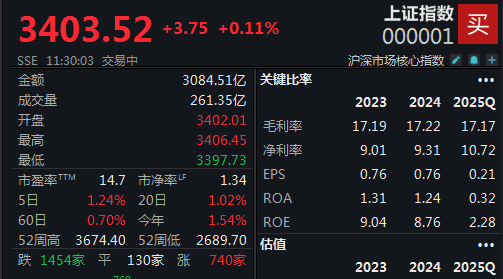
Market Overview - The A-share market showed a narrow range of consolidation on June 10, with the Shanghai Composite Index rising by 0.11% to 3403.52 points, while the Shenzhen Component Index fell by 0.23% and the ChiNext Index decreased by 0.36% [1] - The total trading volume for the A-share market reached 808.39 billion yuan [1] Monetary Policy - The People's Bank of China conducted a 7-day reverse repurchase operation of 198.6 billion yuan at a fixed rate of 1.40%, with a total bid amount matching the operation amount [2] - A net withdrawal of 255.9 billion yuan was calculated for the day, considering that 454.5 billion yuan in reverse repos matured [2] Social Welfare Initiatives - The Ministry of Finance announced increased subsidies and nationwide coordination of pension insurance, benefiting over 300 million elderly individuals [3] - The Ministry of Education plans to address the shortage of high school seats by constructing or renovating over 1000 quality high schools and aims for standardized construction of compulsory education schools within five years [3] Sector Performance - Pharmaceutical stocks showed strong performance, particularly in the CRO and innovative drug sectors, with companies like Angli Kang and ZHONGSHENG Pharmaceutical hitting the daily limit [3] - Banking stocks also saw gains, with Chengdu Bank and Nanjing Bank reaching historical highs during trading [3] Weight Loss Drug Sector - The WHO has been developing new guidelines for obesity prevention and treatment since 2022, which includes the clinical indications and applications of GLP-1 drugs, potentially standardizing their use in weight management [4] - The weight loss drug sector is gaining attention, with GLP-1 drugs expected to see increased application among weight loss populations [4] Company Insights - Hanyu Pharmaceutical is transitioning from a domestic to a global enterprise, planning to launch nearly 20 peptide and small nucleic acid drugs overseas in the next decade, focusing on weight loss and diabetes [7] - Zhongsheng Pharmaceutical has become the only domestic company with both COVID-19 and influenza innovative drugs, aiming to enhance its market position in respiratory medications [8] - Kexing Pharmaceutical is preparing for the domestic approval of a biosimilar of semaglutide by 2025 and is expanding its overseas business through strategic partnerships [9] - Yipin Hong is focusing on innovation, with promising clinical data for AR882, which has the potential to be a best-in-class product [9]

金融助力消费走出“上行线”
Jin Rong Shi Bao· 2025-06-10 03:19
Core Insights - The People's Bank of China, Neijiang Branch, is actively implementing policies to boost consumption and expand domestic demand, resulting in a significant increase in household consumption loans [1] Group 1: Financial Support for Consumption - As of March 2023, household consumption loans in Neijiang (excluding housing loans) grew by 17.28% year-on-year, surpassing the average growth rate of all loans by 5.31 percentage points [1] - Local financial institutions have invested 10.35 million yuan in loans for the renovation and expansion of tourist attractions, contributing to the revitalization of the local tourism economy [2][3] Group 2: Tourism and Economic Revitalization - The "Chuan Nan Grassland" has transformed from an under-visited site to a popular tourist destination, attracting nearly 110,000 visitors during the Spring Festival and generating approximately 24 million yuan in surrounding consumption [2] - Financial institutions have provided nearly 20 million yuan in loans to the hospitality and catering sectors, facilitating upgrades and enhancing customer experience [3] Group 3: Innovative Payment Solutions - The Neijiang Branch is promoting diverse payment scenarios to stimulate market vitality, including the establishment of six senior-friendly payment demonstration sites [4] - By March 2025, Neijiang had issued 675,200 personal digital yuan wallets, with a circulation amount of 1.143 billion yuan and nearly 39,800 operational scenarios [4] Group 4: Commitment to Economic Growth - The Neijiang Branch emphasizes its role in guiding local financial institutions to enhance consumption and production, contributing to high-quality economic development [5]
大金融配置方向展望
2025-06-09 15:30
Summary of Key Points from Conference Call Records Industry Overview - **Banking Sector Stability**: The banking sector is experiencing a stable fundamental environment due to local government debt resolution and fiscal injections, which are gradually alleviating risks in real estate and city investment. This has led to capital replenishment for banks, with improved interest margins as regulatory measures have lowered deposit rates, particularly benefiting small banks and stabilizing large banks' margins [1][2][5]. Core Insights and Arguments - **Stock Performance and Valuation Recovery**: Since May 2025, the banking sector has seen accelerated stock price increases, driven by high dividend yields and passive index fund investments. Active funds have begun increasing their positions in bank stocks, which is expected to continue for one to two years, particularly benefiting high-quality city commercial banks that may exceed a price-to-book (PB) ratio of 1.0 [1][2][5][6]. - **Potential for Valuation Recovery in Leading City Commercial Banks**: Leading city commercial banks such as Hangzhou Bank, Jiangsu Bank, and Chengdu Bank are projected to have dividend yields exceeding 4%, supported by strong asset quality primarily from government-related businesses. This positions them well for valuation recovery beyond a PB of 1.0 [1][4][6]. - **Future Trends in Banking**: The regulatory support for systemically important financial institutions is underestimated, leading to better-than-expected fundamentals in the banking sector. The focus of stock selection is shifting from low valuation to high return on equity (ROE), high growth rates, and long-term regional advantages [1][5]. - **Market Recognition of Bank Stocks**: There is a growing market recognition of bank stocks, reflected in trading activity and initial valuation increases. The expectation is that leading city commercial banks could see their asset valuations recover to 1.2 times PB [6]. Additional Important Insights - **Investment Strategy in Real Estate**: The focus in the real estate sector is on stable cash flow and potential high dividend yield companies, including comprehensive developers and pure commercial real estate firms. The emphasis is on dividend rates, free cash flow stability, and the quality of non-self-owned business assets [3][7][9]. - **Selection Logic for Light Asset Companies**: The selection criteria for light asset companies include static dividend yields between 5% and 10%, growth potential, and the pricing of excess cash. Companies with strong free cash flow relative to market capitalization are prioritized [3][12][13]. - **Market Environment and Investment Focus**: In the current uncertain market environment, there is a heightened interest in assets with stable cash flows and improving dividend capabilities. These assets are considered scarce and are expected to attract more investor attention [14]. - **Impact of Stablecoin Developments**: The recent approval of a stablecoin scheme in Hong Kong is anticipated to increase demand for local currency stablecoins, particularly as the market for stablecoins continues to grow in Asia and Europe [15][16]. This summary encapsulates the key points from the conference call records, highlighting the banking sector's stability, valuation recovery potential, and strategic investment insights across various sectors.