CMES(601872)

Search documents
国信证券:油汇改善利好航空板块 快递龙头竞争优势强化
智通财经网· 2025-12-30 03:59
Shipping Industry - The shipping market is experiencing a seasonal downturn, with oil shipping rates under pressure due to the holiday season and geopolitical tensions affecting supply [2] - Despite entering a low season, the oil shipping demand structure is improving, suggesting a potential upward trend in rates [2] - The container shipping market is expected to face significant pressure on rates by 2026 due to ongoing trade risks and the delivery of new capacity [2] Aviation Industry - Domestic passenger flight volumes have increased slightly, with overall and domestic flights up by 1.3% and 1.5% respectively compared to the previous week [3] - The average ticket price for economy class during the upcoming New Year holiday is projected at 597 yuan, reflecting a 1.1% decrease from 2024 but a 6.7% increase from 2025 [3] - The aviation sector is expected to benefit from a recovering domestic economy, with significant potential for earnings growth as supply constraints from aircraft manufacturers persist [3] Express Delivery Industry - The "anti-involution" policy has led to price increases in the express delivery sector, with most regions in China experiencing price hikes since July [4] - The profitability of express delivery companies is expected to improve in Q4 due to these price increases, despite a decline in overall package volume growth [4] - Companies like Zhongtong and Yuantong are outperforming the market, benefiting from a reduced reliance on low-cost packages [4] Investment Recommendations - The company recommends investing in growth-oriented value stocks and cyclical stocks at low price points, including Zhongtong Express, Yuantong Express, China Eastern Airlines, and others [5]





油轮、散货运价深度回调航空国内国际航线量价均有提升:交通运输行业周报(2025.12.22 - 12.28)-20251229
INDUSTRIAL SECURITIES· 2025-12-29 13:07
Group 1: Industry Overview - The report maintains a positive outlook on the transportation industry, indicating a recovery phase supported by supply and demand dynamics, particularly in the aviation sector [1][75]. - The express delivery sector shows a year-on-year growth in business volume of 14.9% and revenue growth of 7.1% from January to November 2025, reflecting a robust demand environment [3][18]. - The shipping industry is experiencing fluctuations, with the BDI index at 1900 points, down 10.49% week-on-week, while the CCFI and SCFI indices show slight increases, indicating mixed market conditions [59][61]. Group 2: Aviation Sector Insights - Domestic flight volume reached 86,137 flights during the week of December 19-25, 2025, with a daily average of 12,305 flights, reflecting a 1.42% increase week-on-week and a 1.21% increase year-on-year [12][13]. - Domestic passenger volume for the same period was 12.03 million, up 3.48% week-on-week and 6.04% year-on-year, indicating strong recovery in air travel demand [12][13]. - The average ticket price for domestic flights increased by 5.47% week-on-week, while the average bare ticket price rose by 6.08%, suggesting upward pricing pressure in the aviation market [12][13]. Group 3: Express Delivery Sector Analysis - Weekly average collection volume for express delivery was approximately 580 million pieces, with a slight decrease of 1.74% week-on-week, while delivery volume increased by 3.35% [17]. - Year-to-date average collection volume stands at about 544 million pieces per day, reflecting a year-on-year increase of 15.98% [17]. - The express delivery industry is characterized by a CR8 index of 87%, indicating a high level of market concentration, with major players like SF Express, YTO Express, and Shentong Express showing varied growth rates [21][27]. Group 4: Shipping Sector Developments - The international dry bulk market is facing a decline, with the BDI index down 10.49%, while the international container shipping market shows resilience with the SCFI index up 6.66% [59][61]. - The VLCC-TCE rate in the international oil shipping market decreased by 30.29%, indicating volatility in oil transport pricing [60]. - The report highlights the potential for a recovery in shipping rates driven by demand from the oil and dry bulk sectors, particularly as geopolitical factors may influence pricing dynamics [81]. Group 5: Recommendations and Focus Areas - Recommended stocks include China National Offshore Oil Corporation, China Eastern Airlines, and Spring Airlines, reflecting confidence in the aviation sector's recovery [4][76]. - The report suggests focusing on logistics companies like Milkrun and Hongchuan Wisdom, which are expected to benefit from the recovery in chemical logistics and warehousing [80]. - In the shipping sector, companies like China Merchants Energy Shipping are highlighted for their potential to benefit from the oil and dry bulk market recovery [81].


招商轮船(601872) - 【065】附件:招商轮船2025年第三次临时股东会法律意见书JH20251229
2025-12-29 10:00
广东省深圳市福田区中心四路 1-1 号 嘉里建设广场第三座第 28 层 2803-04 室 邮编:518048 电话:(86-755)2587-0765 传真:(86-755)2587-0780 junhesz@junhe.com 北京市君合(深圳)律师事务所 关于招商局能源运输股份有限公司 二〇二五年第三次临时股东会的法律意见书 致:招商局能源运输股份有限公司 北京市君合(深圳)律师事务所(以下简称"本所")接受招商局能源运输股 份有限公司(以下简称"贵公司")的委托,就贵公司二〇二五年第三次临时股东 会(以下简称"本次股东会")召开的有关事宜,根据《中华人民共和国公司法》 (以下简称"《公司法》")、中国证券监督管理委员会颁布的《上市公司股东会规 则》(以下简称"《股东会规则》")等中华人民共和国(为出具本法律意见书之目 的,不包括香港特别行政区、澳门特别行政区及台湾地区,以下简称"中国")现 行法律、法规、规章、规范性文件以及现行《招商局能源运输股份有限公司章程》 (以下简称"《公司章程》")的有关规定,出具本法律意见书。 为出具本法律意见书之目的,本所委派律师(以下简称"本所律师")列席了 贵公司本次 ...
招商轮船(601872) - 招商轮船2025第三次临时股东会决议公告
2025-12-29 10:00
证券代码:601872 证券简称:招商轮船 公告编号:2025-065 招商局能源运输股份有限公司 2025年第三次临时股东会决议公告 本公司董事会及全体董事保证本公告内容不存在任何虚假记载、误导性陈述 或者重大遗漏,并对其内容的真实性、准确性和完整性承担法律责任。 重要内容提示: 本次会议是否有否决议案:无 一、 会议召开和出席情况 (一)股东会召开的时间:2025 年 12 月 29 日 (二)股东会召开的地点:广东省深圳市南山区招商街道五湾社区邮轮大道 5 号太 子湾海纳仓(招商积余大厦)2 楼会议室 (四)表决方式是否符合《公司法》及《公司章程》的规定,会议主持情况等。 会议由公司董事会召集,采用现场会议、现场投票和网络投票相结合的方式 召开,公司董事长冯波鸣先生主持本次股东会。公司部分董事及公司高管通过现 场及网络方式参加会议。会议的召开及表决方式符合《公司法》《上市公司股东 (三)出席会议的普通股股东和恢复表决权的优先股股东及其持有股份情况: 1、出席会议的股东和代理人人数 538 2、出席会议的股东所持有表决权的股份总数(股) 5,834,942,513 3、出席会议的股东所持有表决权股份数占公 ...
交通运输行业周报:原油运价大幅回落,顺丰国际与安睿物流签署战略合作协议-20251229
Bank of China Securities· 2025-12-29 01:49
Investment Rating - The report rates the transportation industry as "Outperform" [2] Core Insights - Crude oil freight rates have significantly decreased, while long-distance shipping rates have increased. The China Import Crude Oil Composite Index (CTFI) dropped by 40.6% to 1354.35 points as of December 25. Meanwhile, shipping rates from Shanghai to Europe and the US have risen by 10.2% and 9.8% respectively [3][14] - The National Development and Reform Commission (NDRC) has issued a trial classification for the low-altitude economy, aiming to clarify the concept and boundaries of the industry. This classification includes a framework of "4 categories + 23 subcategories + 65 small categories" [3][15][16] - China's high-speed rail operating mileage has surpassed 50,000 kilometers, marking a significant milestone in global rail infrastructure. This expansion supports logistics networks and enhances regional connectivity [3][21] Industry Dynamics Shipping and Logistics - The Baltic Air Freight Index has shown a month-on-month decline, while domestic air freight volumes decreased by 2.03% in November 2025. Conversely, international air freight volumes increased by 14.88% [4][35] - The Shanghai Containerized Freight Index (SCFI) reported a week-on-week increase of 6.66% but a year-on-year decrease of 32.68% [39] - In November 2025, the total express delivery volume reached 180.60 billion pieces, a year-on-year increase of 5.00%, while revenue decreased by 3.70% [52] Investment Recommendations - The report suggests focusing on the industrial goods export chain, recommending companies such as COSCO Shipping, China Merchants Energy Shipping, and Huamao Logistics. It also highlights opportunities in the low-altitude economy, road and rail sectors, and e-commerce logistics [5]


油气ETF汇添富(159309)开盘涨0.09%,重仓股杰瑞股份跌2.00%,中国海油跌0.39%
Xin Lang Cai Jing· 2025-12-29 01:37
Group 1 - The core point of the article highlights the performance of the oil and gas ETF Huatai Fuhua (159309), which opened with a slight increase of 0.09% at 1.139 yuan [1] - The major holdings of the oil and gas ETF include companies such as Jereh, CNOOC, PetroChina, Sinopec, and others, with varying performance on the opening day [1] - The ETF's performance benchmark is the CSI Oil and Gas Resource Index return rate, managed by Huatai Fuhua Fund Management Co., Ltd., with a return of 13.88% since its establishment on May 31, 2024, and a return of 5.61% over the past month [1] Group 2 - Jereh shares opened down by 2.00%, while CNOOC and PetroChina saw declines of 0.39% and 0.10% respectively [1] - Sinopec remained unchanged, while other companies like China Merchants Energy and Intercontinental Oil & Gas showed slight increases [1] - The overall performance of the ETF reflects the mixed performance of its underlying assets in the oil and gas sector [1]




国际航线旅客周转亮眼,海外电商双十二GMV激增
GOLDEN SUN SECURITIES· 2025-12-28 08:15
Investment Rating - Maintain "Buy" rating for the transportation sector [5] Core Views - The international passenger turnover for October and November 2025 is expected to grow by 12.9% and 14.3% year-on-year compared to the same months in 2019, indicating a recovery in demand [1][2] - The average economy class ticket price for the New Year holiday in 2026 is projected to be 597 RMB, reflecting a 1.1% decrease from 2024 and a 6.7% increase from 2025 [1][2] - The logistics sector is benefiting from explosive growth in overseas e-commerce, with TikTok Shop's GMV in Southeast Asia increasing by 2.7 times during the "12.12" promotion [1][3] Summary by Sections Weekly Insights and Market Review - The transportation sector index rose by 1.37%, underperforming the Shanghai Composite Index by 0.51 percentage points [1][19] - The top three performing sub-sectors were shipping, public transport, and logistics, with increases of 4.70%, 4.65%, and 1.96% respectively [1][19] Air Travel - From January to November 2025, civil aviation passenger turnover reached 12,865.80 billion person-kilometers, a 19.6% increase compared to the same period in 2019 [2][12] - Domestic routes saw a 25.6% increase, while international routes grew by 3.6% [2][12] - The aviation sector is expected to maintain a positive outlook due to low supply growth and recovering demand, with a focus on business travel and international flight recovery [2][12] Shipping and Ports - The oil and dry bulk freight rates are experiencing a decline, with VLCC rates significantly dropping due to seasonal factors and lower-than-expected January loading volumes [3][13] - The dry bulk shipping index continues to fall, with a focus on the impact of new iron ore production and geopolitical developments [3][14] - The LNG transportation market is anticipated to follow a different cycle compared to larger vessels, with new projects in hydrogen production [3][16] Logistics - The logistics sector is focusing on two investment themes: overseas expansion driven by e-commerce growth and internal competition management amid slowing industry growth [3][17] - The express delivery volume showed a modest increase of 1.6% year-on-year in December, indicating a competitive landscape where leading companies are expected to gain market share [3][17]




运价罕见单日暴跌20%,油轮龙头股价逆势上涨
2 1 Shi Ji Jing Ji Bao Dao· 2025-12-27 23:37
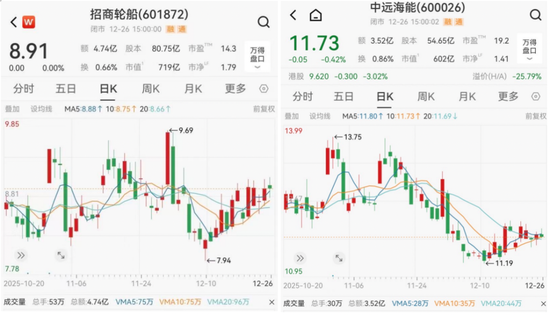
Core Viewpoint - The global tanker market experienced a significant drop in VLCC spot rates, with the Baltic TD3C index falling 20% to $87,711 per day, marking the largest single-day decline since May 2020. Despite this, major domestic oil tanker companies like China Merchants Energy Shipping Company and COSCO Shipping Energy Transportation remained resilient, with China Merchants Energy seeing a weekly increase of over 4% as of December 26 [1][3][8]. Group 1: Market Dynamics - The tanker market is influenced by complex and sometimes contradictory pricing mechanisms, which have led to a notable increase in tanker transport prices since August due to longer transport distances and rising demand [4][11]. - The current geopolitical situation has resulted in a reduction of the global "compliant" fleet, with the number of sanctioned tankers doubling to 906 vessels, representing 19% of the global oil tanker fleet capacity [10][12]. - The demand for oil tankers is expected to rise as OPEC has resumed increasing oil production, which could further support tanker rates [10][12]. Group 2: Company Performance - China Merchants Energy maintains the world's largest VLCC fleet, with 52 VLCCs and 7 Aframax tankers, positioning it well for potential profit growth as tanker rates are projected to reach their highest levels since 2008 in Q4 2025 [7][8]. - Despite the favorable market conditions, the stock price of China Merchants Energy was only 8.91 yuan per share as of December 26, which is lower than its historical prices from 2015 and 2024 [8][12]. - The company's management remains optimistic about the tanker market, predicting that the supply-demand imbalance will persist, keeping average rates above those of 2025 [15]. Group 3: Future Outlook - Analysts suggest that the tanker market may be entering a "super cycle," driven by supply constraints and increasing demand, although the current stock prices of leading companies do not fully reflect this potential [7][12]. - The upcoming delivery of new VLCCs is expected to be insufficient to offset the decline in efficiency from older vessels, maintaining a tight supply situation in the compliant market [13][15]. - The market's perception of seasonal demand fluctuations may not accurately predict future performance, as the first quarter is traditionally a peak season for tanker operations [15].

运价罕见单日暴跌20%,油轮龙头股价逆势上涨
21世纪经济报道· 2025-12-27 23:31
Core Viewpoint - The global tanker market experienced a significant drop in VLCC spot rates, with the Baltic TD3C index falling 20% to $87,711 per day, marking the largest single-day decline since May 2020. Despite this, major domestic oil tanker companies like China Merchants Energy Shipping Company (招商轮船) and COSCO Shipping Energy Transportation (中远海能) remained resilient, with China Merchants' stock rising over 4% in the week ending December 26, 2023 [1][3][8]. Group 1: Market Dynamics - The oil tanker market is characterized by complex and sometimes contradictory pricing mechanisms, which have led to a mixed performance of A-share oil tanker companies despite strong demand [3]. - Analysts from Guotai Junan Securities highlighted a "super bull market option" for oil shipping companies due to unexpected demand and supply bottlenecks, suggesting that current valuations do not fully reflect the potential for a super bull market [7]. - As of mid-2025, China Merchants will maintain the world's largest VLCC fleet, comprising 52 VLCCs and 7 Aframax tankers, positioning it as a key player in the market [7]. Group 2: Supply and Demand Factors - The global fleet of sanctioned oil tankers has doubled to 906 vessels, representing 19% of the total oil tanker fleet, which has led to increased transportation distances and a temporary surge in tanker rates [10][11]. - The geopolitical landscape has restructured global oil transportation routes, contributing to rising tanker rates, while the U.S. shale oil production faces challenges that may support higher rates in the long term [11]. - Despite the recent surge in tanker rates, concerns remain about potential price corrections if geopolitical tensions ease or if floating storage capacities are released [12]. Group 3: Future Outlook - The supply of VLCCs is expected to remain tight until mid-2026, with only a limited number of new deliveries and a significant portion of the fleet being older vessels that may not meet environmental standards [13]. - The company anticipates that the compliance market will continue to experience supply-demand imbalances, with average rates expected to be higher than in 2025 [14]. - The company also noted that the first quarter of the year is typically a peak season for oil transportation, despite historical trends suggesting a decline in activity during the fourth quarter [15].

极端周期,VLCC油运公司命运之局
2 1 Shi Ji Jing Ji Bao Dao· 2025-12-27 00:00
Core Viewpoint - The global tanker market experienced a significant drop in VLCC spot rates, with the Baltic TD3C index falling 20% to $87,711 per day, marking the largest single-day decline since May 2020. This decline is viewed as a market correction rather than a crisis, as VLCC rates remain above the highs seen in the spring of 2020 [1][2]. Group 1: Market Dynamics - The recent drop in tanker rates contrasts sharply with the extreme market conditions of May 2020, where OPEC's failed negotiations led to a drastic reduction in demand and unprecedented negative oil prices. This time, there are no similar geopolitical crises or OPEC production cuts influencing the market [2]. - Despite the drop in rates, major domestic tanker companies like China Merchants Energy Shipping Company (招商轮船) and COSCO Shipping Energy Transportation (中远海能) have shown resilience, with China Merchants experiencing a weekly increase of over 4% as of December 26 [2]. - The tanker market's pricing mechanism is complex, influenced by various factors including geopolitical tensions and supply chain disruptions, which have led to increased transportation distances and demand [3][7]. Group 2: Future Outlook - Analysts suggest that the tanker industry is entering a "super bull market" phase due to unexpected demand and supply constraints, with projections indicating that VLCC spot market earnings could reach their highest levels since 2008 by Q4 2025 [5][6]. - The current fleet of VLCCs is aging, with 20.2% of the global fleet over 20 years old, which may limit supply growth and maintain upward pressure on rates [11]. - The company anticipates that the supply-demand imbalance will persist, particularly as older vessels may not meet new environmental regulations, potentially leading to a decrease in effective fleet capacity [10][13]. Group 3: Investor Sentiment - There is a notable divergence between the performance of tanker rates and the stock prices of related companies, with the latter showing a lackluster response to rising rates due to market concerns over potential price corrections [9]. - The management of China Merchants has expressed optimism about the tanker market, predicting that the stock price will eventually reflect the positive market conditions despite current investor hesitance [12][13].