BANK OF CHINA(601988)

Search documents
景瑞控股股东将股票由中国银行(香港)转入耀才证券 转仓市值108.32万港元
Zhi Tong Cai Jing· 2025-11-24 00:21
截至2025年10月31日止十个月,该集团累计合约签约销售额(连合营企业及联营企业的销售额)约为人民 币8.27亿元,同比减少51.81%;合同销售面积约为54,550平方米,合同销售均价约人民币15,160元╱平 方米。 11月4日,景瑞控股公布,该集团于2025年10月的合约签约销售额(连合营企业及联营企业的销售额)约 为人民币0.87亿元,同比减少65.2%;合同销售面积约为5,135平方米,合同销售均价约人民币16,943元 ╱平方米。 香港联交所最新资料显示,11月21日,景瑞控股(01862)股东将股票由中国银行(香港)转入耀才证券,转 仓市值108.32万港元,占比5.03%。 ...

银行业周度追踪2025年第46周:关注零售贷款资产质量趋势-20251124
Changjiang Securities· 2025-11-23 23:30
Investment Rating - The report maintains a "Positive" investment rating for the banking sector [12] Core Insights - The overall market has seen a decline, with a noticeable drop in risk appetite, yet bank stocks have slightly retreated while outperforming the broader market and the ChiNext index, showcasing their defensive attributes [2] - The report highlights a significant focus on the asset quality trends of retail loans, particularly mortgage loans, due to recent fluctuations in housing prices, raising concerns about the ability to cover loan principal [6][40] - The report anticipates that the decision-makers will prioritize financial system stability and risk thresholds, likely implementing policy adjustments to alleviate the pressure on mortgage loan asset quality [6][40] Summary by Sections Market Performance - The Longjiang Bank Index fell by 0.9%, but outperformed the CSI 300 and ChiNext indices by 2.9% and 5.3% respectively, indicating a defensive characteristic of bank stocks [19] - State-owned banks have shown notable performance, with early mid-term dividend distributions in December encouraging increased allocations [19] Retail Loan Quality - There has been a rise in retail loan non-performing ratios and amounts among listed banks, reflecting pressures from declining housing prices and household income [6][41] - By June 2025, the non-performing balance of personal loans among sample listed banks increased by 88.3 billion yuan, with significant impacts from mortgage loans and rapidly growing personal business loans [6][41] - Individual banks such as China Communications Bank and China Merchants Bank reported rising retail non-performing ratios, while Ping An Bank showed a decline due to effective risk management and write-offs [7][42] Future Outlook - The report suggests that city commercial banks, like Ningbo Bank, are expected to achieve improvements in retail asset quality by actively adjusting their loan structures [8] - The overall retail risk in the banking sector is anticipated to remain under observation, with potential improvements in overdue rates and non-performing ratios expected in the future [7][41]





大象何以轮番“起舞”
Shang Hai Zheng Quan Bao· 2025-11-23 18:02
Group 1 - The core viewpoint of the article highlights the recent surge in stock prices of major state-owned banks in China, indicating a market re-evaluation of their value due to their stable asset quality and high dividend yields [1][6] - Major state-owned banks have collectively experienced significant stock price increases, with China Bank's stock rising over 2% and reaching a historical high, while other banks like ICBC and CCB also approached their peak prices [1] - Analysts attribute the rise in stock prices to the banks' role as a "ballast" in the financial system, which is being recognized by the market as a source of certainty and stability [1][5] Group 2 - The attractiveness of state-owned banks is underscored by their high dividend payouts, with a total of 204.657 billion yuan planned for distribution among the six major banks, accounting for nearly 80% of the total mid-term dividends from all listed banks [2] - The shift in investor sentiment towards equity investments seeking returns is evident, as there is a notable increase in the willingness to allocate funds towards dividend-yielding equity assets [2] - The stable operating performance of state-owned banks is highlighted, with a total profit of 1.07 trillion yuan reported for the first three quarters, marking a positive growth trend for all major banks [3] Group 3 - The competitive landscape of the banking industry has shifted from a focus on scale to one emphasizing quality, resilience, and business structure, which enhances the advantages of state-owned banks [3] - State-owned banks exhibit strong asset quality, benefiting from a customer base primarily composed of state-owned enterprises and large private enterprises, which provides greater resilience during economic fluctuations [3] - The ability of state-owned banks to maintain low funding costs and their significant role in supporting the real economy further solidify their position in the market [3][4] Group 4 - The strong performance of state-owned bank stocks reflects a market reassessment of their role and value within the financial system, with total assets of large commercial banks increasing from 124.03 trillion yuan in Q1 2020 to 208.15 trillion yuan by Q3 2023, a nearly 70% growth [6] - The current market environment, characterized by slowing credit growth, places a premium on credit quality, which state-owned banks are well-positioned to deliver due to their extensive branch networks and high-quality customer bases [6] - The valuation recovery of bank stocks, previously trading below book value, indicates a restoration of market confidence in the asset quality of state-owned banks [6]

银行积极响应国家政策 落实发放育儿补贴资金
Zheng Quan Ri Bao Zhi Sheng· 2025-11-23 16:41
Core Viewpoint - Multiple banks in China are actively participating in the distribution of childcare subsidies to support the national policy aimed at encouraging childbirth, with efficient financial services ensuring that benefits reach newborn families accurately [1][2]. Group 1: Implementation of Childcare Subsidies - The implementation plan for childcare subsidies was issued by the Central Committee and the State Council in July, establishing a subsidy of 3,600 yuan per child per year for children under three years old starting from January 1, 2025 [2]. - China Bank successfully distributed the first batch of childcare subsidies in Liaoning and Hebei, benefiting nearly 1,600 newborn families [2]. - Banks are conducting promotional activities to raise awareness of the policy and are offering additional services such as online applications for social security cards and discounts on parenting-related products [2][3]. Group 2: Role of Commercial Banks - Several banks, including Agricultural Bank and Everbright Bank, have opened channels for online applications for childcare subsidies, enhancing accessibility for families [3]. - The involvement of commercial banks is driven by their robust payment systems and high service efficiency, which are essential for the rapid implementation of the policy [3][4]. - Banks are expected to leverage their extensive service networks to facilitate the effective rollout of the childbirth support policy while also expanding their customer base and service offerings [4]. Group 3: Challenges and Future Developments - Challenges include the need for better integration with government systems and ensuring accurate subsidy distribution to avoid errors [4]. - The surge in business volume may pressure bank branches, necessitating improvements in service efficiency and accuracy in fund transfers [4]. - Looking ahead, banks plan to broaden the coverage of subsidies and introduce diverse financial services related to childbirth, including consumer finance, insurance, and savings products [4].
两部门发文,DeepSeek、Kimi、豆包等或将入围
21世纪经济报道· 2025-11-23 14:31
Core Viewpoint - The article discusses the newly released draft regulations for personal information protection by large internet platforms in China, emphasizing the responsibilities and obligations these platforms must adhere to in safeguarding user data [1][3]. Group 1: Regulatory Framework - The draft regulations define large internet platforms based on user scale, specifically those with over 50 million registered users or 10 million monthly active users [5]. - Major companies like Tencent, Alibaba, ByteDance, and emerging AI firms such as DeepSeek and MiniMax are included under this definition, indicating a broader scope of regulation [3][5]. - The principle of "with great power comes great responsibility" is highlighted, indicating that larger platforms will face stricter compliance requirements [1][3]. Group 2: Compliance Requirements - Large platforms are required to establish dedicated personal information protection teams responsible for creating and implementing internal management systems and emergency response plans [10]. - The regulations mandate that personal information collected within China must be stored in domestic data centers, and platforms must conduct compliance audits and risk assessments [11]. - There is an emphasis on the need for platforms to publish social responsibility reports regarding personal information protection, which has previously been inadequately addressed by many companies [10]. Group 3: Independent Oversight - The draft regulations propose the establishment of independent supervisory committees composed mainly of external members to oversee personal information protection practices [13][15]. - These committees are tasked with monitoring compliance, evaluating the protection of sensitive personal information, and ensuring regular communication with users [15]. - Concerns are raised about the feasibility of these committees, as many platforms have yet to take significant steps towards establishing them [14].





2025中国银行业竞争力100强出炉
2 1 Shi Ji Jing Ji Bao Dao· 2025-11-23 11:52
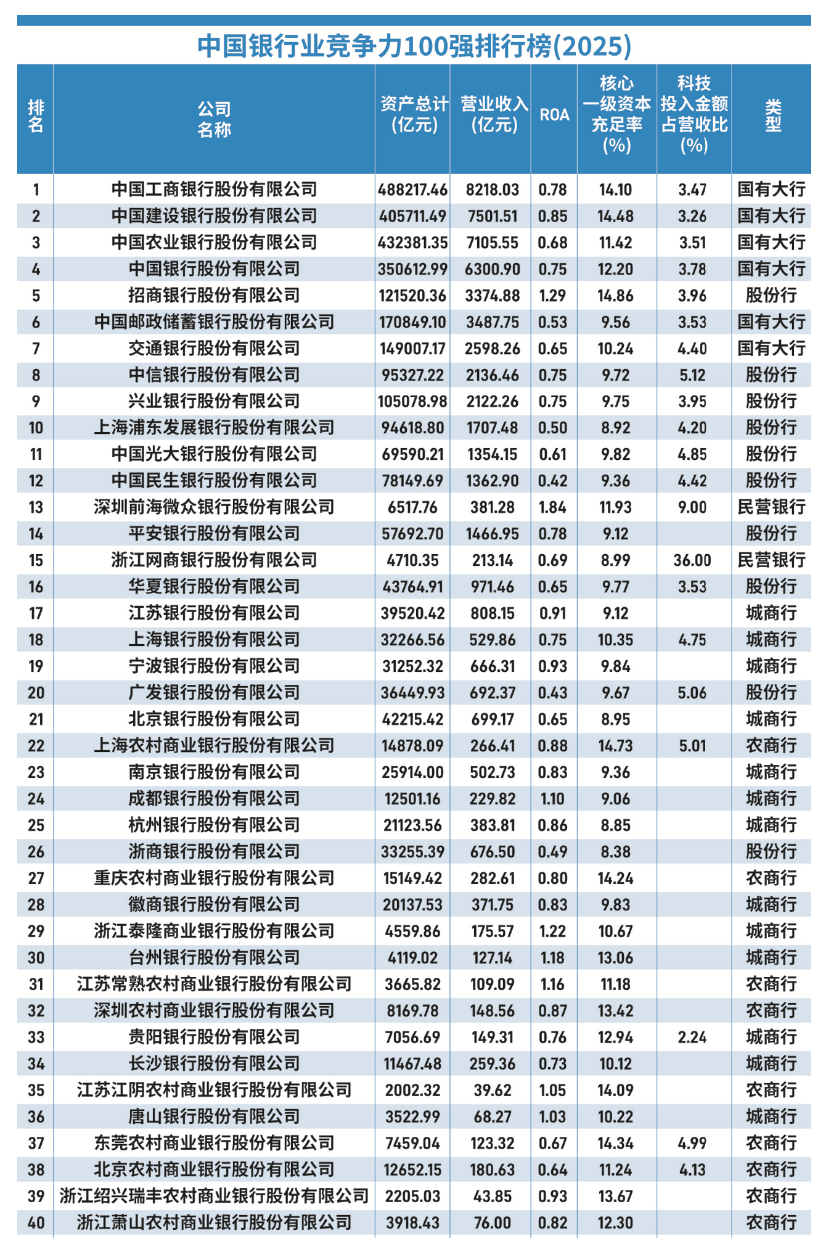
Core Insights - The "2025 China Banking Industry Competitiveness Report" was released, highlighting the evolving competitive landscape of the banking sector amid economic adjustments, fintech innovations, and regulatory improvements [1] - The report ranks the top 100 banks based on a comprehensive evaluation system focusing on four core indicators: scale, profitability, growth, and stability [1] - For the first time, the ranking separates domestic and foreign banks, enhancing the rigor and professionalism of the evaluation [1] Group 1: Overall Ranking and Key Players - The top four banks are dominated by state-owned banks, with Industrial and Commercial Bank of China leading in asset scale and profitability [6] - China Construction Bank ranks second, showcasing balanced development across various indicators [6] - Agricultural Bank of China and Bank of China follow in third and fourth places, respectively, with strengths in asset base and international operations [6] Group 2: National Joint-Stock Commercial Banks - Among the 12 national joint-stock commercial banks, 10 are ranked between 5th and 30th, with China Merchants Bank leading this group at 5th place [7] - CITIC Bank and Industrial Bank are positioned 8th and 9th, respectively, demonstrating strong performance [7] - The overall performance indicates a growing disparity between leading and trailing banks within this category [7] Group 3: City Commercial Banks - City commercial banks represent the largest group with 53 institutions, with Jiangsu Bank leading at 17th place [8] - Shanghai Bank and Ningbo Bank follow closely, benefiting from strong local market engagement [8] - The regional focus of city commercial banks has established them as vital financial support for local economies [8] Group 4: Rural Commercial Banks - Rural commercial banks, with 27 institutions on the list, show robust operational stability and growth potential [9] - Shanghai Rural Commercial Bank ranks 22nd, while Chongqing Rural Commercial Bank leads in the southwest region at 27th [9] - These banks are crucial in supporting local agricultural and small business needs [9] Group 5: Private and Foreign Banks - The two private banks listed, WeBank and Ant Bank, rank 13th and 15th, respectively, showcasing strong performance in profitability and growth [9] - The five foreign banks are ranked separately, with Citibank (China) leading, followed by MUFG Bank (China) and HSBC (China) [9] - Foreign banks leverage international service capabilities and global resource integration to maintain competitive advantages [9] Group 6: Industry Trends and Future Outlook - The report emphasizes the importance of differentiated competition and innovation in building a high-quality banking ecosystem [10] - Various banks are enhancing their core capabilities to support the real economy and provide robust financial services [10] - The rankings reflect the ongoing transformation and adaptation of the banking sector in response to market demands and regulatory changes [10]
中国银行:已实现人工智能核心企业授信超过4000亿元
Xin Lang Cai Jing· 2025-11-23 10:50
Group 1 - The core viewpoint is that the Bank of China has launched an action plan to support the development of the artificial intelligence industry chain, introducing innovative financial products such as the "Zhongyin Sci-Tech Computing Power Loan" and the first-ever linkage between bonds and loans [1] - The Bank of China has provided credit support exceeding 400 billion yuan to core enterprises in the artificial intelligence sector, reinforcing the industrial digital intelligence foundation [1]
《2025中国银行业竞争力研究报告》发布 解码行业发展核心密码
Zheng Quan Ri Bao Wang· 2025-11-23 09:52
Group 1 - The year 2025 is identified as a pivotal year for the banking industry in China, marking a transition period with both opportunities and challenges arising from macroeconomic transformation and global financial changes [1] - The "2025 China Banking Industry Competitiveness Research Report" was released on November 22, focusing on the core theme of high-quality development in the banking sector and analyzing the industry's competitiveness amidst complex environments [1][2] - The report highlights that by 2025, global economic growth will exhibit a "fragmented" characteristic, with increasing policy divergence among major central banks, while domestic economic stability faces challenges due to insufficient effective demand [2] Group 2 - The first part of the report presents the overall situation of high-quality development in China's banking industry, showcasing resilience in the face of internal and external uncertainties, with signs of stabilization in net interest margins and accelerated recovery in middle-income [2] - The second part of the report focuses on the "Top 100 Competitiveness of Chinese Banks (2025)" ranking, utilizing a four-dimensional indicator system based on objective data from commercial banks' 2024 annual reports [2] - The third part of the report covers the practical achievements and development paths in five key areas of finance, including technology finance, green finance, inclusive finance, pension finance, and digital finance, revealing diverse future development paths for the industry [3]
真金白银出手!上市银行,增持潮起!
证券时报· 2025-11-23 08:44
Core Viewpoint - A-share listed banks are experiencing a wave of share buybacks from shareholders and executives, indicating confidence in the long-term prospects of these banks amidst market volatility [1][3][5]. Group 1: Shareholder and Executive Buybacks - Recently, several listed banks, including Nanjing Bank and Chengdu Bank, announced significant share buybacks by major shareholders and executives, reflecting a trend that began in October with other banks like Xiamen Bank and Qilu Bank [3][4]. - Chengdu Bank reported that its two major shareholders invested approximately 611 million yuan to buy back nearly 34.247 million shares, with plans for further purchases totaling between 700 million and 1.4 billion yuan [3][4]. - Nanjing Bank's largest shareholder, BNP Paribas, increased its stake by approximately 12.8 million shares, raising its total holding from 17.02% to 18.06%, marking a new high for its ownership [4]. Group 2: Market Performance and Analyst Insights - The banking sector has shown resilience, with 17 bank stocks reporting positive returns over the past month, including China Bank with a 13.74% increase [9]. - Despite recent gains, the overall valuation of bank stocks remains low, with a median price-to-book ratio of about 0.6, indicating potential for further appreciation [9]. - Analysts from various institutions reaffirmed the investment opportunities in the banking sector, highlighting the appeal of high dividend yields and low valuations as key factors for future investments [10][11]. Group 3: Confidence in Long-term Value - The increase in share buybacks by executives and major shareholders is seen as a signal of confidence in the banks' long-term value and a strategy to stabilize market sentiment [7]. - The shift in buyback activity from low-price periods to times of rising stock prices suggests a proactive approach to managing market perceptions and valuations [7].



两部门拟明确“守门人”认定标准,AI新贵们也入围了?
2 1 Shi Ji Jing Ji Bao Dao· 2025-11-23 07:57
Core Viewpoint - The draft regulations on personal information protection for large internet platforms have been released, establishing criteria for identifying such platforms and outlining their obligations for personal information protection [1][2]. Group 1: Identification of Large Platforms - The draft specifies that platforms with over 50 million registered users or 10 million monthly active users will be classified as large internet platforms, which includes traditional internet giants and emerging AI companies [3][4]. - Companies like DeepSeek, MiniMax, and Kimi, as well as smart device manufacturers such as OPPO, vivo, and Honor, are also likely to fall under this classification due to their user base [1][3]. Group 2: Responsibilities and Compliance - Large platforms are required to establish dedicated personal information protection teams, appoint responsible personnel, and publish annual social responsibility reports regarding personal information protection [6][7]. - The draft emphasizes the need for platforms to store personal information generated within China in domestic data centers and to conduct compliance audits and risk assessments [7]. Group 3: Independent Supervision - The draft regulations propose the establishment of independent supervisory committees composed mainly of external members to oversee personal information protection compliance [10][11]. - These committees will be responsible for monitoring compliance with personal information protection regulations and will need to maintain regular communication with users [11].