
Cambricon(688256)

Search documents
机构:存力+算力量价齐升,半导体设备进入主升阶段,半导体设备ETF(561980)高开上涨1.15%!
Sou Hu Cai Jing· 2026-01-12 02:33
Core Viewpoint - The global semiconductor industry is expected to strengthen in 2026, driven by AI demand and domestic substitution, with a notable increase in semiconductor equipment and materials [1] Group 1: Semiconductor Equipment and ETF Performance - The semiconductor equipment ETF (561980) opened up 1.15% on January 12, with a net inflow of nearly 100 million yuan over the past two trading days [1] - The index tracked by the semiconductor equipment ETF has risen over 15% this year, outperforming mainstream semiconductor indices [2] - Key stocks such as Zhongwei Company and Cambrian have seen significant gains, with Zhongwei up nearly 4% and Jianghua Micro up over 5% [2] Group 2: Market Trends and Pricing - A significant increase in trading volume in A-shares indicates the start of a spring market, with semiconductor equipment leading the upward trend [4] - NVIDIA's new AI chip architecture, Vera Rubin, showcases a fivefold increase in inference performance compared to the previous generation, indicating a surge in storage demand [5] - Major international storage companies plan to raise server DRAM prices by 60% to 70% in Q1 2026 compared to Q4 2025 [5] Group 3: Domestic Substitution and Material Demand - The domestic substitution process for semiconductor materials is advancing, with a recent anti-dumping investigation into dichlorodihydrosilane from Japan, a key material for chip manufacturing [5] - The demand for semiconductor materials and electronic chemicals is expected to rise due to the upgrade of storage driven by AI data centers [6] - The global semiconductor materials market is projected to reach approximately $70 billion by 2025, with a year-on-year growth of 6% [6] Group 4: Industry Outlook and Key Players - The trend of "supply security + domestic substitution" for key semiconductor materials is strengthening, driven by AI computing and data center demands [7] - Leading companies with technological accumulation and production capacity in high-end materials are expected to gain market share and profitability amid advanced process promotion and domestic substitution trends [7] - The semiconductor equipment ETF focuses on leading companies in the sector, with over 90% of its holdings in the upper and mid-stream areas of the semiconductor industry, which have the highest technical barriers and value concentration [7]



267只科创板股融资余额环比增加
Zheng Quan Shi Bao Wang· 2026-01-12 01:45
Core Viewpoint - The financing balance of the Sci-Tech Innovation Board decreased by 1.06 billion yuan, while the margin trading balance increased by 18.93 million yuan, indicating a mixed sentiment among investors [1]. Financing Balance Summary - As of January 9, the total margin trading balance on the Sci-Tech Innovation Board was 282.61 billion yuan, a decrease of 1.05 billion yuan from the previous trading day [1]. - The highest financing balance was held by Cambrian, with a balance of 15.35 billion yuan, followed by SMIC and Haiguang Information with balances of 13.03 billion yuan and 7.30 billion yuan, respectively [1]. - A total of 267 stocks saw an increase in financing balance, while 327 stocks experienced a decrease [1]. - Notable increases in financing balance were observed in Hotgen Biotech (56.65%), Yuyuan Pharmaceutical (54.61%), and Chipone Technology (39.46%) [1]. Margin Trading Balance Summary - Cambrian also had the highest margin trading balance at 41 million yuan, followed by Haiguang Information and SMIC with balances of 36 million yuan and 32 million yuan, respectively [2]. - A total of 264 stocks saw an increase in margin trading balance, while 148 stocks experienced a decrease [2]. - Significant increases in margin trading balance were noted for Huitong Co. (3360.47%), Yaxin Security (1268.15%), and Jinchengzi (805.25%) [2].




计算机行业研究:国内算力斜率陡峭
SINOLINK SECURITIES· 2026-01-11 09:14
Investment Rating - The report does not explicitly state an investment rating for the industry Core Insights - The competition in AI entry points is intensifying, with major companies increasing their investments. China's AI presence globally has significantly improved, with domestic large models continuously iterating. Despite GPT-5.2 and Gemini 3 Pro leading, Chinese models have effectively altered the North American dominance in the competitive landscape. In the global Top 10, three positions are held by Chinese models, and in the Top 15, there are six Chinese companies. By 2025, China's open-source AI model usage is expected to account for over 70% of the global market [2][11][19] - The demand for inference has surged, with the emergence of o1 class inference models unlocking approximately 10 times the potential of traditional models in terms of inference-time compute. The demand for computing power has shifted from being solely "training-driven" to a dual focus on "training + inference" [2][5][37] - The battle for entry points has evolved beyond mobile devices to OS-level intelligent agents and super apps. By December 24, 2025, ByteDance's AI application Doubao announced daily active users (DAU) exceeding 100 million, while Qianwen App reached over 30 million monthly active users within 23 days of public testing, becoming the fastest-growing AI application globally. Doubao bypasses traditional interfaces, creating an "AI operating system" that directly interacts with super apps like WeChat and Alipay, challenging the rules of the traditional app era [2][44][45] Summary by Sections AI Entry Point Competition - China's AI global presence has significantly improved, with domestic large models continuously iterating. In the global Top 10, three positions are held by Chinese models, and in the Top 15, there are six Chinese companies. By 2025, China's open-source AI model usage is expected to account for over 70% of the global market [2][11][19] - The competition for entry points has evolved beyond mobile devices to OS-level intelligent agents and super apps, with significant user engagement reported for new AI applications [2][44][45] Domestic Chip Breakthroughs - The smart computing center in China is expanding, with a projected compound annual growth rate (CAGR) of 57% from 2020 to 2028, reaching 2,781.9 EFLOPS by 2028. Domestic chip technology is steadily improving, with local cloud service providers accelerating the construction of heterogeneous environments [5][50] - Domestic general-purpose GPUs are upgrading from "usable" to "good," with performance metrics approaching those of leading international models. The production capacity of domestic chip manufacturers like SMIC is continuously increasing, providing solid support for domestic AI chip production [5][53][54] Supply and Demand Dynamics - The demand side is characterized by a surge in inference demand as AI applications become more prevalent, while the supply side sees continuous improvements in domestic GPU performance and accelerated adaptation by cloud service providers [5][59] - The AI server market is expected to see a shift towards inference servers becoming the mainstream, with a projected market size of approximately $39.3 billion in 2024, reflecting a year-on-year growth of 49.7% [5][64]


中国不需要那么多“英伟达”
凤凰网财经· 2026-01-10 13:50
Core Viewpoint - The article discusses the current state and future prospects of the domestic GPU industry in China, highlighting the rapid growth driven by AI demand and the challenges posed by market saturation and competition among numerous companies [2][3]. Group 1: Market Dynamics - By the end of 2025, domestic GPU manufacturers are expected to experience a capital frenzy, with market valuations exceeding 440 billion yuan, driven by AI and domestic substitution trends [2]. - The influx of capital into the chip design sector has led to a significant increase in the number of companies, with nearly 600 new chip design firms established in 2021 alone, totaling around 4,000 companies currently [2]. - The domestic RF front-end chip sector has over 300 companies, yet holds less than 20% of the global market share, indicating a severe competitive landscape [3]. Group 2: Competitive Landscape - The RF chip market is characterized by intense price wars, with many companies facing losses due to product homogeneity and lack of differentiation [3][4]. - A notable example is the leading domestic RF chip company, which reported a loss of 147 million yuan in the first half of the year, reflecting the pressure from increased competition [4]. - The article emphasizes that many companies are producing similar products, leading to a race to the bottom in pricing, which is detrimental to profitability [4][5]. Group 3: High-End GPU Market - The high-end GPU market presents a larger growth opportunity compared to the saturated low-end market, but it also faces significant challenges [6]. - Domestic GPUs are currently in a "catch-up" phase, with performance still lagging behind Nvidia's latest offerings, indicating a systemic gap of one to two generations [6][7]. - Despite the challenges, the demand for AI computing power is increasing, particularly in inference scenarios, which domestic GPUs are targeting [7][8]. Group 4: Revenue Trends - Nvidia's revenue from mainland China has decreased by approximately 900 million dollars year-on-year, while domestic GPU companies are experiencing exponential revenue growth [8][9]. - Companies like Cambricon have reported a 24-fold increase in revenue, indicating a strong market response to AI chip demand [10]. - New entrants like Moore Threads and Muxi are also showing rapid revenue growth, with Muxi's revenue increasing fourfold year-on-year [10][11]. Group 5: Industry Consolidation - The GPU market is expected to consolidate to 2-3 leading companies, intensifying competition and reducing the survival space for smaller firms [13][14]. - The article notes that the GPU market is highly concentrated, with Nvidia and AMD dominating nearly 100% of the market share, which poses a challenge for new entrants [13]. - Domestic GPU companies face fragmented customer demands and limited R&D budgets compared to their global counterparts, which could hinder their long-term viability [14][15]. Group 6: Future Outlook - The ability to achieve mass production is critical for the survival of GPU companies, and finding a differentiated path is essential for success [15][17]. - Companies that can balance performance, delivery, ecosystem, and commercialization are more likely to thrive in the competitive landscape [17]. - The article concludes that the true winners in the domestic GPU market will be those who can effectively navigate the challenges of differentiation and market demands [17].
科创板平均股价47.26元,12股股价超300元
Zheng Quan Shi Bao Wang· 2026-01-09 10:25
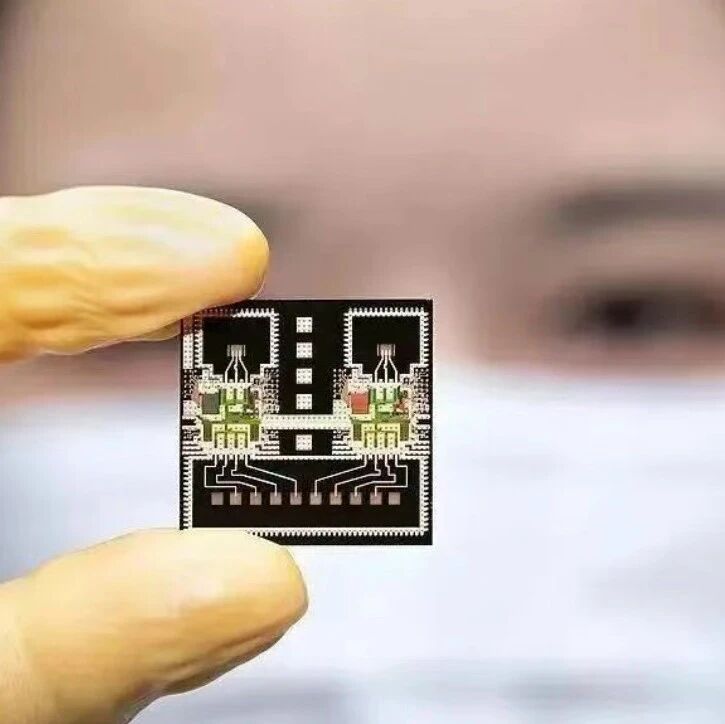
Group 1 - The average stock price of the Sci-Tech Innovation Board is 47.26 yuan, with 92 stocks priced over 100 yuan, and the highest priced stock is Cambrian-U at 1491.00 yuan, which increased by 3.25% today [1] - Among the stocks priced over 100 yuan, 64 stocks increased today with an average rise of 2.62%, while 28 stocks decreased, with the largest declines seen in Xinyuan Micro and Puran Shares [1] - The average premium of the latest closing price of the 100-yuan stocks relative to their issue price is 512.88%, with the highest premiums for companies like Shunwei New Materials and Cambrian-U [1] Group 2 - The net outflow of main funds from the 100-yuan stocks today totaled 1.999 billion yuan, with the highest net inflows seen in Haiguang Information and Qiangyi Shares [2] - The total margin balance for the 100-yuan stocks is 118.59 billion yuan, with Cambrian-U and SMIC having the highest margin balances [2] - The stock list of 100-yuan stocks includes notable companies such as Cambrian-U, Yuanjie Technology, and Moer Thread-U, with varying performance metrics [2][3][4][5]
深沪北百元股数量达213只,电子行业占比最高
Zheng Quan Shi Bao Wang· 2026-01-09 10:22
追溯发现,最新百元股近一个月平均上涨18.78%,其间沪指上涨5.00%,涨幅居前的有超捷股份、臻镭 科技、西测测试等,涨幅分别为145.21%、143.31%、129.46%。 今日有1只股收盘价首次突破百元大关,麦格米特最新收盘价100.81元,上涨3.39%,全天换手率 4.68%,成交额21.53亿元,全天主力资金净流入3551.78万元。 以最新收盘价计算,A股平均股价为14.61元,其中股价超过100元的有213只,相比上一个交易日增加6 只。 百元股作为判定市场热度的信号之一,历来受到投资者关注。证券时报·数据宝统计显示,截至1月9日 收盘,沪指报收4120.43点,上涨0.92%,A股平均股价为14.61元,个股股价分布看,股价超过100元的 有213只,股价在50元至100元的有526只,股价在30元至50元的有798只。 股价超百元个股中,收盘价最高的是寒武纪,今日报收1491.00元,上涨3.25%,其次是贵州茅台、源杰 科技等,最新收盘价分别为1419.10元、752.00元。 市场表现方面,收盘股价超百元股中,今日平均上涨1.89%,跑赢沪指0.97个百分点。今日上涨的有137 只, ...


数据看盘顶级游资扎堆金风科技 北向资金联手机构“爆买”AI应用概念股
Sou Hu Cai Jing· 2026-01-09 09:47
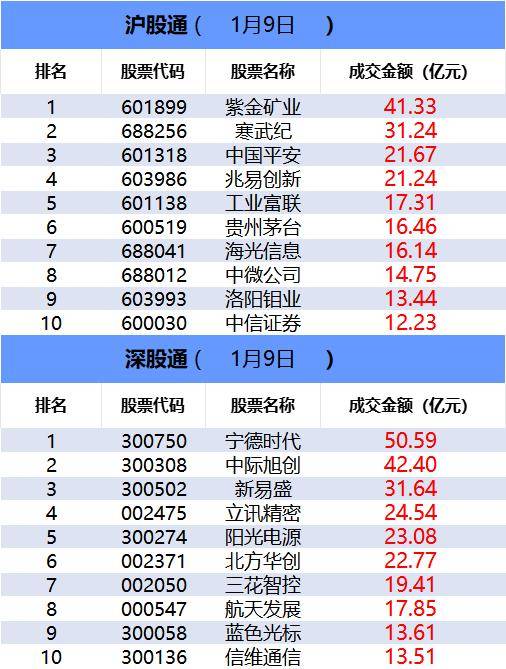
Summary of Key Points Core Viewpoint - The trading volume of the Shanghai and Shenzhen Stock Connect reached a total of 369.64 billion, with Zijin Mining and CATL leading in individual stock trading volume. The cultural media sector saw the highest net inflow of funds, while the Media ETF experienced a significant increase in trading volume, up 214% from the previous day [1][2][8]. Group 1: Trading Volume and Stock Performance - The total trading amount for the Shanghai Stock Connect was 166.43 billion, while the Shenzhen Stock Connect totaled 203.21 billion [2]. - Zijin Mining topped the Shanghai Stock Connect with a trading volume of 41.33 billion, followed by Cambricon Technologies at 31.24 billion and Ping An Insurance at 21.67 billion [3]. - CATL led the Shenzhen Stock Connect with a trading volume of 50.59 billion, followed by Zhongji Xuchuang at 42.40 billion and Xinyi Precision at 31.64 billion [3]. Group 2: Sector Fund Flows - The cultural media sector had the highest net inflow of funds at 9.53 billion, representing a net inflow rate of 8.20% [5]. - The non-ferrous metals sector followed with a net inflow of 3.85 billion, while the computer sector saw a net inflow of 2.57 billion [5]. - The new energy sector experienced the largest net outflow of funds at -10.28 billion, with a net outflow rate of -3.37% [6]. Group 3: ETF Trading Activity - The Media ETF (512980) had a trading volume of 7.88 billion, with a remarkable increase of 214.96% from the previous trading day [8]. - The A500 ETF Huatai Baichuan (563360) led the trading volume among ETFs at 15.17 billion, with a growth of 1.01% [7]. - The A500 ETF Fund (512050) followed closely with a trading volume of 15.09 billion, reflecting a growth of 2.07% [7]. Group 4: Institutional and Retail Investor Activity - Institutional investors showed high activity, with two AI application stocks, Liou Co. and Kunlun Wanwei, receiving significant investments of 2.04 billion and 2.12 billion respectively [11][14]. - Retail investors also actively purchased AI application stocks, with Kunlun Wanwei receiving 1.72 billion from a leading retail investor [14]. - The stock of Jin Feng Technology faced significant selling pressure, with two institutions selling 4.77 billion [12].



科创板收盘播报:科创50指数涨1.43% 通信设备股表现强势
Xin Hua Cai Jing· 2026-01-09 07:45
Core Viewpoint - The ChiNext 50 Index experienced a significant increase on January 9, closing at 1475.97 points with a rise of 1.43%, reflecting a strong market performance despite initial fluctuations [1]. Group 1: Market Performance - The ChiNext Composite Index rose by 2.08% to close at 1803.4 points, with a total trading volume of approximately 327.2 billion yuan [1]. - The average increase for the 600 stocks on the ChiNext board was 2.04%, with an average turnover rate of 4.48% and a total trading volume of 327.2 billion yuan [1]. - The index showed a volatility of 2.73% during the trading session, indicating active trading [1]. Group 2: Sector Performance - Communication equipment and chemical pharmaceutical stocks demonstrated strong performance, while semiconductor and healthcare stocks faced declines [1]. - Individual stock performances included Zhenyou Technology, Xinke Yidong, and Qianyan Biology reaching the daily limit up, while Shengbang Security saw a decline of 7.18%, marking the largest drop [1]. Group 3: Trading Details - Cambrian Technology led in trading volume with 14.9 billion yuan, while ST Yifei had the lowest trading volume at 1.259 million yuan [2]. - Strong Yi Co. had the highest turnover rate at 39.07%, while Longteng Optoelectronics recorded the lowest at 0.28% [2].


计算机行业政策点评:“人工智能+制造”意见发布,工业AI产业发展将提速
Shanxi Securities· 2026-01-09 07:43
Investment Rating - The report maintains an investment rating of "Leading the Market - A" for the computer industry [1][11]. Core Insights - The report highlights the acceleration of AI development in the manufacturing sector, driven by a recent policy issued by multiple government departments, aiming for significant advancements in AI technology and its applications by 2027 [3][5]. - The policy outlines specific goals, including the application of 3-5 general large models in manufacturing, the creation of 100 high-quality datasets, and the promotion of 500 typical application scenarios [3][5]. - The report emphasizes the transition of industrial AI from isolated applications to comprehensive integration across all manufacturing processes, with significant growth in AI adoption among industrial enterprises [6][7]. Summary by Sections Industry Performance - The computer industry has shown a strong market performance over the past year, with a focus on AI applications in manufacturing [1]. Policy Impact - The recent policy is a detailed implementation of previous guidelines, focusing on computational power, model development, data management, and application scenarios in manufacturing [5][6]. - Specific initiatives include support for advanced training chips, the development of industry-specific models, and the establishment of a chief data officer system in enterprises [5][6]. AI Adoption - The report notes a significant increase in the adoption of large models and intelligent agents in Chinese industrial enterprises, rising from 9.6% in September 2024 to 47.5% in 2025, with expectations for further rapid growth in 2026 [6][7]. Investment Recommendations - The report suggests focusing on companies involved in industrial AI applications, data annotation, and AI computing power, including firms like Zhong控 Technology, Kingdee International, and others [7].


科创成长ETF南方(589700.SH)涨2.55%,寒武纪涨3.4%
Jin Rong Jie· 2026-01-09 07:37
Group 1 - The A-share market experienced a broad increase, with the Shanghai and Shenzhen indices rising, particularly in the media and domestic software sectors [1] - The Southern Science and Technology Growth ETF (589700.SH) rose by 2.55%, while Cambricon Technologies increased by 3.4% [1] - According to Galaxy Securities, the current stage of technological development is more robust across multiple dimensions, with dominant industry forces shifting from startups to established tech giants with strong cash flows and balance sheets [1] Group 2 - AI commercialization is still in its early stages and has not yet fully materialized, indicating significant growth potential [1] - Despite some localized valuation bubbles, their transmission effect on the overall stock market remains limited [1] - The global monetary easing environment has not fully unfolded, leaving room for policy adjustments [1] Group 3 - There is a persistent mismatch between technological bottlenecks and explosive demand in the hardware industry, with ongoing tight supply of computing and storage [1] - The evolution of large models towards multimodal applications (e.g., video) and the implementation of AI Agent functionalities are significantly increasing token consumption, creating a rigid demand for high-performance computing [1] Group 4 - The global data center vacancy rate is at a historical low, and the growth rate of power supply industries is accelerating [1] - PCB capacity expansion appears rational, driven mainly by high-end HDI and multilayer boards with over 14 layers, which are characterized by high technical barriers and concentrated production among leading companies [1] Group 5 - The compound annual growth rate (CAGR) for high-end PCBs is expected to reach 20.3% and 11.6% respectively from 2024 to 2029 [1] - As of the first three quarters of 2025, industry capital expenditures grew by only 8.4% year-on-year, significantly lower than demand growth, indicating a restrained and orderly capacity expansion [1] Group 6 - The aforementioned trends provide solid fundamental support for investing in science and technology growth index funds, which broadly cover core areas such as computing chips, advanced storage, high-end PCBs, and cloud computing infrastructure [1] - These funds can capture the benefits of the AI hardware boom while effectively mitigating individual stock bubble risks through diversified index-based allocation [1] - The Southern Science and Technology Growth ETF (589700.SH) is positioned to be an efficient tool for sharing in the new round of technological dividends during the critical transition from infrastructure construction to application implementation in AI [1]