VeriSilicon(688521)

Search documents
芯原股份(688521):四季度新签订单高速增长,长期买入机会
CSC SECURITIES (HK) LTD· 2025-12-29 08:35
Investment Rating - The report assigns a "Buy" rating for the company, indicating a potential upside of 15% to 35% [8][12]. Core Insights - The company announced a significant increase in new orders for Q4 2025, totaling RMB 2.5 billion, which represents a 130% year-over-year growth and a 56% quarter-over-quarter increase. This growth is primarily driven by demand for AI-related chip solutions [8][11]. - The company is expected to benefit from the ongoing transformation in the industry, particularly as internet companies increase their investments in AI computing capabilities [8]. - Despite a recent decline in stock price due to shareholder reductions, this presents a long-term buying opportunity as the company's fundamentals remain strong [8][11]. Summary by Sections Company Information - The company operates in the electronics industry, with a current stock price of RMB 127.90 as of December 26, 2025. The stock has seen a 12-month high of RMB 216.77 and a low of RMB 44.47. The total market capitalization is approximately RMB 640.78 billion [2]. Recent Ratings - The company has consistently received "Buy" ratings in recent reports, with the latest rating issued on August 25, 2025 [3]. Product Mix - The company's revenue sources include 43.4% from chip volume business, 33.5% from IP licensing fees, 17.8% from chip design services, and 5.3% from royalties [4]. Financial Forecast - The company is projected to achieve revenues of RMB 30.6 billion, RMB 54.1 billion, and RMB 84.7 billion for the years 2025, 2026, and 2027, respectively, with year-over-year growth rates of 32%, 77%, and 57% [11]. - Net profits are expected to turn positive in 2025, with projections of RMB 0.26 billion, RMB 2.7 billion, and RMB 6.4 billion for the years 2025, 2026, and 2027, respectively [10][11].

盘中,20%涨停!A股,集体异动!
券商中国· 2025-12-29 07:01
Core Viewpoint - The semiconductor sector in A-shares is experiencing significant activity, driven by the launch of the National Venture Capital Guidance Fund, which is expected to mobilize trillions in funding for early-stage projects in integrated circuits and artificial intelligence [1][3]. Group 1: Market Activity - A-shares semiconductor stocks have shown notable movements, with companies like Maiwei Co., Ltd. hitting a 20% limit up [1][3]. - The semiconductor index rose over 1.5% on December 29, with individual stocks such as Maiwei Co., Ltd. and Dongwei Semiconductor seeing substantial gains [3]. - Korean chip giants SK Hynix and Samsung Electronics have also seen their stock prices rise, contributing to positive sentiment in the A-share semiconductor market [4]. Group 2: National Policy Impact - The National Venture Capital Guidance Fund was officially launched on December 26, aiming to attract a wide range of investments from local governments, central enterprises, financial institutions, and private capital, targeting a total fund size of one trillion yuan [3]. - The fund will focus on early-stage projects in strategic emerging industries, including integrated circuits and artificial intelligence, to enhance innovation and productivity [3]. Group 3: Industry Growth Projections - According to Statista Market Insights, the global semiconductor market is projected to reach $659.1 billion in 2024, representing a 20% year-on-year increase, with integrated circuits accounting for 73.9% of the market [6]. - The fastest growth is expected in AI chips, with a projected increase of 49.3% [6]. - Investment opportunities are anticipated in third-generation semiconductor materials, computing chips, and RF communication chips, driven by domestic policy and international dynamics [7].






我国首部人工智能大模型国家标准实施!科创人工智能ETF华夏(589010) 盘中拉升逾1.5%,芯原股份强势领涨
Mei Ri Jing Ji Xin Wen· 2025-12-29 05:31
每日经济新闻 (责任编辑:董萍萍 ) 【免责声明】本文仅代表作者本人观点,与和讯网无关。和讯网站对文中陈述、观点判断保持中立,不对所包含内容 的准确性、可靠性或完整性提供任何明示或暗示的保证。请读者仅作参考,并请自行承担全部责任。邮箱: news_center@staff.hexun.com 消息方面,从市场监管总局获悉,人工智能大模型系列国家标准正式实施。作为首部聚焦通用大模 型的国家标准,该系列标准填补了技术评价体系空白。截至目前,标准工具完成千余项评测任务,调用 大模型超95万次,精准识别幻觉控制、内容安全等共性问题,助力近30家厂商技术迭代,推动形成"研 发—评测—应用—升级"闭环。 银河证券表示, AI应用商业化加速落地。"人工智能+"行动被写入"十五五"规划,"人工智能+"应 用将提速。"十五五"规划建议稿文件明确"人工智能+"行动要贯穿科研、制造、治理、服务全链条,不 再局限于数字产业化,而是发挥引领及全方位赋能千行百业作用。根据国务院在8月发布的《关于深入 实施"人工智能+"行动意见》要求,到2027年要率先实现人工智能与6大重点领域广泛深度融合,新一代 智能终端、智能体等应用普及率超70%; ...
人形机器人标准化委员会成立助力产业迈向规范化,汽车零部件ETF(562700)持仓股五洲新春涨停
Mei Ri Jing Ji Xin Wen· 2025-12-29 05:31
Group 1 - A-shares trading volume has increased, with sectors such as non-ferrous metals, robotics, and AI performing well. Notable stocks include Wuzhou Xinchun and New Spring Co., which saw significant gains [1] - The Ministry of Industry and Information Technology announced the establishment of the "Humanoid Robot and Embodied Intelligence Standardization Technical Committee," marking a shift from unregulated growth to a structured standard-setting phase in the humanoid robot and embodied intelligence industry [1] - Tianfeng Securities highlights humanoid robots as a potential growth area in AI, with increasing global expectations for the industry. The future development of the humanoid robot supply chain is expected to show "global resonance and multiple blooming" as major tech companies invest more in AI technologies [1] Group 2 - The Smart Car ETF (159888) closely tracks the CS Intelligent Vehicle Index, with constituent stocks primarily in electronics, computers, automotive, and communications sectors, showcasing strong technological attributes [2] - The Automotive Parts ETF (562700) tracks the CSI Automotive Parts Theme Index, covering various fields such as automotive systems, interiors, electronics, and tires, benefiting from the trends of electrification and intelligence in the automotive industry [2] Group 3 - Related products include Automotive Parts ETF (562700), Smart Car ETF (159888), and AI ETF (515070) [3]


刚刚,央行传来重磅利好!
天天基金网· 2025-12-29 05:23
Core Viewpoint - The People's Bank of China has introduced an action plan to strengthen the management and service system for digital RMB, with a new framework set to launch on January 1, 2026 [2][4]. Group 1: Digital Currency Developments - The digital currency sector has seen significant stock price movements, with companies like Yuyin Co. hitting the daily limit and *ST Tianyu rising over 10% [2][6]. - As of November 2025, digital RMB has processed 3.48 billion transactions, amounting to 16.7 trillion yuan, with 230 million personal wallets opened through the digital RMB app [5]. - The multi-central bank digital currency bridge (mBridge) has handled 4,047 cross-border payment transactions, totaling approximately 387.2 billion yuan, with digital RMB accounting for about 95.3% of the transaction volume [5]. Group 2: Challenges and Opportunities - The Deputy Governor of the People's Bank of China highlighted four key challenges in the development of digital currencies, including the impact of modern digital payment tools on monetary control and the risks associated with financial disintermediation [4]. - The recent policy from eight departments supports international cooperation in digital finance, particularly in cross-border payments using central bank digital currencies with countries like Thailand and Singapore [8]. - Predictions suggest that by 2030, the global cross-border payment market could reach $290 trillion, with the RMB's share estimated at 10%-20% and digital currency penetration at 20%-40%, translating to a market potential of 40.6 trillion to 162.4 trillion yuan [8]. Group 3: Industry Growth - As of December 25, 2025, China has registered 74,600 blockchain-related companies, marking a record high in the past five years, with the South China region accounting for 32.5% of new registrations [8]. - The stock of blockchain-related companies in China has been steadily increasing over the past decade, with a notable acceleration in growth since 2019, totaling 289,400 existing companies as of December 25 [8]. - The development of digital RMB is viewed as a strategic asset that integrates finance, technology, and data, enhancing trade efficiency through blockchain technology [8].







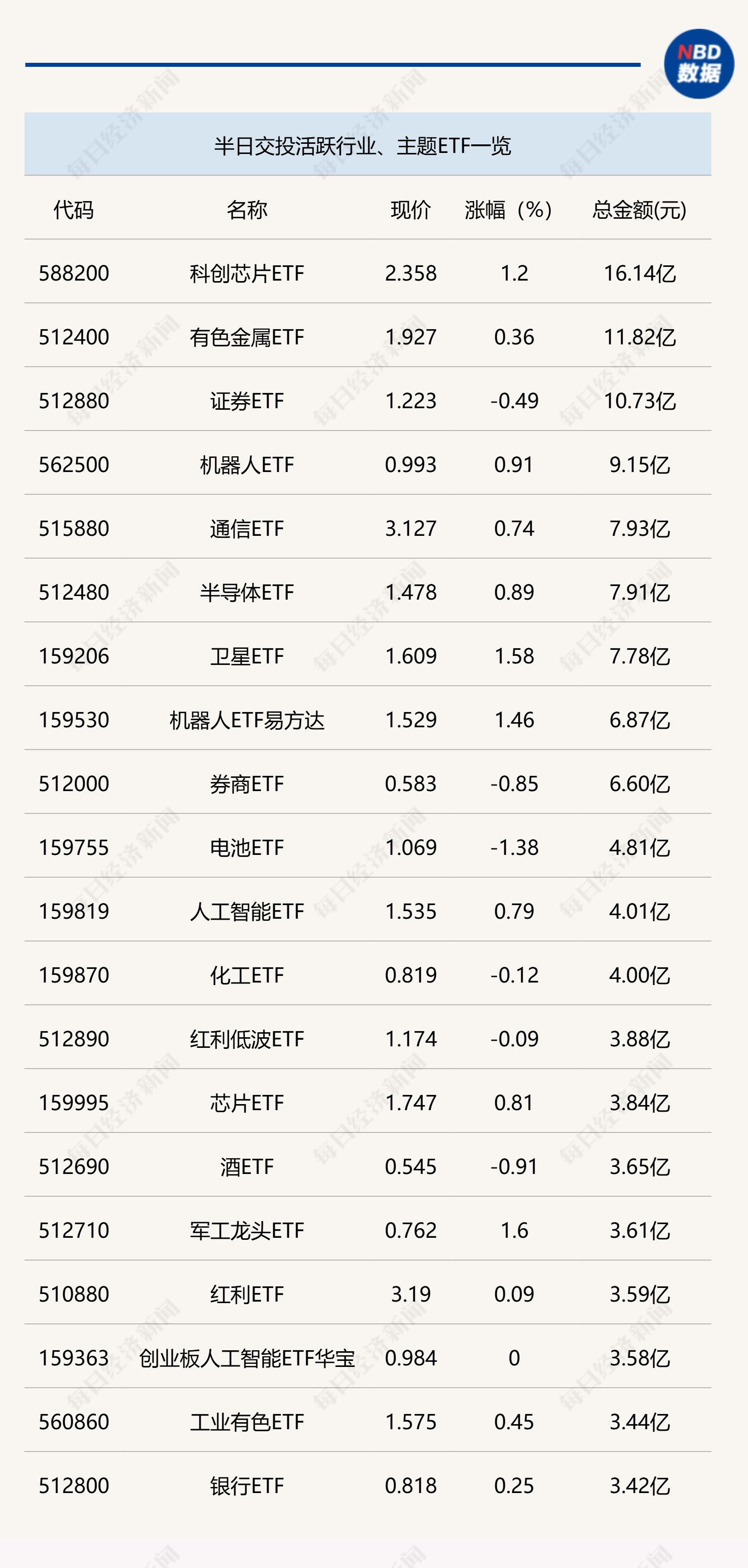
行业ETF风向标丨多行业ETF交投活跃,两只科创人工智能ETF半日涨幅超2%
Sou Hu Cai Jing· 2025-12-29 04:40
Core Viewpoint - The trading activity in the technology and finance sectors, particularly in ETFs related to semiconductor, securities, and AI, has been notably active, with significant transaction volumes reported. Group 1: ETF Trading Activity - The trading volume for the Sci-Tech Chip ETF, Securities ETF, and Non-ferrous Metals ETF exceeded 1 billion yuan during the morning session [1] - The Hong Kong Securities ETF (513090) recorded a transaction amount of 5.238 billion yuan, indicating a high trading volume [1] Group 2: ETF Performance - The Sci-Tech Chip ETF (588200) increased by 1.2% to a price of 2.358 yuan [3] - The Non-ferrous Metals ETF (512400) rose by 0.36% to 1.927 yuan [3] - The Securities ETF (512880) decreased by 0.49% to 1.223 yuan [3] - The AI-focused ETFs, including the Sci-Tech AI ETF (589380), saw a rise of 2.06% with a transaction amount of 9.1229 million yuan [8] - The Sci-Tech AI ETF (588790) had a significant transaction amount of 294 million yuan, with a total of 7.387 billion shares [8] Group 3: AI Industry Insights - The AI industry is shifting focus from "model capability competition" to "application efficiency and scale competition," indicating a transformation in market dynamics [8] - The Sci-Tech Board AI Index comprises 30 large-cap companies that provide foundational resources, technology, and application support for the AI sector [9]


盘中利好传来,这一板块异动拉升
Di Yi Cai Jing Zi Xun· 2025-12-29 03:02
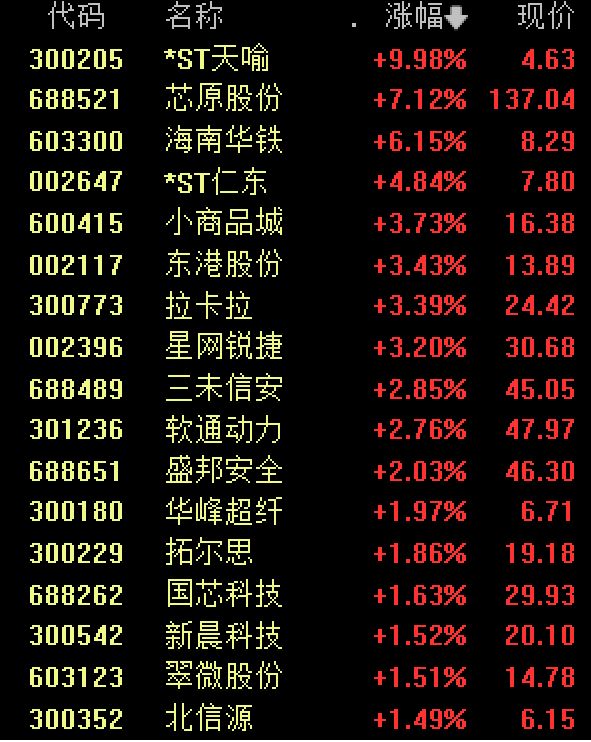
12月29日,A股数字货币概念异动拉升。截至发稿,芯原股份涨超7%,拉卡拉、小商品城、东港股 份、星网锐捷、拓尔思等多股跟涨。 数据显示,截至2025年11月末,数字人民币累计处理交易34.8亿笔,累计交易金额16.7万亿元。通过数 字人民币App开立个人钱包2.3亿个,数字人民币单位钱包已开立1884万个。多边央行数字货币桥 (mBridge)累计处理跨境支付业务4047笔,累计交易金额折合人民币3872亿元,其中数字人民币在各 币种交易额占比约95.3%。 编辑|心一 | 代码 | 名称 | 涨幅量 | 现价 | | --- | --- | --- | --- | | 300205 | *ST大喻 | +9.98% | 4.63 | | 688521 | 芯原股份 | +7.12% | 137.04 | | 603300 | 海南华铁 | +6.15% | 8.29 | | 002647 | *ST仁东 | +4.84% | 7.80 | | 600415 | 小商品城 | +3.73% | 16.38 | | 002117 | 东港股份 | +3.43% | 13.89 | | 300773 | 拉卡拉 ...


商业航天市场关注度突破20%!卫星产业ETF(159218)创下年内第31次新高!海格通信封板!航天环宇、芯原股份紧随其后
Jin Rong Jie· 2025-12-29 03:01
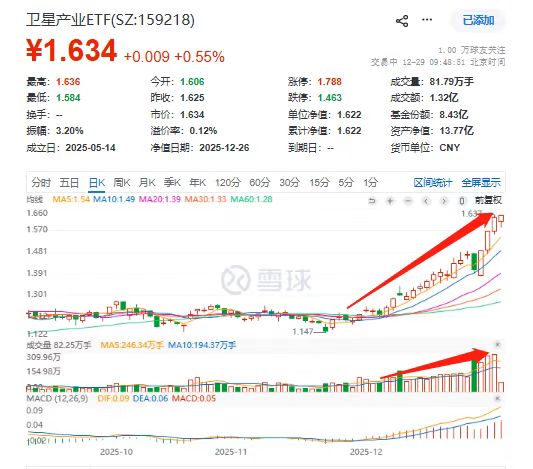
12月29日早盘,卫星板块延续强势。截至9时42分,卫星产业ETF(159218)上涨0.31%,创下年内第31 次新高,实现盘中"四连升"。成分股方面,中国卫星涨3.60%,同样实现四连涨。资金持续涌入,据测 算该ETF十分钟内净流入约1600万元。 风险提示:基金有风险,投资需谨慎。 资讯所属栏目还有更多独家策划、专家专栏,免费查阅>> 值得关注的是,目前已有至少10家商业航天企业启动IPO进程,其中5家为运载火箭企业,包括蓝箭航 天、星际荣耀等。A股多家上市公司已通过直接或间接方式参投相关企业。 当前,卫星产业ETF已成为资金布局商业航天的高效工具,覆盖产业链核心环节。在行业高景气延续背 景下,板块有望持续吸引中长期配置资金关注。 近期,商业航天板块市场关注度已突破20%,显著高于机器人、低空经济等新兴赛道,显示资金正系统 性布局这一战略方向。尽管隔夜美股相关概念股出现调整,但A股在政策与产业进展支撑下走出独立行 情。 ...

科创信息技术ETF摩根(588770)开盘涨0.44%,重仓股海光信息跌0.33%,中芯国际涨0.74%
Xin Lang Cai Jing· 2025-12-29 02:56
Core Viewpoint - The article discusses the performance of the Science and Technology Innovation Information Technology ETF Morgan (588770), highlighting its opening price and the performance of its major holdings [1]. Group 1: ETF Performance - The Science and Technology Innovation Information Technology ETF Morgan (588770) opened at 1.382 yuan, with a gain of 0.44% [1]. - Since its establishment on March 14, 2025, the fund has achieved a return of 37.55%, with a monthly return of 4.71% [1]. Group 2: Major Holdings Performance - Among the major holdings, Haiguang Information opened down by 0.33%, while SMIC (Semiconductor Manufacturing International Corporation) increased by 0.74% [1]. - Other notable performances include Cambrian (up 0.47%), Chipone (up 1.64%), and Stone Technology (up 0.03%), while Kingsoft Office and Huahong Group saw declines of 0.25% and 0.48%, respectively [1].



盘中利好传来,这一板块异动拉升
第一财经· 2025-12-29 02:50
12月29日,A股数字货币概念异动拉升。截至发稿,芯原股份涨超7%,拉卡拉、小商品城、东港股 份、星网锐捷、拓尔思等多股跟涨。 编辑 |心一 消息面上,据央视新闻,中国人民银行已经出台《关于进一步加强数字人民币管理服务体系和相关金融 基础设施建设的行动方案》, 新一代数字人民币计量框架、管理体系、运行机制和生态体系将于2026 年1月1日正式启动实施 。 数据显示,截至2025年11月末,数字人民币累计处理交易34.8亿笔,累计交易金额16.7万亿元。通 过数字人民币App开立个人钱包2.3亿个,数字人民币单位钱包已开立1884万个。多边央行数字货币桥 (mBridge)累计处理跨境支付业务4047笔,累计交易金额折合人民币3872亿元,其中数字人民币 在各币种交易额占比约95.3%。 | 代码 | 名称 | 涨幅 | 现价 | | --- | --- | --- | --- | | 300205 | *ST大喻 | +9.98% | 4.63 | | 688521 | 芯原股份 | +7.12% | 137.04 | | 603300 | 海南华铁 | +6.15% | 8.29 | | 002647 | ...