
Midea Group(000333)

Search documents
“自补”接替“国补”让利消费者,厂商在保份额与保利润之间摇摆
Di Yi Cai Jing· 2025-10-22 12:43
Core Insights - The home appliance market is facing significant pressure this year due to reduced government subsidies and increased competition, leading to a shift from price competition to quality and supply chain efficiency [2][6][10] Group 1: Market Trends - The 2025 Double 11 sales event saw over 80 brands, including Apple and Roborock, achieving over 100 million yuan in sales within the first hour [3] - AI-related products, such as AI glasses and AI phones, experienced nearly 200% year-on-year sales growth, while over 2000 home appliance brands saw sales growth exceeding 100% [3] - The overall market for home appliances is expected to decline compared to last year due to limited government subsidies and a saturated market [7][10] Group 2: Competitive Strategies - Major brands like Gree and Midea are adapting to market changes by launching new products at competitive prices, with Gree's new air conditioning brand "Xiaoliangshen" priced below 2100 yuan [5][9] - Companies are focusing on product bundling and enhancing customer experience, such as offering cooking services with appliance purchases [9] - The trend of "self-subsidization" is emerging among leading brands to maintain market share amidst price wars [5][10] Group 3: Product Performance - Despite a decline in overall sales, certain product categories like large-screen TVs (98 inches and above) and new categories such as washing machines and dishwashers are showing growth potential [8] - The retail share of new categories like washing machines and air purifiers has increased, indicating a shift in consumer preferences [8] Group 4: Supply Chain and Efficiency - Companies are increasingly collaborating on supply chain management to reduce costs and improve market responsiveness, with initiatives like "unified warehousing and distribution" being adopted [10] - The focus is shifting towards enhancing user experience and convenience, especially in regions where government subsidies have been reduced [10]



资本热话 | 国际大行继续“超配中国”,这些A股行业龙头最受青睐
Sou Hu Cai Jing· 2025-10-22 10:29
Group 1 - UBS maintains an overweight rating on China within emerging markets, citing faster revenue and earnings growth compared to India, and improving capital return rates in the MSCI China index [1] - A-shares have experienced a style shift from "growth" to "value dividend" since October, influenced by US-China trade tensions and profit-taking in the tech sector, but the medium-term outlook for A-shares remains positive [1][3] - Foreign investors are closely monitoring China's 14th Five-Year Plan, particularly aspects related to "anti-involution," consumption promotion, high-quality growth, and the development of new productive forces [1][11] Group 2 - A-shares are showing structural differentiation, with major indices fluctuating, but foreign investors believe there is still high allocation value in the market despite recent tariff impacts [3][4] - The market's sensitivity to US-China trade tensions has decreased, and there is an expectation of policy measures to stabilize the market if significant volatility occurs [4] - Foreign investors favor industry leaders, with significant holdings in companies like Kweichow Moutai, Ping An, and Wuliangye, indicating a preference for stable, high-quality stocks [6][7] Group 3 - Foreign investors are increasing their positions in leading stocks, with notable increases in holdings for companies like Siyi Electric and Hai Da Group during the third quarter [8][6] - UBS expresses a preference for A-shares over H-shares due to their defensive nature against geopolitical tensions, maintaining a focus on growth styles as the main investment theme [10] - The upcoming policies in the 14th Five-Year Plan are expected to create potential opportunities in "anti-involution" and service consumption, which could drive cyclical improvements in various industries [12]





家用电器行业10月22日资金流向日报
Zheng Quan Shi Bao Wang· 2025-10-22 10:04
Core Points - The Shanghai Composite Index fell by 0.07% on October 22, with nine industries rising, led by the oil and petrochemical sector, which increased by 1.58% [1] - The total net outflow of capital from the two markets was 44.231 billion yuan, with only four industries experiencing net inflows [1] Industry Summary Oil and Petrochemical - The oil and petrochemical industry saw a net inflow of 558 million yuan and a price increase of 1.58% [1] Home Appliances - The home appliance industry rose by 0.82%, with a net capital inflow of 479 million yuan [2] - Out of 94 stocks in this sector, 50 stocks increased, and 3 stocks hit the daily limit [2] - The top three stocks with the highest net inflow were: - Haier Group: 446 million yuan [2] - Sanhua Intelligent Controls: 203 million yuan [2] - Stone Technology: 57 million yuan [2] Electronics - The electronics industry had the largest net outflow of capital, totaling 8.021 billion yuan [1] Power Equipment - The power equipment sector experienced a net outflow of 6.284 billion yuan [1] Non-Banking Financials and Nonferrous Metals - Both non-banking financials and nonferrous metals also saw significant net outflows, contributing to the overall market decline [1]


美的集团(00300.HK)10月22日耗资人民币1亿元回购135.8万股A股
Ge Long Hui· 2025-10-22 10:00
Core Viewpoint - Midea Group announced a share buyback plan, intending to repurchase 1 billion RMB worth of A-shares, totaling 1.358 million shares at a price range of 72.71 to 73.99 RMB per share [1] Summary by Category - **Company Actions** - Midea Group plans to spend 1 billion RMB to buy back 1.358 million A-shares [1] - The buyback price is set between 72.71 and 73.99 RMB per share [1]
美的集团(00300)10月22日斥资9999.6万元回购135.84万股A股
智通财经网· 2025-10-22 09:59
智通财经APP讯,美的集团(00300)发布公告,于2025年10月22日斥资9999.6万元回购135.84万股A股。 ...
白色家电板块10月22日涨0.82%,澳柯玛领涨,主力资金净流出1.12亿元
Zheng Xing Xing Ye Ri Bao· 2025-10-22 08:19
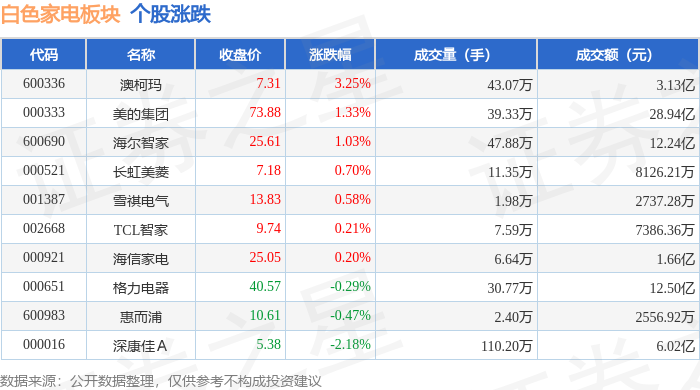
Market Overview - The white goods sector increased by 0.82% on October 22, with Aucma leading the gains [1] - The Shanghai Composite Index closed at 3913.76, down 0.07%, while the Shenzhen Component Index closed at 12996.61, down 0.62% [1] Individual Stock Performance - Aucma (600336) closed at 7.31, up 3.25% with a trading volume of 430,700 shares and a turnover of 313 million yuan [1] - Midea Group (000333) closed at 73.88, up 1.33% with a trading volume of 393,300 shares and a turnover of 2.894 billion yuan [1] - Haier Smart Home (600690) closed at 25.61, up 1.03% with a trading volume of 478,800 shares and a turnover of 1.224 billion yuan [1] - Gree Electric Appliances (000651) closed at 40.57, down 0.29% with a trading volume of 307,700 shares and a turnover of 1.250 billion yuan [1] Capital Flow Analysis - The white goods sector experienced a net outflow of 112 million yuan from institutional investors, while retail investors saw a net outflow of 25.4247 million yuan [1] - Speculative funds had a net inflow of 137 million yuan into the sector [1] Detailed Capital Flow for Key Stocks - Midea Group saw a net inflow of 32.671 million yuan from institutional investors, but a net outflow of 57.134 million yuan from retail investors [2] - Aucma had a net inflow of 5.3203 million yuan from institutional investors, with a net outflow of 4.1458 million yuan from retail investors [2] - Haier Smart Home experienced a net outflow of 64.4444 million yuan from institutional investors, while speculative funds had a net inflow of 49.8336 million yuan [2]




高盛唱多中国资产,放话称应转变思维“逢低买入”!重点投资腾讯、阿里、小米等巨头
Mei Ri Jing Ji Xin Wen· 2025-10-22 06:22
Group 1 - The Hang Seng Technology Index experienced a decline, with a drop of over 1.5% during the afternoon session on October 22, leading to a decrease of over 2% in the largest A-share counterpart, the Hang Seng Technology Index ETF (513180) [1] - Major stocks such as NetEase, BYD Electronics, JD Health, Kingsoft, Baidu Group, and Lenovo Group were among the biggest losers in the ETF [1] - Goldman Sachs reported that a slow bull market for Chinese stocks is forming, predicting a 30% upside for the MSCI China Index over the next two years [1] Group 2 - Goldman Sachs suggests that investors should shift their mindset from "selling on highs" to "buying on lows" as the bull market unfolds in China [1] - The report emphasizes an alpha-driven investment strategy focusing on the "China Ten Giants" which includes Tencent, Alibaba, Xiaomi, BYD, Meituan, NetEase, Midea, Hengrui Medicine, Ctrip, and Anta [1] - The Hang Seng Technology Index ETF (513180) includes 30 leading Hong Kong tech stocks, focusing on the AI industry chain across upstream, midstream, and downstream sectors [2]




国联民生证券:家用空调9月内外销均走弱 关注企业经营面α
Zhi Tong Cai Jing· 2025-10-22 06:20
Core Insights - The report from Guolian Minsheng Securities indicates a weakening trend in both domestic and export sales of household air conditioners in September, influenced by base effects and policy changes [1] - Despite the overall decline, Haier has shown significant growth, suggesting a divergence in performance among leading brands [1][3] - The white goods sector has been underperforming since Q3 2025, with current relative valuations at historical lows, indicating that short-term pressures may already be priced in [1] Group 1: Production and Sales Data - In September, the production of household air conditioners reached 10.57 million units, down 13.48% year-on-year, while sales totaled 10.88 million units, down 10.24% year-on-year [1] - Domestic sales were 5.95 million units, a decrease of 2.52% year-on-year, while exports were 4.94 million units, down 18.06% year-on-year [1] - Inventory at the end of the month stood at 14.26 million units, a decline of 2.36% year-on-year [1] Group 2: Domestic Market Trends - Domestic air conditioner sales in September saw a year-on-year decline of 3%, aligning with expectations due to a high base effect [2] - The upcoming policy for replacing old units in Q4 2024 is expected to drive a significant increase in domestic sales, with projections of a 24% year-on-year growth [2] - The retail volume for online and offline sales showed a two-year CAGR of 31% and 1%, respectively, indicating stable demand despite seasonal fluctuations [2] Group 3: Brand Performance - In September, Midea and Gree experienced year-on-year sales declines of 15% and 13%, respectively, while Haier reported a 25% increase [3] - Haier's market share increased by 3.7 percentage points year-on-year, with a notable 37% growth in Q3 2025 [3] - The average retail prices for air conditioners showed a slight increase of 0.4% online but a decrease of 7.5% offline, reflecting pressure on volume sales [3] Group 4: Export Market Dynamics - Export sales of air conditioners fell by 18% year-on-year, indicating ongoing challenges in the external market [4] - There are signs of improvement in export orders for leading brands, with production guidance for October and November showing a decrease of 9.4% and 6.6% compared to the same period last year [4] - The anticipated growth in export sales for Q4 2024 is projected at 49%, although challenges remain due to trade negotiations and tariff issues [4] Group 5: Investment Recommendations - The report recommends continued investment in leading brands such as Haier Smart Home, Midea Group, Hisense Home Appliances, and Gree Electric Appliances, highlighting their resilience and high-quality attributes [5]

“隐形冠军”神话终破灭
创业邦· 2025-10-22 04:06
Core Insights - The article discusses the concept of "hidden champions," small and medium-sized enterprises (SMEs) that dominate niche markets but remain largely unknown to the public. These companies have been crucial to the economic success of countries like Germany, Japan, and the U.S. [5][7] - The number of hidden champions has increased significantly in China, with a growing number of SMEs emerging as global leaders in their respective fields. [33][34] Group 1: Definition and Characteristics of Hidden Champions - Hidden champions are defined as companies that hold a top two global market share position, have annual sales below $10 billion, and are not widely recognized by the public. This definition has evolved to include companies with annual revenues below $50 billion. [7][9] - As of 2023, there are 3,406 hidden champions globally, with Germany accounting for 1,573, nearly half of the total. The U.S. has 350, and Japan has 283. [7][9] Group 2: Current Challenges Faced by Hidden Champions - The article highlights a decline in the manufacturing sector in Germany, particularly in the automotive industry, which has seen an 80% increase in bankruptcies since 2021. [16][19] - Major automotive companies like Bosch and Volkswagen are implementing significant layoffs, with Bosch planning to cut 13,000 jobs and Volkswagen aiming to reduce 35,000 positions by 2030. [19][21] - The hidden champions that have historically supported these larger manufacturers are now facing severe challenges due to rising costs, supply chain disruptions, and increased competition from Chinese companies. [22][31] Group 3: The Rise of Chinese Hidden Champions - China has seen a rapid increase in the number of hidden champions, with over 14,000 specialized SMEs and 1,500 "single champion" companies. [33] - Chinese companies are increasingly entering the global market, with 15 Chinese firms now listed among the top 100 automotive suppliers, showcasing a shift in the competitive landscape. [31][32] - The article notes that the number of identified hidden champions in China has grown from about 100 to 300 in the past five years, indicating a robust growth trajectory. [33] Group 4: The Future of Hidden Champions - The article suggests that the traditional models of success for hidden champions in Germany and Japan are becoming outdated, as these companies struggle to adapt to new technological advancements and market demands. [34] - The rise of Chinese technology and innovation is reshaping the global industrial landscape, with Chinese firms increasingly dominating sectors like AI and renewable energy. [22][34]




国际大行继续“超配中国” A股行业龙头最受青睐
Di Yi Cai Jing· 2025-10-21 13:32
Core Viewpoint - The A-share market is experiencing a collective rise, with foreign investors expressing optimism about China's market, particularly highlighting the potential for growth in the A-share index compared to other emerging markets like India [1][3]. Group 1: Market Performance and Investor Sentiment - The A-share indices collectively rose on the 21st, with the Shanghai Composite Index reclaiming the 3900-point mark [1]. - UBS has maintained an "overweight" rating on China within emerging markets, citing faster revenue and earnings growth compared to India, and improvements in capital return rates for the MSCI China Index [1][3]. - Since October, A-shares have shifted from a "technology growth" style to a "value dividend" style, influenced by factors such as renewed US-China trade tensions and profit-taking by investors [1][3]. Group 2: Foreign Investment Trends - Foreign investors have been actively targeting leading A-share stocks, with significant holdings in companies like Siyuan Electric, Huaming Equipment, and Hongfa Technology, each having over 24% foreign ownership [2][6]. - As of the end of September, major foreign-favored stocks included Kweichow Moutai, Ping An Insurance, and Wuliangye, with foreign institutional holdings reaching 85, 83, and 81 respectively [6]. - The banking sector remains a strong focus for foreign investors, with seven of the top ten A-share companies by foreign holdings being banks [6][7]. Group 3: Market Outlook and Strategic Focus - UBS believes that the A-share market will continue to perform well in the medium term, with growth styles likely to outperform value styles [9]. - Investors are encouraged to focus on companies with strong fundamentals and pricing power to navigate uncertainties in the trade environment [10]. - The upcoming "14th Five-Year Plan" is expected to provide investment opportunities, particularly in areas like "anti-involution" and service consumption, which may drive cyclical improvements in various industries [10][11].
