LZLJ(000568)

Search documents
泸州老窖:拟注销参股公司中旅泸州老窖文化旅游发展有限公司
Ge Long Hui· 2025-12-30 08:43
Core Viewpoint - Luzhou Laojiao (000568.SZ) has agreed to cancel its stake in the joint venture company, China Travel Luzhou Laojiao Cultural Tourism Development Co., Ltd., after negotiations with another investor, Hong Kong China Travel International Investment Co., Ltd. [1] Group 1 - Luzhou Laojiao has reached a consensus with Hong Kong China Travel International Investment Co., Ltd. regarding the cancellation of the joint venture [1]

与时代共舞 智酿美好未来
Xin Hua Cai Jing· 2025-12-30 08:41
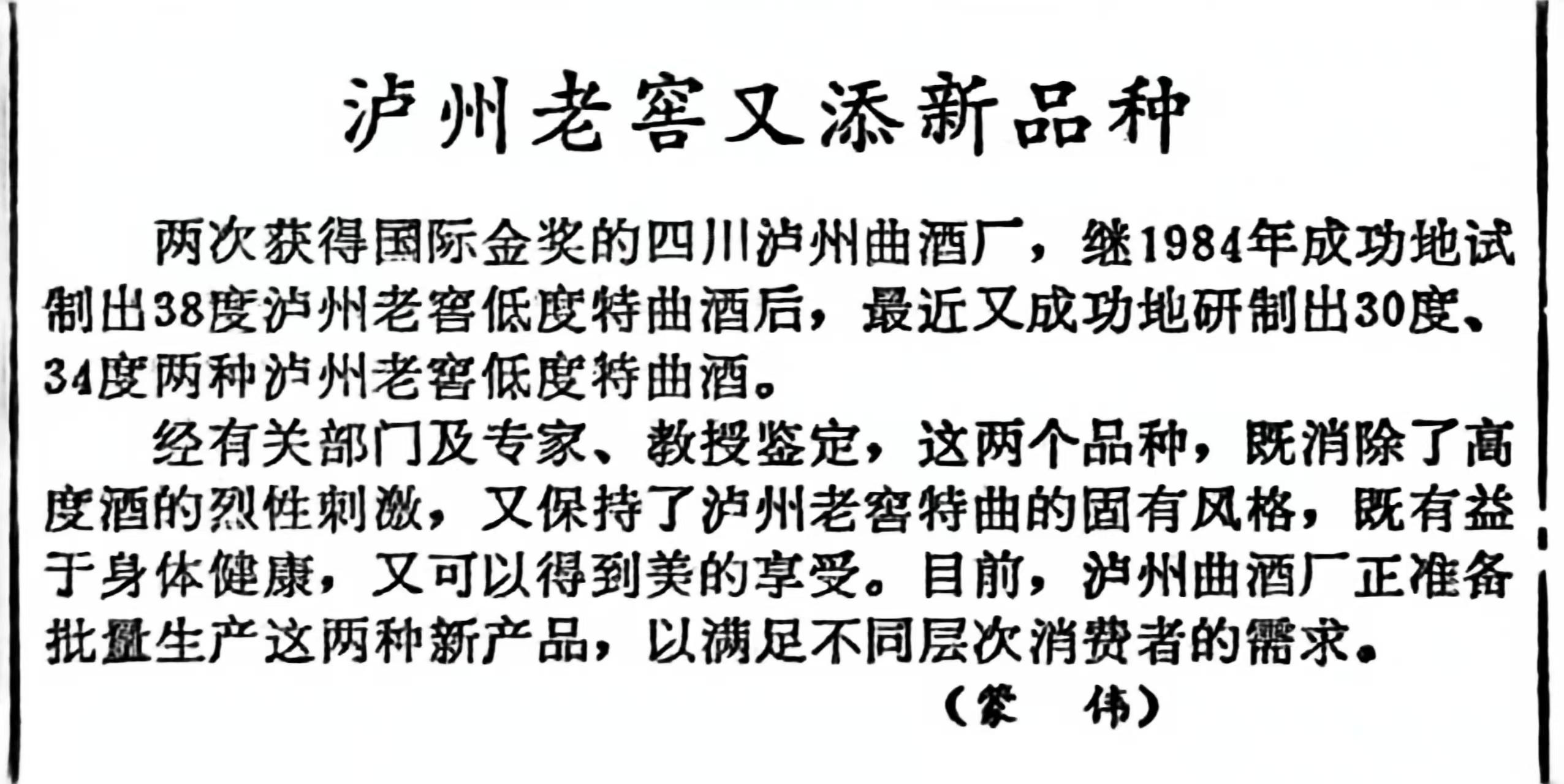
Core Viewpoint - The article highlights the historical significance and innovative journey of Luzhou Laojiao, a leading Chinese liquor brand, particularly focusing on its development of low-alcohol products and the integration of technology in traditional brewing processes [1][3][10]. Group 1: Historical Development - On December 8, 1987, the Economic Reference Daily published an article about Luzhou Laojiao introducing new low-alcohol products, specifically 30-degree and 34-degree varieties, following the successful trial of a 38-degree product in 1984 [1][3][7]. - Luzhou Laojiao has been recognized for its contributions to the low-alcohol segment, receiving high praise for its ability to maintain the unique flavor of its products while reducing alcohol content, which aligns with changing consumer preferences [7][9]. Group 2: Technological Innovation - The company has embraced technological advancements, starting in the 1980s with the development of a computer management system to enhance quality control in brewing processes [11][14]. - Luzhou Laojiao has established a fully automated and intelligent brewing ecosystem, including the construction of a "lighthouse factory" for smart packaging, which significantly improves operational efficiency and reduces costs [14][15]. - The implementation of a digital twin system allows for real-time data analysis, leading to a 45% increase in equipment utilization and a 25% reduction in operational costs [14]. Group 3: Industry Impact - The shift towards low-alcohol products reflects broader trends in the Chinese liquor industry, where consumer demand is moving from high-alcohol content to more palatable options [4][9]. - Luzhou Laojiao's innovations serve as a model for other traditional industries undergoing transformation, showcasing how technology can enhance product quality and operational efficiency [10][15].

泸州老窖(000568) - 泸州老窖股份有限公司对外担保管理制度
2025-12-30 08:32
泸州老窖股份有限公司 对外担保管理制度 (经公司第十一届董事会十九次会议审议通过) 第一章 总则 第一条 为加强泸州老窖股份有限公司(以下简称"公司")对 外担保管理,规范对外担保行为,控制经营风险,根据《中华人民共 和国公司法》《中华人民共和国证券法》《中华人民共和国民法典》 《上市公司监管指引第8号-上市公司资金往来、对外担保的监管要求》 《深圳证券交易所上市公司自律监管指引第1号-主板上市公司规范运 作》《深圳证券交易所股票上市规则》等有关法律、行政法规、部门 规章、规范性文件及《泸州老窖股份有限公司章程》(以下简称"公 司《章程》")的有关规定,制定本制度。 第二条 本制度所称公司是指泸州老窖股份有限公司,子公司是 指本公司拥有实际控制权的子公司。 第三条 对外担保由公司统一管理,未经公司批准,子公司不得 对外提供担保。 公司控股子公司为公司合并报表范围内的法人或者其他组织提供 担保的,公司应当在控股子公司履行审议程序后及时披露。按照深圳 证券交易所《股票上市规则》需要提交公司股东会审议的担保事项除 外。 第四条 公司对外提供担保,除应当经全体董事的过半数审议通 过外,还应当经出席董事会会议的三分之二 ...
泸州老窖(000568) - 第十一届董事会十九次会议决议公告
2025-12-30 08:30
证券代码:000568 证券简称:泸州老窖 公告编号:2025-52 泸州老窖股份有限公司 第十一届董事会十九次会议决议公告 本公司及董事会全体成员保证信息披露的内容真实、准确、完整, 没有虚假记载、误导性陈述或重大遗漏。 一、董事会会议召开情况 泸州老窖股份有限公司(以下简称"公司")第十一届董事会十九 次会议于2025年12月30日以通讯表决的方式召开。召开本次会议的通 知已于2025年12月25日以邮件方式发出,截止会议表决时间2025年12 月30日,共收回11名董事的有效表决票11张。本次董事会会议的召开 符合有关法律、行政法规、部门规章、规范性文件和公司《章程》的 规定。 二、董事会会议审议情况 表决结果:11 票同意,0 票反对,0 票弃权。 具体内容参见同日发布的《泸州老窖股份有限公司对外担保管理 制度》。 三、备查文件 1.经与会董事签字并加盖董事会印章的董事会决议; 2.深交所要求的其他文件。 泸州老窖股份有限公司 1.审议通过了《关于注销参股公司中旅泸州老窖文化旅游发展有 限公司的议案》。 表决结果:11 票同意,0 票反对,0 票弃权。 经与另一出资方香港中旅国际投资有限公司协商一致, ...
17只白酒股下跌 贵州茅台1389.72元/股收盘
Bei Jing Shang Bao· 2025-12-30 07:44
Core Viewpoint - The liquor sector in China is experiencing a slight decline, with major brands showing mixed performance in stock prices, while analysts predict a gradual recovery in the industry by 2026 [1]. Industry Summary - The Shanghai Composite Index closed at 3965.12 points on December 30, with the liquor sector index at 2173.07 points, down 0.51% [1]. - A total of 17 liquor stocks declined, with notable drops in major brands such as Kweichow Moutai, Wuliangye, and Shanxi Fenjiu [1]. - Kweichow Moutai's stock closed at 1389.72 yuan per share, down 0.88% [1]. - Wuliangye closed at 107.36 yuan per share, down 0.65% [1]. - Shanxi Fenjiu closed at 173.05 yuan per share, down 1.11% [1]. - Luzhou Laojiao saw a slight increase, closing at 117.85 yuan per share, up 0.55% [1]. - Yanghe's stock closed at 61.19 yuan per share, down 0.46% [1]. Analyst Insights - Guosheng Securities highlighted that leading companies are actively optimizing supply, with expectations for sales recovery in the upcoming spring festival [1]. - The report anticipates that by 2025, the industry will fully release risks, and by 2026, there will be a dual improvement in supply and demand [1]. - Short-term outlook suggests a recovery in sales during the spring festival, while the medium to long-term perspective indicates a gradual improvement in the industry [1].




坐拥百亿利润的泸州老窖,为何在青岛连设5支基金?
Sou Hu Cai Jing· 2025-12-30 04:00
Core Viewpoint - The article discusses the increasing trend of Chinese liquor companies, particularly Luzhou Laojiao, to diversify their investments beyond traditional liquor production into various industries, indicating a strategic shift in response to market challenges and the search for new growth opportunities [1][9][12]. Group 1: Investment Activities - Luzhou Laojiao has established multiple equity investment partnerships in Qingdao, marking it as a pioneer among liquor companies in this investment strategy [3][6]. - The company has set up several funds, including Jin Jue Investment and Pu Xin Investment, focusing on technology sectors and other emerging industries [5][10]. - In 2023, Luzhou Laojiao formed several investment partnerships in Qingdao, with notable contributions such as 52 million yuan for Qingdao Pu Zhong Equity Investment Partnership and 21.1 million yuan for Qingdao Han Pu Equity Investment Partnership [6][8]. Group 2: Financial Performance - Luzhou Laojiao reported a revenue of 23.127 billion yuan and a net profit of 10.762 billion yuan for the first three quarters of 2023, demonstrating strong financial health despite industry pressures [10][12]. - The company’s third-quarter revenue was 6.674 billion yuan, with a net profit of 3.099 billion yuan, indicating resilience in a challenging market environment [10]. Group 3: Industry Context - The liquor industry is facing significant challenges, including regulatory restrictions and changing consumer preferences, leading to a slowdown in growth and increased competition [12][13]. - A report indicated that 59.7% of liquor companies experienced a decrease in profit margins, highlighting the need for companies to seek new growth avenues [12][13]. - The trend of liquor companies diversifying into investments is seen as a necessary strategy to mitigate risks associated with their core business and to explore new profit centers [13][14].

低度酒品类狂欢下,却赚了个寂寞
3 6 Ke· 2025-12-30 04:00
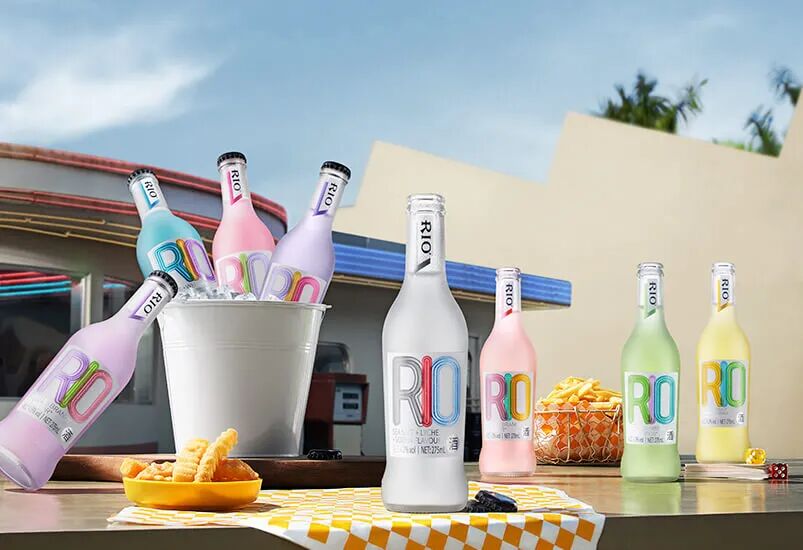
Core Insights - The low-alcohol beverage market in China has rapidly expanded, with market size projected to grow from 200 billion yuan in 2020 to over 570 billion yuan by 2024, and globally reaching 634.17 billion yuan in 2023, expected to exceed 740 billion yuan by 2025 [1][4][6] - The shift in consumer preferences from traditional high-alcohol beverages to low-alcohol options is driven by younger generations seeking healthier and more enjoyable drinking experiences [5][6][8] - The market is becoming increasingly competitive with new brands entering, including traditional liquor companies and retail chains launching their own low-alcohol products [5][9][12] Market Trends - The rise of low-alcohol beverages is characterized by a cultural shift from "drinking for social obligation" to "drinking for personal enjoyment," with 50% of consumption occurring at home and a 56% increase in outdoor activities like camping [5][6] - Young consumers aged 18-35 account for 68% of sales, with a significant portion being female [5][6] - Health concerns are a primary motivator for Gen Z consumers choosing low-alcohol options, as traditional high-alcohol spirits are viewed as outdated [6][8] Competitive Landscape - Established brands like RIO and emerging players such as Mei Jian and Bei Rui Tian Xin are competing for market share, with RIO facing challenges due to declining sales and brand fatigue [2][9][11] - Traditional liquor companies like Moutai and Wuliangye are diversifying into low-alcohol products, while retail chains like Hema and Haidilao are also launching their own offerings [5][9] - The market is characterized by a lack of standout brands, with many new entrants struggling to differentiate themselves in a crowded space [12] Consumer Behavior - Young consumers prefer low-alcohol products that are smooth and sweet, contrasting with the strong flavors of traditional spirits [8] - The use of social media has significantly increased the visibility and popularity of low-alcohol beverages, with discussions on platforms tripling in 2020 [4] - The trend towards low-alcohol beverages is not just a passing fad; it reflects a deeper cultural shift in drinking habits among younger generations [5][6]

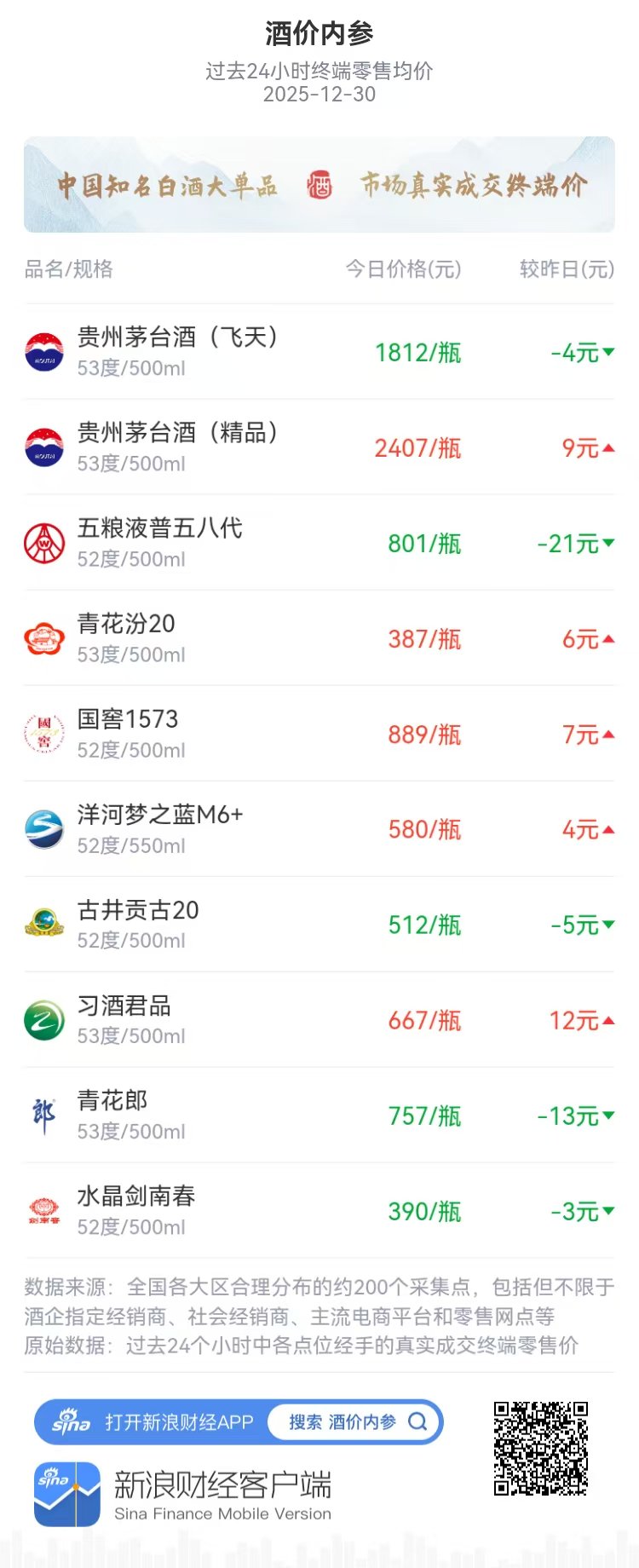
酒价内参12月30日价格发布,习酒君品上涨12元领涨
Xin Lang Cai Jing· 2025-12-30 01:17
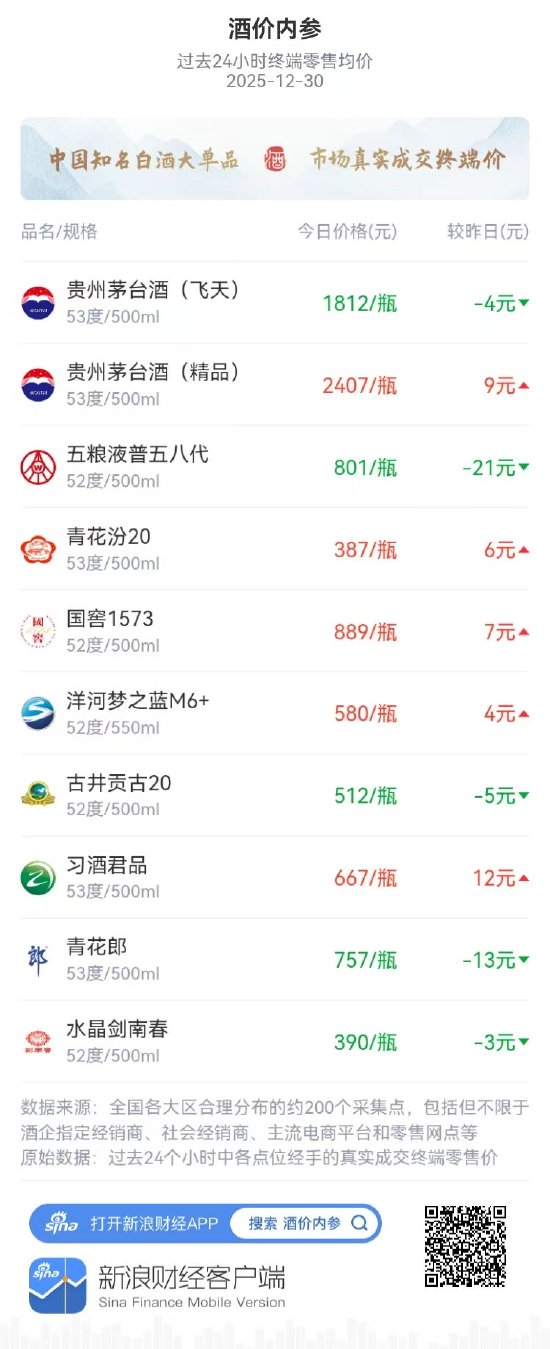
Core Insights - The core viewpoint of the article highlights the recent trends in the Chinese liquor market, particularly focusing on the retail prices of the top ten liquor products, which have shown a slight overall decline after a period of volatility [1][6]. Price Trends - The average retail price of the top ten liquor products is currently 9,202 yuan, down by 8 yuan from the previous day [1][6]. - The market is experiencing a mixed performance with significant fluctuations in individual product prices, reflecting typical year-end trading behaviors influenced by capital and sentiment [7]. Price Increases - Notable price increases include: - Xijiu Junpin, which rose by 12 yuan per bottle, leading the market after three consecutive declines [7]. - Guizhou Moutai (premium) increased by 9 yuan per bottle, marking its third consecutive rise, now priced above 2,400 yuan [7]. - Other increases include: - Guojiao 1573: up 7 yuan per bottle - Qinghua Fen 20: up 6 yuan per bottle - Yanghe Dream Blue M6+: up 4 yuan per bottle [7]. Price Decreases - Significant price declines include: - Wuliangye Pu 58th generation, which dropped by 21 yuan per bottle, nearing the 800 yuan threshold [7]. - Qinghua Lang fell by 13 yuan per bottle after a previous increase of 45 yuan over eight days [7]. - Other decreases include: - Gujing Gonggu 20: down 5 yuan per bottle - Feitian Moutai: down 4 yuan per bottle - Shuijing Jian Nan Chun: down 3 yuan per bottle [7]. Market Dynamics - The article discusses the competitive landscape in the liquor industry, particularly the strategic moves by Langjiu to penetrate the Jiangsu market, which has been traditionally dominated by Yanghe [8]. - The competition among major brands such as Sichuan liquor, Guizhou liquor, and Anhui liquor indicates a shrinking market for smaller enterprises, necessitating larger brands to capture market share from competitors [8].

酒价内参12月30日价格发布 市场高位整理整体价格小幅回调
Xin Lang Cai Jing· 2025-12-30 01:12
Core Viewpoint - The Chinese liquor market is experiencing a high-level consolidation with slight price adjustments, indicating a stable end to the year after significant fluctuations in mid-December [1]. Price Trends - The overall retail price for the top ten liquor products is 9,202 yuan, down 8 yuan from the previous day [1]. - The market shows mixed performance with significant price changes among various products, reflecting typical year-end trading behaviors influenced by capital and sentiment [1]. Price Increases - Xijiu Junpin saw a price increase of 12 yuan per bottle, leading the market after three consecutive declines [1]. - Guizhou Moutai's premium product rose by 9 yuan per bottle, marking its third consecutive increase and surpassing 2,400 yuan per bottle [1]. - Other products with price increases include: - Guojiao 1573: up 7 yuan per bottle [1]. - Qinghua Fen 20: up 6 yuan per bottle [1]. - Yanghe Dream Blue M6+: up 4 yuan per bottle [1]. Price Decreases - Wuliangye Pu 58th generation experienced a notable decline of 21 yuan per bottle, barely maintaining the 800 yuan threshold [1]. - Qinghua Lang saw a decrease of 13 yuan per bottle after a previous increase of 45 yuan over eight days [1]. - Other products with price decreases include: - Gujing Gonggu 20: down 5 yuan per bottle [1]. - Feitian Moutai: down 4 yuan per bottle [3]. - Shuijing Jian'nan Chun: down 3 yuan per bottle [4].
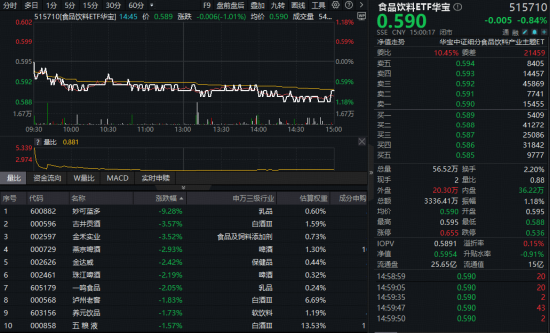
“茅五泸汾洋”重挫,食品饮料ETF华宝(515710)收跌0.84%!茅台董事长喊话“穿越周期”,配置时机渐显?
Xin Lang Cai Jing· 2025-12-29 14:18
Group 1: Market Performance - The food and beverage sector experienced a decline on December 29, with the Food and Beverage ETF Huabao (515710) opening lower and dropping over 1% during the day, ultimately closing down 0.84% [1][8] - Major consumer goods and some liquor stocks performed poorly, with Miaokelan falling by 9.28%, and both Gujing Gongjiu and Jinhai Industrial dropping over 3% [1][8] Group 2: Industry Insights - The chairman of Moutai Group announced at a conference that the primary marketing task for Moutai liquor in 2026 is to focus on consumer needs and promote market-oriented transformation [1][10] - The overall liquor industry is currently in a deep adjustment phase, facing challenges such as high channel inventory and slowing growth rates, but Moutai is optimistic about navigating these challenges [3][10] - The valuation of the food and beverage sector is at a historical low, with the PE ratio of the underlying index for the Food and Beverage ETF Huabao at 20.19, placing it in the 5.77% percentile of the last decade, indicating a potential opportunity for long-term investment [3][11] Group 3: Future Outlook - Analysts predict that the demand for liquor will remain subdued in 2025, continuing the trend of weak seasonal demand, which may lead to further declines in liquor prices [4][11] - The liquor sector is entering a more favorable configuration zone, with expectations that any improvement in supply and demand could act as a catalyst for recovery [5][11] - The Food and Beverage ETF Huabao is recommended for investors looking to allocate to core assets in the food and beverage sector, with a significant portion of its holdings in leading liquor stocks [5][12]