
LZLJ(000568)

Search documents
自由现金流量迎投资元年 上市公司自由现金流量创造力等三大榜单发布
Jing Ji Guan Cha Wang· 2025-10-29 06:24
Core Insights - The 2024 FCF Top 99 list was released on October 28, highlighting the free cash flow generation capabilities of A-share listed companies in China [1] - The report series, including CVA Top 50 and EVA Top 99, aims to reveal the shareholder value creation abilities of these companies [1] - The focus on free cash flow generation has led to the introduction of various index products linked to free cash flow by index companies [1] FCF Top 99 Summary - Guizhou Moutai (600519) and Focus Media (002027) share the highest net asset free cash flow return rate (FCFOE) at 0.361, up from 0.277 in 2023 [3] - Among the 16 companies listed continuously from 2016 to 2024, five are in the liquor sector, and two are in home appliances [3] - Gree Electric (000651) has seen a decline in ranking from a three-time champion to 8th place [3] Company Ownership Structure - The 2024 list includes 35 state-controlled companies, a decrease of 11 from the previous year, while non-state-controlled companies increased to 64, surpassing 60% [4] - The pharmaceutical manufacturing industry leads with 15 companies, followed by the beverage and refined tea manufacturing, and electrical machinery and equipment manufacturing with 12 each [4] CVA Top 50 Summary - The CVA Top 50 report indicates that only companies generating net profits or free cash flow exceeding the cost of equity capital create true shareholder value [5] - Among the 11 companies consistently listed from 2016 to 2024, five are in the liquor sector [5] - The number of state-controlled companies on the list decreased to 18, while non-state-controlled companies rose to 32, making up 64% [5] EVA Top 99 Summary - The EVA Top 99 list emphasizes that economic value added (EVA) reflects the true shareholder value creation by accounting for the cost of equity capital [6] - Chongqing Beer (600132) topped the list with an EVA return rate (EVAOE) of 0.297, while Guizhou Moutai ranked second at 0.235 [8] - The liquor industry dominates the top three positions in the EVA rankings [8] Long-term Trends - From 2016 to 2024, the liquor sector maintained a strong presence with six companies consistently listed, while the number of state-controlled companies decreased to 27 [9] - Non-state-controlled companies increased to 72, representing 72% of the total [9]






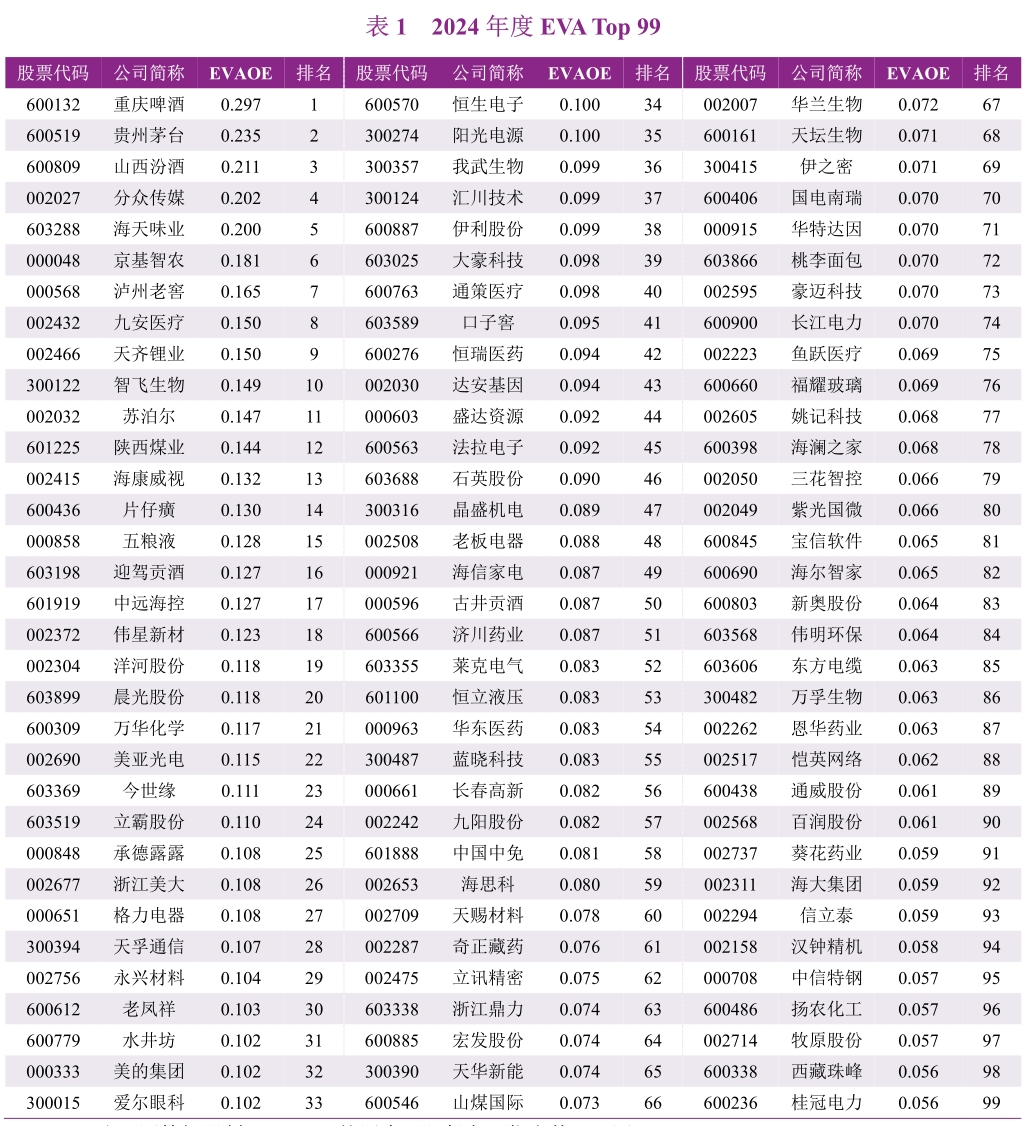
2024年度A股上市公司经济增加值创造力99强(EVA Top 99)报告
Jing Ji Guan Cha Wang· 2025-10-29 05:52
Core Insights - The 2024 EVA Top 99 report highlights the top A-share listed companies in terms of Economic Value Added (EVA), emphasizing the importance of high-quality development for micro-enterprises in achieving broader economic goals [2][3]. Research Purpose and Significance - The report aims to assess how micro-enterprises can achieve high-quality development, which is crucial for overall economic progress [2]. - Economic Value Added (EVA) is defined as net profit minus the cost of equity capital, indicating true shareholder value creation [2][3]. Methodology - The sample for the report includes A-share non-financial companies that have been listed for at least ten years [8]. - Companies must meet specific criteria, including having unqualified audit opinions for the last three years and being in normal operational status [9][10]. - The EVA performance is measured using the Net Asset Economic Value Added Return Rate (EVAOE), which reflects the long-term shareholder value creation [14][16]. 2024 EVA Top 99 Companies - The report lists the top companies based on their EVAOE, with notable entries including: - Chongqing Beer (EVAOE: 0.297) - Kweichow Moutai (EVAOE: 0.235) - Shanxi Fenjiu (EVAOE: 0.211) [7]. New Entrants and Exits - New companies entering the 2024 list include: - Yingjia Gongjiu - Morning Light Co. - Liba Co. [20]. - Companies that dropped off the list include: - Shuanghui Development - Rongjie Co. [21]. Industry Distribution - The report categorizes the companies by industry, with the pharmaceutical manufacturing sector having the highest representation (16 companies) [25]. - Other notable sectors include electrical machinery and equipment manufacturing (14 companies) and beverage manufacturing (13 companies) [25]. Ownership Structure - The report indicates a mix of state-owned and non-state-owned enterprises among the top companies, with 22 state-controlled firms and 72 non-state-controlled firms [27]. Regional Distribution - The majority of the top companies are located in eastern China, with a notable increase in representation from provinces like Jiangsu and Guangdong [35].

白酒板块午盘下跌 贵州茅台跌幅0.93%
Bei Jing Shang Bao· 2025-10-29 05:29
Core Viewpoint - The overall market showed a collective increase, while the liquor sector experienced a decline, indicating mixed performance within the industry [1] Market Performance - The three major indices collectively rose, with the Shanghai Composite Index reaching 4002.83 points, an increase of 0.37% [1] - The liquor sector closed at 2246.58 points, down 0.89%, with 19 liquor stocks declining [1] Individual Stock Performance - Kweichow Moutai closed at 1431.58 CNY per share, down 0.93% [1] - Wuliangye closed at 118.58 CNY per share, down 1.27% [1] - Shanxi Fenjiu closed at 186.00 CNY per share, down 0.69% [1] - Luzhou Laojiao closed at 129.30 CNY per share, down 0.91% [1] - Yanghe Brewery closed at 69.19 CNY per share, down 0.63% [1] Industry Outlook - Dongxing Securities noted that short-term price fluctuations do not affect the recovery process of the industry [1] - Leading companies, particularly Kweichow Moutai, are showing strong performance that can withstand economic cycles, with signs of bottoming out becoming more evident [1]

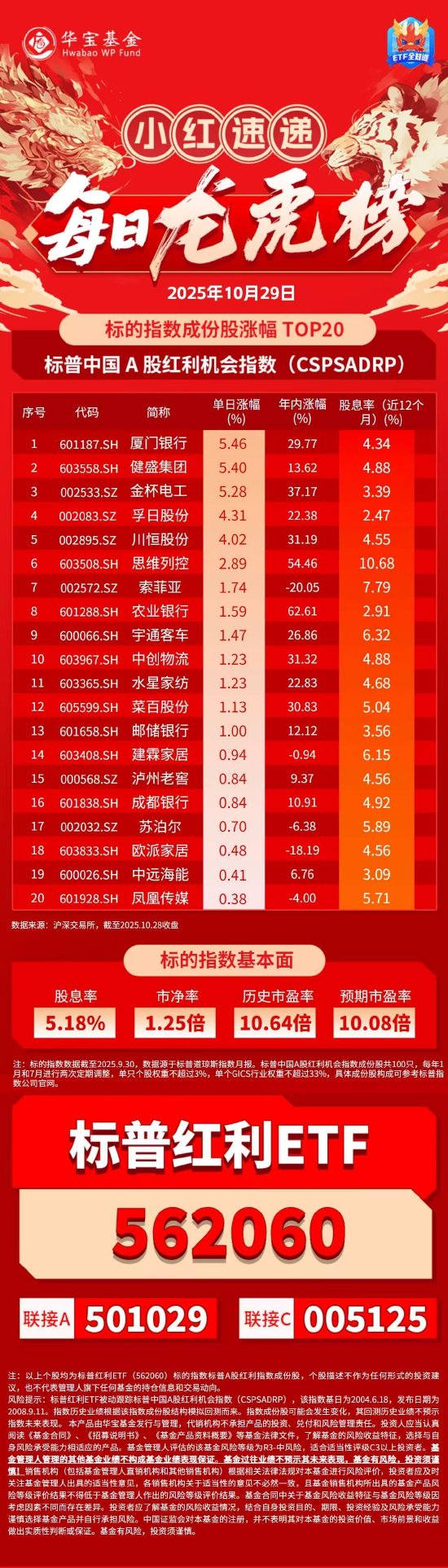
小红日报|银行板块彰显韧性,标普红利ETF(562060)标的指数收跌0.41%
Xin Lang Ji Jin· 2025-10-29 01:42
Group 1 - The article highlights the top 20 stocks in the S&P China A-Share Dividend Opportunity Index, showcasing their daily and year-to-date performance along with dividend yields [1] - Xiamen Bank (601187.SH) leads with a daily increase of 5.46% and a year-to-date increase of 29.77%, offering a dividend yield of 4.34% [1] - Other notable performers include Jian Sheng Group (603558.SH) with a daily rise of 5.40% and a year-to-date increase of 13.62%, and Jinbei Electric (002533.SZ) with a daily increase of 5.28% and a year-to-date increase of 37.17% [1] Group 2 - The article also mentions that MACD golden cross signals have formed, indicating a positive trend for certain stocks [3]





川企百强!五年洗牌,谁立潮头?
Sou Hu Cai Jing· 2025-10-29 01:20
Core Insights - The 2025 Sichuan Top 100 Enterprises list highlights significant trends and changes in the province's corporate landscape, with a focus on the emergence of new leaders and the performance of established companies [1][3]. Group 1: Top Enterprises - The number of billion-dollar enterprises in Sichuan has increased from 4 in 2021 to 8 in 2025, indicating robust growth among leading companies [1][3]. - The top five companies by revenue are: 1. Tongwei Group Co., Ltd. - 24,137,998 million CNY 2. Sichuan Yibin Wuliangye Group Co., Ltd. - 19,529,677 million CNY 3. Sichuan Changhong Electric Holding Group Co., Ltd. - 15,267,474 million CNY 4. Sichuan Energy Development Group Co., Ltd. - 11,745,767.72 million CNY 5. Qiya Group Co., Ltd. - 11,035,872.53 million CNY [4][5]. - Qiya Group made its debut in the top rankings, showcasing rapid growth and a diverse industrial portfolio [3][5]. Group 2: Industry Trends - In 2025, billion-dollar enterprises accounted for 32.63% of total revenue, serving as a stabilizing force in the complex economic environment [3]. - New entrants in the hundred-million revenue category reflect a shift towards emerging industries such as renewable energy, smart manufacturing, and finance [11][13]. - The list features over ten new hundred-million revenue companies, indicating a dynamic shift in industry focus and growth potential [11][13]. Group 3: Regional Distribution - Chengdu remains the dominant city, with 64 enterprises listed in 2025, although there is a notable increase in companies from Mianyang and Luzhou [22][26]. - The concentration of top enterprises in Chengdu highlights regional economic disparities, prompting calls for differentiated development strategies across cities [26][28]. Group 4: Ownership Structure - State-owned enterprises dominate the list, comprising over 70% of the top companies, while private enterprises, though fewer, show strong market vitality with revenues exceeding 10 billion CNY [28]. - The shift towards high-quality development in the private sector emphasizes the need for efficiency and innovation [28].




白酒行业周期专题 2:以史为镜,当前时点为什么我们认为白酒进入布局阶段?
Guoxin Securities· 2025-10-28 12:10
Investment Rating - The report maintains an "Outperform" rating for the liquor industry [5][6]. Core Viewpoints - The current market for the liquor sector shows divergence, with significant year-on-year performance declines expected for liquor companies in Q3 2025. However, both valuation and holdings are at low levels, and positive factors on both supply and demand sides are increasing [1][4]. - Historical analysis from 2013-2015 indicates strong similarities between the current cycle and previous ones, suggesting that buying opportunities may accelerate [1][4]. Summary by Sections Price and Performance Trends - Most companies confirmed their stock price bottoms between Q4 2013 and Q1 2014, with performance declines starting in Q3 2013. Despite the declining performance, stock prices showed moderate reactions, following the overall market uptrend [2][7]. - The stock price performance of individual companies remains closely tied to their fundamentals, with regional leaders like Gujing and Laobaigan showing smaller declines compared to the overall market [2][13]. Company Strategies - Companies are leveraging channels to amplify brand and product advantages during the adjustment phase. High-end liquor brands focus on maintaining brand strength, with Moutai shifting its focus to customer expansion [3][32]. - Regional leaders are retreating to core markets while enhancing their presence in lower-tier markets, with companies like Yanghe and Gujing focusing on channel cultivation [3][39]. Investment Recommendations - The report suggests a two-phase recovery path for industry valuations. The first phase is driven by demand recovery, with expectations for Moutai's PE ratio to recover from 20x to 25x, corresponding to a dividend yield of about 3% [4][17]. - The second phase anticipates a return to long-term confidence in liquor assets, with industry PE potentially reaching 30x by Q4 2026. Recommended stocks include Luzhou Laojiao, Moutai, and Shanxi Fenjiu, with a watch on Wuliangye and Yanghe for potential recovery [4][5].

白酒行业周期专题2:以史为镜,当前时点为什么我们认为白酒进入布局阶段?
Guoxin Securities· 2025-10-28 10:59
Investment Rating - The report maintains an "Outperform" rating for the liquor industry [5][6] Core Viewpoints - The current market for the liquor sector shows divergence, with significant year-on-year performance declines expected for Q3 2025, yet both valuation and holdings are at low levels, indicating potential positive changes in supply and demand dynamics [1][4] - Historical analysis from 2013-2015 suggests that the current cycle has strong similarities, indicating that buying opportunities may accelerate [1][4] - The report anticipates a two-phase recovery in industry valuations, with the first phase driven by demand recovery and the second phase contingent on improved supply-demand relationships and market confidence in long-term liquor assets [4][17] Summary by Sections Price and Performance Analysis - Most companies confirmed their stock price bottoms between Q4 2013 and Q1 2014, with performance declines starting in Q3 2013, while stock prices remained relatively stable [2][7] - The report highlights that stock price performance is closely linked to fundamental performance, with regional leaders showing less decline compared to the overall market [2][13] Company Strategies - Companies are leveraging channels to enhance brand and product advantages during the adjustment phase, with a focus on maintaining brand strength for high-end products [3][30] - Regional leaders are concentrating on core markets and enhancing distribution channels, while expansion-oriented companies are increasing their presence in mid-to-low-end products [3][30] Investment Recommendations - The report suggests that the industry is entering a layout phase, recommending investments in stable-performing companies with long-term growth potential, such as Luzhou Laojiao, Guizhou Moutai, and Shanxi Fenjiu, while also monitoring Wuliangye and Yanghe for potential recovery [4][5]
押宝年轻化赛道,20多度白酒能否“破圈”?
Bei Ke Cai Jing· 2025-10-28 08:55
Core Viewpoint - The recent trend in the Chinese liquor industry is a shift towards low-alcohol white spirits, with major brands launching products with alcohol content below 30 degrees, aiming to attract younger consumers and adapt to changing consumption preferences [1][3][5]. Group 1: Market Trends - Numerous brands showcased low-alcohol white spirits at recent trade fairs, reigniting discussions on the trend of lower alcohol content in white liquor [1][3]. - The market for low-alcohol white spirits is significant, with approximately 450 billion yuan in market size, accounting for nearly half of the total white liquor consumption [7]. - The penetration rate of low-alcohol spirits is increasing, with regions like Hebei and Shandong showing over 80% and 70% penetration rates, respectively [7]. Group 2: Consumer Preferences - Younger consumers prefer low-alcohol options for their comfort and drinking experience, moving away from traditional drinking cultures [5][11]. - The perception that higher alcohol content equates to better quality is fading, with consumers now prioritizing flavor and overall drinking experience [11][12]. - The trend towards low-alcohol spirits is seen as a response to the lifestyle changes of younger generations, who favor casual drinking and home cocktail preparation [5][11]. Group 3: Industry Response - Major liquor companies are actively developing low-alcohol products, with brands like Wuliangye and Gujinggong launching new offerings specifically targeting younger demographics [4][10]. - The industry is undergoing a transformation, with a focus on creating products that emphasize flavor and experience rather than just alcohol content [10][12]. - The introduction of new standards for low-alcohol spirits aims to address quality concerns and align with consumer demand for diverse and personalized products [9][10]. Group 4: Challenges and Future Outlook - The transition to low-alcohol products requires time and successful market examples to educate consumers [12][13]. - Companies must not only adjust alcohol content but also enhance brand positioning and marketing strategies to resonate with younger consumers [13]. - The future of the industry may see a complete redefinition of quality metrics, moving away from alcohol content as the primary indicator of product value [10][12].


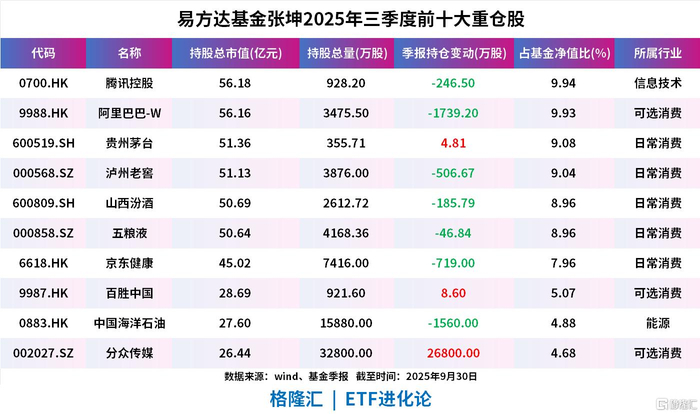
张坤三季度调仓动态出炉!或被动减持腾讯、阿里巴巴,顺丰跌出前十大重仓股名单,大手笔加仓分众传媒
Ge Long Hui A P P· 2025-10-28 08:23
Core Viewpoint - Zhang Kun, a prominent fund manager at E Fund, has disclosed the top ten holdings of four funds as of Q3 2025, indicating a strategic shift in investment focus towards consumer and technology sectors, while also reflecting on the long-term growth potential of China's consumption market [1][9]. Fund Holdings Summary - The combined top ten holdings of Zhang Kun's four funds include Tencent Holdings, Alibaba-W, Kweichow Moutai, Luzhou Laojiao, Shanxi Fenjiu, Wuliangye, JD Health, Yum China, CNOOC, and Focus Media [1]. - The total market value of the top holdings is as follows: - Tencent Holdings: 56.18 billion - Alibaba-W: 56.16 billion - Kweichow Moutai: 51.36 billion - Luzhou Laojiao: 51.13 billion - Shanxi Fenjiu: 50.69 billion - Wuliangye: 50.64 billion - JD Health: 45.02 billion - Yum China: 28.69 billion - CNOOC: 27.60 billion - Focus Media: 26.44 billion [2]. Changes in Holdings - Compared to Q2 2025, the only change in the top ten holdings was the exit of SF Express, replaced by Focus Media [2]. - In Q3, Zhang Kun reduced his holdings in Tencent and Alibaba by 2.465 million shares and 17.392 million shares, respectively, likely due to price increases of 31% and 61% during the quarter [5]. - In the liquor sector, there was an increase in Kweichow Moutai by 48,100 shares, while reductions were made in Luzhou Laojiao, Shanxi Fenjiu, and Wuliangye [6]. Sector Analysis - In the consumer sector, there were reductions in Luzhou Laojiao and Shanxi Fenjiu, but increases in Kweichow Moutai and Wuliangye, indicating a positive outlook on premium liquor [7]. - The new investments in Yum China and Focus Media reflect expectations of recovery in the restaurant and advertising sectors [7]. - In the technology sector, there were reductions in Tencent and Alibaba across all funds, while new positions were taken in Google-A and reductions in ASML and TSMC, indicating a shift towards more globally competitive tech giants [8]. Long-term Outlook - The team believes that China's consumption growth is likely to outpace GDP growth, supported by a low consumer spending ratio relative to GDP compared to other major economies [9]. - The potential for a unified market of 1.4 billion people offers significant scale advantages for product development and sales [9]. - The current low valuation levels provide a safety margin for investments in the domestic consumption market, which is expected to remain fertile ground for long-term investment [9].

白酒板块午盘微跌贵州茅台上涨0.46%
Xin Lang Cai Jing· 2025-10-28 07:33
Core Viewpoint - The Shanghai Composite Index rose to 4000 points, reflecting a 0.21% increase, while the liquor sector showed mixed performance with a slight decline of 0.09% in the afternoon session [1] Company Performance - Kweichow Moutai closed at 1447.00 CNY per share, up 0.46% - Wuliangye closed at 120.35 CNY per share, up 0.05% - Shanxi Fenjiu closed at 189.12 CNY per share, up 2.31% - Luzhou Laojiao closed at 131.16 CNY per share [1] Market Analysis - According to Huachuang Securities, the performance in different consumption scenarios varies, with business banquets showing weak demand, while mass consumption and wedding banquets remain relatively strong with a smaller decline in Q3 - There is an observed improvement in high-end gifting ahead of the festival season - Liquor companies are adopting a more pragmatic approach, accelerating adjustments to clear inventory and reduce channel pressure [1]