
CHANGAN AUTOMOBILE-B(000625)

Search documents
天枢智能品牌率先搭载深蓝和启源车型!朱华荣首次对外明确中国长安核心业务,微调2030年销量目标
Mei Ri Jing Ji Xin Wen· 2025-09-06 06:44
Group 1 - The core business of Changan Automobile includes three major smart electric vehicle brands: Avita, Deep Blue, and Changan Qiyuan [1] - Changan's sales target for 2030 has been adjusted to ensure production and sales of 4 million vehicles, with a goal of 5 million, where over 60% will be new energy vehicles and over 30% will be from overseas markets [1] - The company aims to achieve a sales increase of at least 1 million vehicles annually over the next five years, with a current target of 3 million vehicles for this year [1] Group 2 - On September 5, Changan launched the "Tianshu Intelligent" brand, focusing on driving assistance, cockpit, and chassis technologies, utilizing core technologies such as end-to-end interactive navigation assistance and distributed electric drive [3] - Changan plans to expand Tianshu Intelligent into emerging industries like humanoid robots and flying cars, with goals to mass-produce humanoid robots by 2028 and release the first manned flying car by 2026 [3][4] - The company is actively recruiting for its humanoid robot development project, seeking engineers in various fields including simulation, testing, and AI technology [4] Group 3 - Changan has accelerated its smart technology development, announcing that from 2025, it will no longer develop non-smart products and plans to launch 35 new smart vehicles in the next three years [4] - The company emphasizes both independent research and collaborative innovation in its smart technology development, with a focus on the SDA platform and Tianshu model [4] - The Tianshu Intelligent technology will first be applied to the new models Deep Blue L06 and Qiyuan A06, with the latter featuring advanced communication protocols and dual power systems [4][6] Group 4 - Changan is restructuring its software development teams, consolidating resources from multiple subsidiaries into Changan Technology, which will be managed by Vice President He Gang [6] - Changan Technology is a wholly-owned subsidiary aimed at transforming Changan into a technology company, with plans to invest over 150 billion yuan and build a team of over 10,000 for technological innovation [6] - The company is enhancing its capital operation capabilities and pursuing financing and listing for its subsidiaries, while also collaborating with tech giants like Tencent and Huawei [6]


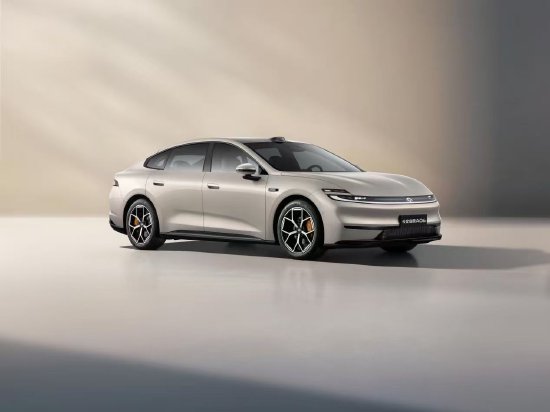
长安启源A06首秀:配备800V碳化硅高压平台+6C闪充,纯电续航630km
Xin Lang Ke Ji· 2025-09-06 05:44
Core Insights - Changan Automobile launched its intelligent brand "Tianshu Intelligent" and introduced the Changan Qiyuan A06, a new family sedan designed to address various consumer needs [1] Group 1: Product Features - The Changan Qiyuan A06 features a space utilization improvement of over 10% through innovative materials and structure [1] - Charging time is reduced by 65% compared to 1.6C and by 40% compared to 3C, with energy consumption lowered by 15.7% [1] - The vehicle offers a spacious interior with a total space of 2168L, accommodating up to 42 pieces of 20-inch luggage [1] Group 2: Comfort and Technology - The A06 is equipped with four-season zero-pressure electric massage seats and features a 145° infinitely adjustable rear seat [2] - It includes the Tianshu AI intelligent cockpit and a human-machine interaction system, along with laser radar and an 800V silicon carbide high-voltage platform [2] - The vehicle has a pure electric range of 630 km and an energy consumption of 11.3 kWh per 100 km [2] Group 3: Safety Features - The vehicle's body structure includes a "ten horizontal and nine vertical" steel-aluminum hybrid design, with high-strength steel and aluminum alloy making up 82.9% [2] - The battery pack features a protective structure with multiple layers and 24-hour monitoring for safety risk alerts [2]
长安汽车发布智能化新品牌“天枢智能”,朱华荣:安全是智能化的目标和底线
Xin Lang Cai Jing· 2025-09-06 05:19
Core Insights - Changan Automobile officially launched its intelligent brand "Tianshu Intelligent" at the Fifth Changan Automobile Technology Ecological Conference, focusing on driving assistance, cabin, and chassis areas to provide "extremely safe intelligent travel solutions" [1] Group 1: Brand and Technology Development - The brand "Tianshu Intelligent" aims to address the evolving safety risks associated with advanced technology, shifting from traditional hardware risks to complex software system risks [1] - Changan's Chairman Zhu Huarong emphasized that safety is the ultimate goal and bottom line of intelligence, reflecting the company's long-standing commitment to safety over its 41 years of vehicle manufacturing [1] Group 2: Safety Philosophy - Changan is expanding its safety philosophy from a narrow focus on physical protection to a broader "pan-safety" system that includes driving safety, health safety, psychological safety, and privacy safety [1] - This comprehensive safety concept will be fully integrated into the development of Changan's intelligent technologies, culminating in the establishment of the "Tianshu Intelligent" brand [1]
新央企首次“科技大秀” 长安汽车正式发布智能化新品牌
Zheng Quan Ri Bao Wang· 2025-09-06 04:44
Core Viewpoint - Changan Automobile officially launched its intelligent brand "New Changan·New Safety - Tian Shu Intelligent" at the fifth Technology Ecology Conference, aiming to provide "extremely safe intelligent travel solutions" [1][2] Group 1: Brand Launch and Objectives - The launch event took place from September 5 to September 8, 2025, in Chongqing, featuring new vehicle releases from brands under Changan, including Avita and Deep Blue [1] - The brand focuses on building a key technology platform centered around driving assistance, cabin, and chassis, establishing a new safety benchmark for intelligent travel [1][2] Group 2: Technological Innovations - Changan's intelligent platform incorporates 62 key technologies, achieving 96 functional scenarios, with 8 being industry firsts [4] - The platform emphasizes proactive intelligent safety with a goal of "zero accidents, zero casualties," utilizing advanced technologies such as laser radar and AI-driven learning from real-world driving data [2][3] Group 3: Research and Development - Changan has established 44 technology research and product development centers across 16 fields, supported by a 24,000-member engineering R&D team [5] - The company is committed to increasing R&D investment and has plans for future innovations, including humanoid robots and flying cars, aiming for significant milestones by 2028 and beyond [5]
长安启源A06全球首秀 金钟罩电池“四横三纵全面护航家庭安全出行
Zheng Quan Ri Bao Wang· 2025-09-06 04:44
Core Viewpoint - The fifth Chang'an Automobile Technology Ecological Conference showcased the company's technological innovations in the context of the smart automotive era, highlighting the launch of the intelligent brand "Tianshu Intelligent" and the global debut of the Chang'an Qiyuan A06 model, which aims to enhance user experience in smart mobility [1] Group 1: Product Features - The Chang'an Qiyuan A06 is designed to meet the diverse needs of mainstream family users by offering enhanced space, comfort, intelligence, and safety [1] - The vehicle achieves a space utilization improvement of over 10% through innovative material and structural integration [4] - The charging time is reduced by 65% compared to 1.6C and by 40% compared to 3C, with energy consumption lowered by 15.7% [4] - The vehicle features a pure software-defined architecture, with a 140% increase in computing power for the vehicle control chip, enabling millisecond-level safety responses [4][5] Group 2: Technological Innovations - The Qiyuan A06 is the first pure electric sedan on the SDA (Software-Driven Architecture) platform, equipped with advanced features such as a laser radar typically found in vehicles priced at 200,000 yuan [5] - The vehicle offers a charging experience of "1 second for 1 kilometer" with an 800V silicon carbide high-voltage platform and 6C fast charging capabilities [5] - The vehicle has a pure electric range of 630 km and an energy consumption of only 11.3 kWh per 100 km, allowing for a weekly charging frequency of once for daily commuting [5] Group 3: Safety Features - The Qiyuan A06 employs a "ten horizontal and nine vertical" Ark cage structure with a high-strength steel and aluminum alloy ratio of 82.9%, enhancing collision energy absorption efficiency by 70% [5] - The battery pack features a robust aluminum alloy structure with multiple layers of protection and 24-hour monitoring for safety risk alerts within 30 seconds [6]
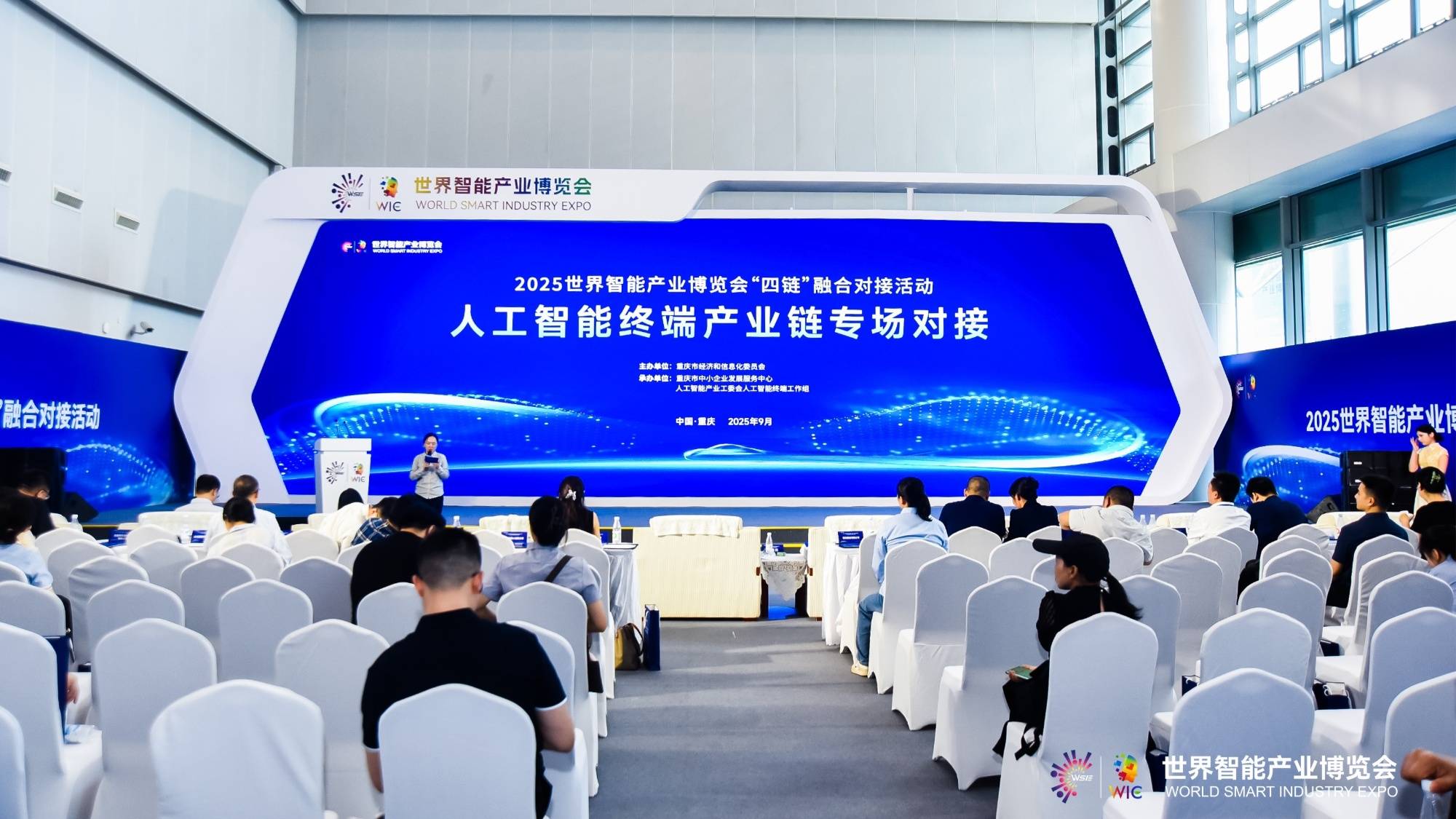
“智”感未来|重庆举办2025智博会“四链”融合对接活动
Sou Hu Cai Jing· 2025-09-06 03:42
Core Insights - The 2025 World Intelligent Industry Expo's AI terminal industry chain event was held in Chongqing, with over 200 participants aimed at promoting supply-demand connections in the industry [1][3] - The event was guided by the Ministry of Industry and Information Technology and local economic information committees, focusing on enhancing the AI terminal ecosystem through collaboration among various stakeholders [3] Group 1: Event Overview - The event featured application scenario demand sharing, supply capability demonstrations, and one-on-one exchange sessions [3] - Key industry players such as Huawei, Lenovo, and Seres shared insights on AI terminal ecosystems and strategic alliances [3] Group 2: Company Contributions - Huawei discussed the development trends of AI terminal intelligent ecosystems [3] - Lenovo presented its AIPC upgrade and open collaboration model [3] - Seres introduced its strategies for automotive transformation and strategic alliances [3] - Other companies like OPPO and Vision Source shared trends in AI smartphones and interactive displays [3] Group 3: Supply Capability Demonstrations - Beidou Zhili showcased AI applications in automotive cockpits [3] - Ruishi Chuangxin presented its achievements in RF front-end layout and technology transformation [3] - Qiteng Robotics demonstrated its multi-field implementation of 3D inspection products [3] - Local companies like Chongqing Chuan Yi Microcircuit and Chongqing Blue Coast Technology displayed their core products [3] Group 4: Networking and Collaboration - Leading companies such as Changan Automobile, Seres, Huawei, and Xiaomi engaged in in-depth discussions with small and medium enterprises from across the country [3] - The event fostered a vibrant atmosphere for collaboration, effectively building a platform for the coordinated development of the industry chain [3]



研判2025!中国车规级SOC芯片行业产业链、发展现状、细分市场、企业布局及发展趋势分析:舱驾融合驶入快车道,多企业布局加速SOC芯片国产化替代[图]
Chan Ye Xin Xi Wang· 2025-09-06 00:50
Core Insights - The automotive-grade SoC (System on Chip) chips are essential for vehicle intelligence, covering smart cockpit and autonomous driving, and are becoming key replacements for traditional ECUs as automotive electronic architectures upgrade [1][2] - The smart cockpit market is expected to double globally from $33.16 billion in 2021 to $70.63 billion by 2024, with China experiencing a growth rate exceeding 31% [1][8] - The penetration rate of cockpit domain controllers in China is projected to reach 29.37% by 2024, highlighting the potential in lower-tier markets [1][8] - Autonomous driving is accelerating towards L3 level, with significant penetration expected by 2025, and L4 level projected to reach 4.4% by 2027 [1][9] Industry Overview - Automotive-grade SoC chips are integrated circuits designed for automotive electronic systems, combining processors, memory, interfaces, and sensors into a single chip to enable functionalities like autonomous driving and smart cockpit [2][3] - The industry is characterized by a clear upstream and downstream collaboration, with upstream relying on imported IP cores and semiconductor materials, while the midstream chip design is active with companies like Horizon Robotics and Black Sesame [6][7] Market Segmentation - The automotive-grade SoC chips are primarily divided into two categories: smart cockpit SoCs focusing on CPU/GPU performance and multimedia processing, and autonomous driving SoCs emphasizing AI computing power and functional safety [3][5] - The smart cockpit market is rapidly growing, with a projected compound annual growth rate (CAGR) of 28.66% from 2021 to 2024, and expected to reach $148.41 billion by 2030 [8] - The autonomous driving sector is transitioning from ADAS to higher-level autonomous driving, with L3 technology expected to be implemented in 2024 [9] Competitive Landscape - The smart cockpit chip market is currently dominated by foreign companies, with Qualcomm, AMD, and Renesas holding 85% of the market share by 2024, while domestic suppliers have increased their market share from less than 3% to over 10% [12][13] - The autonomous driving SoC market is primarily led by Nvidia, Tesla, and Mobileye, but domestic companies like Huawei and Horizon Robotics are gaining traction [13] Future Trends - The automotive-grade SoC industry is evolving towards high computing power, low power consumption, and increased localization, with a target of achieving over 70% localization by 2028 [14][15] - The demand for high-performance SoC chips is expected to grow significantly as autonomous driving capabilities penetrate lower-tier vehicle markets [16] - The integration of chip technology with algorithms and tools is expected to enhance the competitive edge of domestic manufacturers, fostering a collaborative ecosystem [15][16]





理想、比亚迪降速,8月国产新能源全面乱战
Tai Mei Ti A P P· 2025-09-06 00:27
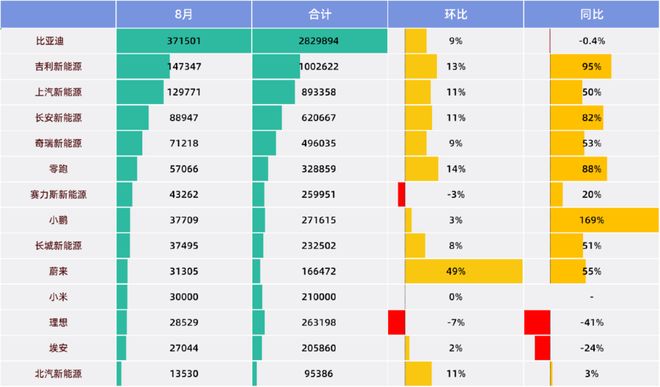
Core Viewpoint - The electric vehicle market is experiencing significant changes, with traditional and new players facing varying degrees of success and challenges, leading to a reshaping of market dynamics and competition. Group 1: Sales Performance - In December last year, Li Auto achieved a remarkable sales figure of 58,000 units, but by August 2025, its sales plummeted to 28,529 units, placing it at the bottom of the "Wei Xiaoli" rankings [1] - In August, 14 major automakers reported sales, with a median sales figure of 40,486 units, reflecting a year-on-year increase of 4,717 units, although there was a month-on-month decline [2] - BYD maintained its dominance with sales of 371,500 units in August, significantly outpacing competitors [2][23] Group 2: Market Segmentation - The market is divided into three tiers: BYD leads as a standalone leader, followed by traditional automakers like Geely, SAIC, Changan, and Chery in the second tier, while new forces and weaker performers fall into the third tier [2][4] - The number of brands achieving monthly sales over 10,000 has increased, with notable performances from Geely's Galaxy, Leap Motor, and NIO [6] Group 3: Brand Dynamics - Geely's Galaxy brand has become a strong contender, achieving over 100,000 units in monthly sales for three consecutive months [6] - NIO's sales surged to 16,434 units in August, marking a significant recovery [21] - Li Auto's new model, the i8, faced challenges due to safety concerns, leading to a price adjustment shortly after its launch [13][22] Group 4: Competitive Landscape - The competitive landscape is shifting, with previously strong players like Li Auto and Aion facing declines, while brands like NIO, Xpeng, and Leap Motor are gaining traction [11][32] - BYD's sales growth is slowing, and it faces increasing pressure from competitors in the second tier [4][25] Group 5: International Expansion - Companies are increasingly focusing on international markets, with BYD exporting vehicles to Europe and establishing assembly plants in Malaysia [16][17] - Chery has emerged as a leader in overseas sales, delivering 129,400 units in August [17] Group 6: Future Outlook - The market is expected to continue evolving, with companies like Li Auto aiming to regain momentum through new model launches and strategic adjustments [22][32] - The overall market dynamics indicate that no company can claim stability, as competition remains fierce and unpredictable [32]



今日新闻丨全新问界M7预售1小时,小订突破10万台!长安汽车发布天枢智能品牌!新款阿维塔07开启预售!
电动车公社· 2025-09-05 16:29
Core Viewpoint - Changan Automobile has launched the Tian Shu intelligent brand, focusing on advanced driving assistance, cockpit technology, and chassis innovations, with plans for future developments in humanoid robots and flying cars [2][12]. Group 1: Tian Shu Intelligent Brand - The Tian Shu brand encompasses 62 key technologies across three areas: driving assistance, cockpit, and chassis, enabling 96 functional scenarios [2]. - The driving assistance system utilizes end-to-end technology for real-time risk scene recognition and predictive driving, enhancing safety features like automatic emergency braking [6]. - The cockpit integrates AI technologies, including a voice interaction system that meets personalized user needs [8]. Group 2: Future Innovations - Changan plans to produce humanoid robots by 2028 and aims to expand into household service robots by 2030, focusing on core technologies like "brain," "energy," and "drive" [9]. - The company intends to launch its first manned flying car by 2026, with mass production expected by 2028, targeting various applications such as low-altitude tourism and emergency services [9]. Group 3: New Vehicle Launches - The new Wanjie M7 has started pre-sales with a price range of 288,000 to 388,000 yuan, achieving over 100,000 reservations within an hour [12][14]. - The Wanjie M7 features two powertrain options and various interior configurations, showcasing significant upgrades in design and technology [21]. - The new Avita 07 has also begun pre-sales, offering six models with a focus on enhanced features and competitive pricing [22][35].

上市乘用车企半年报:六成实现盈利 部分企业支付账期缩短
Jing Ji Guan Cha Wang· 2025-09-05 15:28
Core Insights - Despite intense competition and ongoing price wars, the overall automotive industry in China shows resilience, with 12 out of 17 listed passenger car companies reporting revenue growth in the first half of the year [1] - Among these companies, only BYD and Leap Motor achieved both revenue and profit growth, while many traditional automakers faced the challenge of increasing revenue without corresponding profit growth [1][2] - The report highlights a trend of "increased revenue but decreased profit" among traditional automakers, with seven companies reporting losses [1][3] Revenue and Profit Performance - BYD led the industry with a revenue of 371.28 billion yuan, a year-on-year increase of 23.3%, and a net profit of 15.51 billion yuan, up 13.79% [2] - SAIC Motor, Geely, and Great Wall Motors ranked second to fourth in revenue but experienced profit declines, with SAIC's revenue at 299.59 billion yuan (up 5.2%) and net profit down 9.21% to 6.018 billion yuan [3][4] - Geely reported a revenue of 150.3 billion yuan (up 27%) but a net profit decrease of 14% to 9.29 billion yuan, primarily due to non-recurring gains in the previous year [4] - Great Wall Motors achieved a revenue of 92.335 billion yuan (up 0.99%) but saw a net profit decline of 10.21% to 6.337 billion yuan [4] New Energy Vehicle Companies - New energy vehicle companies showed improved profitability, with Leap Motor achieving revenue of 24.25 billion yuan (up 174%) and a net profit of 30 million yuan, marking its first half-year profit [7] - Li Auto reported a revenue of 56.2 billion yuan (down 2%) but a net profit increase of 3% to 1.744 billion yuan, maintaining a high gross margin of 20.3% [7][8] - Seres, despite a slight revenue decline to 62.402 billion yuan (down 4.06%), saw its net profit nearly double to 2.941 billion yuan, with a gross margin of 28.93% [8] Market Trends and Future Outlook - Traditional automakers are facing challenges in maintaining profitability amid rising costs and increased competition, leading to a focus on improving operational efficiency and cost management [5][6] - The report indicates that several companies are investing in new models and marketing strategies to enhance brand visibility and sales performance [5] - The automotive industry is also witnessing a trend of shortening payment cycles, with some companies committing to reduce supplier payment terms to no more than 60 days, which is expected to alleviate cash flow pressures for component suppliers [10][11]