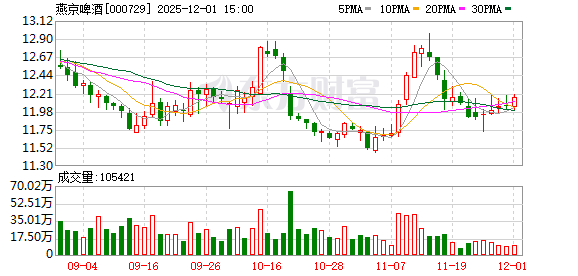
Yanjing Brewery(000729)

Search documents
2025年1-10月中国啤酒产量为3163.1万千升
Chan Ye Xin Xi Wang· 2025-12-06 02:43
Core Viewpoint - The Chinese beer industry is experiencing a decline in production, with a reported decrease in output for the year 2025 compared to the previous year [1]. Group 1: Industry Overview - According to the National Bureau of Statistics, the beer production in China for October 2025 is 1.79 million kiloliters, representing a year-on-year decrease of 1% [1]. - The cumulative beer production in China from January to October 2025 is 31.631 million kiloliters [1]. Group 2: Related Companies - Listed companies in the Chinese beer sector include Zhujiang Beer (002461), Chongqing Beer (600132), Yanjing Beer (000729), Lanzhou Yellow River (000929), and Huichuan Beer (600573) [1]. Group 3: Market Research - The report titled "2025-2031 China Non-Alcoholic Beer Industry Market Dynamics and Competitive Strategy Analysis" by Zhiyan Consulting provides insights into the market trends and competitive landscape of the non-alcoholic beer segment [1].


百威喜力鏖战中国:啤酒生意 要重做一遍|跨国酒企变局2025
2 1 Shi Ji Jing Ji Bao Dao· 2025-12-05 17:35
Core Insights - The Chinese beer industry is experiencing a shift towards domestic brands, with a notable recovery in their performance while international brands face challenges [1][2][3] - The overall beer consumption in China is still on a steady rise, despite a slight decline in production in October [1] - The market dynamics have changed, with domestic brands like Qingdao Beer and Yanjing Beer showing growth, while international brands like Budweiser are struggling [1][10] Industry Overview - The Chinese beer market has entered a phase of stock competition, with the industry's scale at about 70% of its peak [1] - The latest statistics show a 1% year-on-year decline in beer production for October, with cumulative production growth for the first ten months at 0% [1] - The industry is now in its twelfth year of stock competition, indicating a mature market environment [1] Brand Performance - Domestic brands such as Qingdao Beer, Yanjing Beer, and Zhujiang Beer have maintained growth in revenue, profit, and sales in the first three quarters of 2025 [1] - Budweiser has reported a double-digit decline in revenue, profit, and sales in the Chinese market for the first three quarters [1][10] - Heineken has shown significant growth, with sales increases of 30% to 70% for its products in recent years, positioning China as its second-largest market globally [11][14] Market Dynamics - The shift in consumer preferences has led to a decline in the dominance of international brands, particularly in the nightlife channel, which has been underperforming [2][24] - Heineken's strategy has focused on expanding into non-nightlife channels, leveraging partnerships with local distributors to enhance market penetration [20][25] - Budweiser's market share in regions like Fujian has decreased significantly, while the combined share of China Resources and Heineken has increased [12] Marketing Strategies - Both Budweiser and Heineken have engaged in high-profile sponsorships and events to enhance brand visibility, with Budweiser sponsoring the Tomorrowland music festival in Shanghai [4][7] - Heineken has also positioned itself as a key player in major events like the F1 China Grand Prix, resulting in a 14% increase in sales during the event [8] - The marketing strategies of both brands have evolved, with a focus on aligning with local consumer trends and preferences [29][30] Consumer Trends - The Chinese beer market is witnessing a shift towards innovative flavors and products, with a growing acceptance of new beer styles such as tea-infused beers [42] - There is a notable preference for higher alcohol content and unique flavors among Chinese consumers, contrasting with trends in Western markets [41][42] - The industry is encouraged to expand its product offerings to include low-alcohol and non-alcoholic options, although these segments remain niche in China [40][41]





百威喜力鏖战中国:啤酒生意,要重做一遍
2 1 Shi Ji Jing Ji Bao Dao· 2025-12-05 12:22
Core Insights - The Chinese beer market is undergoing significant changes, with local brands showing resilience and growth while international brands face challenges [2][3][5] - The industry is shifting from a focus on high-end products to a more diverse range of offerings, including lower-priced options and innovative flavors [31][37][38] Industry Overview - The beer industry in China has entered a phase of stock competition, with production levels at about 70% of their peak [3] - The latest statistics show a 1% year-on-year decline in beer production in October, with cumulative production growth for the first ten months at 0% [3] Brand Performance - Domestic brands like Tsingtao, Yanjing, and Zhujiang have reported growth in revenue, profit, and sales, while international brands like Budweiser and Carlsberg are experiencing declines [3][11] - Budweiser's performance in China has been disappointing, with a projected decline in revenue, profit, and sales for three consecutive years [11][12] Market Dynamics - The shift in consumer preferences has led to a decline in the night-time economy, affecting high-end brands that previously thrived in this channel [5][24] - Heineken has successfully leveraged local partnerships to expand its market presence, achieving significant sales growth in recent years [13][25] Strategic Initiatives - Budweiser is attempting to adapt by focusing on lower-priced products and expanding its presence in non-drinking channels [31][33] - Heineken's strategy includes entering various retail channels and enhancing its marketing efforts to resonate with local consumers [28][29] Consumer Trends - Chinese consumers are increasingly open to innovative beer flavors, with tea-infused beers gaining popularity [37][38] - The market is seeing a shift towards non-alcoholic and low-alcohol products, although these remain niche compared to traditional beer consumption [37][38]

百威喜力鏖战中国:啤酒生意,要重做一遍|跨国酒企变局2025
2 1 Shi Ji Jing Ji Bao Dao· 2025-12-05 12:13
Core Insights - The beer industry in China is undergoing significant changes, with multinational companies needing to adapt to a rapidly evolving market where traditional strategies are no longer effective [1][4][24] - Domestic brands are showing strong recovery, while international brands are experiencing mixed results, highlighting a shift in consumer preferences and market dynamics [3][10][17] Industry Overview - The Chinese beer market has entered a phase of stock competition, with overall production capacity at about 70% of its peak [3] - In October, the production of beer by large-scale enterprises in China saw a year-on-year decline of 1%, with cumulative production growth for the first ten months remaining at 0% [2] Brand Performance - Domestic brands like Tsingtao, Yanjing, and Zhujiang have reported growth in revenue, profit, and sales, while international brands like Budweiser and Carlsberg are facing challenges [3][10] - Budweiser's performance in China has been declining for three consecutive years, with double-digit decreases in revenue, profit, and sales in the first three quarters of 2023 [9][10] Market Dynamics - The high-end beer market, traditionally dominated by Budweiser and Heineken, is facing pressure as the on-premise consumption channels weaken and new product categories emerge [4][25] - Heineken has successfully leveraged its partnership with China Resources to expand its market presence, achieving significant sales growth in recent years [10][20] Consumer Preferences - Chinese consumers are increasingly open to new beer categories and flavors, with a notable rise in interest for innovative products like tea-infused beers [32] - The shift in consumer behavior has led to a greater focus on non-on-premise channels, with 60% of beer sales now coming from retail channels [29] Strategic Adjustments - Budweiser is adjusting its strategy by focusing on its Harbin brand to capture growth opportunities in the 8-10 yuan price range, reflecting a broader trend of price adjustments in the industry [26][25] - Both Budweiser and Heineken are recognizing the need to enhance their presence in non-on-premise channels and adapt to changing consumer preferences [28][29]
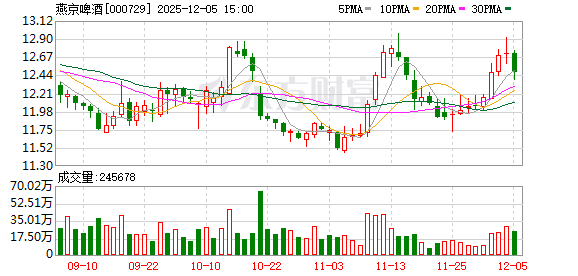
燕京啤酒:燕京营养家是北京燕京中发生物技术有限公司的线下销售渠道
Zheng Quan Ri Bao· 2025-12-05 12:08
证券日报网讯 12月5日,燕京啤酒在互动平台回答投资者提问时表示,燕京纳豆及燕京纳福多肽是公司 控股子公司北京燕京中发生物技术有限公司研发生产的产品。燕京营养家是北京燕京中发生物技术有限 公司的线下销售渠道,致力于为消费者提供更多科学、安全的健康选择。 (文章来源:证券日报) ...
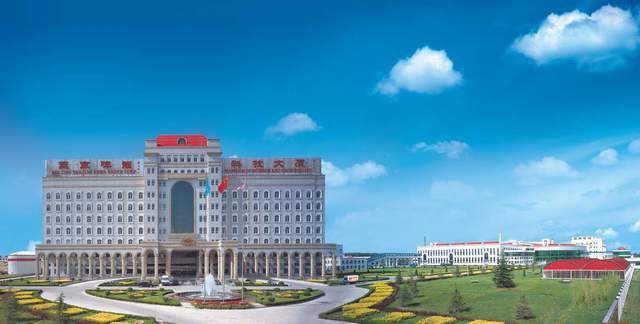
淬火成钢,逐梦远航,燕京啤酒“十四五”交出亮眼成绩单
Bei Jing Ri Bao Ke Hu Duan· 2025-12-04 06:41
Core Insights - The Chinese beer industry is undergoing a transformation from scale expansion to quality enhancement, with Yanjing Beer leading this change through a "second entrepreneurship" initiative and a commitment to "reviving Yanjing" [1][2] - Yanjing Beer has achieved continuous growth in sales, revenue, and profit, with net profit increasing from 197 million in 2020 to 1.056 billion in 2024, and brand value surpassing 237.9 billion, earning a spot in the "Asia's 500 Most Valuable Brands" [1][14] Transformation and Strategy - Yanjing Beer is implementing a comprehensive transformation involving nine major reforms across various aspects such as ideology, organization, mechanism, production, operation, marketing, research and development, culture, and governance [2][4] - The company has established a new organizational structure to enhance operational efficiency, focusing on five key centers: production, marketing, supply chain, accounting evaluation, and technology research and development [5][7] Market Positioning - Yanjing Beer is focusing on high-end products and new consumer trends, with the Yanjing U8 product becoming a significant success, achieving a sales volume increase from 110,000 kiloliters in 2020 to nearly 700,000 kiloliters in 2024, reflecting a compound annual growth rate of 62% [8][10] - The company has successfully increased the proportion of mid-to-high-end products from less than 60% in 2020 to 67.01% in 2024, with expectations to exceed 70% in the first half of 2025 [10][13] Financial Performance - Yanjing Beer has shown strong financial resilience, achieving a beer sales volume of 4.0044 million kiloliters and revenue of 14.667 billion in 2024, with net profit reaching 1.056 billion [13] - The company's gross profit margin has improved from 39.19% in 2020 to 45.66% in the first half of 2025, driven by the optimization of high-end product structures and effective supply chain management [13][14] Brand Value and Recognition - Yanjing Beer has been recognized for its brand value, ranking 237.916 billion in the "China's 500 Most Valuable Brands" list and maintaining its position in "Asia's 500 Most Valuable Brands" [14] - The company has embraced a new positioning as "China's own beer," showcasing the quality and charm of Chinese manufacturing through various initiatives, including ESG management and carbon footprint reporting [14][15]
燕京啤酒:公司将持续深化大健康领域布局
Zheng Quan Ri Bao Zhi Sheng· 2025-12-03 09:44
(编辑 楚丽君) 证券日报网讯 12月3日,燕京啤酒在互动平台回答投资者提问时表示,未来,公司将持续深化大健康领 域布局,通过燕京营养家等渠道,打造线上线下联动的健康消费场景,为消费者提供更多科学、安全的 健康选择。 ...
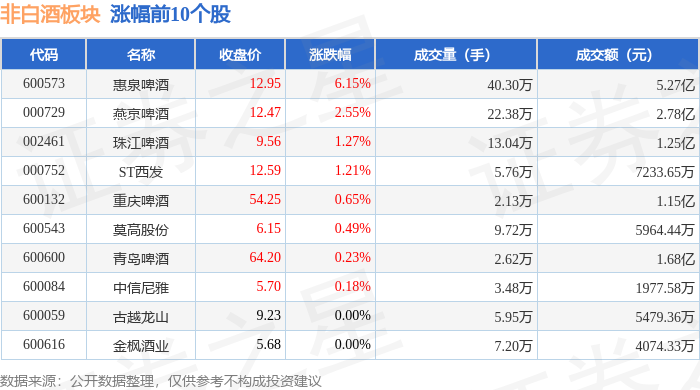
非白酒板块12月2日涨0.52%,惠泉啤酒领涨,主力资金净流入1.13亿元
Zheng Xing Xing Ye Ri Bao· 2025-12-02 09:03
Market Overview - The non-liquor sector increased by 0.52% on December 2, with Huichuan Beer leading the gains [1] - The Shanghai Composite Index closed at 3897.71, down 0.42%, while the Shenzhen Component Index closed at 13056.7, down 0.68% [1] Individual Stock Performance - Huichuan Beer (600573) closed at 12.95, up 6.15% with a trading volume of 403,000 shares and a turnover of 527 million yuan [1] - Wujing Beer (000729) closed at 12.47, up 2.55% with a trading volume of 223,800 shares and a turnover of 278 million yuan [1] - Zhujiang Beer (002461) closed at 9.56, up 1.27% with a trading volume of 130,400 shares and a turnover of 125 million yuan [1] - ST Xifa (000752) closed at 12.59, up 1.21% with a trading volume of 57,600 shares and a turnover of 72.34 million yuan [1] - Chongqing Beer (600132) closed at 54.25, up 0.65% with a trading volume of 21,300 shares and a turnover of 115 million yuan [1] Capital Flow Analysis - The non-liquor sector saw a net inflow of 113 million yuan from institutional investors, while retail investors experienced a net outflow of 94.81 million yuan [2][3] - Huichuan Beer had a net inflow of 191.1 million yuan from institutional investors, but a net outflow of 64.7 million yuan from retail investors [3] - Wujing Beer experienced a net inflow of 24.35 million yuan from institutional investors, with a net outflow of 42.18 million yuan from retail investors [3]


国泰海通策略2025年12月金股组合:12月金股策略:做多跨年行情
GUOTAI HAITONG SECURITIES· 2025-12-01 11:59
Group 1 - The report emphasizes that the Chinese stock market is entering a favorable zone, with a significant opportunity for investment in the upcoming months due to a convergence of policy, liquidity, and fundamentals [12][14][13] - The report identifies key sectors to focus on, including technology, financial services, and consumer goods, suggesting a strategic shift towards more aggressive investment positions [14][12] - The anticipated growth in the Chinese capital market is supported by a reduction in previous valuation discounts, with expectations of double-digit profit growth in the non-financial sector by 2026 [13][12] Group 2 - In the technology sector, companies like Tencent and Alibaba are highlighted for their robust revenue and profit growth, driven by advancements in AI and cloud services [20][24] - The electronics industry is seeing accelerated demand for domestic AI solutions, with companies like Haiguang Information benefiting from this trend [32][8] - The communication sector is expected to thrive due to increased capital expenditure on AI infrastructure, with significant growth anticipated in light communication technologies [39][40] Group 3 - The machinery sector is experiencing growth, with companies like Changying Precision and Hengli Hydraulic showing improved profitability and market positioning [6][8] - The automotive industry, particularly Weichai Power, is noted for steady revenue and performance improvements, indicating a positive outlook [6][8] - The healthcare sector, with a focus on innovative pharmaceuticals, is recommended for investment, particularly in companies like Ying'en Bio [6][8] Group 4 - The consumer sector is poised for recovery after a three-year adjustment period, with low valuations and potential policy support creating structural opportunities [14][12] - Companies in the retail and food & beverage sectors, such as Shoulu Hotel and Yanjing Beer, are highlighted for their improving performance metrics [6][8] - The financial sector, particularly non-bank financial institutions like Huatai Securities and China Ping An, is expected to benefit from market reforms and improved profitability [6][8]




燕京啤酒:截至11月28日公司股东总户数为44334户
Zheng Quan Ri Bao· 2025-12-01 11:37
Core Insights - Yanjing Beer reported that as of November 28, 2025, the total number of shareholders is 44,334 [2] Company Summary - Yanjing Beer is actively engaging with investors through interactive platforms [2] - The company is providing transparency regarding its shareholder structure by disclosing the total number of shareholders [2]