
ZGXT(000831)

Search documents
小金属板块8月1日跌2.49%,盛和资源领跌,主力资金净流出27.52亿元
Zheng Xing Xing Ye Ri Bao· 2025-08-01 08:27
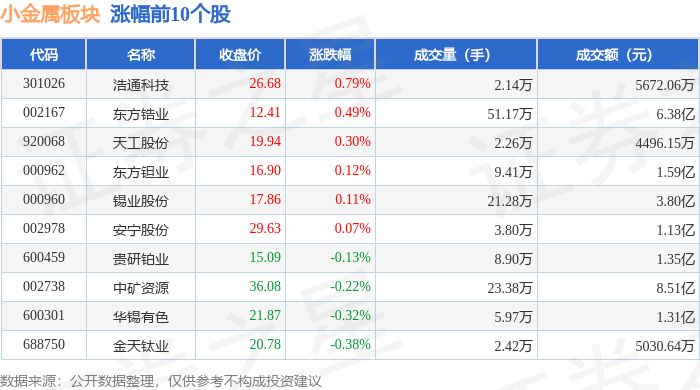
证券之星消息,8月1日小金属板块较上一交易日下跌2.49%,盛和资源领跌。当日上证指数报收于 3559.95,下跌0.37%。深证成指报收于10991.32,下跌0.17%。小金属板块个股涨跌见下表: | 代码 | 名称 | 收盘价 | 涨跌幅 | 成交量(手) | 成交额(元) | | --- | --- | --- | --- | --- | --- | | 301026 | 浩通科技 | 26.68 | 0.79% | 2.14万 | 5672.06万 | | 002167 | 东方错业 | 12.41 | 0.49% | 51.17万 | 6.38亿 | | 920068 | 天工股份 | 19.94 | 0.30% | 2.26万 | 4496.15万 | | 000962 | 东方银业 | 16.90 | 0.12% | 9.41万 | 1.59亿 | | 000960 | 锡业股份 | 17.86 | 0.11% | 21.28万 | 3.80亿 | | 002978 | 安宁股份 | 29.63 | 0.07% | 3.80万 | 1.13亿 | | 600459 | 盖研铂业 | 15.09 ...


中国稀土收盘下跌3.12%,滚动市盈率584.82倍,总市值435.53亿元
Jin Rong Jie· 2025-08-01 08:26
Group 1 - The core viewpoint of the article highlights the performance and valuation of China Rare Earth, with a closing price of 41.04 yuan and a decline of 3.12% [1] - The rolling price-to-earnings ratio (PE) stands at 584.82, significantly higher than the industry average of 64.77 and median of 61.37, placing China Rare Earth at the 39th position in the small metals industry [1][2] - The total market capitalization of China Rare Earth is reported at 43.553 billion yuan [1][2] Group 2 - As of July 18, 2025, the number of shareholders for China Rare Earth has increased to 186,516, with an average holding value of 352,800 yuan and an average shareholding of 27,600 shares [1] - The main business activities of China Rare Earth include mining, processing of rare earth minerals, production of rare earth oxides, and technology research and consulting services [1] - The company has recently applied for 26 new patents, with 7 invention patents and 4 utility model patents granted [1] Group 3 - In the latest quarterly report for Q1 2025, China Rare Earth achieved a revenue of 728 million yuan, representing a year-on-year increase of 141.32%, and a net profit of 72.618 million yuan, up 125.15% year-on-year, with a gross profit margin of 9.77% [1]
太平洋证券:我国稀土规模和技术均全球领先 看好产业链在需求增长和涨价带动下投资机会
Zhi Tong Cai Jing· 2025-08-01 07:48
Group 1 - China holds the largest rare earth resources globally, with reserves of 44 million tons, accounting for 38% of the world's total [1] - The Chinese government has implemented a quota management system for rare earth exports, with a total quota of 270,000 tons for 2024, including a 6.36% year-on-year increase in light rare earths [1] - Significant progress has been made in overseas rare earth mining, with Myanmar and Thailand producing substantial amounts of rare earth products [1] Group 2 - China leads the world in rare earth permanent magnet technology and production, with the highest sales volume globally [2] - The demand for high-performance rare earth permanent magnets is increasing, driven by sectors such as electric vehicles and consumer electronics [2] - Future developments in humanoid robots and eVTOL (electric vertical takeoff and landing) vehicles are expected to significantly boost the demand for high-performance rare earth permanent magnets [2]

稀土产业链,优势在我
Tai Ping Yang Zheng Quan· 2025-08-01 06:03
Investment Rating - The report maintains a positive outlook on the rare earth industry, highlighting investment opportunities driven by demand growth and price increases [4]. Core Insights - China holds the largest rare earth reserves globally, with 44 million tons, accounting for 38% of the world's total [4][16]. - The demand for high-performance rare earth permanent magnets is expected to grow significantly, particularly in the automotive and consumer electronics sectors [4]. - The report emphasizes the leading position of Chinese companies in the rare earth permanent magnet industry, with a focus on companies like Northern Rare Earth, China Rare Earth, and Shenghe Resources [4]. Summary by Sections 1. Global Supply of Rare Earth Resources - China is the largest supplier of rare earths, with a well-established separation industry and significant technological advantages [27]. - The report outlines the increasing production and export quotas for rare earths in China, with a total quota of 270,000 tons for 2024, including 250,000 tons of light rare earths [27]. 2. Definition and Global Distribution of Rare Earths - Rare earths consist of 17 elements, including 15 lanthanides, yttrium, and scandium, with significant reserves found in China, Brazil, and the USA [16][20]. 3. Production and Export of Rare Earths in China - Major companies in China include Northern Rare Earth and Shenghe Resources, with production figures for 2024 indicating substantial output in various rare earth products [30][37]. - China exported 123,000 tons of rare earth products in 2024, with a total export value of 25.6 billion yuan, reflecting a 7.7% year-on-year increase [37]. 4. Overseas Supply of Rare Earths - The report discusses the increasing production of rare earths in the USA and Australia, with significant developments in the Mountain Pass mine and Lynas Corporation's operations [40][48]. 5. Rare Earth Prices - Current prices for key rare earth products are reported to be reasonable, with potential for further increases, particularly for praseodymium-neodymium oxide and dysprosium oxide [64]. 6. Rare Earth Permanent Magnet Industry - The report highlights the growing demand for rare earth permanent magnets in various applications, including electric vehicles and consumer electronics, with production expected to exceed 250,000 tons in 2024 [88]. 7. Key Companies in the Rare Earth Sector - Northern Rare Earth is identified as a leading player with significant production capacity and a focus on high-end magnetic materials [123]. - China Rare Earth is noted for its comprehensive industry chain, covering resource development to deep processing [127]. - Shenghe Resources is recognized for its overseas resource layout and strategic partnerships [138].


有色金属行业双周报(2025、07、18-2025、07、31):美联储表态偏鹰,年内降息预期弱化-20250801
Dongguan Securities· 2025-08-01 04:10
Investment Rating - The report maintains a "Market Weight" rating for the non-ferrous metals industry, indicating that the industry index is expected to perform within ±10% of the market index over the next six months [66]. Core Insights - The non-ferrous metals industry has shown a 4.02% increase over the past two weeks, outperforming the CSI 300 index by 3 percentage points, ranking 5th among 31 industries [3][12]. - The small metals sector has surged by 14.01%, while precious metals have declined by 3.84% during the same period [18]. - The Federal Reserve's hawkish stance has led to a reduction in expectations for interest rate cuts, impacting the prices of precious and industrial metals [5][60]. Market Performance Summary - As of July 31, 2025, the LME copper price is at $9,607/ton, aluminum at $2,562.5/ton, lead at $1,969.50/ton, zinc at $2,762/ton, nickel at $14,950/ton, and tin at $32,685/ton [24][60]. - The COMEX gold price is $3,342.30/ounce, down $7.5 since early July, while silver is at $36.79/ounce, up $0.54 [35][60]. Subsector Analysis - Rare earth prices have stabilized and increased due to improved supply-demand dynamics, with the rare earth price index at 204.36, up 22.35 since early July [43][63]. - Tungsten prices are rising due to supply constraints and increased demand from the new energy and military sectors, with average tungsten concentrate prices at 192,900 yuan/ton, up 19,000 yuan [63]. Recommended Stocks - The report suggests focusing on China Rare Earth (000831) and Kinglong Permanent Magnet (300748) due to their expected profitability improvements [64]. - Xiamen Tungsten (600549) is also highlighted for its strategic value in the tungsten market [63].
稀土指数盘中跌超2%
Mei Ri Jing Ji Xin Wen· 2025-08-01 02:13
8月1日,稀土指数盘中跌幅超2%,包钢股份、盛和资源、北方稀土、中国稀土、广晟有色跌幅靠前。 (文章来源:每日经济新闻) ...

中国稀土获融资买入1.81亿元,近三日累计买入8.96亿元
Jin Rong Jie· 2025-08-01 01:20
Group 1 - On July 31, the financing buy-in amount for China Rare Earth reached 181 million yuan, ranking 153rd in the two markets, with a financing repayment amount of 256 million yuan and a net sell of 74.92 million yuan [1] - Over the last three trading days, from July 29 to July 31, China Rare Earth received financing buy-ins of 390 million yuan, 325 million yuan, and 181 million yuan respectively [1] Group 2 - On the same day, the short selling amounted to 0.05 thousand shares, with a net buy of 0.51 thousand shares [2]
中美稀土战争持续!美国重金开采稀土!中国稀土武器会失去优势吗
Sou Hu Cai Jing· 2025-07-31 10:28
Core Viewpoint - The U.S. is investing heavily in domestic rare earth production to reduce reliance on China, but faces significant challenges in cost, technology, and time to establish a competitive industry [1][22][40]. Group 1: U.S. Investment and Production - The Pentagon invested $400 million in MP Materials and promised an additional $150 million loan to expand rare earth separation capabilities [3][4]. - Apple followed with a $500 million investment, indicating a broader corporate involvement in the U.S. rare earth self-sufficiency initiative [4]. - The Mountain Pass mine in California, the only operating rare earth mine in the U.S., has begun large-scale production, achieving a record output of over 45,000 metric tons of rare earth oxide concentrate in 2024, accounting for 15% of global production [5][7]. Group 2: Cost and Competitive Disadvantages - The cost of rare earth refining in the U.S. is significantly higher, with China at $35,000 per ton compared to the U.S. at $58,000 per ton, a 65% difference [15]. - Even with increased production, U.S. facilities may only meet 30% of military needs by 2028, highlighting a substantial gap in supply for electric vehicles and other sectors [17][19]. - The U.S. lacks the necessary refining technology and skilled workforce, having fallen behind China, which controls nearly 90% of global rare earth refining capacity [19][22]. Group 3: China's Strategic Position - China has implemented export restrictions on seven rare earth elements, impacting U.S. industries such as automotive and defense, revealing vulnerabilities in the supply chain [11][13]. - The Chinese rare earth industry benefits from stable government support and a well-established ecosystem, making it difficult for the U.S. to replicate this model quickly [24][26]. - China's recent measures include a dynamic export adjustment mechanism and a safety assessment system for the rare earth industry, maintaining its dominant position in the global market [13][28]. Group 4: Future Outlook and Competition - The competition for rare earths is evolving into a contest of development models, with the U.S. focusing on technology and capital, while China emphasizes systematic layout and long-term accumulation [38][40]. - The International Energy Agency predicts a threefold increase in global rare earth demand by 2030, but supply diversification is progressing slowly, posing systemic risks for over-reliance on any single country [36][44]. - The U.S. is also exploring strategic reserves and technological innovations in recycling, but these efforts will take time to materialize [40][42].


中国稀土对美出口暴涨660%,已经达成稀土和解?中方随即打破惯例
Sou Hu Cai Jing· 2025-07-31 02:15
Core Insights - The article discusses the strategic manipulation of rare earth exports by China, particularly in relation to the U.S. military and automotive industries, highlighting a significant increase in exports of rare earth magnets to the U.S. while restricting military-grade materials [1][4][8] Group 1: Export Dynamics - In June, China's exports of rare earth magnets to the U.S. surged to 353 tons, a 660% increase from May's 46 tons, indicating a tactical maneuver rather than a genuine trade recovery [1][3] - The U.S. military's reliance on rare earth materials is underscored, with the F-35 fighter jet requiring 417 kg of rare earths and Virginia-class submarines needing up to 4 tons [3][4] Group 2: Strategic Agreements - A temporary agreement was reached in May, allowing Chinese exports of civilian-grade magnets to U.S. automakers like General Motors and Ford, in exchange for the U.S. permitting exports of Nvidia's H20 chips to China [4][6] - Despite this agreement, military-grade rare earths remain tightly controlled, forcing the Pentagon to resort to recycling materials from old phones [4][7] Group 3: Market Manipulation - China has shifted to a "strategic ambiguity" regarding rare earth mining quotas, delaying the announcement of the first batch for 2025 and not disclosing specific figures, which disrupts international market clarity [6][8] - The price of dysprosium oxide in Europe has surged to $700-$1000 per kg, three times higher than domestic prices, due to the lack of transparency in China's export quotas [6][8] Group 4: U.S. Industry Challenges - U.S. company MP Materials received $400 million from the Defense Department but has only restored 45% of its production capacity, with a 40% waste rate in magnet production [7][8] - The influx of 353 tons of magnets from China led U.S. automakers to cancel domestic orders, resulting in a significant drop in MP Materials' stock price [7][8] Group 5: Ongoing Tensions - The article emphasizes that the competition between the U.S. and China over rare earths is far from over, with China monitoring the destination of exported magnets to prevent them from reaching military applications [8][9] - The U.S. is facing a strategic dilemma, as investments of $40 billion have not resolved the underlying issues of dependency on Chinese rare earths and chips [9][11]
中国稀土获融资买入3.25亿元,近三日累计买入14.54亿元
Jin Rong Jie· 2025-07-31 01:20
本文源自:金融界 作者:智投君 7月30日,沪深两融数据显示,中国稀土获融资买入额3.25亿元,居两市第66位,当日融资偿还额4.47亿 元,净卖出12244.41万元。 最近三个交易日,28日-30日,中国稀土分别获融资买入7.40亿元、3.90亿元、3.25亿元。 融券方面,当日融券卖出0.97万股,净卖出0.87万股。 ...