ZGXT(000831)

Search documents
中国稀土:公司主营产品稀土氧化物中包括氧化镨钕、氧化镨、氧化钕、氧化镝、氧化铽等产品
Mei Ri Jing Ji Xin Wen· 2025-07-30 10:55
每经AI快讯,有投资者在投资者互动平台提问:请问公司产品有镨钕系列吗? 中国稀土(000831.SZ)7月30日在投资者互动平台表示,公司主营产品稀土氧化物中包括氧化镨钕、氧 化镨、氧化钕、氧化镝、氧化铽等产品。 (文章来源:每日经济新闻) ...


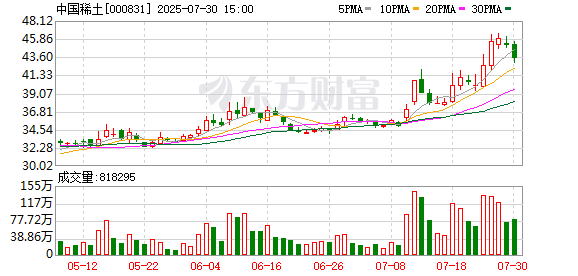
中国稀土获融资买入3.90亿元,近三日累计买入18.61亿元
Jin Rong Jie· 2025-07-30 01:11
Group 1 - The core point of the article highlights the financing activities related to China Rare Earth, with a total financing buy amount of 3.90 billion yuan on July 29, ranking 59th in the two markets [1] - Over the recent three trading days from July 25 to July 29, China Rare Earth experienced financing buy amounts of 7.31 billion yuan, 7.40 billion yuan, and 3.90 billion yuan respectively [1] - On the same day, the securities lending saw a sell-off of 0.17 thousand shares, with a net buy of 1.34 thousand shares [2]
绕过中国稀土?日本找到电机替代方案,日欧组建“稀土联盟”
Sou Hu Cai Jing· 2025-07-30 00:51
Group 1 - Rare earth elements, despite their name, are not extremely rare in nature but are essential for various high-tech applications, including smartphones, electric vehicles, and military systems [1][3] - In the military sector, rare earths provide critical capabilities, such as stability in missile guidance systems and radar absorption in stealth aircraft [3] - China holds a dominant position in the rare earth market, controlling approximately 70% of global extraction and 90% of refining capacity, making it a key player in the global supply chain [3][5] Group 2 - The U.S.-China trade war highlighted China's leverage over rare earth exports, leading to significant impacts on U.S. industries reliant on these materials [5][7] - Japan's historical dependence on Chinese rare earths, exceeding 90%, has prompted efforts to diversify supply sources and reduce reliance on China [7][9] - Recent developments in Japan include the announcement of a new electric motor magnet that does not rely on rare earth elements, potentially reducing dependence on Chinese supplies [9][11] Group 3 - Japan and the EU are collaborating to secure rare earth supply chains, with plans to invest in mining operations outside of China [11][18] - However, challenges remain, including higher extraction costs and the need for significant investment and time to establish alternative supply chains [16][18] - China's comprehensive control over the entire rare earth industry chain, from mining to processing, presents a significant barrier for Japan and the EU in their attempts to reduce reliance on Chinese rare earths [18]
有色金属行业今日净流出资金44.34亿元,盛和资源等12股净流出资金超亿元
Zheng Quan Shi Bao Wang· 2025-07-29 11:11
有色金属行业资金流入榜 沪指7月29日上涨0.33%,申万所属行业中,今日上涨的有16个,涨幅居前的行业为通信、钢铁,涨幅 分别为3.29%、2.59%。跌幅居前的行业为农林牧渔、银行,跌幅分别为1.36%、1.19%。有色金属行业 今日下跌0.27%。 资金面上看,两市主力资金全天净流出356.37亿元,今日有4个行业主力资金净流入,医药生物行业主 力资金净流入规模居首,该行业今日上涨2.06%,全天净流入资金29.96亿元,其次是钢铁行业,日涨幅 为2.59%,净流入资金为4.19亿元。 主力资金净流出的行业有27个,有色金属行业主力资金净流出规模居首,全天净流出资金44.34亿元, 其次是机械设备行业,净流出资金为37.92亿元,净流出资金较多的还有计算机、基础化工、非银金融 等行业。 有色金属行业今日下跌0.27%,全天主力资金净流出44.34亿元,该行业所属的个股共137只,今日上涨 的有51只,涨停的有1只;下跌的有85只。以资金流向数据进行统计,该行业资金净流入的个股有29 只,其中,净流入资金超3000万元的有7只,净流入资金居首的是云南锗业,今日净流入资金6.29亿 元,紧随其后的是鑫科材料 ...


八月策略及十大金股:新驱动的出现
SINOLINK SECURITIES· 2025-07-29 05:16
Group 1: Market Strategy and Outlook - The core driver behind the recent A-share market rally is the optimistic expectation of a rebound in corporate ROE, rather than mere speculation around policy themes [4][9] - The current valuation of A-shares, while having outpaced the recovery of fundamentals, is not extreme, indicating that the recovery in sectors like food and beverage, coal, and oil and petrochemicals is still in its early stages [4][9] - The "anti-involution" and demand-side policies are expected to show quicker effects compared to the comprehensive policies of 2024, with companies having undergone three quarters of self-purging [10][11] Group 2: Sector Recommendations - **Machinery**: Companies like Xugong Machinery and Yingliu Shares are recommended due to domestic demand stabilization and overseas market recovery [14][15] - **Non-ferrous Metals**: China Rare Earth is favored as export controls may lead to price increases in rare earths, supported by moderate quota growth [16] - **Non-bank Financials**: China Galaxy is highlighted for its strengthening brokerage business and potential for international expansion [17] - **Media and Internet**: Yao Cai Securities is positioned to benefit from increased trading volumes in Hong Kong and potential synergies from Ant Group's acquisition [18] - **Agriculture**: Muyuan Foods is recognized as a leading pig farming enterprise with expected stable profits amid rising pork prices [19] - **Defense and Military**: North Navigation is anticipated to benefit from a rising demand cycle for its products [20] - **Computing**: Kingsoft Office is seen as a leader in AI applications, with significant growth potential from its innovative products [21][22] - **Electronics**: Lante Optics is expected to see strong demand from various sectors, including automotive and AI [23] - **Pharmaceuticals**: Kelun-Botai is noted for its leading ADC technology and potential for international sales growth [24][25]


供需两端催化提振原料价格!稀土ETF(516780)连续5个交易日获资金净流入
Xin Lang Ji Jin· 2025-07-29 05:15
Core Insights - The A-share rare earth permanent magnet sector has shown renewed activity, with significant market interest in related products, particularly the rare earth ETF (516780) which recorded a trading volume of 253 million yuan on July 28, marking seven consecutive trading days with over 200 million yuan in daily trading volume, indicating strong capital inflow [1] - The rare earth ETF has seen a net inflow of 127 million yuan over the past five trading days, with its total scale reaching 1.731 billion yuan as of July 28, the highest in nearly four years [1] - The price of praseodymium has increased, reflecting the strategic value of rare earth resources amid the global energy revolution and geopolitical tensions [1] Industry Analysis - A recent report from Founder Securities indicates that the rare earth magnetic materials sector is experiencing tightening supply expectations due to the ban on rare earth mining in Myanmar's Kachin region by the end of 2025 and the zero imports of rare earth metals by the U.S. in June, leading to a price surge for praseodymium and neodymium oxide, which has surpassed 500,000 yuan per ton [2] - The rare earth ETF (516780) closely tracks the CSI Rare Earth Industry Index, which includes companies involved in rare earth mining, processing, trading, and applications, with the top five constituent stocks being Northern Rare Earth, China Rare Earth, China Aluminum, Greeenmei, and Lingyi Technology, all of which are competitive leaders in the industry [2] - The management of the rare earth ETF, Huatai-PB Fund, has over 18 years of ETF operation experience and has created several benchmark ETFs, with its total ETF scale exceeding 520 billion yuan as of July 28, placing it in the top tier of the industry [2] Market Outlook - With improving demand and expectations of tightening rare earth supply, prices in the rare earth industry are likely to be supported, presenting potential investment opportunities in the rare earth sector, particularly in the rare earth ETF (516780) and its linked funds [3]



近6天获得连续资金净流入,稀有金属ETF(562800)规模创新高!成分股云南锗业10cm涨停
Sou Hu Cai Jing· 2025-07-29 03:24
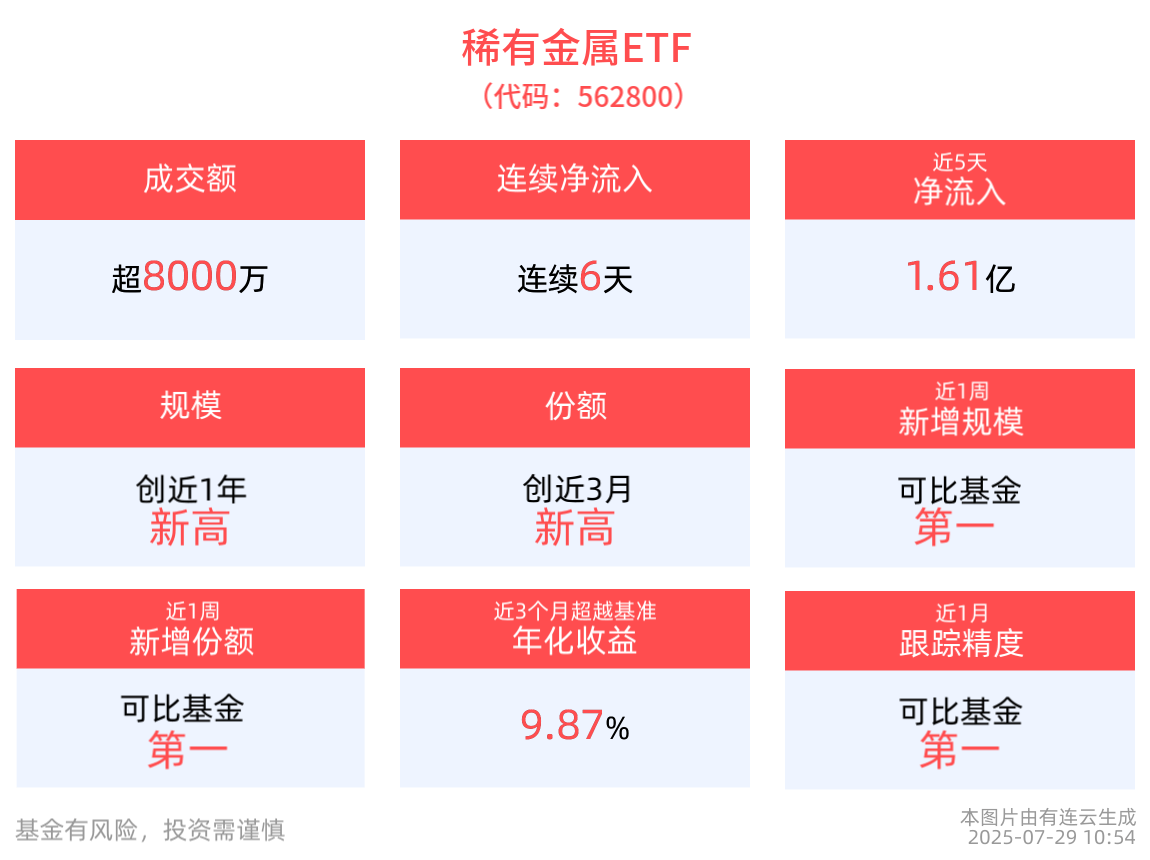
Group 1: ETF Performance - The Rare Metals ETF has a turnover rate of 6.87% with a transaction volume of 83.93 million yuan, and it ranks first among comparable funds in terms of average daily trading volume over the past week at 131 million yuan [3] - The latest scale of the Rare Metals ETF reached 1.22 billion yuan, marking a one-year high and ranking first among comparable funds [3] - The ETF's shares reached 1.843 billion, a three-month high, also ranking first among comparable funds [3] - Over the past six days, the Rare Metals ETF has seen continuous net inflows, with a single-day peak of 50.91 million yuan, totaling 177 million yuan in net inflows [3] - As of July 28, 2025, the ETF's net value has increased by 59.46% over the past year, ranking 267 out of 2938 in the index stock fund category, placing it in the top 9.09% [3] - The ETF has recorded a maximum monthly return of 24.02% since its inception, with the longest consecutive monthly gains being three months and the longest gain percentage being 14.06%, averaging a monthly return of 7.76% [3] - The ETF has outperformed its benchmark with an annualized return of 9.87% over the past three months [3] Group 2: Market Insights - Huatai Securities notes that the domestic "anti-involution" policies are intensifying, combined with recent overseas fiscal and monetary easing, leading to strong performance in the metals sector [4] - The price of polysilicon has successfully recovered, boosting market confidence, which has spilled over into lithium carbonate and alumina [4] - Lithium, cobalt, and rare earths have found price bottoms from a cost perspective, with independent factors driving price increases, such as stricter mining rights reviews for lithium and strategic enhancements and shortages for rare earths [4] - Zhongyou Securities highlights that the Democratic Republic of the Congo has banned cobalt exports since February, with extensions in June, leading to a depletion of in-transit cobalt mines, and anticipates that the peak season in September and October will drive inventory reductions [4] - The top ten weighted stocks in the China Rare Metals Theme Index as of June 30, 2025, include Salt Lake Co., Northern Rare Earth, Luoyang Molybdenum, Huayou Cobalt, Ganfeng Lithium, Tianqi Lithium, China Rare Earth, Western Superconducting, Zhongmin Resources, and Xiamen Tungsten, collectively accounting for 54.07% of the index [4]


哪个行业反内卷最受益?
2025-07-29 02:10
Summary of Conference Call Records Industry or Company Involved - The discussion primarily revolves around the **internet platform industry**, particularly **food delivery services** such as Meituan, JD.com, and Alibaba, as well as the **rare earth industry** and the **financial sector**. Core Points and Arguments 1. **Internet Platforms and Price Undercutting** Internet platforms engage in price undercutting through subsidies to gain market share, which raises concerns about monopolistic practices and impacts on upstream suppliers. Regulatory bodies need to intervene to address these issues [1][2][4] 2. **Government Regulation and Pricing Mechanisms** The government is revising pricing laws to clarify improper pricing behaviors and establish standards for price undercutting. This includes shifting from direct price regulation to a cost-plus pricing model to protect public goods and prevent irrational subsidies [1][4][3] 3. **Rare Earth Industry Dynamics** The rare earth sector benefits from China's supply advantages, with a significant increase in prices (approximately 30% year-on-year). The government is cracking down on illegal rare earth mining and controlling legal supply, which enhances the market share of companies like Northern Rare Earth and China Rare Earth [1][6] 4. **Impact of Subsidies on Food Delivery Services** While subsidies increase traffic for food delivery platforms, they also pressure merchants and reduce profits. Regulatory bodies have urged platforms to improve quality assurance for riders, merchants, and food products [1][7] 5. **JD.com's Competitive Strategy** JD.com is expected to emerge from the competitive turmoil in the food delivery market by implementing a standardized cooking model through its Seven Fresh Kitchen initiative, which aims to enhance food quality and safety while reducing costs [1][9] 6. **Healthcare Procurement Strategy Changes** The National Healthcare Security Administration has adjusted its procurement strategy to focus on quality rather than low prices, addressing issues like drug efficacy and stability. This includes providing price protection for innovative drugs to encourage development [1][10] 7. **Challenges in the Financial Sector** The financial industry faces intense competition, with banks and insurance companies employing aggressive strategies to capture market share. Industry associations are working on standards to mitigate these competitive pressures [1][11] 8. **Environmental Regulations in the Construction Industry** New environmental guidelines are being implemented for non-metallic mineral manufacturing, aiming to phase out illegal operations and address overcapacity. However, local government protectionism poses challenges to these efforts [1][12] 9. **International Trade Negotiations** Recent progress in US-China tariff negotiations may lead to relaxed export controls on rare earths and semiconductors, which could impact market dynamics in various sectors, including technology and finance [1][13] Other Important but Possibly Overlooked Content - The discussion highlights the need for a shift in local government strategies to avoid redundant construction and overcapacity issues, emphasizing the importance of adjusting the objectives of local governments to prevent short-term solutions to long-term problems [1][5] - The ongoing competition among food delivery platforms is expected to lead to a transformation in consumer benefits as companies adapt to new market conditions [1][9]


中美稀土战争持续!美国大力开采稀土!中国稀土武器是否会失效
Sou Hu Cai Jing· 2025-07-28 10:06
Core Viewpoint - The U.S. is determined to reduce its reliance on China's rare earths by investing significantly in domestic production and refining capabilities, with a focus on establishing a complete rare earth industry chain [1][3][27]. Group 1: U.S. Investments and Developments - The Pentagon has invested $400 million in MP Materials, becoming its largest shareholder, and has committed an additional $150 million loan to expand rare earth separation capabilities [3]. - Apple has also announced a $500 million investment agreement, indicating that the U.S. rare earth self-sufficiency efforts are extending beyond government initiatives to the corporate sector [5]. - MP Materials' Mountain Pass mine, the only operating rare earth mine in the U.S., produced over 45,000 metric tons of rare earth oxide concentrate in 2024, accounting for 15% of global production [7]. Group 2: Challenges Facing the U.S. - Despite significant investments, the U.S. faces substantial challenges in establishing a competitive rare earth industry chain, particularly due to technological barriers and cost advantages held by China [14][18]. - Approximately 80% of MP Materials' revenue came from exporting rare earth concentrates to China before the export controls were implemented, highlighting the U.S.'s previous dependency [16]. - The rare earth separation and purification process is capital and technology-intensive, and the U.S. has lagged in this field for decades, making rapid advancements difficult [18]. Group 3: Global Supply Chain Dynamics - China maintains a dominant position in the rare earth supply chain, controlling 90% of rare earth refining capacity and 70% of total production [10]. - The global demand for rare earths is expected to surge, particularly in key applications like electric vehicles and wind power, where China has a well-established supply chain [14][24]. - Other countries, including Saudi Arabia, are also recognizing the strategic value of rare earths and are beginning to establish their own supply chains [22]. Group 4: Future Outlook - The ongoing U.S.-China rare earth competition is likely to lead to a more diversified and sustainable global rare earth industry, with cooperation and competition coexisting as the new norm [29]. - Even with U.S. efforts to increase production, the short-term dependency on Chinese rare earths is expected to persist, as supply chain adjustments will take time [25][27].
继印度之后,白宫也砸下重金,要挑战中国稀土,美企说了句实话
Sou Hu Cai Jing· 2025-07-28 06:47
Group 1 - The article discusses the escalating tensions in the rare earth market, particularly due to China's tightening control over rare earth exports in response to U.S. tariffs [2][7][19] - India plans to invest 25 billion rupees to support its rare earth industry, indicating a shift towards self-sufficiency in response to supply chain disruptions caused by China's dominance [2][11][32] - U.S. companies express skepticism about the government's heavy investment in rare earth production, highlighting a lack of confidence in overcoming China's market control [21][27][30] Group 2 - China's rare earth resources are critical for high-tech industries, and the country currently dominates the global supply chain, controlling over 90% of rare earth processing capacity [7][13] - The inefficiency of India's rare earth extraction methods raises concerns about its ability to compete with China, despite significant financial investments [15][23] - The U.S. government's acquisition of a major stake in a rare earth company signals a strategic move to bolster domestic production, but experts doubt the effectiveness of this approach in the short term [21][30]