
WLY(000858)

Search documents
食品饮料行业研究:飞天茅台动销逐步起势,关注子版块春节备货催化
SINOLINK SECURITIES· 2026-01-25 07:50
Investment Rating - The report maintains a cautious outlook on the liquor industry, particularly on high-end liquor such as Moutai, with expectations of gradual recovery in sales and pricing stability post-Spring Festival [10][11][12]. Core Insights - The high-end liquor segment, especially Moutai, is experiencing a sales boost as the Spring Festival approaches, with expectations of price recovery due to increased demand driven by wealth effects [10][11]. - The report suggests that the market's concerns about post-festival price drops for Moutai are likely to be unfounded, predicting only minor seasonal fluctuations [10][12]. - The overall sentiment in the liquor industry is shifting from a pessimistic outlook to a more stable one, with expectations of improved sales dynamics as external constraints on consumption ease [11][12]. Summary by Sections Liquor Industry - The report highlights that Moutai's sales are performing better than previously cautious expectations, leading to a price recovery for both Moutai and newer Moutai products [10]. - It is noted that the market is still wary of potential price declines after the Spring Festival, but historical patterns suggest only minor adjustments are likely [10][11]. - The report emphasizes the importance of brand strength and market positioning for high-end liquor companies, recommending investments in brands with strong market presence and growth potential [12]. Beer Industry - The beer sector is seeing a steady recovery in on-premise consumption, with companies diversifying into non-drink channels and soft drinks [12]. - The report suggests that the beer industry's performance is expected to stabilize, with a focus on maintaining competitive pricing and improving dividend yields [12]. Snack Industry - The snack sector is benefiting from pre-Spring Festival stocking and product innovation, with companies like Qiaqia and Ganyuan expected to show significant profit elasticity due to low comparative bases [14]. - The report recommends focusing on leading snack companies that are expanding their store presence and adapting their product offerings [14]. Beverage Industry - The soft drink sector is currently facing challenges due to seasonal demand fluctuations and competition from ready-to-drink tea brands, leading to a slight decline in overall sales growth [14]. - Despite these challenges, leading brands like Dongpeng and Nongfu are expected to maintain double-digit growth through brand strength and market share consolidation [14]. Seasoning Industry - The seasoning sector is stabilizing as restaurant demand begins to recover, with expectations of improved performance in 2026 driven by seasonal effects [15]. - The report highlights companies like Angel Yeast and Qianhe Condiments as having strong growth potential due to favorable market conditions and dividend yields [15].




食品饮料行业周报 2026年第4期:白酒探底,餐供积极
GUOTAI HAITONG SECURITIES· 2026-01-25 07:45
Investment Rating - The report assigns an "Overweight" rating for the food and beverage industry, indicating a positive outlook compared to the market benchmark [6]. Core Insights - The report emphasizes the recovery of the consumer price index (CPI) in December, suggesting a turning point in supply and demand dynamics. It highlights the importance of focusing on growth opportunities and the valuation flexibility of consumer goods [3][9]. - The report identifies key investment targets in the liquor sector, including Guizhou Moutai, Wuliangye, and Luzhou Laojiao, as well as other brands expected to clear inventory [9]. - The beverage sector is expected to benefit from improved travel conditions, with recommendations for companies like Dongpeng Beverage and Nongfu Spring [9]. - The report notes the ongoing recovery in the restaurant supply chain and the high growth potential of companies like Bailong Chuangyuan [15]. Summary by Sections Investment Recommendations - The report suggests focusing on companies with price elasticity, including Guizhou Moutai, Wuliangye, and Luzhou Laojiao, as well as those expected to clear inventory like Yingjia Gongjiu and Guxi Gongjiu [9]. - It recommends beverage companies such as Dongpeng Beverage and Nongfu Spring, while also highlighting low-valuation, high-dividend stocks like China Foods and Master Kong [9]. - For snacks and food raw materials, it suggests Bailong Chuangyuan, Yanjinpuzi, and Three Squirrels as growth targets [9]. Liquor Sector Insights - As the Spring Festival approaches, the report highlights the importance of monitoring sales volume and pricing. It notes that the peak sales period is expected in February, with varying performance among brands [10]. - The report mentions that the liquor industry faced a significant production decline in 2025, with a total output of 3.549 million kiloliters, a year-on-year decrease of 12.1%, marking the largest drop since 2019 [11][13]. - It anticipates that the recovery in market conditions and inventory reduction will take time, with companies likely to maintain relationships through pricing strategies [11]. Consumer Goods Sector Insights - The report indicates that the restaurant supply chain is recovering, with the pre-prepared food sector expected to benefit from new national standards [15]. - Bailong Chuangyuan is highlighted for its strong growth, reporting a revenue of 1.38 billion yuan in 2025, a year-on-year increase of 19.8%, and a net profit of 366 million yuan, up 48.9% [15][16]. - The report notes that the company’s growth is driven by product optimization and increased production capacity utilization [16].


食品饮料行业周报 2026年第4期:白酒探底,餐供积极-20260125
GUOTAI HAITONG SECURITIES· 2026-01-25 05:28
Investment Rating - The report assigns an "Overweight" rating for the food and beverage industry, indicating a positive outlook compared to the market benchmark [6]. Core Insights - The report emphasizes the recovery of the consumer price index (CPI) in December, suggesting a turning point in supply and demand dynamics. It highlights the importance of focusing on companies with price elasticity and those expected to clear inventory [6][9]. - The report identifies key investment opportunities in the liquor sector, particularly with brands like Guizhou Moutai, Wuliangye, and Luzhou Laojiao, as well as in the beverage and snack sectors, recommending companies such as Dongpeng Beverage and Nongfu Spring [6][9]. Summary by Sections Investment Recommendations - The report suggests focusing on companies with price elasticity, including Guizhou Moutai, Wuliangye, and Luzhou Laojiao. It also highlights potential inventory clearance candidates like Yingjia Gongjiu and Guxi Gongjiu [9]. - Beverage companies are expected to benefit from improved travel conditions, with recommendations for Dongpeng Beverage and Nongfu Spring. Low valuation and high dividend stocks like China Foods and Master Kong are also highlighted [9]. - In the snack and food raw materials sector, companies such as Bailong Chuangyuan and Yanjinpuzi are recommended for their growth potential [9]. Liquor Sector Insights - As the Spring Festival approaches, the report notes the importance of monitoring sales and pricing in the liquor sector. Current trends indicate moderate enthusiasm for payments at the retail level, with peak sales expected in February [10]. - The report mentions that the liquor industry faced a significant production decline in 2025, with a total output of 3.549 million kiloliters, a year-on-year decrease of 12.1%, marking the largest drop since 2019 [11][13]. - The report anticipates that the recovery in market conditions and inventory clearance will take time, with companies likely to maintain relationships through pricing strategies [11][12]. Consumer Goods Sector Insights - The report highlights a recovery in the restaurant supply chain, with the food service industry expected to benefit from CPI increases. The introduction of national standards for prepared dishes is also anticipated to enhance industry quality [15]. - Bailong Chuangyuan is noted for its strong growth, with a reported revenue of 1.38 billion yuan in 2025, reflecting a year-on-year increase of 19.8% and a net profit growth of 48.9% [15][16].
酒行业周度市场观察-20260125
Ai Rui Zi Xun· 2026-01-25 03:02
Investment Rating - The report does not explicitly provide an investment rating for the industry Core Insights - The Australian wine market is reshaping the Chinese imported wine market after a year and a half of absence, with a significant initial increase in imports followed by a decline in sales due to inventory issues and economic pressures [2] - The low-alcohol beverage category is rapidly growing, appealing to younger consumers, but faces challenges such as brand homogenization and declining repurchase rates [2] - The white liquor industry is experiencing a shift in market dynamics, with top brands competing fiercely and some companies facing their first quarterly negative growth in nearly a decade [4] - New beverage products are emerging, with brands like Xiaojin Wine and Guoli Fang successfully capturing market share through innovative approaches [5] - The industry is expected to return to rationality in 2026, focusing on consumer needs and product quality, while smaller companies may face elimination [6] Industry Environment - The Australian wine market is seeing a resurgence in China due to the removal of anti-dumping taxes, but initial sales have not met expectations, leading to inventory issues and price reductions [2] - The low-alcohol market is projected to grow from 20 billion yuan in 2020 to 57 billion yuan by 2024, but faces challenges in brand differentiation and consumer loyalty [2] - The white liquor market is undergoing structural changes, with companies like Shanxi Fenjiu surpassing others in revenue, indicating a competitive landscape [4] - The introduction of innovative products is crucial for the industry's transformation, with a focus on low-alcohol and health-oriented offerings [5] - The industry is moving towards a more rational approach, emphasizing product quality and consumer experience, as it transitions from a bubble phase to a healthier growth period [6] Top Brand Dynamics - Guizhou Zhenjiu is upgrading its "Dazhen" product to enhance quality and market positioning, aiming to compete with top brands like Moutai [8] - Wuliangchun is celebrating its 30th anniversary with a marketing campaign that deepens emotional connections with consumers [9] - Xifengjiu is focusing on quality and cultural empowerment to drive its revival in the competitive white liquor market [10] - Moutai is launching a new product structure to meet diverse consumer needs and stabilize its market presence [14] - Niulanshan is evolving its product strategy to maintain its position in the mass market while enhancing emotional connections with consumers [18]


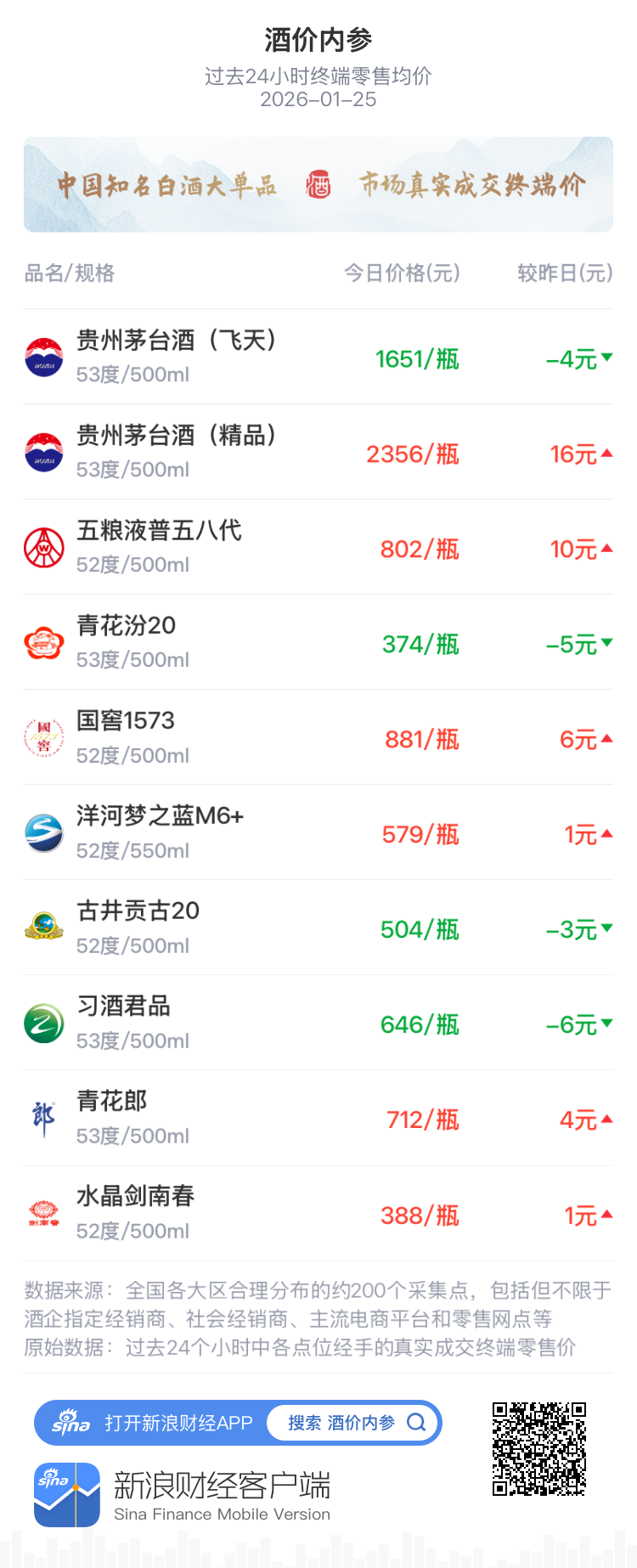
酒价内参1月25日价格发布 十大单品结构性回升精品茅台领涨
Xin Lang Cai Jing· 2026-01-25 01:12
Core Insights - The Chinese white liquor market has experienced a structural rebound in retail prices for the top ten products as of January 25, with an overall average price of 8,893 yuan, an increase of 20 yuan from the previous day, marking a five-day high [1] - The market shows a mixed performance with six products increasing in price and four decreasing, indicating ongoing structural adjustments within the industry [1] Price Movements - The premium Moutai (Jingpin) saw the largest increase, rising by 16 yuan to 2,356 yuan per bottle [3] - Wuliangye (Pu Wu 58) increased by 10 yuan to 802 yuan per bottle, contributing significantly to the average price rise [3] - Other notable increases include Guojiao 1573 (+6 yuan), Qinghua Lang (+4 yuan), and slight increases for Yanghe Dream Blue M6+ and Shuijing Jian Nan Chun (+1 yuan each) [1][4] Declines in Prices - The price of Xijiu Junpin decreased by 6 yuan to 646 yuan per bottle [4] - Qinghua Fen 20 dropped by 5 yuan, while Feitian Moutai faced a slight decline of 4 yuan due to consistent supply from the iMoutai platform [1][4] - Other declines include Gujing Gong Gu 20, which fell by 3 yuan [4]


“新旧消费”龙头股,基金经理现操作分歧
券商中国· 2026-01-24 15:29
Core Viewpoint - The "technology bull" continues to lead the market in Q4 2025, while both "new consumption" and traditional consumption sectors, represented by brands like Bubble Mart and liquor companies, show weak performance throughout the year [1]. New Consumption Sector - In Q4 2025, the new consumption sector, particularly represented by Bubble Mart, experienced a significant decline, with Bubble Mart's stock dropping by 29.65% [2]. - Despite the downturn, Bubble Mart remained a key holding for 123 funds, with a total of approximately 37.587 million shares held, although it was reduced by 8.7591 million shares in the quarter [2]. - Other new consumption stocks like Mao Geping and Mixue Group also saw increased fund interest, with Mao Geping being increased by 575.93 million shares and Mixue Group by 1.0322 million shares [3]. - Analysts suggest that the new consumption sector has potential for growth due to low penetration rates, despite volatility in some companies [3]. Traditional Consumption Sector (Liquor) - The traditional consumption sector, particularly the liquor industry, has shown disappointing profit results, with many stocks experiencing declines [4]. - Major liquor companies like Kweichow Moutai, Wuliangye, and Luzhou Laojiao faced reductions in holdings by funds, with Wuliangye being reduced by approximately 15.9 million shares [5]. - Despite the overall decline, Kweichow Moutai saw an increase in holdings by over 20,000 shares in Q4, indicating continued investor confidence [5]. - Analysts believe that the liquor industry is currently in a bottoming phase, with expectations for stabilization in the future, although the bottom for prices and financial reports has yet to be seen [5].

五粮液:伴随宏观经济持续回升向好等因素 行业将逐渐步入修复期
Zheng Quan Shi Bao Wang· 2026-01-24 14:13
人民财讯1月24日电,针对"白酒行业上行周期拐点何时到来?"的提问,五粮液(000858)在互动平台 表示:"我们认为伴随宏观经济持续回升向好、消费需求持续回暖、各类产业支持政策持续加码,行业 将逐渐步入修复期。" ...
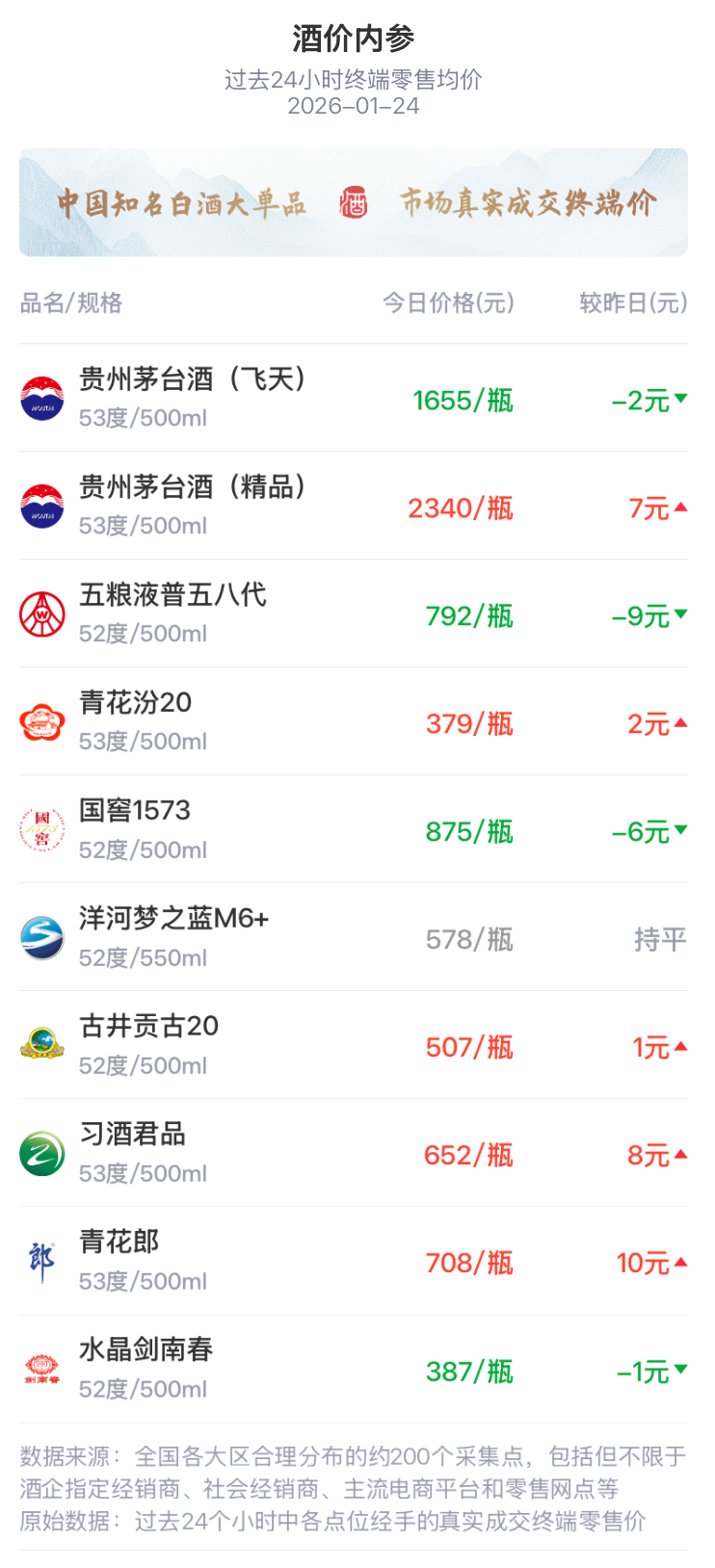
酒价内参1月24日价格发布 价格小幅回暖创四日新高
Xin Lang Cai Jing· 2026-01-24 01:10
Core Viewpoint - The Chinese liquor market shows signs of a slight recovery in retail prices for the top ten products as of January 24, with an overall average price of 8,873 yuan, an increase of 10 yuan from the previous day. However, the market remains cautious with structural fluctuations dominating the short-term outlook [1]. Price Movements - Among the top ten liquor products, five experienced price increases, four saw declines, and one remained stable. The overall average price remained relatively stable [1]. - The leading price increase was observed in Qinghua Lang, which rose by 10 yuan per bottle. Xijiu Junpin followed with an increase of 8 yuan per bottle, while the price of premium Moutai rose by 7 yuan per bottle [1]. - Other products that saw slight increases include Qinghua Fen 20 and Gujing Gong Gu 20, which rose by 2 yuan and 1 yuan per bottle, respectively [1]. Declining Prices - The product with the largest decline was Wuliangye Pu 58th generation, which fell by 9 yuan per bottle. Guojiao 1573 also saw a decrease of 6 yuan per bottle, and Feitian Moutai dropped by 2 yuan per bottle, primarily due to the continued supply of low-priced goods on the iMoutai platform [1][3]. - Additionally, Shuijing Jian Nan Chun experienced a minor decline of 1 yuan per bottle, while Yanghe Dream Blue M6+ remained unchanged at 578 yuan [1][4].
五粮液:2025年报数据还在统计过程中
Zheng Quan Ri Bao Wang· 2026-01-23 14:14
Group 1 - The company Wuliangye (000858) is currently in the process of compiling its 2025 annual report data [1]
张坤在管基金披露2025年四季报:减持白酒股 加仓阿里巴巴(09988)
Zhi Tong Cai Jing· 2026-01-23 12:24
Core Viewpoint - E Fund's Zhang Kun reported a decline in total assets under management to 48.383 billion yuan as of December 2025, with three A-share focused funds underperforming their benchmarks, while the E Fund Asia Select fund achieved positive returns, significantly exceeding its benchmark [1][2]. Group 1: Fund Performance - As of December 2025, the largest fund, E Fund Blue Chip Select, had a net asset value of 1.8623 yuan, with a report period net asset value growth rate of -8.93%, compared to a benchmark return of -2.63% [1]. - Three main A-share focused funds reported negative quarterly returns and failed to outperform their performance benchmarks [1]. Group 2: Portfolio Adjustments - Zhang Kun reduced holdings in major stocks such as Kweichow Moutai, Wuliangye, Luzhou Laojiao, and Shanxi Fenjiu, while also significantly reducing positions in Focus Media and China Merchants Bank [1]. - The top ten holdings of E Fund Blue Chip Select remained unchanged, including Tencent, Kweichow Moutai, and Alibaba, with notable reductions in Focus Media and increases in Alibaba [2]. Group 3: Market Outlook - Zhang Kun expressed a long-term optimistic view on the macro economy and market, predicting significant improvements in living standards and social security in China over the next decade [2]. - He emphasized the importance of a strong domestic demand market in promoting technological innovation, suggesting that improved consumer environments could enhance subscription revenues and model capabilities [3]. Group 4: Confidence in Business Models - Zhang Kun maintained confidence in the business models, competitive barriers, and cash flow generation capabilities of the companies in the portfolio, asserting that the market's perception of quality companies presents good opportunities for long-term investors [3].

