WLY(000858)

Search documents
002155,一字涨停!
Zhong Guo Ji Jin Bao· 2026-01-26 05:13
Market Overview - The A-share market opened higher but experienced fluctuations, with the Shanghai Composite Index closing at 4141.01 points, a slight increase of 0.12% [1] - The Shenzhen Component Index fell by 0.74%, and the ChiNext Index dropped by 0.86% [1] Individual Stock Performance - A total of 3756 stocks declined, while 1606 stocks rose, with 50 stocks hitting the daily limit up [2] - The total trading volume in the Shanghai and Shenzhen markets reached 2.24 trillion yuan, an increase of 347.8 billion yuan compared to the previous trading day [2] Sector Performance Precious Metals - The precious metals sector saw significant gains, with stocks such as Hunan Gold (002155) hitting the daily limit up, and others like Jin Hui Shares (603132) and Zhao Jin Gold (000506) also achieving 10% limit up [3][5] - The price of spot gold surpassed $5000 per ounce for the first time, increasing by over 1%, while spot silver rose by over 5% [5] Oil and Gas - The oil and gas sector experienced a rally, with major companies like China Petroleum and China Oil & Gas seeing increases of over 4% [6] - International oil prices surged, with WTI and ICE crude oil both rising by over 3% due to escalating geopolitical tensions [6] Financial Sector - The financial sector showed upward movement, with securities stocks rising, and insurance and banking stocks also performing well [8] - Notable gains were seen in stocks like Caitong Securities (601108) and Xingye Securities, both increasing by over 4% [9] Alcoholic Beverages - The liquor sector faced a downturn, with a decline of over 1%, particularly affected by a significant drop in Yanghe Shares (002304), which fell by over 8% [13] - Yanghe Shares projected a net profit decline of 62.18% to 68.30% for the fiscal year 2025, indicating potential financial distress [14]







食品饮料行业周报:白酒动销渐起-20260126
CMS· 2026-01-26 04:52
Investment Rating - The report maintains a positive outlook on the liquor industry, indicating a bottoming out and potential for a rebound during the Spring Festival, with a focus on key stocks such as Guizhou Moutai, Wuliangye, and Shanxi Fenjiu [5][16]. Core Insights - The report highlights that the safety margin for liquor companies is derived more from brand strength, market share, and sales momentum rather than just dividend yields, which are expected to be adjusted downwards for the years 2025-2026 [1][16]. - Recent sales tracking shows that Moutai's sales and pricing are better than market expectations, with a slight increase in overall channel sales volume and stable pricing [1][16]. - The report emphasizes the importance of cash flow and dividend planning, with companies like Yanghe planning to maintain dividends at no less than 100% of their net profit for 2025-2027 [2][11]. Summary by Relevant Sections Core Company Tracking - Yanghe's net profit for 2025 is projected to be between 2.12 billion and 2.52 billion yuan, a decline of 62.2%-68.3% year-on-year, with a focus on inventory reduction and price stabilization [2][11]. - Yanjing Beer expects a net profit of 1.58 billion to 1.74 billion yuan for 2025, reflecting a year-on-year increase of 50.0%-65.0%, with plans to launch a high-end product in 2026 [3][12]. - Yihai International anticipates low single-digit growth in H2 2025, driven by improved gross margins and a return of key personnel, which is expected to enhance business performance [4][13]. - IFBH is expected to face pressure in H2 2025, but with potential recovery in 2026 as supply issues are resolved [4][14]. Investment Recommendations - The report suggests a bottom-up approach to investing in liquor stocks, with a focus on key players and potential rebounds in sales, particularly in the context of the upcoming Spring Festival [5][16]. - It identifies four main lines for consumer goods: restaurant chains, dairy products, valuation-matched companies, and bottom-up recovery plays [5][17]. Industry Overview - The report notes that the food and beverage industry has a total market capitalization of 4,560.2 billion yuan, with 142 listed companies [5]. - The industry index shows a 1-month performance of 0.6%, a 6-month performance of 4.4%, and a 12-month performance of 17.7% [7].





白酒巨头,将分红20亿!
Nan Fang Du Shi Bao· 2026-01-26 04:36
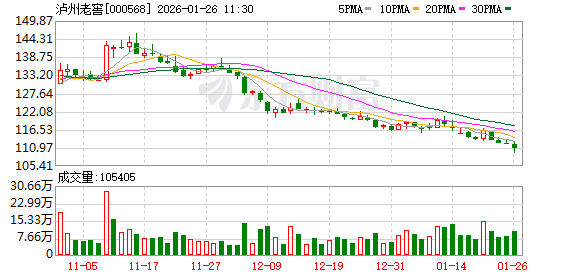
Core Viewpoint - Luzhou Laojiao, a company with a market value of over 100 billion, is set to implement a mid-term dividend plan totaling approximately 2 billion yuan (including tax), highlighting its financial stability and commitment to shareholder returns amidst industry challenges [2][4]. Group 1: Dividend Plans - The mid-term dividend plan involves a cash distribution of 13.58 yuan per 10 shares, based on a total share capital of 1.472 billion shares, with a total payout of around 2 billion yuan [2][4]. - Luzhou Laojiao's shareholder return plan states that annual dividends will not be less than 8.5 billion yuan for the years 2024-2026, with a minimum payout ratio of 65%, 70%, and 75% of net profit for those years respectively [4][10]. - In 2024, the company plans to distribute a total of approximately 8.759 billion yuan in dividends, exceeding the minimum target outlined in its shareholder return plan [4][10]. Group 2: Financial Performance - For the first three quarters of 2025, Luzhou Laojiao reported revenues of 23.127 billion yuan and a net profit of 10.762 billion yuan, reflecting year-on-year declines of 4.84% and 7.17% respectively [6]. - The overall white liquor market is experiencing pressure, with major companies like Luzhou Laojiao facing declining performance due to macroeconomic factors and high inventory levels [6][11]. Group 3: Industry Context - Other leading companies in the white liquor sector, such as Kweichow Moutai and Wuliangye, are also implementing mid-term dividend plans, indicating a trend among top firms to ensure shareholder returns despite market challenges [8][9]. - Kweichow Moutai's mid-term dividend for 2025 is set at 300.01 billion yuan, while Wuliangye plans to distribute 100.07 billion yuan, showcasing the competitive landscape in dividend payouts among leading brands [8][9].
张坤四季报:困难只是暂时的,中国消费“有鱼可钓”!
Xin Lang Cai Jing· 2026-01-26 03:19
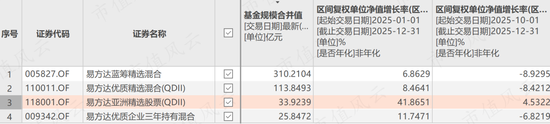
Group 1 - The core focus of the article is on the performance and strategic adjustments of funds managed by Zhang Kun of E Fund, highlighting the significant differentiation in fund performance and his outlook on domestic consumption and investment opportunities [1][2][3] Group 2 - In Q4 2025, Zhang Kun's managed fund size decreased to 48.3 billion yuan, with a quarterly reduction exceeding 8 billion yuan [2][3] - The largest fund, E Fund Blue Chip Selection Mixed Fund (005827.OF), experienced a nearly 9% loss in Q4, underperforming its benchmark by over 6%, while the E Fund Asia Select Stock Fund (118001.OF) achieved a 4.5% positive return, outperforming its benchmark by over 2% and recording a nearly 42% increase for the entire year [2][3][4] Group 3 - Zhang Kun continued to reduce holdings in the liquor sector, albeit at a slower pace compared to Q3 2025, maintaining a near 10% position in leading liquor stocks like Kweichow Moutai and Wuliangye [4][5][6] - Significant reductions were also noted in pharmaceutical and media stocks, with JD Health seeing a cut of about half in holdings, alongside Tencent Holdings and Focus Media [5][6][7] Group 4 - In overseas investments, Samsung Electronics replaced Tencent Holdings as the top holding in the E Fund Asia Select, with Zhang Kun opting to take profits as stock prices surged [6][7][8] Group 5 - Zhang Kun expressed a strong belief in the future of domestic consumption, arguing that current consumer weakness is not a permanent state and will improve, supported by government goals for income growth and stabilization of housing prices [8][9][10] - He emphasized that a robust domestic consumption market is crucial for technological innovation, suggesting that increased consumer spending will benefit domestic AI companies and accelerate their development [10][11][12] - Zhang Kun remains optimistic about the long-term potential of Chinese consumption and economic growth, viewing current market valuations of quality companies as attractive for long-term investors [10][11][12]


食品饮料周报(26年第4周):各品类春节备货有序进行,预制菜国标将征求意见-20260126
Guoxin Securities· 2026-01-26 02:59
Investment Rating - The report maintains an "Outperform the Market" rating for the food and beverage sector [4][5][11]. Core Views - The food and beverage sector is expected to perform well in 2026, driven by cost advantages, efficiency improvements, innovation, and potential recovery opportunities in the liquor segment [3][11][15]. - The report highlights a diversified performance across sub-sectors, with beverages outperforming food and liquor categories [2][11]. Summary by Relevant Sections 1. Sector Overview - The food and beverage sector saw a cumulative decline of 1.37% this week, with A-shares down 1.57% and H-shares up 1.21% [1]. - Key performers included companies like Hao Xiang Ni and Wei Zhi Xiang, with significant weekly gains [1]. 2. Sub-sector Insights - **Liquor**: - Moutai's price remains stable with an upward trend, and the focus is on sales momentum during the Spring Festival. Recommendations include Moutai, Shanxi Fenjiu, and Luzhou Laojiao [2][11]. - **Beverages**: - The dairy segment is seeing orderly preparations for the Spring Festival, with a focus on leading companies like Yili. Recommendations include Nongfu Spring and Dongpeng Beverage [2][15]. - **Snacks**: - The report emphasizes strong alpha stocks in the snack sector, particularly in konjac products, with companies like Weidong and Yanjinpuzi showing strong innovation [2][13]. - **Catering Supply Chain**: - The sector is entering a peak season for inventory and sales, with new standards for prepared dishes being solicited for public opinion [2][14]. 3. Investment Recommendations - The report suggests a focus on four main lines for investment: cost advantages, efficiency improvements, innovation-driven companies, and potential recovery in the liquor sector [3][11]. - Recommended stocks include Baba Foods, Dongpeng Beverage, Weidong, and Shanxi Fenjiu, which have shown resilience and growth potential [17][19]. 4. Earnings Forecasts - Key companies are projected to maintain strong earnings growth, with Moutai expected to achieve a stable performance and Yili showing significant recovery potential [4][15][19]. - The report provides detailed earnings forecasts for several companies, indicating a positive outlook for the food and beverage sector [4][19].



酒价内参1月26日价格发布 十大单品涨跌互现青花郎领涨
Xin Lang Cai Jing· 2026-01-26 01:17
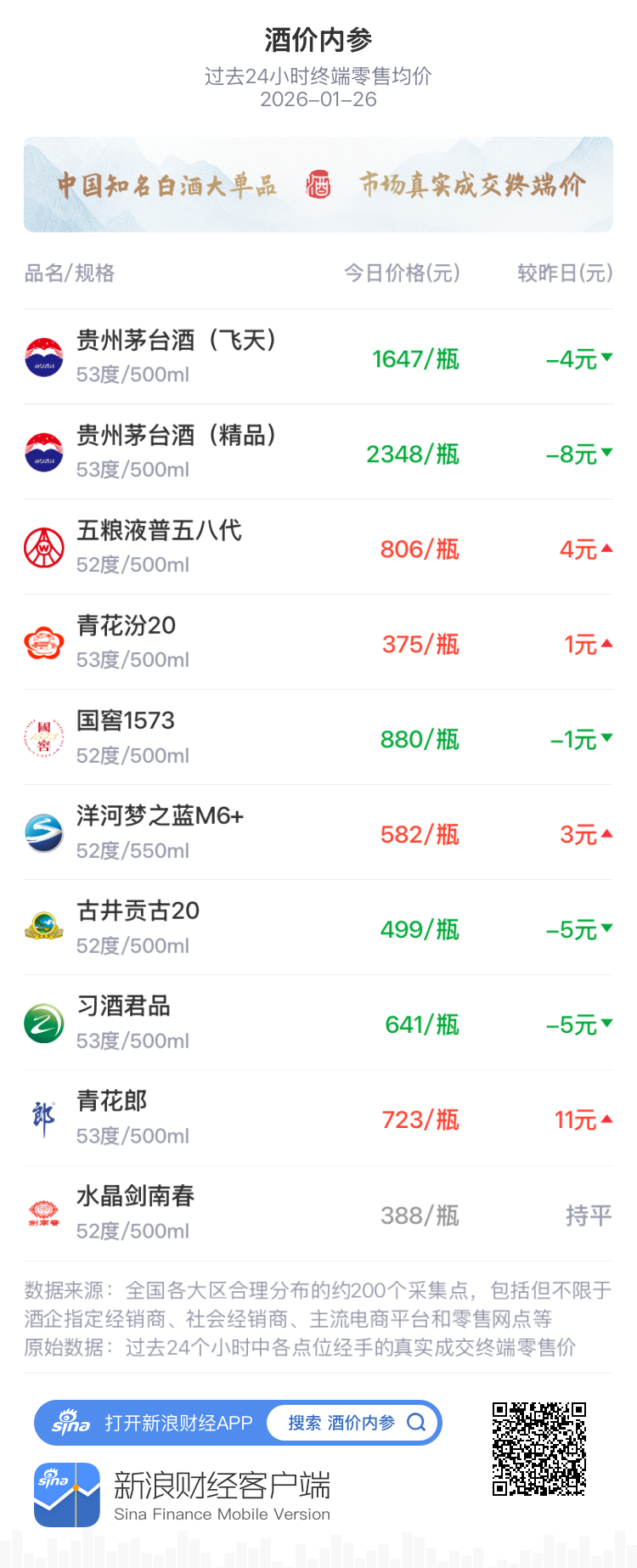
Core Viewpoint - The Chinese liquor market is experiencing a weak price differentiation among the top ten products, with a slight overall decline in retail prices, indicating a phase of market rebalancing [1]. Price Trends - The total retail price for a package of the top ten liquor products is 8,889 yuan, down by 4 yuan from the previous day [1]. - The market shows four products increasing in price, five decreasing, and one remaining stable [1]. Price Increases - Qinghua Lang leads the price increase with an 11 yuan rise per bottle, marking four consecutive days of price growth [1]. - Wuliangye and Mengzhilan M6+ saw increases of 4 yuan and 3 yuan per bottle, respectively, providing support in the mid-range segment [1]. - Qinghua Fen 20 experienced a slight increase of 1 yuan per bottle [1]. Price Decreases - Premium Moutai saw a price drop of 8 yuan per bottle [1]. - Xijiu Junpin and Gujing Gonggu 20 both decreased by 5 yuan per bottle [1]. - Feitian Moutai fell by 4 yuan per bottle due to normalized supply from the iMoutai platform [1]. - Guojiao 1573 experienced a minor decline of 1 yuan per bottle [1]. - Shujin Jianan Spring's price remained unchanged from the previous day [1]. Specific Product Prices - Feitian Moutai: 1,647 yuan per bottle, down 4 yuan [3]. - Premium Moutai: 2,348 yuan per bottle, down 8 yuan [3]. - Wuliangye: 806 yuan per bottle, up 4 yuan [3]. - Qinghua Fen 20: 375 yuan per bottle, unchanged [3]. - Guojiao 1573: 880 yuan per bottle, down 1 yuan [3]. - Mengzhilan M6+: 582 yuan per bottle, up 3 yuan [4]. - Gujing Gonggu 20: 499 yuan per bottle, down 57 yuan [4]. - Xijiu Junpin: 641 yuan per bottle, down 57 yuan [4]. - Qinghua Lang: 723 yuan per bottle, up 11 yuan [4]. - Shujin Jianan Spring: 388 yuan per bottle, unchanged [4].

食品饮料行业周报:茅台批价坚挺旺季氛围渐起,鸣鸣很忙上市催化零食板块-20260125
Shenwan Hongyuan Securities· 2026-01-25 13:08
Investment Rating - The report maintains a positive outlook on the liquor sector, particularly on premium brands like Guizhou Moutai, Luzhou Laojiao, and Shanxi Fenjiu, while also highlighting the potential of other brands such as Wuliangye and Jinjing Wine [2][7]. Core Insights - The liquor market is undergoing a restructuring phase, with expectations of a double-digit decline in sales year-on-year for Q1 2026, but a potential stabilization in Q2 and a turning point in Q3 [2][7]. - The report anticipates a recovery in the liquor sector by the end of 2026 and into 2027, driven by improved fundamentals and valuation [2][7]. - The consumer goods sector is showing structural improvements, with competition shifting from price to quality, leading to a gradual balance in supply and demand [2][9]. Summary by Sections 1. Weekly Insights on Food and Beverage - The food and beverage sector saw a decline of 1.41% last week, with liquor down 2.80%, underperforming the Shanghai Composite Index by 2.25 percentage points [6]. - Notable stock performances included a 19.59% increase for Haoxiangni and a 14.32% rise for Wancheng Group [6]. 2. Market Performance of Food and Beverage Sectors - The report highlights the price stability of Moutai, with a current price of 1560 RMB per bottle, up 20 RMB from the previous week, indicating a positive trend in pricing [8][27]. - The report notes that Moutai's pricing has found a bottom, reducing downward risks significantly, and anticipates a potential increase in sales volume as the Spring Festival approaches [8]. 3. Industry Events and Updates - The report mentions the upcoming IPO of Mingming Hen Mang, a leading snack retail chain, which is expected to catalyze the snack sector [10]. - The report emphasizes the importance of supply chain management and digitalization in enhancing competitive advantages for companies like Mingming Hen Mang [10]. 4. Valuation Table - The food and beverage sector's dynamic PE is currently at 19.27x, with a premium rate of 10%, while the liquor sector's dynamic PE stands at 17.50x, indicating a zero premium [27].
食品饮料行业2025年四季度基金持仓分析:食饮板块超配比例略有回升,乳品、预加工食品等获得增持
Guoxin Securities· 2026-01-25 12:49
Investment Rating - The food and beverage industry maintains an "Outperform" rating [4][5]. Core Insights - The food and beverage sector's fund holding ratio is 4.48%, with a slight decrease of 0.25 percentage points from the previous quarter, ranking eighth among Shenwan's primary industries. The sector continues to be overweight, with an overweight ratio increasing by 0.02 percentage points [1][11]. - The white liquor sector remains the most heavily weighted, but its overweight ratio has decreased. Conversely, the dairy, snacks, and seasoning sectors have seen an increase in fund holding ratios [2][16]. - Key individual stocks such as Kweichow Moutai and Wuliangye have seen a decrease in their heavy holding ratios, while Yuran Dairy and Angel Yeast have received increased allocations [3][27]. Summary by Sections Fund Holdings Analysis - The food and beverage industry has a fund holding ratio of 4.48%, with a total heavy holding market value of approximately 117.8 billion yuan. The sector's overweight ratio is 0.64%, indicating a maintained overweight status [1][11]. Subsector Analysis - The white liquor sector's fund holding ratio is 3.32%, with an overweight ratio of 0.84%. Excluding Kweichow Moutai, the ratio drops to 1.84% with an overweight ratio of 0.85%. The dairy sector's fund holding ratio has increased to 0.25%, ranking third among subsectors [2][16][17]. Individual Stock Analysis - Kweichow Moutai's heavy holding ratio has decreased to 1.47%, despite an increase in the number of funds holding it to 296. Other major stocks in the white liquor sector, such as Wuliangye and Shanxi Fenjiu, have also seen declines in their heavy holding ratios [3][27][28].

食品饮料行业 2025 年四季度基金持仓分析:食饮板块超配比例略有回升,乳品、预加工食品等获得增持
Guoxin Securities· 2026-01-25 12:40
Investment Rating - The food and beverage industry maintains an "Outperform" rating [4][5][35] Core Views - The food and beverage sector's fund holding ratio is 4.48%, with a slight decrease of 0.25 percentage points from the previous quarter, ranking eighth among Shenwan's primary industries. The sector continues to be overweight, with an overweight ratio increasing by 0.02 percentage points [1][11] - The white liquor sector remains the most heavily weighted, but its overweight ratio has decreased. Conversely, the dairy, snacks, and seasoning sectors have seen an increase in fund holding ratios [2][16] - Key individual stocks such as Kweichow Moutai and Wuliangye have seen a decrease in their heavy holding ratios, while Yuran Dairy and Angel Yeast have received increased allocations [3][27] Summary by Sections Fund Holdings Analysis - The food and beverage industry has a fund holding ratio of 4.48%, with a total institutional heavy holding market value of approximately 117.8 billion yuan [1][11] - The white liquor sector's fund holding ratio is 3.32%, while the ratio excluding Kweichow Moutai is 1.84% [2][16] Subsector Performance - White liquor: Fund holding ratio decreased by 0.37 percentage points to 3.32%, with an overweight ratio down to 0.84% [2][16] - Dairy: Fund holding ratio increased by 0.10 percentage points to 0.25%, with an overweight ratio up to -0.16% [17] - Snacks: Fund holding ratio increased by 0.03 percentage points to 0.22%, with an overweight ratio up to 0.12% [17] Individual Stock Analysis - Kweichow Moutai's heavy holding ratio decreased to 1.47%, despite an increase in the number of funds holding it to 296 [3][27] - Wuliangye's heavy holding ratio decreased to 0.41%, with a reduction in the number of funds holding it [3][27] - Yuran Dairy's heavy holding ratio increased to 0.07%, indicating a positive shift in fund allocations [3][27]
湖北和广东调研反馈、周观点:啤酒推新蓄力,烘焙旺季稳健-20260125
GOLDEN SUN SECURITIES· 2026-01-25 11:22
Investment Rating - The report maintains an "Accumulate" rating for the food and beverage industry [5] Core Insights - The upcoming Spring Festival is expected to boost sales in the liquor sector, with Moutai leading the industry towards an unexpected improvement. Short-term focus should be on the demand for the Spring Festival, while medium-term investments should target leading brands across various price segments [1] - In the beer segment, new product launches are being prepared, with a focus on high-growth channels and consumer trends towards personalized and diversified consumption [2] - The baking sector is showing stable performance, with companies like Lihigh Foods preparing for the sales peak and benefiting from favorable policies regarding cream products [3] Summary by Relevant Sections Liquor Sector - The Spring Festival is driving demand, with Moutai expected to lead the market. Key short-term stocks include Guizhou Moutai, Guo Jiu Gong Jiu, and others, while medium-term focus should be on Wuliangye and Shanxi Fenjiu [1] Beer Sector - Current beer sales are in a low season, but new product launches and high growth in instant retail channels are promising. Companies like Chongqing Beer are launching new 1L cans to meet consumer preferences [2] Food Sector - Lihigh Foods is preparing for the sales peak with a focus on quality over quantity, while Anqi Yeast is benefiting from declining sugarcane prices, enhancing profit margins [3] - Yizhi Konjac is experiencing rapid demand growth, with a stable supply chain and product innovation driving its market position [4]