Bank of Ningbo(002142)

Search documents
多家银行积存金千元起购,风控升级下“炒金”攻略盛行
Bei Jing Shang Bao· 2025-05-05 11:37
在分析人士看来,积存金适合作为长期资产配置工具,但其短期波动风险较高,为通过风险测评而填写虚假投资经历或信息,有可能导致投资者 购买超出自身承受能力的产品,一旦金价大幅回调,可能引发资金损失甚至投诉纠纷。对于风险承受能力较弱的投资者,建议采用定期定额投 资,分散买入时点以平滑成本,并控制黄金在投资组合中的比例。 起购"门槛"升至千元 随着金价波动加剧,多家银行积存金起购"门槛"不断上调。5月5日,北京商报记者注意到,近期多家银行积存金认购起点金额已从百元涨至千 元。除上调起购"门槛"外,亦有银行对积存金业务风险测评进行优化调整。而在银行严控"炒金"风险的背景下,为顺利通过银行风险测评,积存 金业务的风险评估攻略在社交平台悄然兴起。 例如,此前有银行要求,个人客户办理积存金业务的开户、主动积存或新增定投计划的,需通过营业网点、网上银行或手机银行App等渠道,按 该行统一的风险测评试题重新进行风险承受能力评估、取得C1-保守型及以上的评估结果并签订积存金风险揭示书。 而在银行严控"炒金"风险的背景下,积存金业务风险测评攻略却在社交平台悄然兴起,为顺利通过银行风险测评购入积存金,多位投资者利用重 新评估、网友分享的 ...





宁波银行(002142):利息强劲,存贷高增
Changjiang Securities· 2025-05-05 02:41
Investment Rating - The investment rating for the company is "Buy" and is maintained [9]. Core Views - The company reported a revenue growth rate of 5.6% and a net profit growth rate of 5.8% for Q1 2025, with net interest income increasing by 11.6%. Non-interest income decreased by 5.8%, primarily due to a 1.3% decline in net fee income. The decline in net profit growth was mainly due to an increase in credit costs, while a reduction in income tax expenses and a decrease in the cost-to-income ratio contributed positively, resulting in a PPOP growth rate of 9.7% [2][6][11]. - The company experienced significant growth in loans and deposits, with loans increasing by 11.1% and deposits by 18.9% compared to the beginning of the period. The non-performing loan ratio remained stable at 0.76%, while the provision coverage ratio decreased by 19 percentage points to 371% [2][6][11]. - The net interest margin stood at 1.80%, down 6 basis points from the previous year, with the yield on interest-earning assets declining by 31 basis points to 3.66%. The cost of interest-bearing liabilities decreased by 22 basis points to 1.84% [11]. Summary by Sections Performance - The company's profitability remains robust, with net interest income maintaining a high growth rate of 11.6%. The decline in non-interest income is expected to improve as previous fee reductions in wealth management gradually dissipate. The net profit growth deceleration is attributed to rising credit costs, but the overall performance remains strong with a PPOP growth of 9.7% [11]. Scale - The total assets grew by 8.7% compared to the beginning of the year, with loans increasing by 11.1% and deposits by 18.9%. The growth in corporate and bill loans was particularly strong, while retail loan demand showed signs of weakness [11]. Interest Margin - The company maintains a clear advantage in absolute levels of net interest margin, although it has seen a slight decline. The cost of liabilities is expected to continue decreasing, which may alleviate some pressure on the net interest margin [11]. Non-Interest Income - The pressure on non-interest income is expected to improve, with a smaller decline in fee income. Investment income has been cautious, and the company has not significantly released investment gains to boost revenue [11]. Asset Quality - The non-performing loan ratio remains low, and the company is closely monitoring retail risk. The annualized net non-performing loan generation rate for Q1 2025 was 1.14%, showing a decrease compared to the previous year [11]. Investment Recommendation - The strong growth in net interest income and the expectation of improving retail risk conditions support the "Buy" rating. The current valuation is at 0.70x 2025 PB, indicating no significant premium compared to peers, with potential for upward valuation adjustments if retail asset quality improves [11].

你追我赶的长三角城商行!
券商中国· 2025-05-04 08:54
Core Viewpoint - The overall credit growth in China's banking sector has slowed from double digits to single digits, primarily due to insufficient demand, especially from the household sector. However, some regional banks in the Yangtze River Delta continue to show robust credit growth due to local economic vitality [1]. Group 1: Credit Demand and Growth - Insufficient credit demand, particularly from the residential sector, has led to a slowdown in overall credit growth in China's banking industry [1]. - Regional banks in the Yangtze River Delta, such as city commercial banks, have maintained stable credit growth due to strong local economic activity [1][2]. Group 2: Asset Scale Changes - The asset scale rankings among city commercial banks in the Yangtze River Delta have shifted, with Jiangsu Bank reaching a scale of 4 trillion yuan, surpassing Beijing Bank to become the second-largest city commercial bank in China [3]. - Ningbo Bank has overtaken Shanghai Bank, with asset totals of 3.4 trillion yuan and 3.27 trillion yuan, respectively, as of the end of Q1 [3][6]. Group 3: Q1 Performance Highlights - Q1 is typically a peak period for commercial bank lending, contributing significantly to overall credit growth. Despite a general slowdown, banks in the Yangtze River Delta achieved an average asset growth rate of 7% in Q1 [4]. - Jiangsu Bank, Ningbo Bank, Shanghai Bank, Nanjing Bank, and Hangzhou Bank reported significant asset growth, with Jiangsu Bank leading with a 12.84% increase [6]. Group 4: Interest Income and Revenue Growth - Net interest income for banks in the Yangtze River Delta has seen substantial growth, with Jiangsu Bank, Ningbo Bank, Shanghai Bank, Nanjing Bank, and Hangzhou Bank all reporting double-digit increases [8]. - The average revenue growth for city commercial banks in the Yangtze River Delta was approximately 5% in Q1, outperforming the average growth of 1.59% for listed city commercial banks [11]. Group 5: Non-Interest Income and Investment Gains - Non-interest income, particularly from investment gains, has also shown strong performance, with Jiangsu Bank, Ningbo Bank, and Nanjing Bank reporting investment income growth around 30% [12]. - Investment income has become a significant contributor to overall revenue, with some banks achieving over 100% growth in this area [13].




A股上市城商行一季报出炉:北京银行、贵阳银行、厦门银行营收利润均下降
Guan Cha Zhe Wang· 2025-05-03 07:24
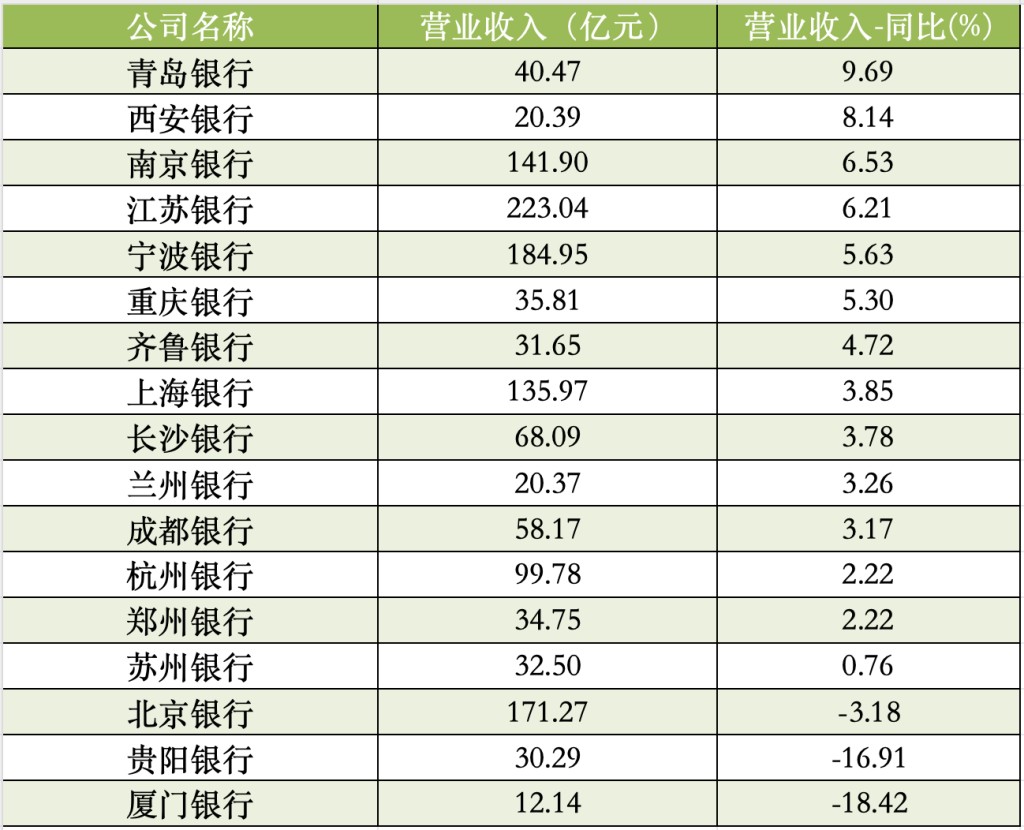
Core Insights - In the first quarter of 2025, 14 out of 17 A-share listed city commercial banks reported positive revenue growth, with an average growth rate of 2.96%, a decline from 5.61% in the same period last year [1][3][6] - The net profit for 14 banks also showed positive growth, averaging 5.49%, down from 7.05% year-on-year [1][6][7] - The asset scale of A-share listed city commercial banks increased by 6.53% compared to the end of the previous year, up from 4.65% year-on-year [2][9] Revenue Performance - Qingdao Bank led the revenue growth with a year-on-year increase of 9.69%, followed by Xi'an Bank (8.14%), Nanjing Bank (6.53%), and Jiangsu Bank (6.21%) [3][5] - Three banks reported negative revenue growth: Beijing Bank (-3.18%), Guiyang Bank (-16.91%), and Xiamen Bank (-18.42%) [4][5] - Jiangsu Bank achieved the highest revenue among the listed banks, totaling 22.304 billion yuan, while Xiamen Bank had the lowest at 1.214 billion yuan [4][5] Net Profit Performance - Hangzhou Bank led in net profit growth with a 17.3% increase, followed by Qilu Bank (16.47%) and Qingdao Bank (16.42%) [7][8] - Negative net profit growth was reported by Beijing Bank (-2.44%), Guiyang Bank (-6.82%), and Xiamen Bank (-14.21%) [7][8] - Jiangsu Bank reported the highest net profit at 9.78 billion yuan, while Xiamen Bank had the lowest at 0.645 billion yuan [7][8] Asset Scale and Quality - As of March 31, 2025, eight A-share listed city commercial banks had asset scales exceeding 1 trillion yuan, with Beijing Bank and Jiangsu Bank surpassing 4 trillion yuan [9][10] - The overall asset quality showed improvement, with seven banks reporting non-performing loan ratios below 1%, the lowest being Chengdu Bank at 0.66% [11][12]

宁波银行:开门红存贷两旺,资产质量韧性凸显-20250502
Huaan Securities· 2025-05-02 05:23
Investment Rating - The investment rating for the company is "Buy" (maintained) [1] Core Views - The company has demonstrated strong performance in both deposits and loans, with resilient asset quality [1] - Revenue and net profit for the first quarter of 2025 increased by 5.63% and 5.76% year-on-year, respectively, despite a slight decline compared to 2024 [4] - Interest income continued to grow significantly, supporting stable revenue and profit growth, with a year-on-year increase of 11.59% in net interest income [4][5] - The bank's total assets, loans, and financial investments grew by 17.58%, 20.91%, and 13.66% year-on-year, respectively, indicating improved growth rates compared to 2024 [5] - The bank's non-performing loan ratio remained stable at 0.76%, with a provision coverage ratio of 370.54% [8] - The bank's competitive advantages are highlighted by its focus on the Zhejiang region and its clear market positioning [9] Summary by Sections Financial Performance - For Q1 2025, the bank's revenue and net profit growth rates were 5.63% and 5.76%, respectively, with net interest income accounting for 69.4% of total revenue [4] - The bank's total assets reached approximately 3,125.232 billion, with loans totaling 1,380.363 billion [12] - The projected revenue for 2025 is 71,878 million, with a year-on-year growth of 7.87% [11] Asset Quality - The non-performing loan ratio was stable at 0.76%, and the provision coverage ratio was 370.54%, indicating strong risk management [8] - The bank has shown proactive adjustments in credit and risk control strategies, leading to improvements in forward-looking risk indicators [8] Growth Outlook - The bank is expected to maintain a revenue growth of 7.87% in 2025, with net profit growth projected at 4.61% [11] - The bank's diversified financial services and solid risk control capabilities position it well to benefit from domestic demand and industrial chain shifts [9]
机构持仓大曝光!社保、QFII、公募持股50强出炉
券商中国· 2025-05-01 12:44
Core Viewpoint - The article provides insights into the latest stock holdings and trading activities of major institutional investors in the A-share market, focusing on the Social Security Fund, QFII, and public funds, highlighting their preferences and adjustments in stock positions during the first quarter of 2025 [2][3][8][13]. Social Security Fund Holdings - As of the end of Q1 2025, the Social Security Fund was involved in 597 listed companies, with a total holding of 10.913 billion shares, a year-on-year decrease of 11.26%, and a total market value of 173.945 billion yuan, down 6.43% year-on-year [3]. - The fund's investments in sectors such as machinery, basic chemicals, electronics, non-ferrous metals, electric equipment, and pharmaceuticals exceeded 13 billion yuan, with the pharmaceutical sector having the highest number of holdings at 61 companies [3]. - The top 50 companies held by the Social Security Fund accounted for 66.579 billion yuan, representing 38.28% of its total holdings, with SANY Heavy Industry leading at 3.352 billion yuan [3][4]. QFII Holdings - By the end of Q1 2025, QFII held shares in 692 listed companies, a decrease of 3.76% year-on-year, with a total market value of 117.213 billion yuan, an increase of 11.5% year-on-year [8]. - Notably, two companies, Ningbo Bank and Nanjing Bank, had QFII holdings exceeding 10 billion yuan, with values of 32.17 billion yuan and 19.264 billion yuan, respectively [10]. - QFII's investments were concentrated, with the top 50 stocks accounting for 81.02% of its total holdings [8]. Fund Holdings - The public fund holdings report indicated that 51 stocks had a market value exceeding 10 billion yuan, with Ningde Times and Kweichow Moutai leading at 146.823 billion yuan and 141.539 billion yuan, respectively [13][16]. - The number of funds holding Ningde Times reached 1,864, while Kweichow Moutai had 1,196 funds, both showing significant growth [13]. - Other notable companies with substantial fund holdings included China Merchants Bank, Midea Group, and Ping An Insurance, each exceeding 50 billion yuan [17]. Market Outlook - Fund managers expressed optimism about the A-share market, citing strong economic resilience and potential recovery signals, particularly in consumer sectors [14].



【2025-04-30】晨会纪要
Ping An Securities· 2025-05-01 01:00
Group 1: Investment Rating - The report maintains a "Recommended" rating for the companies analyzed, indicating a positive outlook for their future performance [10][19][33]. Group 2: Core Insights - The active bond fund market shows a slight increase in the number of funds and total assets, with 3,263 funds and a total scale of 7.90 trillion yuan, reflecting a 0.8% and 1.0% increase respectively [7][8]. - The performance of active bond funds in Q1 was influenced by rising government bond yields, with short-term pure bond funds performing particularly well [7][8]. - The report highlights a shift in asset allocation within mixed secondary bond funds, with increased holdings in sectors such as non-ferrous metals, pharmaceuticals, and steel [8][9]. - The medical device company Mindray achieved a revenue of 36.73 billion yuan in 2024, with a year-on-year growth of 5.14%, while its international business grew by 21.28% [10][11]. - Haibo Technology reported a revenue of 8.27 billion yuan in 2024, marking an 18.44% increase, with a significant focus on energy storage systems [15][18]. - The refrigerant manufacturer Sanmei achieved a revenue of 4.04 billion yuan in Q1 2025, reflecting a 26.42% increase, driven by strong demand in the home appliance and automotive sectors [26][27]. Group 3: Summary by Sections Active Bond Funds - As of Q1 2025, the number of active bond funds reached 3,263, with a total scale of 7.90 trillion yuan, and 43 new funds were issued, totaling 783.7 billion yuan [7][8]. - The performance of short-term pure bond funds was notably strong due to rising yields, while mixed bond funds showed volatility [7][8]. Mindray Medical - Mindray's revenue for 2024 was 36.73 billion yuan, with a net profit of 11.67 billion yuan, and a proposed cash dividend of 5.6 yuan per 10 shares [10][11]. - The company anticipates a recovery in domestic business in 2025, with international revenue expected to continue growing [11][12]. Haibo Technology - Haibo's revenue for 2024 was 8.27 billion yuan, with a focus on energy storage systems, which accounted for a significant portion of its revenue [15][18]. - The company has established partnerships with international firms to explore new market opportunities [18]. Sanmei - Sanmei's revenue for 2024 was 4.04 billion yuan, with a significant increase in refrigerant prices due to supply constraints [26][27]. - The company is well-positioned in the market with a leading share in the production of third-generation refrigerants [29]. Huayu Automotive - Huayu reported a revenue of 168.85 billion yuan in 2024, with a slight decline in net profit due to cost pressures [31][32]. - The company is adjusting its customer structure to mitigate risks associated with its largest client, SAIC [32][33].



银行行业今日净流出资金20.11亿元,工商银行等6股净流出资金超亿元
Zheng Quan Shi Bao Wang· 2025-04-30 12:11
Market Overview - The Shanghai Composite Index fell by 0.23% on April 30, with 21 out of the 28 sectors experiencing gains, led by the computer and automotive sectors, which rose by 2.33% and 1.59% respectively [2] - The banking sector had the largest decline, dropping by 2.09%, followed by the steel sector with a decrease of 1.35% [2] Fund Flow Analysis - The net outflow of capital from the two markets was 1.431 billion yuan, with 13 sectors seeing net inflows [2] - The computer sector had the highest net inflow of capital, amounting to 2.428 billion yuan, while the automotive sector followed with a net inflow of 2.231 billion yuan [2] - The banking sector experienced the largest net outflow, totaling 2.011 billion yuan, followed by the non-ferrous metals sector with a net outflow of 1.450 billion yuan [2] Banking Sector Performance - Within the banking sector, 42 stocks were tracked, with only 4 stocks rising and 37 stocks declining [3] - The top three banks with the highest net outflows were Industrial and Commercial Bank of China, Agricultural Bank of China, and China Construction Bank, with outflows of 558 million yuan, 341 million yuan, and 235 million yuan respectively [3][4] - Notable individual stock performances included Ningbo Bank with a net inflow of 52.64 million yuan, and Huaxia Bank with a significant outflow of 855 million yuan [4]


长三角城商行座次重排:宁波银行首次超过上海银行 三大业务板块动能切换
2 1 Shi Ji Jing Ji Bao Dao· 2025-04-30 09:38
Core Viewpoint - The financial performance of four major city commercial banks in the Yangtze River Delta—Jiangsu Bank, Shanghai Bank, Ningbo Bank, and Nanjing Bank—has shown varying strengths, with Jiangsu Bank maintaining its leading position while the others have demonstrated notable growth in specific areas [1][2]. Group 1: Financial Performance Overview - As of the end of Q1, Jiangsu Bank leads in total assets at 4.46 trillion yuan, followed by Ningbo Bank at 3.40 trillion yuan, Shanghai Bank at 3.27 trillion yuan, and Nanjing Bank at 2.77 trillion yuan [1]. - For 2024, Jiangsu Bank reported the highest revenue at 808.15 billion yuan, with Ningbo Bank at 666.31 billion yuan, and both Shanghai and Nanjing Banks in the 500 billion yuan range [1]. - Nanjing Bank exhibited the highest revenue growth rate at 11.32%, while Jiangsu and Ningbo Banks maintained over 8% growth [1]. Group 2: Q1 Revenue and Profit Analysis - In Q1, revenue rankings shifted, with Jiangsu Bank at 223.04 billion yuan, Ningbo Bank at 184.95 billion yuan, Nanjing Bank at 141.90 billion yuan, and Shanghai Bank at 135.97 billion yuan [2]. - Jiangsu Bank's net profit for the previous year was the highest at 333.06 billion yuan, with a year-on-year growth of 10.97% [2]. - In Q1, Jiangsu Bank's net profit surpassed 100 billion yuan, reaching 100.92 billion yuan, followed by Ningbo Bank at 74.56 billion yuan [2]. Group 3: Revenue Sources and Trends - The three main revenue sources for banks—net interest income, net fee and commission income, and net investment income—are under pressure due to declining interest rates and changing wealth management demands [3]. - Ningbo Bank showed a significant increase in net interest income growth, with a 2024 growth rate of 17.32%, while Jiangsu Bank's growth was 6.29% [3]. - Jiangsu Bank's net interest income as a percentage of revenue is 69.24%, while Ningbo Bank leads at 72.03% [4]. Group 4: Fee and Commission Income - Jiangsu Bank is the only bank showing a positive growth trend in fee and commission income for 2024, with a growth rate of 3.29% [4]. - Other banks, including Ningbo and Shanghai Banks, experienced declines in fee income, although the rate of decline has slowed [5]. Group 5: Investment Income Insights - Investment income for Jiangsu and Ningbo Banks saw a significant decrease compared to the previous year, with Jiangsu Bank's investment income rising slightly to 22.78% of revenue [6]. - In Q1, Nanjing Bank's fee and commission income surged by 18.001%, becoming the highest among the four banks [7]. Group 6: Net Interest Margin and Cost of Liabilities - As of Q1, Jiangsu Bank had the highest net interest margin at 1.82%, while Shanghai Bank had the lowest at 1.16% [8]. - The banks are facing challenges with narrowing interest margins due to declining benchmark rates and rising liability costs [8][9]. Group 7: Loan Growth and Strategy - Jiangsu and Ningbo Banks increased corporate loan growth significantly, with growth rates of 28.59% and 24.13%, respectively [9]. - Nanjing Bank has also focused on increasing high-interest personal loans, achieving significant growth in consumer loans [10].
关注的一些银行24年年报数据整理
雪球· 2025-04-30 08:44
以下文章来源于躺师傅的投资世界 ,作者躺师傅 躺师傅的投资世界 . 格施好学徒,佛系收息人~ 风险提示:本文所提到的观点仅代表个人的意见,所涉及标的不作推荐,据此买卖,风险自负。 作者: 躺红利摊转债 来源:雪球 银行板块的年报陆陆续续都出完了 , 今天有空就来做个数据整理 , 现在整个银行板块数量也挺 多 , 为减少工作量 , 就从国有行 、 股份行和城商行中各选四家具有代表性的银行做一个数据 对比吧~ 一 、 整体业绩概览 | 营收(亿) | | 同比 | 净利润(亿) | 同比 | 风险加权资 | 同比 | 24年 | | --- | --- | --- | --- | --- | --- | --- | --- | | | | | | | 产(亿) | | 浅幅 | | 工商银行 8218.03 | | -2.52% | 3658. 63 | 0. 51% | 257108. 55 | 4. 34% | 52. 30% | | 建设银行 7501.51 | | -2.54% | 3355. 77 | 0. 88% | 218545. 90 | -2. 42% | 42. 44% | | 农业银行 71 ...