TLC(002466)

Search documents
能源金属板块11月21日跌8.9%,寒锐钴业领跌,主力资金净流出37.69亿元
Zheng Xing Xing Ye Ri Bao· 2025-11-21 09:33
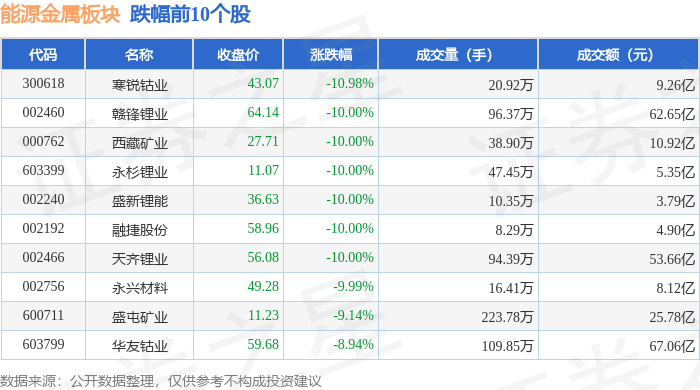
Core Insights - The energy metals sector experienced a significant decline of 8.9% on November 21, with Hanrui Cobalt leading the drop [1] - The Shanghai Composite Index closed at 3834.89, down 2.45%, while the Shenzhen Component Index closed at 12538.07, down 3.41% [1] Sector Performance - Major stocks in the energy metals sector saw substantial losses, with several companies reporting a decline of 10% or more, including: - Sai Rui Aluminum: -10.98% [1] - Ganfeng Lithium: -10.00% [1] - Tibet Mining: -10.00% [1] - Yongshan Lithium: -10.00% [1] - Shengxin Lithium Energy: -10.00% [1] - Rongjie Co., Ltd.: -10.00% [1] - Tianqi Lithium: -10.00% [1] - Yongxing Materials: -9.99% [1] - Shengtun Mining: -9.14% [1] - Huayou Cobalt: -8.94% [1] Capital Flow - The energy metals sector saw a net outflow of 3.769 billion yuan from major funds, while retail investors contributed a net inflow of 2.551 billion yuan [1] - Specific stock capital flows indicated: - Ganfeng Lithium: Major net outflow of 10.90 billion yuan [2] - Huayou Cobalt: Major net outflow of 9.51 billion yuan [2] - Tianqi Lithium: Major net outflow of 7.81 billion yuan [2] - Shengtun Mining: Major net outflow of 2.79 billion yuan [2] - Tibet Mining: Major net outflow of 1.71 billion yuan [2]






港股收盘 | 恒指收跌2.38% 科技股显著承压 锂矿概念遭重创
Zhi Tong Cai Jing· 2025-11-21 08:51
Market Overview - The US stock market experienced significant volatility, leading to a decline in the Hong Kong stock market, with the Hang Seng Index and the Hang Seng China Enterprises Index both dropping over 2% [1] - The Hang Seng Index closed down 2.38% at 25,220.02 points, with a total trading volume of HKD 285.7 billion, while the Hang Seng China Enterprises Index fell 2.45% [1] - For the week, the Hang Seng Index and the Hang Seng China Enterprises Index both saw a cumulative decline of 5.09%, and the Hang Seng Technology Index dropped 7.18% [1] Blue-Chip Stocks Performance - Xiaomi Group (01810) rose 1.01% to HKD 38.08, contributing 10.85 points to the Hang Seng Index, following a record buyback of 13.5 million shares at an average price of HKD 37.61 [2] - Among blue-chip stocks, only four saw gains, with Longfor Group (00960) up 1.43% and China Telecom (00728) up 0.69%, while Xinyi Solar (00968) and Link REIT (00823) faced significant declines [2] Sector Performance - Major technology stocks generally declined, with Alibaba down 4.65% and Tencent down 1.77%, while AI-related stocks also fell sharply [3] - Semiconductor stocks like SMIC and Hua Hong both dropped over 6%, and lithium stocks faced heavy losses due to regulatory changes affecting lithium futures [3][4] - The cryptocurrency market continued to experience a sell-off, with related stocks declining significantly [3] Lithium Stocks - Lithium stocks suffered major losses, with Ganfeng Lithium (01772) down 12.47% and Tianqi Lithium (09696) down 11.93% [4] - The futures market for lithium carbonate saw a limit down, with a 9% drop in the main contract [4] Cryptocurrency Market - The cryptocurrency market saw Bitcoin drop over 8% to USD 84,384, with Ethereum down over 9% [5] - Analysts suggest that the market is entering a "winter" phase, advising investors to take profits [5] Gaming Sector - Gaming stocks collectively declined, with Sands China (01928) down 5.97% and MGM China (02282) down 5.73% [6] - The Macau government projects a total gaming revenue of MOP 236 billion for the upcoming year, reflecting cautious optimism amid external uncertainties [6] Notable Stock Movements - Shide Global (00487) experienced a dramatic drop of 48.25% due to the termination of a service agreement affecting its operations [7] - Link REIT (00823) continued to face pressure, with a 7.47% decline following a downgrade in earnings forecasts [8]
暴跌!原因,找到了
Zhong Guo Ji Jin Bao· 2025-11-21 08:28
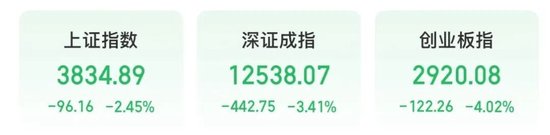
Market Overview - On November 21, A-shares experienced a significant decline, with the Shanghai Composite Index dropping by 2.45%, the Shenzhen Component Index falling by 3.41%, and the ChiNext Index decreasing by 4.02% [1] - A total of 354 stocks rose, 33 stocks hit the daily limit up, while 5072 stocks fell, with 99 stocks hitting the daily limit down [2] Stock Performance - The AI application sector showed resilience amid the market downturn, with stocks like Vision China (000681) and Jiuxi Software (002279) hitting the daily limit up [4] - The military industry sector was also active, with Longxi Co. (600592) hitting the daily limit up and Jiuzhiyang (300516) rising over 10% [6] - Conversely, lithium mining stocks faced a collective decline, with companies such as Tianqi Lithium (002466) and Ganfeng Lithium (002460) hitting the daily limit down [8] - The storage chip sector saw significant adjustments, with stocks like Demingli (001309) and Dagang Co. (002077) hitting the daily limit down [10] Market Sentiment and Influences - The sharp decline in the market was influenced by a significant drop in the US stock market overnight, which affected investor sentiment across Asia-Pacific markets [12] - Concerns over high valuations and heavy capital expenditures by tech giants contributed to the market's cautious mood, with Nvidia's stock dropping by 3.2% following optimistic earnings expectations [13] - The recent statements from multiple Federal Reserve officials regarding the caution against premature interest rate cuts have further fueled uncertainty in the market [13] - Analysts view the current market correction as a technical adjustment rather than the beginning of a prolonged downturn, despite rising volatility [13] Broader Economic Context - The US stock market's decline lacked a clear trigger, with various explanations emerging, including doubts about the profitability of AI projects and a strong employment report that suggested the Fed's rate cuts may have peaked [14] - The drop in Bitcoin to a six-month low also signaled a risk-off sentiment among investors, contributing to the overall market decline [14]

暴跌!原因,找到了...
中国基金报· 2025-11-21 08:22
Core Viewpoint - The A-share market experienced a significant decline on November 21, with all three major indices falling sharply, influenced by a broader downturn in the Asia-Pacific markets and concerns over high valuations and economic indicators from the U.S. [2][10][12] Market Performance - The Shanghai Composite Index fell by 2.45%, the Shenzhen Component Index dropped by 3.41%, and the ChiNext Index decreased by 4.02% [2] - A total of 354 stocks rose, 33 stocks hit the daily limit up, while 5,072 stocks declined, with 99 stocks hitting the daily limit down [3][4] Sector Analysis - AI application stocks showed resilience, with companies like Vision China and Ji Qi Software hitting the daily limit up [5] - The military industry sector was partially active, with Longxi Co. hitting the daily limit up and Jiu Zhi Yang rising over 10% [7] - Conversely, lithium mining stocks collectively plummeted, with Tianqi Lithium and Ganfeng Lithium among those hitting the daily limit down [9] Broader Market Context - The downturn in the A-share market was part of a larger trend, as the Asia-Pacific markets also faced declines, with significant drops in indices such as the KOSPI and the Hang Seng Index [11] - The U.S. stock market's overnight plunge was attributed to various factors, including concerns over the sustainability of AI investments and a strong employment report that raised doubts about the Federal Reserve's ability to lower interest rates [12][13]


逆势异动!龙头股午后直线涨停
Zhong Guo Zheng Quan Bao· 2025-11-21 08:17
Market Overview - The A-share market experienced weak fluctuations with the three major indices closing lower, where the Shanghai Composite Index fell by 2.45%, the Shenzhen Component Index by 3.41%, and the ChiNext Index by 4.02% [1][2] - The total market turnover reached 198.36 billion yuan, an increase of 26.1 billion yuan compared to the previous trading day [1] Sector Performance - The China Shipbuilding sector saw a notable increase of over 3%, while sectors such as energy metals, batteries, and silicon energy underwent adjustments [2] - New stock Dapeng Industrial surged over 1200%, and leading stocks in the coated sand industry, such as Changjiang Materials, hit the daily limit [2][4] - The energy metals sector faced significant declines, with leading stocks like Ganfeng Lithium, Shengxin Lithium Energy, and Tianqi Lithium hitting the daily limit down [2] AI and Technology Sector Insights - Concerns regarding the ability of AI investments to achieve substantial capital returns through a commercial loop are central to market anxieties about the technology sector [3] - The technology sector is currently experiencing a divergence of opinions, with some analysts viewing AI valuations as high and capital expenditure pressures significant, while others remain optimistic about long-term applications [2][3] Specific Company Developments - Changjiang Materials, a leader in the coated sand industry, reported a total market value of 3.816 billion yuan and plans to expand its 3D printing sand products [6][4] - Pingao Co., Ltd. announced a planned investment of 400 million yuan in Jiangyuan Technology, acquiring a 14.2151% stake, which is expected to increase to 15.4182% post-investment [8] Price Trends in Energy Metals - The energy metals sector saw a significant drop of 9.11%, with lithium carbonate and lithium hydroxide prices expected to decline by 25.17% and 21.47% respectively in the first three quarters of 2025 compared to 2024 [9] - Analysts predict a potential rebound in energy metal prices in the third quarter of 2025, supported by macroeconomic easing expectations [9][10]



近5100只个股下跌
Di Yi Cai Jing Zi Xun· 2025-11-21 07:38
Market Overview - On November 21, A-shares experienced a collective decline across the three major indices, with the Shanghai Composite Index falling by 2.45%, the Shenzhen Component Index down by 3.41%, and the ChiNext Index decreasing by 4.02% [2][3]. Sector Performance - The lithium battery industry chain led the decline, with lithium mining stocks experiencing a wave of limit downs. Other sectors such as computing hardware, semiconductor, consumer electronics, photovoltaic, and fintech also saw significant drops [3]. - Conversely, the military industry sector showed strong performance, with stocks like Pinggao Group, Longxi Co., and TeFa Information hitting the daily limit, while JiuZhiYang and JiangLong Shipbuilding rose over 10% [3][4]. Stock Movements - Notable gainers included: - Pinggao Group: +20.00% at 49.02 - JiuZhiYang: +15.63% at 48.60 - JiangLong Shipbuilding: +14.50% at 22.42 - TeFa Information: +10.00% at 10.45 - Longxi Co.: +10.00% at 25.20 [4]. - Lithium mining stocks such as Tianqi Lithium, Ganfeng Lithium, and Shengxin Lithium Energy faced significant declines, with over ten stocks hitting the limit down [4]. Trading Volume - The total trading volume in the Shanghai and Shenzhen markets reached 1.97 trillion yuan, an increase of 257.5 billion yuan compared to the previous trading day, with nearly 5,100 stocks declining [4]. Capital Flow - Main capital inflows were observed in sectors like media, agriculture, and shipbuilding, while outflows were noted in non-ferrous metals, power equipment, and electronics [6][7]. - Specific stocks with net inflows included: - Kaimete Gas: 767 million yuan - Yidian Tianxia: 641 million yuan - Vision China: 546 million yuan [6]. - Stocks facing significant net outflows included: - Industrial Fulian: 2.064 billion yuan - Shenghong Technology: 1.760 billion yuan - Xinyi Sheng: 1.729 billion yuan [7]. Analyst Insights - Qianhai JuZhen Capital indicated that the market is expected to continue its volatile adjustment phase, but the medium to long-term positive trend remains supported by capital, policy, and fundamentals [8]. - CITIC Securities suggested that the securities industry is likely to enter a new upward cycle, aligning with the core directive of enhancing the inclusiveness and adaptability of the capital market [8]. - Zhongyuan Securities projected a steady upward trend for the market in the short term, advising investors to maintain reasonable positions and avoid chasing highs or selling lows [9].




近5100只个股下跌
第一财经· 2025-11-21 07:31
Core Viewpoint - The A-share market experienced a collective decline, with major indices falling significantly, indicating a bearish sentiment among investors [3][4]. Market Performance - The Shanghai Composite Index fell by 2.45% to 3834.89, the Shenzhen Component Index dropped by 3.41% to 12538.07, and the ChiNext Index decreased by 4.02% to 2920.08 [4]. - The lithium battery industry chain led the decline, with lithium mining stocks experiencing a wave of limit-downs [3][4]. Sector Analysis - The military industry sector showed strong performance, with stocks like Pingao Co., Longxi Co., and Tefa Information hitting the daily limit, while Jiuzhiyang and Jianglong Shipbuilding rose over 10% [3][4]. - Conversely, sectors such as semiconductor, consumer electronics, photovoltaic, and fintech saw significant declines [3]. Trading Volume and Market Breadth - The total trading volume in the Shanghai and Shenzhen markets reached 1.97 trillion, an increase of 257.5 billion compared to the previous trading day, with nearly 5100 stocks declining [6]. Capital Flow - Main capital inflows were observed in sectors like media, agriculture, and shipbuilding, while outflows were noted in non-ferrous metals, power equipment, and electronics [8]. - Specific stocks such as Kaimete Gas, Yidian Tianxia, and Vision China saw net inflows of 767 million, 641 million, and 546 million respectively, while Industrial Fulian, Shenghong Technology, and Xinyi Sheng faced outflows of 2.064 billion, 1.760 billion, and 1.729 billion respectively [8]. Institutional Perspectives - Qianhai Ju Zhen Capital suggests that the market will continue to experience fluctuations but maintains a long-term positive outlook supported by capital, policy, and fundamentals [10]. - Zhongxin Jiantou anticipates a new upward cycle for the securities industry, aligning with the "14th Five-Year Plan" to enhance the inclusivity and adaptability of the capital market [10]. - Zhongyuan Securities expects a steady upward trend in the short term and advises investors to maintain reasonable positions to avoid chasing highs and cutting losses [11].



收盘丨A股三大指数放量调整,市场近5100只个股下跌
Di Yi Cai Jing· 2025-11-21 07:16
沪深两市成交额1.97万亿,较上一个交易日放量2575亿。 11月21日,A股三大指数集体下挫,个股呈现普跌态势。截至收盘,沪指跌2.45%,深成指跌3.41%,创业板指跌4.02%。 | 代码 | 名称 | 两日图 | 现价 | 涨跌 | 涨跌幅 | | --- | --- | --- | --- | --- | --- | | 000001 | 上证指数 | 1 Wm | 3834.89 | -96.16 | -2.45% | | 399001 | 深证成指 | WW | 12538.07 | -442.75 | -3.41% | | 399006 | 创业板指 | 1 mon | 2920.08 | -122.26 | -4.02% | 盘面上,锂电池产业链领跌,锂矿方向掀跌停潮;算力硬件题材大幅走低,存储器方向跌幅靠前;半导体、消费电子、光伏、金融科技 概念股跌幅明显。 具体来看,军工板块表现活跃,品高股份、龙溪股份、特发信息涨停,久之洋、江龙船艇涨超10%。 沪深两市成交额1.97万亿,较上一个交易日放量2575亿。全市场近5100只个股下跌。 | | | 【资金流向】 主力资金全天净流入传媒、农林 ...

刚刚!A股突变!
天天基金网· 2025-11-21 05:20
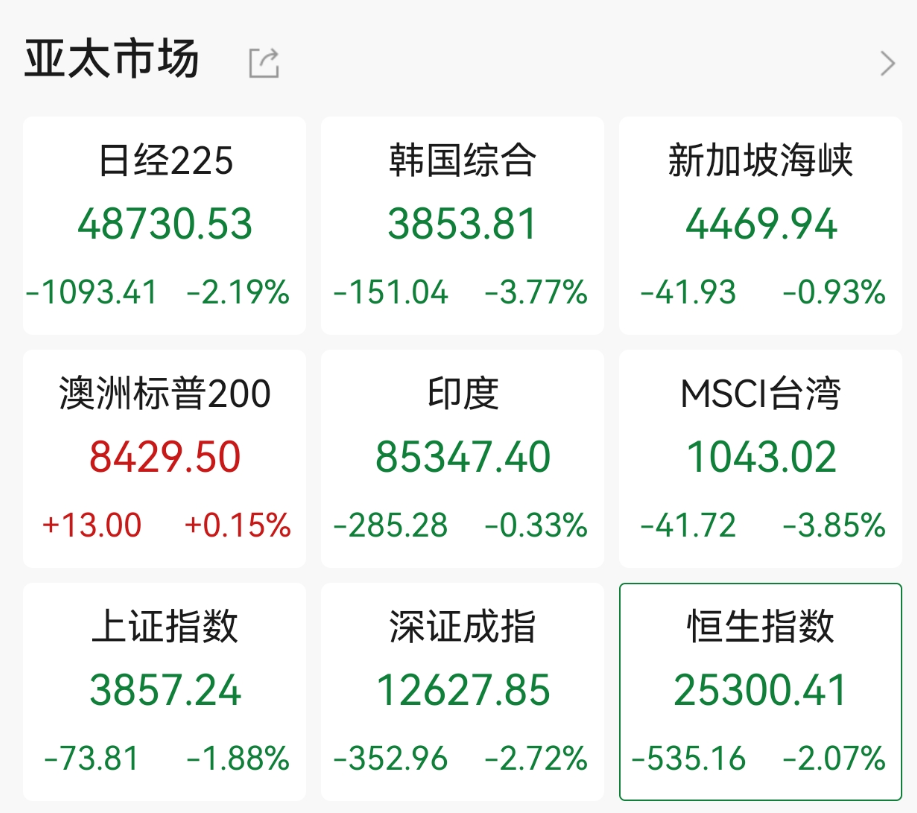
Market Overview - The Asia-Pacific markets experienced a general decline, with the Nikkei 225 index dropping over 2% and the Korean Composite Index falling more than 3% [3][4] - The A-share market opened lower and continued to decline, with the Shanghai Composite Index down 1.88%, the Shenzhen Component down 2.72%, and the ChiNext Index down 3.18% [5][6] Trading Volume and Sector Performance - The A-share market's half-day trading volume reached 1.32 trillion yuan, showing a slight increase compared to the previous day, with nearly 5,000 stocks declining [6] - The market showed a broad decline, particularly in sectors such as non-ferrous metals, power equipment, telecommunications, and electronics, with lithium battery concept stocks experiencing significant losses [6][10] Lithium Battery Sector - The lithium battery sector faced a wave of limit-downs, with major stocks like Ganfeng Lithium and Tianqi Lithium hitting the limit down [11][13] - The futures contract for lithium carbonate saw a significant drop, with predictions for next year's lithium prices remaining conservative, expected to range between 75,000 to 90,000 yuan per ton [15] Shipbuilding Sector - The shipbuilding sector showed resilience, with stocks like Jiuzhiyang and China Shipbuilding Defense hitting their daily limit up [17][18] Aquaculture Sector - The aquaculture sector maintained its recent positive momentum, with stocks like Zhongshui Fishery achieving consecutive gains and Zhuangzi Island hitting the limit up [19] Photoresist Sector - The photoresist sector saw a surge, with stocks like Kaimete Gas and Guofeng New Materials experiencing significant buying interest and hitting their daily limit up [21][22]
A股,突变!20cm涨停
Zhong Guo Ji Jin Bao· 2025-11-21 04:32
【导读】A股市场低开低走,锂电板块遭重挫;"中船系"逆市走强,久之洋(300516)20cm涨停;光刻胶概念股午前异动 大家好!全球市场遭遇"黑色星期五",来一起关注上午的市场行情和资讯~ 11月21日上午,亚太市场普遍走低,日经225指数跌超2%,韩国综合指数跌超3%,仅澳洲标普200指数微红。 | 亚太市场 区 | | | | --- | --- | --- | | 日轻225 | 韩国综合 | 新加坡海峡 | | 48730.53 | 3853.81 | 4469.94 | | -1093.41 -2.19% -151.04 -3.77% -41.93 --0.93% | | | | 澳洲标普200 | 印度 | MSCI台湾 | | 8429.50 | 85347.40 | 1043.02 | | +13.00 +0.15% -285.28 -0.33% -41.72 -3.85% | | | | 上证指数 | 深证成指 | 恒生指数 | | 3857.24 | 12627.85 | 25300.41 | | -73.81 -1.88% -352.96 -2.72% | | -535.16 -2.07 ...