
CENTURY HUATONG(002602)

Search documents
2026年传媒互联网行业年度策略:聚焦出海、AI赋能,布局内容新供给
Guoyuan Securities· 2026-01-21 02:16
Group 1 - The media sector outperformed the index in 2025, with a 24.75% increase, ranking 8th among 31 sub-industries, driven primarily by a 60.67% rise in the gaming sector [1][14][21] - The overall revenue growth for the media industry in the first three quarters of 2025 was 5.92%, while net profit increased by 37.12%, indicating strong earnings per share (EPS) performance [1][21][24] - The current valuation of the media industry is at the 47th percentile of the past three years, with attractive valuations in the gaming and film sectors [1][24][25] Group 2 - The mobile gaming market in 2025 achieved sales revenue of 257.08 billion yuan, a year-on-year increase of 7.92%, indicating a recovery in market sentiment [2][26] - New game releases such as "Supernatural Action Group" and "Staff Sword Legend" exceeded expectations, while established titles like "Honor of Kings" and "Peace Elite" continued to perform well [2][26] - The approval process for new game licenses remained stable in 2025, benefiting the supply side of the gaming industry [2][34] Group 3 - The short drama market in China reached a scale of 67.79 billion yuan in 2025, growing by 34.4% year-on-year, with a significant portion attributed to IAA [3][22] - The overseas short drama market is expected to grow by 145.7% in 2025, reaching a scale of 21.07 billion yuan, indicating strong international demand [3][22] - AI-driven animated dramas are emerging rapidly, with the market size expected to exceed 20 billion yuan, benefiting from lower production costs and enhanced efficiency [3][29] Group 4 - AI model capabilities continued to iterate in 2025, with significant advancements in models like Gemini 3 and ChatGPT 5.2, leading to accelerated commercialization [4][38] - The annual recurring revenue (ARR) for OpenAI reached 12 billion USD in 2025, with various AI applications generating over 100 million USD in annual revenue [4][38] - Investment opportunities in AI applications are expected to grow, particularly in AI video, advertising, animated dramas, and gaming [4][38] Group 5 - Recommended companies for investment include Giant Network, Perfect World, Century Huatong, and others, indicating a focus on firms with strong product pipelines and market positions [5][10]




传奇游戏专题研究报告:2026年市场规模突破400亿,在投传奇小游戏增18%,传奇正版化进程加速
3 6 Ke· 2026-01-21 00:55
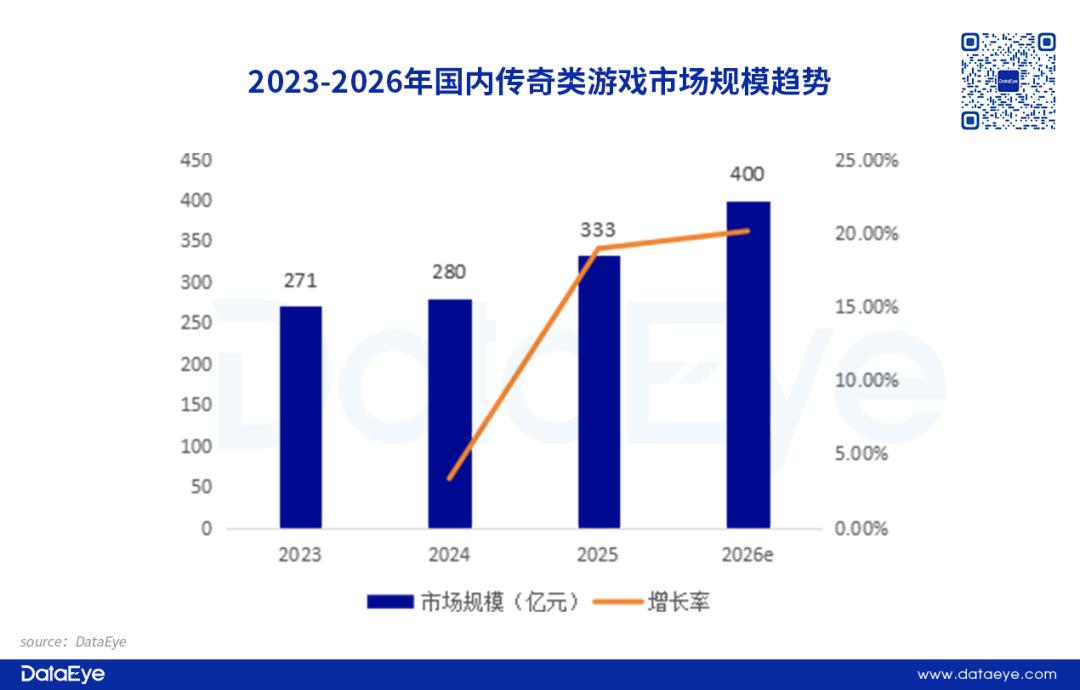
Market Overview - The market size of legendary games is projected to reach 33.3 billion yuan in 2025, with a year-on-year growth of 18.93%. The estimated market size for 2026 is expected to exceed 40 billion yuan [1][3] - The core user base for legendary games is expected to rise to 55 million by 2025, driven by the compliance of copyright and the emergence of mini-games [2][13] - The number of legendary mini-games in operation is estimated to be around 480 in 2025, reflecting an increase of approximately 18.67% compared to 2024 [1][54] Industry Dynamics - The legendary game market has experienced fluctuations due to the compliance of legendary games, leading to a decline in private servers. The market size for 2024 is estimated at 28 billion yuan, with a modest growth of 3.32% [2] - The end of the private server era is marked by the resolution of copyright disputes, with the legitimate copyright holder, Shengqu Games, required to pay significant licensing fees, thus driving the market towards compliance and regulation [5][9] - The integration of mini-games into the legendary game ecosystem is expected to provide new growth momentum, with mini-games projected to account for about 8% of the overall market consumption [2][3] User Demographics - The user base for legendary games is predominantly male, accounting for over 71%, while female users represent less than 30% [23] - The age distribution shows a strong presence of users aged 31-40, making up 30.92% of the user base, while younger users under 30 account for nearly 40% [26] - The overall user ecosystem is characterized by a "mobile-first" approach, with mobile users expected to dominate at 62% of the total user base by 2025 [16] Revenue and Value - The cumulative revenue for legendary games is projected to reach 410.68 billion yuan by 2025, with legitimate games accounting for approximately 38.7% of this revenue [5] - The total value of the legendary IP is estimated to be around 3.6478 trillion yuan from 2001 to 2023, with an expected annual average value generation of 28.53 billion yuan starting in 2024 [35][41] - The gaming segment remains the primary revenue source, contributing approximately 93% of the total IP value, highlighting the strong market demand for gameplay-driven content [37] Marketing and Advertising - The marketing strategy for legendary games heavily relies on user acquisition through paid advertising, with a significant decline in the number of materials for mobile games, dropping by 56% in 2025 [42][46] - In contrast, the advertising material for legendary mini-games is expected to surge by approximately 116%, indicating a shift in focus towards this segment [46][49] - The average usage duration of advertising materials has improved, reflecting a transition towards quality-driven marketing strategies [72] Competitive Landscape - The legendary game market is characterized by a concentration of top-tier companies, with major players like Shengqu Games, Ke Ying Network, and Tanwan Games dominating the market [81][84] - The competitive dynamics are shifting towards a model where head companies leverage their strong relationships with IP holders and extensive operational experience to maintain market leadership [81][86] - The emergence of mini-games as a core battlefield for user acquisition is reshaping the competitive landscape, with traditional mobile games facing challenges in user retention and acquisition costs [68][69]


旗下手游连续24个月霸榜、累计吸金超40亿美元!世纪华通直面投资者“增长之问”:出海神话能否延续?
Mei Ri Jing Ji Xin Wen· 2026-01-20 14:44
Core Insights - Century Huatong's mobile game "Whiteout Survival" has topped China's overseas mobile game revenue rankings for 2025, marking 24 consecutive months at the top and becoming a phenomenon in China's game export history [1] - The company is focusing on balancing resources between existing strong products and new product incubation to maintain growth momentum [1] Group 1: Financial Performance - Century Huatong's overseas business brand, Century Games, achieved a remarkable 87% year-on-year revenue growth in 2025, becoming the second in the overseas revenue rankings [2] - "Whiteout Survival" generated $2.1 billion in revenue for the year, a 45% increase, surpassing $4 billion in total revenue [2] - The game saw a 32% increase in overseas revenue, contributing over $1.65 billion, with the U.S., South Korea, and Japan accounting for 64% of this revenue [2] Group 2: Product Development and Strategy - The company is leveraging a "racehorse mechanism" for parallel development and rapid validation of new products, ensuring efficient resource allocation between mature and new products [3][4] - Century Huatong is actively developing both SLG (strategy) and casual game segments, with a focus on expanding into subcategories like match-3 and merging games [4] - The company maintains a strong resource allocation strategy, ensuring that rapid growth products like "Kingshot" receive adequate support [3] Group 3: Operational Efficiency and Challenges - Century Huatong is balancing expansion with operational efficiency, emphasizing prudent growth and effective management of resources [5][6] - The company has expanded its workforce in key areas like R&D and marketing while maintaining a cautious approach to business expansion [6] - Financial management has been optimized, with efforts to reduce past debts and lower financial costs [6] Group 4: Industry Outlook - The gaming industry is driven by supply-side dynamics, with favorable policies, dedicated professionals, and AI technology enhancing development efficiency [7] - Century Huatong is confident in the industry's future, focusing on innovation and experience upgrades to withstand competition [6][7]
世纪华通:2026年公司将继续优化财务结构,强化财务管理
Zheng Quan Ri Bao Zhi Sheng· 2026-01-20 14:09
Group 1 - The core viewpoint of the article is that Century Huatong is focusing on sustainable high-quality development and has taken measures to reduce financial expenses by repaying part of its past debts [1] - The company plans to continue optimizing its financial structure and strengthening financial management by 2026 [1]
世纪华通:点点互动的核心竞争力是研发和发行一体化
Zheng Quan Ri Bao Zhi Sheng· 2026-01-20 14:09
Core Viewpoint - Century Huatong emphasizes that the core competitiveness of Didi Interactive lies in the integration of research and development with publishing [1] Group 1 - Didi Interactive possesses extensive experience in user acquisition and has a rich product line in SLG (Simulation Game) and casual games [1] - The organic combination of user acquisition expertise and diverse product offerings has enabled Didi Interactive to break revenue records in the SLG and casual gaming sectors [1]
世纪华通:公司在研发、买量领域都做了一定程度的人员扩张
Zheng Quan Ri Bao Zhi Sheng· 2026-01-20 14:09
Core Viewpoint - Century Huatong is experiencing rapid business growth and is expanding its game offerings while maintaining a cautious approach to business expansion [1] Group 1: Business Development - The company is expanding its personnel in both research and development as well as user acquisition areas to support its diverse game types [1] - Despite the expansion, the company emphasizes a balance between restraint and efficiency in its team growth [1]
世纪华通:抄袭产品对点点互动的影响是客观存在的
Zheng Quan Ri Bao Zhi Sheng· 2026-01-20 14:09
Core Viewpoint - The impact of plagiarized products on Dd Interactive is objectively acknowledged by Century Huatong, but significant product barriers and user differences exist between Dd Interactive's works and the plagiarized products [1] Group 1 - Dd Interactive has experienced rapid development over the years, establishing a strong market presence [1] - There are substantial product barriers and deep user differences between Dd Interactive's offerings and those of the plagiarized products [1] - Dd Interactive's user acquisition and operational capabilities are unique in the industry, emphasizing the importance of focusing on its own products [1]
瑞雪兆丰年 世纪华通积极回应市场“四问”
Xin Lang Cai Jing· 2026-01-20 13:40
Core Viewpoint - The company, Century Huatong, expresses confidence in the gaming industry's future, highlighting multiple favorable developments and opportunities in the sector [4][7]. Group 1: Product Operations and New Product Incubation - The company's main SLG products, "Whiteout Survival" and "Endless Winter," are performing steadily, while another product, "Kingshot," is in a rapid growth phase. The company has sufficient resource reserves and does not face concerns regarding resource allocation [3][6]. - The subsidiary, Diandian Interactive, employs a "horse racing" mechanism for new product incubation, leveraging mature R&D capabilities and extensive user acquisition experience to enhance its new product development capacity [3][6]. - The company aims to create a second growth track beyond SLG by diversifying into casual subcategories, utilizing differentiated designs to avoid direct competition with market hits [3][6]. Group 2: Business Layout and Competitive Barriers - The core competitiveness of Diandian Interactive lies in its integrated R&D and publishing model, which helps the company break revenue records in the SLG category [3][6]. - The company has established a strong risk resistance framework against the impacts of product imitation, focusing on refining its own products [3][6]. Group 3: Financial Management - The company plans to continue optimizing its financial structure and strengthening financial management in 2026 [3][6]. Group 4: Industry Outlook - The gaming industry is experiencing a convergence of favorable factors, including increased governmental support for the dual promotion of technology and culture, heightened focus among industry players, and the efficiency improvements brought by AI technology [4][7]. - The gaming sector is characterized as a supply-driven demand market, where high-quality products remain the core growth engine [4][7].
世纪华通:在游戏业务方面 AI工具已渗透至业务运营全链条
Xin Lang Cai Jing· 2026-01-20 13:32
Core Viewpoint - The company has integrated AI tools across its entire gaming business operations, enhancing efficiency and quality in various key areas [1] Group 1: AI Integration in Business Operations - AI tools have penetrated critical aspects of business operations including digital asset creation, product quality testing, customer service, marketing, and operations [1] - The internal AI tool platform developed by the subsidiary Shengqu Games includes seven core functions, such as intelligent translation, AI voice synthesis, AI character generation, AI sound effect generation, AICG dubbing, data analysis agents, and AI image enhancement [1] Group 2: Impact on Production Efficiency - The AI tool platform significantly compresses traditional production cycles, allowing for rapid project iteration and saving valuable time [1]
世纪华通接待25家机构调研,包括睿远基金、招商证券、东方证券、中泰证券等
Jin Rong Jie· 2026-01-20 12:04
Group 1 - The core viewpoint of the article highlights Century Huatong's stable growth in game product layout and development strategy, with key products like "Whiteout Survival" and "Endless Winter" performing steadily, while "Kingshot" is in a rapid growth phase [1][2] - Century Huatong's stock price increased by 2.20% to 20.44 yuan, with a total market capitalization of 150.657 billion yuan, and its rolling P/E ratio of 39.99 ranks 8th in the gaming industry, which has an average P/E ratio of 44.24 [1][2] - The company maintains a cautious approach to business expansion and financial management, optimizing its financial structure and reducing financial costs by clearing past debts [2] Group 2 - Century Huatong expresses confidence in the future development of the gaming industry, citing favorable policy environments and the emphasis on technology and culture, as well as the empowering effect of AI on industry efficiency [2] - The company employs a "horse racing" mechanism in its new product incubation process to ensure high recovery efficiency and success rates, leveraging its R&D capabilities and past successes [1][2] - As of September 30, 2025, Century Huatong had 159,127 shareholders, an increase of 51,896, with an average holding value of 946,800 yuan and an average holding quantity of 46,300 shares [2]
