
EVE(300014)

Search documents
电池板块10月10日跌6.99%,利元亨领跌,主力资金净流出169.03亿元
Zheng Xing Xing Ye Ri Bao· 2025-10-10 08:51
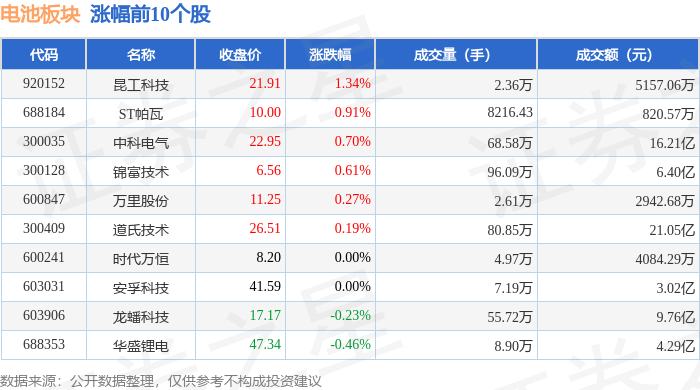
Market Overview - The battery sector experienced a decline of 6.99% on the trading day, with Li Yuanheng leading the drop [1] - The Shanghai Composite Index closed at 3897.03, down 0.94%, while the Shenzhen Component Index closed at 13355.42, down 2.7% [1] Individual Stock Performance - Notable gainers included: - Kun Gong Technology (21.91, +1.34%) with a trading volume of 23,600 shares and a turnover of 51.57 million yuan [1] - ST Pava (10.00, +0.91%) with a trading volume of 8,216 shares and a turnover of 820,570 yuan [1] - Significant losers included: - Li Yuanheng (61.70, -13.43%) with a trading volume of 142,200 shares and a turnover of 26.16 million yuan [2] - Xian Dao Intelligent (54.79, -12.89%) with a trading volume of 2,015,100 shares and a turnover of 1.1387 billion yuan [2] - Yi Wei Lithium Energy (80.38, -10.96%) with a trading volume of 1,008,800 shares and a turnover of 834.9 million yuan [2] Capital Flow Analysis - The battery sector saw a net outflow of 16.903 billion yuan from major funds, while retail investors contributed a net inflow of 12.3 billion yuan [2] - The table of capital flow indicates varying levels of net inflow and outflow among individual stocks, with notable movements in stocks like Dao Shi Technology and Hua Sheng Lithium Battery [3]





锂电出口管控加严,利好生产高端材料和有海外产能的公司:对商务部与海关总署公布对锂电池和相关材料实施出口管制的解读
Shenwan Hongyuan Securities· 2025-10-10 08:25
Investment Rating - The industry investment rating is positive, indicating an overweight outlook for the lithium battery sector due to recent export control measures [3][12]. Core Insights - The recent export controls on lithium batteries and related materials are expected to benefit companies with high-end product capabilities and overseas production capacity. The measures aim to prevent the uncontrolled spread of high-end lithium battery technologies and enhance China's bargaining power in international trade [3][4]. - The export restrictions are not expected to have a significant short-term impact on the battery, cathode, and anode sectors, as companies can still export through licensing and other means. The current energy density of exported liquid batteries is primarily between 200-280 Wh/kg, which means the new restrictions will have a limited effect [3][4]. - The report suggests focusing on companies like CATL, Yiwei Lithium Energy, and others that have overseas production capabilities, as the premium for high-end products is likely to increase under the new export control policies [3][4]. Summary by Sections Export Control Measures - On October 9, 2025, the Ministry of Commerce and the General Administration of Customs announced export controls on lithium batteries and artificial graphite anode materials, effective from November 8, 2025. This includes specific requirements for high energy density batteries and advanced cathode materials [3][4]. Impact on Industry - The export controls are designed to safeguard high-end technology from leaking abroad and to strengthen domestic industry competitiveness. The policy reflects a trend towards controlling the export of high-end products and technologies [3][4]. Investment Recommendations - The report recommends investors pay attention to battery manufacturers such as CATL, Yiwei Lithium Energy, and others, as well as material companies with overseas production like Hunan Youneng and others, due to their potential to benefit from the new export restrictions [3][4].


锂电出口管控加严,利好生产高端材料和有海外产能的公司
Shenwan Hongyuan Securities· 2025-10-10 05:51
Investment Rating - The industry investment rating is "Overweight" indicating a positive outlook for the lithium battery sector [3][9]. Core Insights - The recent export control measures on lithium batteries and related materials by the Ministry of Commerce and the General Administration of Customs are aimed at preventing the uncontrolled spread of high-end lithium battery technologies and enhancing China's competitive edge in the global market [3]. - The export controls are expected to have limited short-term impact on the battery, cathode, and anode sectors, as companies can still export through licensing and other means [3]. - Companies with overseas production capacity and those producing high-end products are likely to benefit from these export restrictions, as the premium for high-end products is expected to increase [3]. Summary by Sections Export Control Details - Effective from November 8, 2025, the export control applies to lithium batteries with energy density ≥300wh/kg, high-density lithium iron phosphate, and related production equipment [3]. - The policy aims to mitigate risks of technology leakage and enhance negotiation leverage in international trade [3]. Impact on Industry - Current exports of liquid batteries mainly range from 200-280wh/kg, thus the new restrictions will have minimal effect on existing exports [3]. - The export control does not equate to a complete ban, allowing for continued exports through various channels [3]. Investment Recommendations - Recommended companies to watch include battery manufacturers such as CATL, Yiwei Lithium Energy, and others with overseas production capabilities [3]. - Material manufacturers with overseas capacity like Hunan Youneng and others are also highlighted as potential investment opportunities [3].
资金持续抢筹!机器人ETF、有色金属ETF基金五连“吸金”
Ge Long Hui A P P· 2025-10-10 03:29
Group 1 - Precious metals, semiconductors, and new energy battery sectors are leading the decline, with Yiwei Lithium falling nearly 9% and CATL dropping over 6% [1] - The market is showing strong structural characteristics, with increased volatility this week, potentially influenced by the upcoming review of the "14th Five-Year Plan" proposals [1] - Institutional strategies for October focus on technology, anti-involution, and promoting domestic demand, highlighting sectors benefiting from improved profit expectations such as innovative pharmaceuticals and new energy [1] Group 2 - The largest robot-themed ETF, Robot ETF (562500), has seen a net inflow of 1.757 billion yuan over five days, with key stocks including Huichuan Technology, Greentech Harmonic, and Stone Technology [2] - The non-ferrous metal ETF (516650) has attracted a net inflow of 300 million yuan over five days, with major holdings including Zijin Mining, Luoyang Molybdenum, Northern Rare Earth, Huayou Cobalt, and China Aluminum [2] - The largest new energy vehicle ETF (515030) has received a total net inflow of 7.104 million yuan over four days, with key stocks including Huayou Cobalt, Tianqi Lithium, Ganfeng Lithium, CATL, Huichuan Technology, Guoxuan High-Tech, and leading vehicle manufacturers like BYD and Changan Automobile [2]





锂电池产业链走低,宁德时代跌超5%
Di Yi Cai Jing Zi Xun· 2025-10-10 02:25
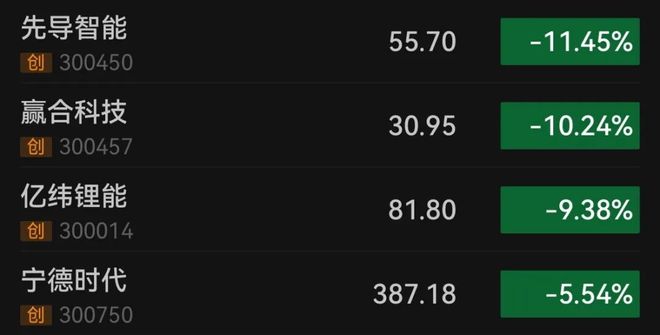
Group 1 - The lithium battery industry chain experienced a significant decline on October 10, with major companies such as XianDao Intelligent and Yinghe Technology both dropping over 10% [1] - EVE Energy saw a decrease of over 9%, while CATL (Contemporary Amperex Technology Co., Limited) fell by more than 5% [1] Group 2 - XianDao Intelligent's stock price was reported at 55.70, reflecting a decline of 11.45% [2] - Yinghe Technology's stock price was 30.95, down by 10.24% [2] - EVE Energy's stock price stood at 81.80, with a decrease of 9.38% [2] - CATL's stock price was 387.18, showing a decline of 5.54% [2]

创业板指跌超3%,锂电池产业链大幅杀跌
Xin Lang Cai Jing· 2025-10-10 02:22
10月10日早盘,A股持续走低,截至发稿时,创指跌超3%,沪指跌超0.45%,深证成指跌1.6%。 锂电池产业链大幅杀跌,先导智能、赢合科技双双跌超10%,亿纬锂能跌近9%,宁德时代跌超5%。 个股上,上涨个股与下跌个股比约为2900:2400。 ...

锂电池产业链走低,宁德时代跌超5%
第一财经· 2025-10-10 02:19
Core Viewpoint - The article discusses the recent performance of several companies in the battery and technology sector, highlighting significant declines in their stock prices. Group 1: Company Performance - Leading Intelligent (先导智能) reported a stock price of 55.70, reflecting a decrease of 11.45% [1] - Winbond Technology (赢合科技) has a stock price of 30.95, down by 10.24% [1] - EVE Energy (亿纬锂能) is priced at 81.80, showing a decline of 9.38% [1] - CATL (宁德时代) has a stock price of 387.18, with a decrease of 5.54% [1]

亿纬锂能股价跌5.31%,中海基金旗下1只基金重仓,持有38.17万股浮亏损失182.83万元
Xin Lang Cai Jing· 2025-10-10 02:00
Group 1 - The core point of the news is that EVE Energy Co., Ltd. experienced a decline of 5.31% in its stock price, reaching 85.48 CNY per share, with a trading volume of 3.2 billion CNY and a turnover rate of 2.04%, resulting in a total market capitalization of 174.868 billion CNY [1] - EVE Energy, established on December 24, 2001, and listed on October 30, 2009, is located in Huizhou, Guangdong Province. The company specializes in the research, production, and sales of consumer batteries (including lithium primary batteries, small lithium-ion batteries, and ternary cylindrical batteries) and power batteries (including electric vehicle batteries and energy storage batteries) [1] - The revenue composition of EVE Energy is as follows: power batteries account for 45.26%, energy storage batteries 36.56%, consumer batteries 18.03%, and others 0.16% [1] Group 2 - From the perspective of major fund holdings, data shows that one fund under China Ocean Fund holds a significant position in EVE Energy. The China Ocean Environmental New Energy Mixed Fund (398051) held 381,700 shares in the second quarter, accounting for 2.41% of the fund's net value, ranking as the tenth largest holding [2] - The China Ocean Environmental New Energy Mixed Fund (398051) was established on December 9, 2010, with a current scale of 724 million CNY. Year-to-date, it has achieved a return of 41.34%, ranking 2240 out of 8166 in its category; over the past year, it has returned 39.67%, ranking 2194 out of 8014; and since inception, it has returned 137.04% [2]
A股固态电池概念股下挫 天际股份一度逼近跌停
Ge Long Hui· 2025-10-10 01:55
Group 1 - The solid-state battery concept stocks experienced a decline, with Tianji Co. nearing a limit down [1] - Leading Intelligent fell over 10%, while Yiwei Lithium Energy, Guoxuan High-Tech, Tianci Materials, and Hunan YN Energy dropped more than 5% [1]



“一芯难求”:储能电芯企业订单已排至明年
Zheng Quan Ri Bao· 2025-10-09 15:51
Group 1: Industry Overview - The energy storage industry in China is experiencing a dual benefit from technological breakthroughs and a surge in market demand, with significant advancements in solid-state lithium batteries and a dramatic increase in orders for energy storage cells [1] - In the first eight months of 2025, the domestic new energy storage installation capacity reached 75.9 GWh, a year-on-year increase of 42%, while the energy storage EPC bidding scale reached 116 GWh, up approximately 40% [2] - The supply-demand imbalance for energy storage cells is exacerbated by structural shortages, with high-capacity cells becoming the market mainstream due to early capacity locking by clients, leading to increased prices for energy storage cells [2][3] Group 2: Policy Support - Recent policies have shifted the industry from "mandatory storage" to "independent storage," enhancing the quality requirements for energy cells and intensifying the supply-demand imbalance for high-quality production [3] - The National Development and Reform Commission and the National Energy Administration have set a target for new energy storage installation capacity to exceed 180 million kilowatts by 2027, driving direct investment of approximately 250 billion yuan [2] Group 3: Company Strategies and Performance - Domestic energy storage companies are adjusting their strategies and increasing investments in energy storage, with many listed companies reporting full production and high order volumes [4] - Companies like Yiwei Lithium Energy and Ganfeng Lithium have achieved large-scale production of energy storage cells and established stable supply partnerships with leading industry players, ensuring stable delivery to clients [5] - The focus for energy storage companies should be on original innovation in technology, particularly in high-capacity and high-safety cells, while enhancing collaboration across the supply chain [5]
