
ZHONGJI INNOLIGHT(300308)

Search documents
CPO板块午后拉升,通信设备ETF、通信ETF、通信ETF广发涨1%
Sou Hu Cai Jing· 2025-12-10 08:48
Group 1 - The A-share market saw a strong performance in CPO concept stocks, with Zhongji Xuchuang and Xinyi Sheng reaching new historical highs, with market capitalizations of approximately 690 billion and 430 billion respectively [1] - The stock price of Moer Thread surged by 16% [1] - Various ETFs related to communication and artificial intelligence also experienced gains, with increases ranging from 1% to 1.6% [1] Group 2 - Major cloud providers in the US, including Google, Microsoft, Meta, and Amazon, are projected to spend $230 billion on capital expenditures in 2024, a 55% year-on-year increase, with further investments expected to reach $259 billion in the first three quarters of 2025, a 65% increase [4] - The global shipment of 800G and 1.6T optical module products is expected to reach 49 million and 22 million units respectively by 2026, with a significant supply-demand gap anticipated, particularly for 1.6T modules [4] - The communication equipment ETF has a CPO content of 60.7%, while the communication device index has a CPO content of 53.41% [8][10] Group 3 - The first MUSA Developer Conference by Moer Thread will take place from December 19 to 20, where the new GPU architecture will be unveiled along with a comprehensive product and technology layout [3] - Zhongke Shuguang and Haiguang Information's merger was terminated, leading to a sell-off in the market [3] - Zhongyin International noted that the securities industry is experiencing a "spring surge" driven by policy catalysts, with a focus on AI computing hardware, particularly optical modules, leading the market [12]


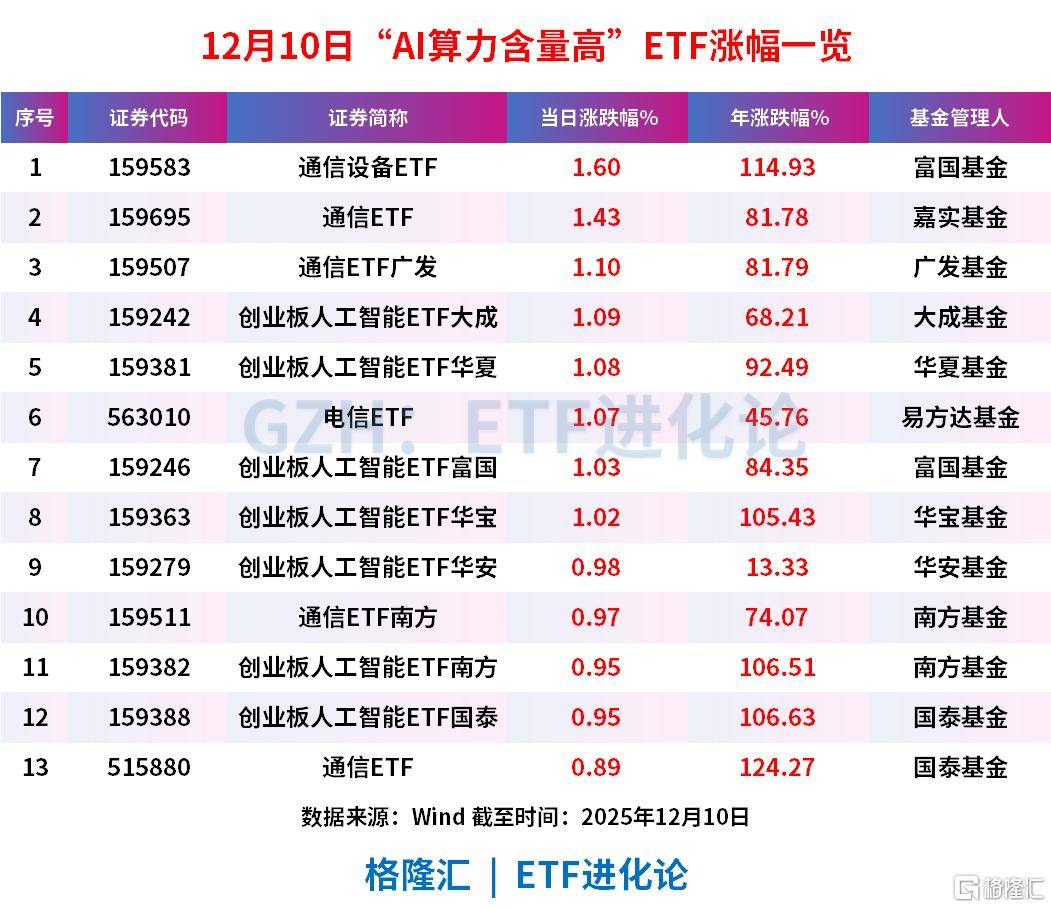
CPO午后异动拉升,低费率创业板人工智能ETF华夏(159381)涨超1%冲击5连阳!盘中成交额超4亿元
Mei Ri Jing Ji Xin Wen· 2025-12-10 07:07
Core Viewpoint - The A-share market is experiencing a surge in the optical module CPO and optical communication sectors, with significant movements in related ETFs and stocks, indicating a strong interest in the computing power sector driven by AI applications [1] Group 1: Market Performance - The Shenzhen Component Index turned positive as the optical module CPO and optical communication sectors saw notable gains [1] - The Huaxia (159381) ETF, which tracks the entrepreneurial board AI index, rose over 1% and achieved a trading volume exceeding 400 million yuan during the session [1] - The optical module CPO concept stocks accounted for over 56% of the ETF's weight, contributing to its strong performance [1] Group 2: Investment Trends - In the past 20 days, the Huaxia ETF has attracted over 200 million yuan in investments, reflecting accelerated capital allocation towards the high-growth computing power sector [1] - Guosheng Securities highlighted Nvidia's record performance and guidance, showcasing the ongoing demand for computing infrastructure [1] - The interplay between model upgrades and computing power demand is creating a virtuous cycle, sustaining high prosperity in the computing power industry chain [1] Group 3: ETF Composition - The Huaxia ETF tracks the "Entrepreneurial Board AI Index," with a significant weight of 56.7% in optical module CPO stocks, while also covering domestic software and AI application companies [1] - The top three weighted stocks in the ETF are Zhongji Xuchuang (26.62%), Xinyi Sheng (19.35%), and Tianfu Communication (5.05%) [1]


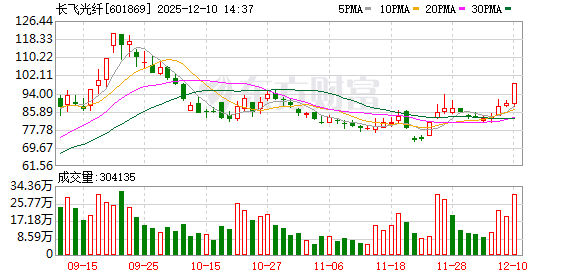
CPO板块探底回升,长飞光纤、特发信息午后拉升涨停
Xin Lang Cai Jing· 2025-12-10 06:46
每经AI快讯,12月10日,CPO板块探底回升,长飞光纤、特发信息午后拉升涨停,新易盛涨3%、中际 旭创涨2%创历史新高。 每经AI快讯,12月10日,CPO板块探底回升,长飞光纤、特发信息午后拉升涨停,新易盛涨3%、中际 旭创涨2%创历史新高。 ...

CPO板块探底回升 长飞光纤、特发信息午后拉升涨停
Mei Ri Jing Ji Xin Wen· 2025-12-10 06:37
Group 1 - The CPO sector experienced a rebound after hitting a low, with notable stocks such as Changfei Fiber and TeFa Information reaching their daily limit up [2] - New Yisheng saw a 3% increase, while Zhongji Xuchuang rose by 2%, achieving a historical high [2]
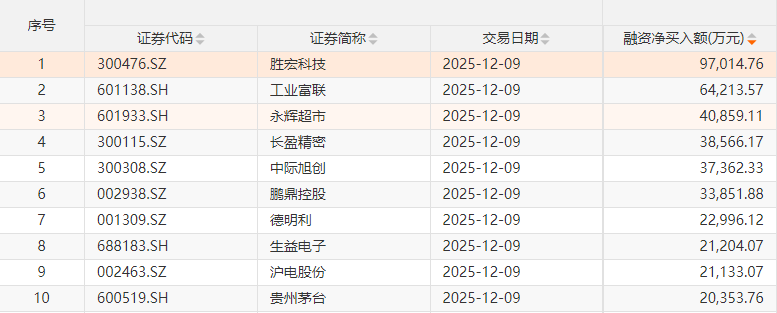
两融余额较上一日增加100.58亿元 电子行业获融资净买入额居首
Sou Hu Cai Jing· 2025-12-10 02:03
Group 1 - As of December 9, the margin trading balance in A-shares reached 25,105.72 billion yuan, an increase of 100.58 billion yuan from the previous trading day, accounting for 2.59% of the A-share circulating market value [1] - The trading volume for margin transactions on that day was 2,031.2 billion yuan, a decrease of 256.13 billion yuan from the previous trading day, representing 10.58% of the total A-share trading volume [1] - Among the 31 primary industries in the Shenwan index, 23 industries experienced net financing inflows, with the electronics sector leading at a net inflow of 5.487 billion yuan [1] Group 2 - A total of 42 individual stocks had net financing inflows exceeding 100 million yuan, with Shenghong Technology leading at a net inflow of 970.14 million yuan [2] - Other notable stocks with significant net financing inflows included Industrial Fulian, Yonghui Supermarket, Changying Precision, Zhongji Xuchuang, Pengding Holdings, Demingli, Shengyi Electronics, Hudian Co., and Kweichow Moutai [2] - Guojin Securities research report indicates that strong demand for AI is driving both price and volume increases in PCB, with many AI-PCB companies experiencing robust orders and full production, leading to high growth expectations for Q4 and next year [2]





“易中天”的“泡沫”炒到2027年了
虎嗅APP· 2025-12-09 23:47
以下文章来源于妙投APP ,作者董必政 妙投APP . 虎嗅旗下二级市场投研服务品牌,为您提供精选上市公司价值拆解,热门赛道产业链梳理 最近,"易中天"又躁动了。 如果说,美股的AI盛宴是在围猎英伟达、谷歌;那么,A股的AI狂欢就集中在两个代号里:一个是 炒芯片的"纪联海"(寒武纪、工业富联、海光信息),另一个则是炒连接的"易中天"(新易盛、中 际旭创、天孚通信)。 中际旭创在11月27日刷新历史高价,天孚通信紧随其后,在12月8日创出新高。截至12月8日,中际 旭创、天孚通信、新易盛的市值分别为6333亿、1842亿和4021亿。 光模块的性能直接决定了数据传输的效率和稳定性。一旦数据传输跟不上,就像高速路上堵了车, 算力再强也白搭。 正因为"算力"与"运力"的搭档,GPU、光模块缺一不可。 但在欢呼声中,资本市场的质疑也没停过。 此前,多少人盯着这个赛道,看到光模块企业有40-60倍、甚至超80倍的PE(市盈率)直呼"泡 沫",毕竟通信行业的历史估值均值常年趴在15-20倍。 也有观点认为,要想支撑这种估值,企业净利润得维持三位数增长,在成熟制造业里,这简直是天 方夜谭。 出品 | 妙投APP 作者 | ...


ESG动态跟踪月报(2025年11月):碳市场新增行业配额方案落地,国际政策分化下绿色金融保持活跃-20251209
CMS· 2025-12-09 15:08
Quantitative Models and Construction Methods Model 1: Carbon Emission Intensity Deviation and Carbon Emission Intensity Coefficient - **Model Name**: Carbon Emission Intensity Deviation and Carbon Emission Intensity Coefficient - **Model Construction Idea**: The model aims to allocate carbon quotas based on the deviation of a company's carbon emission intensity from the industry average, incentivizing companies to reduce emissions. - **Model Construction Process**: - The carbon emission intensity deviation (X) is calculated as the difference between a company's unit product carbon emission and the industry average, divided by the industry average: $$ X = \frac{I - BP}{BP} $$ where \( I \) is the company's unit product carbon emission, and \( BP \) is the industry average. - The carbon emission intensity coefficient (α) is determined based on the deviation (X): $$ \alpha = \begin{cases} -3\% & \text{if } X \leq -20\% \\ 15\% \times X & \text{if } -20\% < X \leq 20\% \\ +3\% & \text{if } X > 20\% \end{cases} $$ - The quota amount (A) is calculated as: $$ A = E \times (1 + \alpha) $$ where \( E \) is the company's verified emissions for the year. - **Model Evaluation**: This model ensures that differences in emission control levels among companies are reflected in their quota allocations, providing positive incentives for emission reduction while maintaining overall quota stability.[8][9][11] Model Backtesting Results - **Carbon Emission Intensity Deviation and Carbon Emission Intensity Coefficient**: - The model's implementation is expected to significantly expand the coverage of the national carbon market, enhancing the price discovery function of carbon prices and reflecting marginal abatement costs more clearly.[12][13] Quantitative Factors and Construction Methods Factor 1: National Certified Voluntary Emission Reduction (CCER) Methodology - **Factor Name**: National Certified Voluntary Emission Reduction (CCER) Methodology - **Factor Construction Idea**: The factor aims to provide a quantifiable method for voluntary emission reduction projects, converting emission reductions into tradable environmental credits. - **Factor Construction Process**: - The methodology includes three key scenarios: offshore oilfield associated gas recovery, onshore gas field test gas recovery, and onshore oilfield low-gas-volume associated gas recovery. - Each scenario has specific mechanisms for emission reduction, monitoring, and accounting requirements. - For example, the offshore oilfield associated gas recovery scenario involves recovering gas that would otherwise be flared, converting it into usable products, and reducing methane emissions. - **Factor Evaluation**: This methodology provides clear technical specifications and market incentives for methane emission reduction projects in the oil and gas industry, supporting the achievement of methane control targets.[14][15] Factor Backtesting Results - **National Certified Voluntary Emission Reduction (CCER) Methodology**: - The implementation of this methodology is expected to lead to the initiation of more associated gas recovery projects, contributing to the achievement of China's dual carbon goals and supporting the green and low-carbon transition of the oil and gas industry.[14][15]




通信行业周观点:AWS Trainium3强化异构生态,DeepSeek V3.2突破开源推理-20251209
Changjiang Securities· 2025-12-09 12:41
Investment Rating - The report maintains a "Positive" investment rating for the communication industry [9]. Core Insights - The communication sector saw a 3.65% increase in the 49th week of 2025, ranking 3rd among major industries, and a 70.43% increase since the beginning of the year, ranking 2nd [2][4]. - AWS launched the Trainium 3 chip, significantly enhancing performance and energy efficiency, while DeepSeek V3.2 made breakthroughs in inference capabilities and cost reduction for long sequences [2][5][6]. - The collaboration between AWS and NVIDIA is expected to accelerate the integration of self-developed chips with the NVIDIA ecosystem, clarifying the ASIC penetration logic [7]. Summary by Sections Market Performance - The communication sector's performance in the 49th week of 2025 was a 3.65% increase, with a year-to-date increase of 70.43% [2][4]. - Top gainers in the sector included Tianfu Communication (+25.8%), Tongyu Communication (+23.9%), and Meige Intelligent (+13.7%), while the largest declines were seen in Online and Offline (-11.8%), Data Port (-10.8%), and Kesi Technology (-8.6%) [4]. Technological Developments - AWS's Trainium 3 chip offers a 4.4x performance increase and a 40% improvement in energy efficiency, reducing training costs for clients by up to 50% [5]. - DeepSeek V3.2, the first open-source model to integrate "deep thinking" and "tool invocation," surpassed GPT-5 in inference benchmarks, significantly lowering costs for long sequence tasks [6]. Investment Recommendations - Recommended companies include China Mobile, China Telecom, and China Unicom in the operator category; Zhongji Xuchuang, Xinyi Sheng, and Tianfu Communication in optical modules; and AI applications such as Boshi Jie, Heertai, and Tuobang Co. [7].



2025年光学元件零组件行业词条报告
Tou Bao Yan Jiu Yuan· 2025-12-09 12:14
Investment Rating - The report rates the optical components industry with a positive outlook, indicating a robust growth trajectory and significant investment opportunities. Core Insights - The optical components industry is projected to grow from $8.5 billion in 2019 to $15 billion in 2024, with a compound annual growth rate (CAGR) of 12.03%. It is expected to further increase from $17.2 billion in 2025 to $26.366 billion by 2029, with a CAGR of 11.27% [4][42][49]. Industry Definition - Optical components are core devices used to alter light paths, control spectra, or complete optoelectronic energy conversion. They include lenses, prisms, gratings, mirrors, filters, optical fibers, lasers, LEDs, photodiodes, and micro-nano diffraction elements. These components are essential for applications in barcode scanning, motion optics, photography, autonomous driving LiDAR, high-end cameras, AR/VR, and more [5][4]. Industry Characteristics - The industry is characterized by high-precision manufacturing, multidisciplinary integration, and a coexistence of customization and small-batch production. The manufacturing process requires extreme precision, often within nanometers, and involves advanced techniques such as ultra-precision diamond turning and ion beam polishing [9][10][11][12]. Development History - The optical components industry has evolved from manual grinding of spherical lenses in the early 1900s to a highly automated and precise manufacturing process today. The industry has transitioned through phases of industrialization, precision, and now to intelligent manufacturing, with significant contributions from countries like Germany, Japan, and China [14][15][16]. Industry Chain Analysis - The optical components industry chain consists of upstream raw material and equipment suppliers, midstream optical component manufacturers, and downstream end-users and system integrators. The industry exhibits a collaborative culture that binds materials, design, manufacturing, and application [17][18]. Market Dynamics - The market is experiencing a healthy differentiation in profits, with upstream materials accounting for over 30% of BOM costs. Leading companies like Schott maintain high gross margins, while some midstream manufacturers face negative margins due to intense competition [19][24][25]. Future Trends - The industry is expected to see a shift towards high-value segments driven by AI and high-speed optical communication. Companies that can integrate technology and respond quickly to market demands will likely gain a competitive edge [61][62][63].
