EOPTOLINK(300502)

Search documents
公募基金资金流向哪些行业?:主动权益基金2025 四季度持仓解析
ZHONGTAI SECURITIES· 2026-01-23 15:35
- The report does not contain any quantitative models or factors for analysis, as it primarily focuses on the analysis of active equity funds' holdings, preferences, and structural changes in Q4 2025[3][6][7] - The report provides detailed insights into the number, scale, and allocation preferences of active equity funds, including their industry and sectoral adjustments, but does not include any specific quantitative models or factor construction methodologies[3][6][7] - The analysis highlights the changes in fund holdings and preferences, such as increased allocation to cyclical and financial sectors and reduced allocation to technology and healthcare, but no quantitative models or factors are discussed[44][48][49]






AI光提速-重视硅光链和谷歌链
2026-01-23 15:35
Summary of Conference Call Notes Industry Overview - The conference call focuses on the silicon photonics industry, particularly the demand for 800G and 1.6T optical modules, which is experiencing a surge due to a shortage of upstream EML chips and an increase in silicon photonics module penetration rates [1][2]. Key Points and Arguments - **Silicon Photonics Technology**: By 2024, silicon photonics technology is expected to become the mainstream solution for high-speed optical modules. The penetration rate of silicon photonics modules is projected to significantly increase by 2025, with a transition to the 1.6T high-speed era anticipated by 2026. Current demand for 800G and 1.6T optical modules is strong, leading to a 20% shortage of upstream EML chips, while silicon chips and CW chips remain relatively abundant [2]. - **Investment Opportunities in Silicon Photonics**: The silicon photonics industry can be divided into two main areas: silicon photonic devices, modules, and engines, and supporting process equipment and software manufacturers. Leading companies such as Zhongji Xuchuang and Xinyi Sheng are well-positioned to benefit from the upcoming industry evolution. Additionally, companies like Robert Technologies and JEPET are highlighted for their coupling and testing equipment, respectively. Other suppliers of CW lasers and passive devices, such as Yuanjie Technology, Shijia Technology, and Zhishang Technology, are also worth monitoring [3]. - **TSMC's Performance and Impact**: TSMC reported a revenue of $33.7 billion for Q4 2025, exceeding expectations and showing a year-over-year growth of 1.9%. The gross margin increased by 2.8 percentage points to 62.3%. TSMC plans to significantly increase its capital expenditure budget for 2026 to between $52 billion and $56 billion, up from $40.9 billion in 2025. This indicates strong global demand for AI chips, which supports the demand for 800G and 1.6T high-speed modules and benefits related industries such as liquid cooling [4][5]. - **NVIDIA's CES Announcements**: At CES, NVIDIA introduced the VeloRoulette cabinet and CPO switch, featuring an Ethernet CPU switch with a dual ASIC design that supports 128 800G ports, providing a total bandwidth of 102.4T. This development indicates active progress in CPO solutions and is beneficial for the entire silicon photonics industry, accelerating the growth of CPO modules and liquid cooling demand [6]. - **Google Chain Development**: The Google chain encompasses five key areas: 1.6T optical modules represented by Zhongji Xuchuang, Xinyi Sheng, and Yuanjie Technology; the liquid cooling market led by Invec; server power upgrades benefiting Oulu Tong; OCS participation from companies like Tengjing Technology and Jujing Technology; and the MPO connector market led by Changfei Fiber amid rising prices. The Google ecosystem is entering a positive cycle, continuously driving AI computing demand, with all parties ensuring TPU capacity to meet the growing market needs [7]. Additional Important Insights - The overall trend indicates a robust growth trajectory for the silicon photonics industry, driven by advancements in technology and increasing demand for high-speed data transmission solutions. The interplay between major players like TSMC, NVIDIA, and Google is crucial for shaping the future landscape of this sector [1][6][7].



公募基金调仓路线图浮现 中际旭创成头号重仓股
2 1 Shi Ji Jing Ji Bao Dao· 2026-01-23 13:33
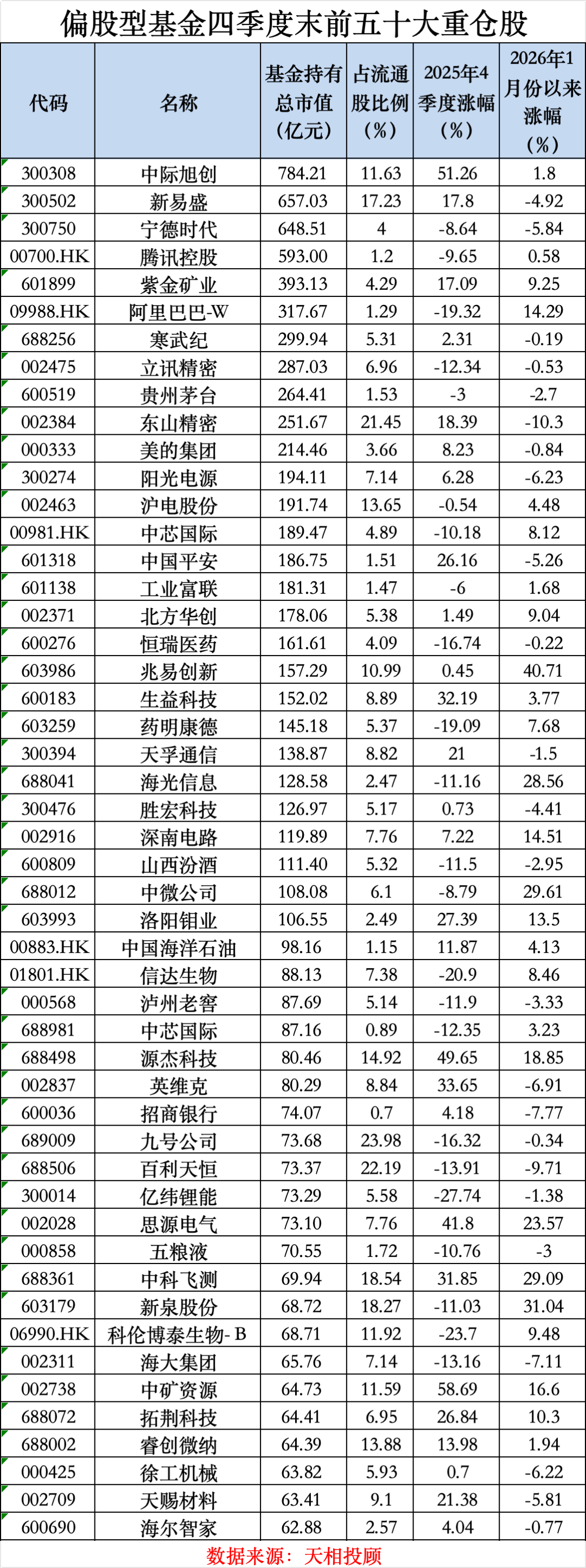
Core Viewpoint - The latest statistics indicate a significant shift in the top holdings of actively managed equity funds, with Zhongji Xuchuang replacing CATL as the largest holding, reflecting changing market dynamics and investment strategies [2][3]. Group 1: Changes in Top Holdings - As of the end of Q4 2025, the top ten holdings of actively managed equity funds are: Zhongji Xuchuang, Xinyi Semiconductor, CATL, Tencent Holdings, Zijin Mining, Alibaba-W, Cambrian Biologics-U, Luxshare Precision, Kweichow Moutai, and Dongshan Precision [3]. - The total market value of these top ten stocks held by actively managed equity funds is 76.8 billion, 63.8 billion, 63 billion, 57.4 billion, 36.8 billion, 31 billion, 29.1 billion, 28 billion, 25.8 billion, and 24.4 billion respectively [3]. - Notable changes from Q3 2025 include Zhongji Xuchuang rising from fourth to first, Xinyi Semiconductor from third to second, and Zijin Mining from eighth to fifth, while CATL and Tencent Holdings dropped to third and fourth respectively [3][6]. Group 2: Sector Allocation Adjustments - In Q4 2025, actively managed equity funds increased their allocations in sectors such as non-ferrous metals, communication, non-bank financials, chemicals, and machinery, while reducing exposure to electronics, pharmaceuticals, media, computers, and power equipment [2][8]. - The overall stock position of actively managed equity funds decreased to 84.4%, down 1.4 percentage points from the previous quarter, indicating a cautious approach amidst market volatility [7]. - The increase in allocation to sectors like non-ferrous metals and chemicals is attributed to supply constraints and recovering demand from new energy and AI applications, while the reduction in electronics and pharmaceuticals is linked to high valuations and weak short-term outlooks [8][9]. Group 3: Market Trends and Insights - The changes in top holdings and sector allocations reflect a shift in market focus towards technology, particularly in the communication sector, driven by the rapid development of the digital economy and AI [4][5]. - The strategic importance of communication infrastructure and chip manufacturing is highlighted, with ongoing policy support for industry upgrades creating new growth opportunities [5]. - The overall market sentiment is characterized by a balance between short-term gains and long-term strategic positioning, influenced by industry prospects and policy environments [9].




83股特大单净流入超2亿元
Xin Lang Cai Jing· 2026-01-23 13:11
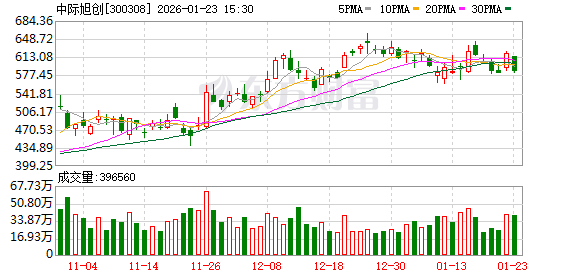
Group 1 - The core point of the article highlights significant net inflows and outflows of capital in specific stocks, indicating investor interest and market trends [1] Group 2 - Longi Green Energy leads with a net inflow of 2.654 billion, the highest among stocks [1] - Aerospace Electronics follows with a net inflow of 2.423 billion, ranking second [1] - Other notable stocks with high net inflows include Goldwind Technology, Lens Technology, and China Satellite [1] Group 3 - On the outflow side, TBEA shows the largest net outflow of 3.335 billion [1] - NewEase and Zhongji Xuchuang have net outflows of 2.913 billion and 2.625 billion, ranking second and third respectively [1]





2025Q4基金仓位解析:四季度基金调仓五大看点
GOLDEN SUN SECURITIES· 2026-01-23 12:56
Overall Allocation: Scale Decline, Position Adjustment - In Q4 2025, the scale of actively managed equity funds slightly decreased, with the market value of holdings dropping by 5.21% to 33,843.12 billion yuan and total fund assets declining by 3.63% to 40,191.1 billion yuan. The proportion of circulating market value also fell from 3.72% in Q3 2025 to 3.44% [1][7] - The equity position was adjusted downwards, with the overall equity position decreasing by 1.40% to 84.21% from the overall perspective, and a decrease of 0.99% to 82.19% from the average perspective [9][10] Fund Reallocation Highlights in Q4 2025 - The overall scale fluctuation narrowed, and redemption pressure weakened. The impact of net value fluctuations on fund scale significantly decreased compared to Q3. The estimated redemption pressure in Q4 was approximately halved compared to Q3 [2] - The allocation to the ChiNext board saw a concentrated increase, reaching a new high since 2017. The fund's allocation to the ChiNext board increased while the allocation to the main board and the Sci-Tech Innovation board was adjusted downwards [2] - The main positions of AI and non-ferrous metals continued to strengthen. Despite fluctuations in risk appetite, AI and non-ferrous metals became the core focus of fund allocations, with significant investments in computing power and various sub-industries reaching historical peak levels [2][3] Industry Allocation - The marginal decline in industry concentration was noted, but the trend of reducing oligopoly remained strong. The allocation in the electronics sector decreased, leading to a slight reduction in industry concentration, yet it remained at historically high levels [3] - The overall allocation to TMT (Technology, Media, and Telecommunications) decreased, with a notable reduction in AI-related applications while maintaining a strong focus on core AI computing directions [3] Individual Stock Allocation - The concentration of holdings continued to rise, with TMT maintaining a high proportion. By the end of Q4 2025, the top 20, top 50, and top 100 stocks held by public funds saw their respective holding ratios change by 0.77%, 0.16%, and -0.44%, reaching 34.50%, 48.54%, and 61.02% [31] - The top five heavyweights included Zhongji Xuchuang, Xinyi Technology, CATL, Zijin Mining, and Cambricon, with Zhongji Xuchuang being the most significantly increased stock [31][32]
见证历史!公募第一重仓股变了 积极加仓信息技术、有色等板块
Zhong Guo Ji Jin Bao· 2026-01-23 12:46
Core Insights - The public fund's top holdings have shifted, with Zhongji Xuchuang and Xinyi Sheng replacing CATL and Tencent as the first and second largest holdings respectively, reflecting a significant change in investment focus within the technology sector [1][4]. Group 1: Fund Holdings Overview - As of the end of Q4 2025, the top ten holdings of actively managed equity funds included Zhongji Xuchuang, Xinyi Sheng, CATL, Tencent, Zijin Mining, Alibaba-W, Cambricon, Luxshare Precision, Kweichow Moutai, and Dongshan Precision [1]. - Zhongji Xuchuang emerged as the largest holding with a total market value of 78.42 billion yuan, representing 11.63% of the circulating shares, and a quarterly increase of 51.26% [2][5]. - Xinyi Sheng followed with a market value of 65.70 billion yuan, accounting for 17.23% of circulating shares, and a quarterly increase of 17.8% [2][5]. Group 2: Changes in Holdings - The top five holdings experienced varying degrees of reduction in shares held by equity funds, with Zhongji Xuchuang seeing a decrease of 970.14 million shares, a 7.02% decline from the previous quarter [4]. - Despite the reduction in shares, the market value of Zhongji Xuchuang held by funds increased from 55.81 billion yuan to 78.42 billion yuan due to a significant rise in stock price [4]. - China Ping An was noted as a new entrant into the top twenty holdings, moving up from 41st to 15th place, indicating a growing interest in the insurance sector [4]. Group 3: Sector Focus - The information technology sector saw substantial increases in fund holdings, with four out of the top five increased holdings belonging to this sector, alongside significant investments in the insurance sector, particularly in China Ping An [1][4]. - The top stocks that received the most significant increases in holdings were primarily concentrated in the information technology, non-ferrous metals, and chemical sectors [4]. Group 4: Performance of Stocks - Several stocks that doubled in price during Q4 2025 received considerable increases in fund holdings, including Tianhua New Energy, which surged by 118.53%, leading to a rise in the number of funds holding the stock from 2 to 93 [7]. - Maiwei Co. also saw a significant increase in fund interest, with its stock price rising by 107.34% and the number of funds holding it increasing from 8 to 54 [7]. Group 5: Reduction in Holdings - Notable reductions in holdings were observed in several major stocks within the Hang Seng Technology Index, including Alibaba-W, Tencent, and SMIC, reflecting a broader trend of fund managers reducing exposure to these tech giants [8][9]. - The top ten stocks with the largest reductions in holdings included Alibaba-W, Industrial Fulian, CATL, and Tencent, indicating a strategic shift away from these previously favored stocks [9].

兴证策略:2025年四季度主动权益基金管理规模小幅下降 四季度存量基金的赎回压力仍然较大
Sou Hu Cai Jing· 2026-01-23 12:38
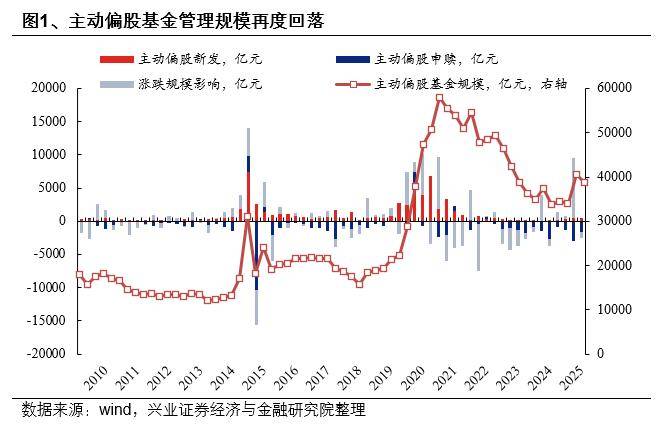
Group 1 - The active equity fund management scale decreased slightly in Q4 2025, primarily due to significant redemption pressure from existing funds, resulting in a net redemption of 165.6 billion yuan [1] - The total management scale of three types of active equity funds (ordinary stock, mixed equity, and flexible allocation) decreased by 189.8 billion yuan, with new active equity fund issuance at 56.2 billion yuan [1] - The active equity fund's position in Q4 2025 decreased by 0.83 percentage points to 86.62%, remaining at the second-highest level in history [2] Group 2 - In terms of sector allocation, the proportion of the ChiNext board increased by 1.24 percentage points to 24.98%, while the main board and Sci-Tech Innovation board saw declines [5][8] - The allocation to the main board decreased by 0.30 percentage points to 58.21%, indicating a further increase in underweight [8] - Active equity funds increased their positions in cyclical and financial real estate sectors while reducing exposure to technology growth and pharmaceuticals [11] Group 3 - The active equity funds increased their allocation in the non-ferrous metals, communication, and non-bank financial sectors, with increases of 2.26 percentage points, 1.85 percentage points, and 0.87 percentage points respectively [13] - The funds reduced their positions in electronics, pharmaceuticals, media, power equipment, and computers, with reductions of 1.72 percentage points, 1.54 percentage points, and 1.16 percentage points respectively [13] - Excluding thematic/sector funds, the active equity funds still increased their positions in non-ferrous metals, communication, and non-bank financial sectors [14] Group 4 - The allocation to the TMT sector slightly decreased in Q4 2025, with the configuration coefficient at 1.48, indicating room for further improvement [29] - Within the TMT sector, active equity funds increased their holdings in communication equipment and components while reducing positions in consumer electronics and semiconductors [32] - The dividend sector's allocation stabilized and increased, with the low-volatility dividend index rising by 1.7 percentage points to 4.3% [37] Group 5 - The top five stocks in active equity funds in Q4 2025 included Zhongji Xuchuang, Xinyi Sheng, Dongshan Precision, China Ping An, and Zijin Mining, with respective increases in holding ratios [43] - The top ten holdings accounted for 4.83%, 4.01%, and 3.97% of the total market value of the funds [46] - The concentration of individual stocks in active equity funds increased slightly, while the concentration of industries showed a mixed trend [49] Group 6 - The Hong Kong stock allocation of active equity funds decreased to 15.98%, down from 19.09%, with a total holding value of 302.9 billion yuan [51] - The funds increased their positions in the healthcare, materials, and energy sectors while reducing exposure to consumer discretionary and information technology sectors [54] - Tencent maintained its position as the largest holding in Hong Kong stocks, with a market value of 57.3 billion yuan [56]



通信行业2026年度投资策略:聚焦AI:算力降本向光而行,应用落地网络先行
Guolian Minsheng Securities· 2026-01-23 12:20
Group 1 - The core viewpoint of the report emphasizes that the demand for AI computing power will continue to grow and diversify in 2026, extending from data centers to network edges and even internal terminals [8][13][27] - The report highlights the significant capital expenditure (Capex) growth driven by business revenue, with major cloud service providers like Google, Microsoft, and Amazon showing consistent revenue growth exceeding 20% year-on-year [27][31][35] - The report identifies the increasing importance of silicon photonics technology, particularly the 1.6T optical module, which is expected to maintain accelerated growth and enhance the global market share of domestic optical chips and devices [7][54][70] Group 2 - The report discusses the emergence of new technologies such as Scale-UP supernodes and their impact on optical link demand, indicating that these technologies will drive additional link requirements in 2026 [7][9][66] - It notes that the AI infrastructure is experiencing a high level of prosperity, with significant investments in data centers and AI capabilities expected to continue, particularly in the U.S. [47][49][53] - The report anticipates that the integration of silicon photonics will significantly increase its market penetration, projecting that by 2026, over half of optical module sales will come from silicon photonics solutions [70][75]


主力动向:1月23日特大单净流入86.65亿元
Zheng Quan Shi Bao Wang· 2026-01-23 10:24
Market Overview - The net inflow of large orders in the two markets reached 8.665 billion yuan, with 83 stocks seeing net inflows exceeding 200 million yuan, led by Longi Green Energy with a net inflow of 2.654 billion yuan [1][2] - The Shanghai Composite Index closed up 0.33%, with a total of 2,408 stocks experiencing net inflows and 2,576 stocks seeing net outflows [1] Industry Performance - Among the 13 industries with net inflows, the power equipment sector had the highest net inflow of 13.781 billion yuan, with an index increase of 3.50% [1] - The defense and military industry followed with a net inflow of 4.370 billion yuan and a rise of 2.65% [1] - Other notable sectors with significant inflows included non-ferrous metals and media [1] Individual Stock Performance - Longi Green Energy led the net inflow rankings with 2.654 billion yuan, followed by Aerospace Electronics with 2.423 billion yuan [2] - Other top stocks with significant inflows included Goldwind Technology, Lens Technology, and China Satellite [2] - Stocks with net outflows were led by TBEA with a net outflow of 3.335 billion yuan, followed by NewEase and Zhongji Xuchuang with outflows of 2.913 billion yuan and 2.625 billion yuan, respectively [2][4] Stock Price Movements - Stocks with net inflows exceeding 200 million yuan saw an average increase of 9.90%, outperforming the Shanghai Composite Index [2] - Notable stocks that closed at their daily limit included Meichang Co. and Qianzhao Optoelectronics [2] Detailed Stock Data - Top stocks with net inflows: - Longi Green Energy: 19.35 yuan, +10.01%, 2.654 billion yuan, Power Equipment [2] - Aerospace Electronics: 31.46 yuan, +10.00%, 2.423 billion yuan, Defense and Military [2] - Goldwind Technology: 29.58 yuan, +10.00%, 2.097 billion yuan, Power Equipment [2] - Top stocks with net outflows: - TBEA: 28.55 yuan, -1.21%, -3.335 billion yuan, Power Equipment [4] - NewEase: 383.02 yuan, -6.51%, -2.913 billion yuan, Communication [4] - Zhongji Xuchuang: 585.00 yuan, -5.80%, -2.625 billion yuan, Communication [4]

数据复盘丨钙钛矿电池、商业航天等概念走强 191股获主力资金净流入超1亿元




Zheng Quan Shi Bao Wang· 2026-01-23 09:56
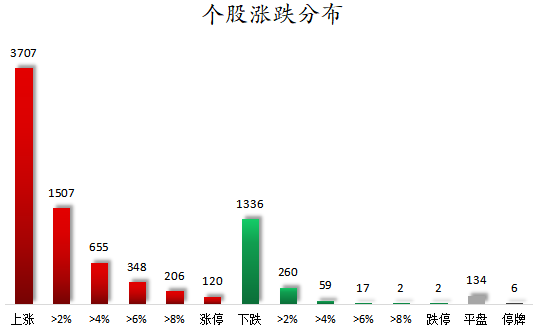
Market Overview - The Shanghai Composite Index closed at 4136.16 points, up 0.33%, with a trading volume of 1.3369 trillion yuan. The Shenzhen Component Index rose 0.79% to 14439.66 points, with a trading volume of 1.7484 trillion yuan. The ChiNext Index increased by 0.63% to 3349.50 points, with a trading volume of 822.63 billion yuan. The STAR Market 50 Index closed at 1553.71 points, up 0.78%, with a trading volume of 110.8 billion yuan. The total trading volume of both markets was 3.0853 trillion yuan, an increase of 393.5 billion yuan compared to the previous trading day [1]. Sector Performance - The market saw more sectors gaining than losing, with notable increases in power equipment, non-ferrous metals, precious metals, defense and military, steel, media, computer, environmental protection, and textile and apparel sectors. Concepts such as perovskite batteries, commercial aerospace, satellite internet, sapphire, lithium mining, cultivated diamonds, small metals, gold, and interactive short dramas were particularly active. In contrast, sectors like communication, insurance, banking, coal, and home appliances experienced declines [1]. Individual Stock Performance - A total of 3707 stocks rose, while 1336 stocks fell, with 134 stocks remaining flat and 6 stocks suspended. Excluding newly listed stocks, there were 120 stocks hitting the daily limit up and 2 stocks hitting the limit down [2]. - Among the stocks that hit the daily limit up, 23 stocks had consecutive limit-up days of 2 or more, with Fenglong Co., Ltd. leading with 18 consecutive limit-ups [3]. Capital Flow - The net capital outflow from the two markets was 4.167 billion yuan, with the ChiNext seeing a net inflow of 1.515 billion yuan. The CSI 300 index experienced a net outflow of 1.005 billion yuan, while the STAR Market saw a net outflow of 3.171 billion yuan. Out of 31 sectors, 13 sectors had net capital inflows, with the power equipment sector leading with a net inflow of 8.977 billion yuan [4][6]. - The top sectors with net inflows included non-ferrous metals (4.552 billion yuan), media (2.173 billion yuan), and defense and military (2.157 billion yuan). Conversely, the communication sector had the highest net outflow of 7.992 billion yuan, followed by electronics (6.350 billion yuan) and machinery (5.077 billion yuan) [4][6]. Notable Stocks - 191 stocks had net capital inflows exceeding 1 billion yuan, with Jin Feng Technology receiving the highest net inflow of 1.861 billion yuan. Other notable stocks included Lens Technology (1.594 billion yuan), Qian Zhao Optoelectronics (1.267 billion yuan), and Xian Dao Intelligent (1.217 billion yuan) [7][8]. - Conversely, 116 stocks experienced net capital outflows exceeding 1 billion yuan, with Xin Yi Sheng leading with a net outflow of 3.471 billion yuan, followed by Zhong Ji Xu Chuang (3.103 billion yuan) and Li Ou Shares (2.604 billion yuan) [10][11]. Institutional Activity - Institutional investors had a net selling of approximately 1.02 billion yuan, with 22 stocks seeing net purchases and 14 stocks net sales. Jin Feng Technology was the most purchased stock by institutions, with a net purchase amount of approximately 266 million yuan [13][14].