CATL(300750)

Search documents
沪深300成长ETF华夏(159523)涨0.76%,半日成交额466.93万元
Xin Lang Cai Jing· 2026-02-12 05:04
Group 1 - The core viewpoint of the article highlights the performance of the HuShen 300 Growth ETF managed by Huaxia Fund Management, which has seen a return of 31.56% since its inception on September 5, 2023 [1] - As of the midday close on February 12, the HuShen 300 Growth ETF (159523) increased by 0.76%, reaching a price of 1.324 yuan with a trading volume of 4.6693 million yuan [1] - The top holdings of the ETF include companies such as CATL, which rose by 2.57%, and Gree Moutai, which fell by 1.42%, indicating mixed performance among its key stocks [1] Group 2 - The ETF's performance benchmark is the CSI Select 300 Growth Innovation Strategy Index, which reflects its investment strategy [1] - The fund manager is Zhao Zongting, indicating a specific leadership in the management of the ETF [1] - The ETF has shown a monthly return of 1.97%, suggesting a stable short-term performance [1]





锂电池供需偏紧 电芯厂加速扩产
经济观察报· 2026-02-12 04:50
Core Viewpoint - The lithium battery industry in China is experiencing significant growth, with a projected total investment exceeding 820 billion yuan by 2025, marking a year-on-year increase of over 74% [1][2]. Group 1: Industry Expansion and Investment - By 2025, there will be over 282 publicly announced investment projects across the entire lithium battery supply chain in China, including lithium batteries, key materials, solid-state batteries, and sodium batteries [1][2]. - Major manufacturers like CATL and Guoxuan High-Tech are accelerating their expansion plans, with Guoxuan High-Tech aiming to raise 5 billion yuan for a 60GWh lithium battery capacity project [2]. - The overall capacity utilization rate in the lithium battery industry is expected to exceed 80% by Q2 2026, indicating a recovery from previous overcapacity issues [3]. Group 2: Market Dynamics and Supply Constraints - The supply of lithium battery cells is currently tight, with many manufacturers having initiated expansion plans that will come online in the latter half of 2025 [3][6]. - The demand for lithium batteries is projected to grow significantly, with total sales expected to reach 1,700.5 GWh in 2025, a year-on-year increase of 63.6% [7]. - The transition to larger cell formats, such as the shift from 300Ah to 314Ah cells, is underway, with future upgrades to even larger cells anticipated [11]. Group 3: Competitive Landscape and Technological Advancements - The iteration of battery cell production lines is becoming a core competitive advantage for manufacturers, with Guoxuan High-Tech benefiting from the introduction of its third-generation cells [8][9]. - The third-generation cells utilize a manganese iron phosphate chemistry, which can reduce costs by 10%-15% and improve low-temperature performance [9]. - The competitive landscape is intensifying as leading battery manufacturers strive to meet the growing demands of the market while optimizing their production capabilities [9]. Group 4: Cautious Outlook from Energy Storage Integrators - Energy storage integrators are approaching their battery expansion plans with caution, despite the increasing demand for storage batteries [14][15]. - Many integrators are facing challenges in securing battery supplies, leading to a reliance on high-priced purchases from external sources [15][16]. - The overall sentiment among energy storage companies is that while demand will continue to rise, the rapid increase in lithium battery production capacity may outpace demand growth, making further investments in battery production potentially unwise [16].



储能电池板块上涨,储能电池ETF易方达、储能电池ETF广发涨超3%
Ge Long Hui· 2026-02-12 04:09
Core Viewpoint - The energy storage battery sector is experiencing significant growth, with ETFs such as E Fund and GF rising over 3%, reflecting strong market interest and demand in the energy storage industry [1][2]. Group 1: ETF Performance - E Fund Energy Storage ETF increased by 3.09% year-to-date, with an estimated scale of 46.58 billion [2] - GF Energy Storage ETF rose by 3.33% year-to-date, with an estimated scale of 2.51 billion [2] Group 2: Market Dynamics - Recent bidding for a 12GWh energy storage system by Huadian showed an average price of 0.55 yuan/Wh, indicating a significant increase and a tight supply-demand situation [2] - The State Power Investment Corporation announced a public bidding for 7GWh energy storage cells with prices ranging from 0.325 to 0.355 yuan/Wh, reflecting strong downstream demand [3] Group 3: Policy Developments - A new notification established a unified national compensation logic for independent energy storage capacity pricing, which is expected to enhance revenue stability for energy storage projects [4] - The projected internal rate of return (IRR) for energy storage projects under different capacity pricing scenarios is 5.8% for 2 years, 7.9% for 10 years, and 9.2% for 20 years, indicating a favorable investment environment [4] Group 4: Industry Insights - The demand for lithium mining stocks is expected to rise due to increasing lithium carbonate prices, with potential for upward price adjustments [5] - The solid-state battery technology is anticipated to drive a new wave of capital expenditure in the industry by 2025, highlighting the importance of companies with integrated solid-state battery equipment capabilities [5] - The downstream battery terminal segment is currently viewed as the most stable part of the lithium battery supply chain, offering high win rates and safety [5]



宁德时代周四发行的科创债票面利率1.69% 创公司境内债发行史上最低
Jin Rong Jie· 2026-02-12 03:58
Core Viewpoint - Ningde Times announced the issuance of technology innovation corporate bonds with a coupon rate of 1.69%, marking the lowest rate since the company began issuing domestic bonds in 2019 [1] Group 1 - The bond issuance is targeted at professional investors [1] - The final coupon rate was determined after an offline inquiry by the issuer and the lead underwriter [1]
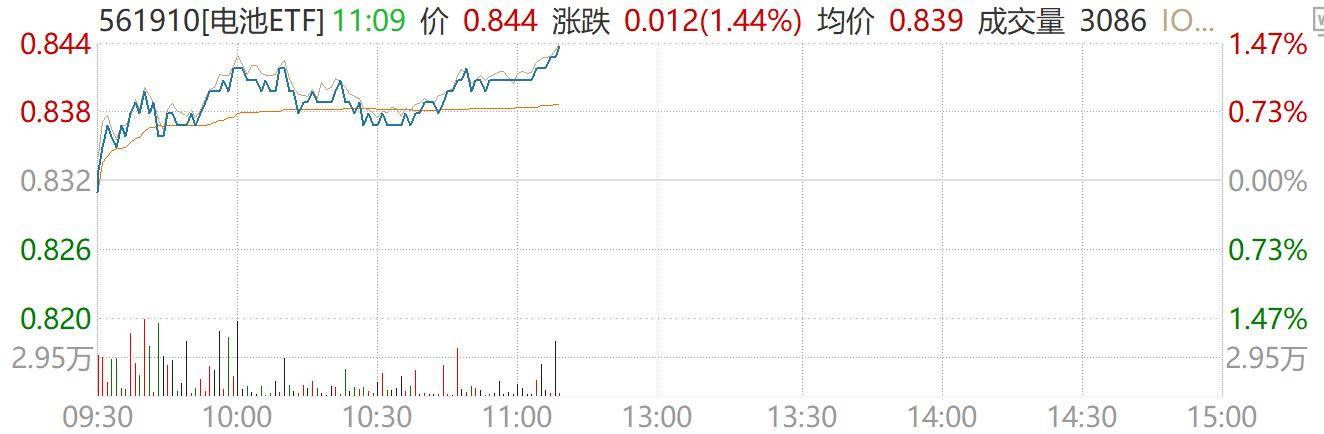
锂电从周期底部迈入业绩上行期,电池ETF(561910)盘中拉涨1.5%,科士达、银轮股份领涨!
Sou Hu Cai Jing· 2026-02-12 03:28
Core Viewpoint - The battery sector continues to show strong performance, driven by a combination of robust demand, capacity utilization, and profitability recovery, alongside advancements in solid-state battery technology [2][3]. Group 1: Demand Dynamics - Downstream demand has exceeded expectations, with the global electric vehicle (EV) sales projected to reach 23.54 million units by 2025, marking a year-on-year growth of 29.1%, with China accounting for over 70% of this market [4]. - The energy storage sector is expected to see explosive growth, with global energy storage battery shipments projected to reach 640 GWh by 2025, representing a staggering year-on-year increase of 82.9% [4]. - Major Chinese battery manufacturers reported a production increase of over 45% year-on-year in January and February, significantly surpassing previous forecasts of less than 30% growth for the year [4]. Group 2: Supply and Pricing Dynamics - The supply-demand landscape in the lithium battery industry has fundamentally shifted, moving from a phase of oversupply and profit decline to one of recovery and price increases starting June 2025 [5]. - The price of lithium hexafluorophosphate and lithium carbonate has risen since September, driven by strong demand from downstream battery cell manufacturers and improved capacity utilization in the materials sector [5]. - Recent earnings forecasts from several lithium material companies indicate substantial growth in Q4 2025, confirming the industry's transition from a "cyclical bottom" to an "upward performance phase" [5]. Group 3: Technological Advancements - The solid-state battery sector is experiencing accelerated industrialization, with significant developments such as the mass production of dry electrode technology and the first international output of domestic dry process technology [6]. - The battery ETF (561910) closely tracks the battery theme index, which is strategically positioned to benefit from the current industrial cycle, with 56% exposure to energy storage and over 45% to solid-state battery concepts [6]. - The top ten weighted stocks in the index include leading companies across various segments of the battery supply chain, indicating a strong focus on industry leaders [6].

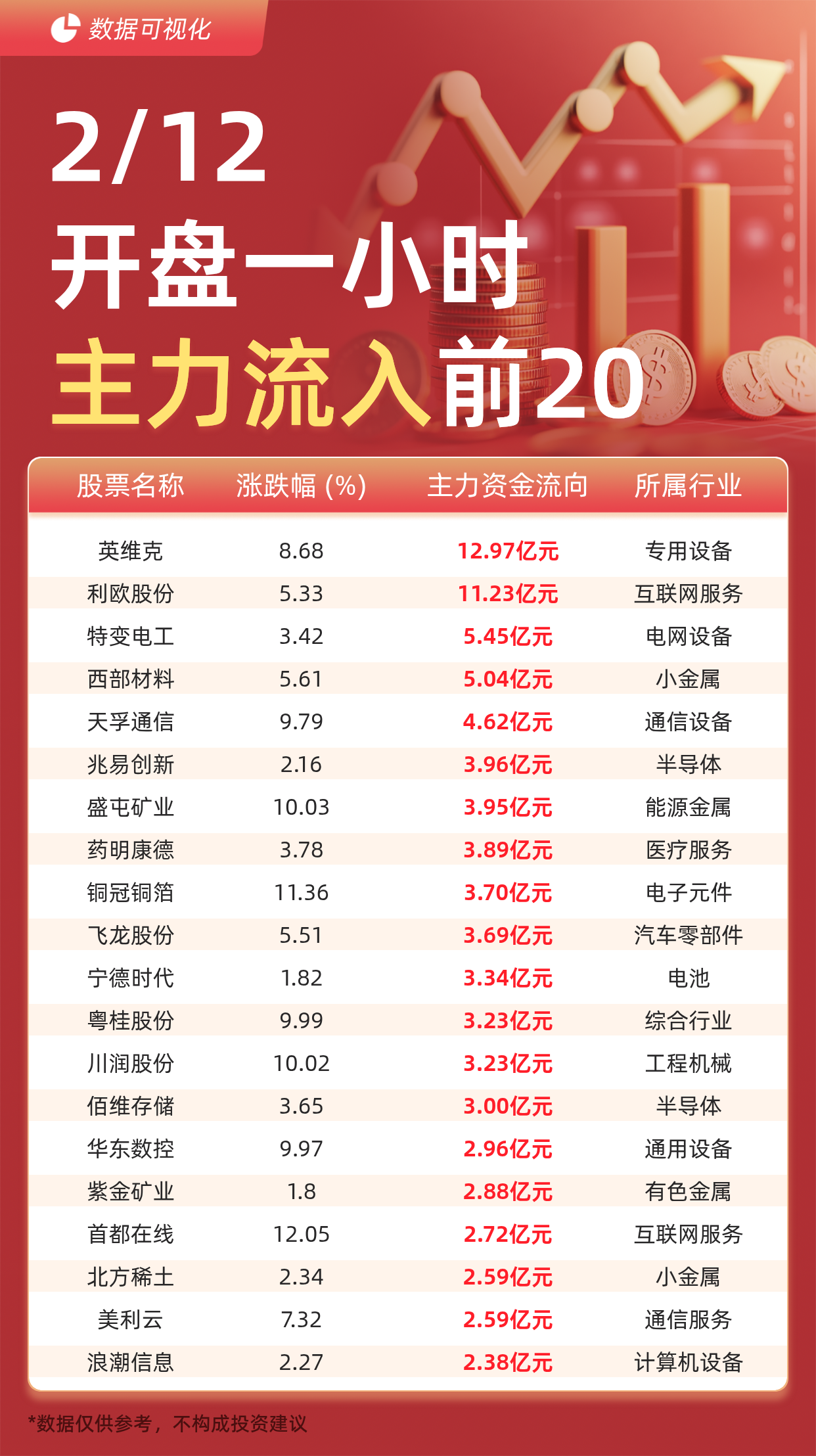
主力资金流入前20:英维克流入12.97亿元、利欧股份流入11.23亿元
Jin Rong Jie· 2026-02-12 02:56
Core Insights - The main focus of the news is the significant inflow of capital into specific stocks, indicating strong investor interest and potential market trends. Group 1: Stock Performance and Capital Inflow - The top stock by capital inflow is Yingweike, with an inflow of 1.297 billion yuan and a price increase of 8.68% [1][2] - Leo Group follows with an inflow of 1.123 billion yuan and a price increase of 5.33% [1][2] - TBEA has an inflow of 545 million yuan and a price increase of 3.42% [1][2] - Western Materials shows an inflow of 504 million yuan with a price increase of 5.61% [1][2] - Tianfu Communication has an inflow of 462 million yuan and a notable price increase of 9.79% [1][2] Group 2: Sector Analysis - The stocks listed belong to various sectors, including specialized equipment, internet services, power grid equipment, and communication devices, indicating diverse investment interests [2][3] - The energy metals sector is represented by Shengtun Mining, which has an inflow of 395 million yuan and a price increase of 10.03% [1][2] - The healthcare sector is highlighted by WuXi AppTec, with an inflow of 389 million yuan and a price increase of 3.78% [1][2] Group 3: Additional Notable Stocks - Copper Crown Copper Foil has an inflow of 370 million yuan and a significant price increase of 11.36% [1][2] - Ningde Times, a key player in the battery sector, has an inflow of 334 million yuan with a price increase of 1.82% [1][2] - Other notable stocks include Yunnan Tin with an inflow of 288 million yuan and a price increase of 1.8% [1][3]



电力设备新能源行业2026年投资策略报告:驭风逐光,破卷新章-20260212
Guoyuan Securities· 2026-02-12 02:46
Group 1: Photovoltaic Industry - The photovoltaic industry is experiencing a clear upward trend due to supply-side clearing and demand-side support, with expectations of profitability recovery in 2026 as inefficient companies exit the market and leading firms enhance efficiency through technological upgrades [1][14] - In 2025, China's photovoltaic industry saw a significant increase in installed capacity, reaching 315.07 GW, with a year-on-year growth rate of 13.67%, despite a slowdown in the second half of the year [14][16] - The introduction of policies aimed at preventing "involution" in the industry has led to a recovery in prices, with polysilicon prices rising over 50% from June to November 2025, indicating a shift towards a more rational pricing environment [22][29] Group 2: Wind Power Industry - The wind power industry is expected to benefit from a favorable supply-demand structure, with significant growth anticipated in offshore wind projects and exports, particularly in 2025 [1][3] - The domestic wind power market is projected to continue its growth trajectory, with offshore wind becoming a key focus area, supported by increasing demand for domestic and international markets [1][3] - Investment recommendations include focusing on leading manufacturers in the wind turbine sector and companies involved in high-barrier components such as submarine cables, which are expected to see increased demand [3][3] Group 3: New Energy Vehicles - The new energy vehicle sector in China is projected to achieve sales of 16.49 million units in 2025, reflecting a year-on-year growth of 28.2%, driven by stable market demand and improved product structures [2][3] - The industry is witnessing a recovery in profitability as supply-side chaos is effectively managed, with significant price increases in key materials like lithium hexafluorophosphate and vinyl carbonate [2][3] - The transition to a high-quality development phase is expected in 2026, supported by technological innovations and enhanced supply chain capabilities [2][3] Group 4: Lithium Battery Industry - The lithium battery industry is experiencing a recovery in profitability as inefficient production capacity is eliminated, with key materials seeing price increases and demand from new energy vehicles and energy storage continuing to rise [8][8] - Recommendations include focusing on leading companies in the battery and structural components sectors, which are expected to benefit from the industry's recovery [8][8] - The commercialization of solid-state batteries is accelerating, with several companies making significant progress in this area [8][8]




地平线 × 时代智能达成战略合作 软硬协同共筑新能源智能出行新生态
Zhong Guo Qi Che Bao Wang· 2026-02-12 02:24
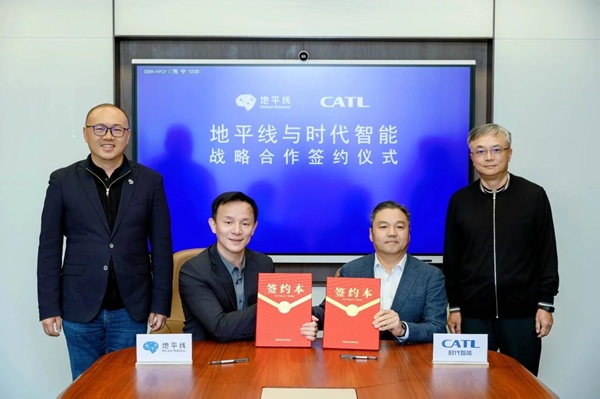
Core Viewpoint - Horizon and CATL's subsidiary, Times Intelligent, signed a strategic cooperation agreement to focus on the trend of intelligent upgrades in the electric vehicle sector, aiming to enhance the smart travel experience for global automotive manufacturers and end users [1][4]. Group 1: Strategic Cooperation - The cooperation will leverage Times Intelligent's Rock Solid chassis products and core technologies, while Horizon will provide full-scene assisted driving products and solutions, creating a comprehensive intelligent system from foundational architecture to top-level applications [4]. - This partnership signifies a transition from capital collaboration to technical research and product co-creation, marking a new phase in their relationship [6]. Group 2: Product and Technology Integration - Times Intelligent specializes in integrated smart chassis development, with its core product, the Rock Solid chassis, enhancing battery integration efficiency and enabling parallel development of vehicle body and intelligent driving modules [4]. - Horizon has become the first domestic smart driving technology brand to exceed a shipment volume of 10 million units, with its Horizon SuperDrive™ system leading the industry towards a more accessible smart driving era [5]. Group 3: Industry Ecosystem and Future Outlook - Horizon has established partnerships with over 200 industry chain partners and has strategic collaborations with top-tier global companies like Bosch and Denso, aiming to build a mature, scalable production and delivery system [6]. - The collaboration with Times Intelligent is seen as a significant step in expanding Horizon's technological boundaries and deepening commercial scenarios in the intelligent driving sector [6].
宁德时代孙明岩:内卷源于创新保护不足需完善知识产权体系
Zhong Guo Jing Ying Bao· 2026-02-12 02:20
Core Viewpoint - The essence of the current "involution" in the industry is a lack of innovation protection leading to homogeneous competition, highlighting the need for a robust intellectual property system to create a healthy industrial ecosystem [1] Group 1: Industry Challenges - The industry faces challenges such as frequent overseas patent litigation and geopolitical uncertainties [1] - The lack of adequate legal protection for China's leading innovation capabilities in the power battery sector is a significant concern [1] Group 2: Company Strategy - The company invests nearly 20 billion yuan annually in R&D and has established a global patent portfolio of 60,000 patents, creating a comprehensive "innovation-protection-application" management system [1] - The company employs a "technology licensing + light asset operation" (LRS model) strategy to effectively mitigate market risks and enhance global technological influence [1] Group 3: Recommendations - The company should adopt a "leader mentality" to construct an intellectual property strategy that continuously enhances the global competitiveness of Chinese enterprises [1] - There is a need to reshape the competitive order by strengthening intellectual property protection to address the issue of homogeneous competition caused by a lack of innovation protection [1]

2026格局与趋势丨(下):汽车制造商痛失定价权
3 6 Ke· 2026-02-12 01:52
Core Insights - Tesla is shifting its production focus from Model S and Model X to the Optimus robot, indicating a broader industry trend towards innovation and transformation amidst profit challenges [1] - The automotive industry is facing a profit crisis, with a projected profit margin of only 4.1% in 2025, significantly lower than the 5.9% margin of downstream industries [4][6] - The price war initiated by Tesla has spread across the entire automotive market, leading to a decline in revenue and profit margins for many manufacturers [6][8] Industry Challenges - The automotive sector is experiencing a "spiral of death" in profits due to five core factors: intense price competition, rising costs, imbalanced profit distribution, overcapacity, and the pains of electrification [3] - In December 2025, the industry's profit margin fell to a historic low of 1.8%, with revenues declining by 0.8% while costs increased by 0.8%, creating a "scissors gap" [6][8] - The overall capacity utilization rate for the automotive industry is projected to be 73.2% in 2025, below the healthy threshold of 75%, with some joint ventures operating at only 40-60% [8][9] Financial Performance - The automotive industry's revenue is expected to reach approximately 11.18 trillion yuan in 2025, reflecting a year-on-year growth of 7.1% [4] - The cost of production is anticipated to rise by 8.1% in 2025, leading to a decrease in per vehicle revenue by 1.6 million yuan and continuous pressure on gross profit margins [8] - The average profit margin for automotive dealers is projected to be around 4.1%, with over 58% of dealers expected to incur losses in 2025 [10][12] Supply Chain Dynamics - The supply chain is experiencing a bifurcation, with suppliers showing moderate improvement while dealers face significant losses [12] - The dominance of battery manufacturers like CATL is evident, as they captured 76.9% of the net profits in the industry, with CATL alone accounting for 68.1% [27][29] - The shift in value from traditional automotive manufacturers to technology and battery suppliers is reshaping the industry's profit landscape [14][27] Future Outlook - The automotive industry is expected to face ongoing challenges from rising costs in chips and materials, with potential cost increases of 4,000 to 7,000 yuan per vehicle due to supply chain pressures [35] - The transition towards electric and smart vehicles is creating a competitive environment where traditional manufacturers are losing pricing power to tech companies and battery suppliers [21][29] - The long-term outlook suggests that while battery suppliers currently hold significant power, this may shift as competition intensifies and manufacturers seek to reduce dependency on external suppliers [33]