
CATL(300750)

Search documents
钠电池加速“上车”长安汽车携手宁德时代开启“锂钠协同”新阶段
Zheng Quan Ri Bao· 2026-02-05 16:41
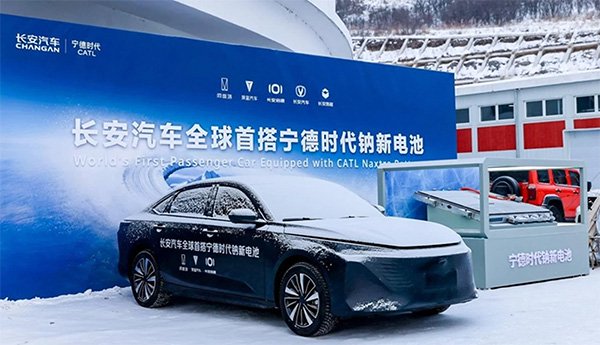
Core Insights - Changan Automobile has officially launched its global sodium battery strategy and unveiled the world's first mass-produced sodium-powered passenger vehicle in Yakeshi, in collaboration with CATL [1][2] - The sodium battery technology is seen as a significant complement to lithium batteries, enhancing the adaptability of electric vehicles in extreme cold conditions [1][2] - CATL's sodium battery, combined with its third-generation CTP system, offers a range of over 400 km, with potential future upgrades to 500 km or even 600 km [2][3] Group 1 - Changan Automobile's sodium battery-powered vehicle has demonstrated a discharge power nearly three times higher than conventional lithium iron phosphate models at -30°C, with over 90% capacity retention at -40°C [1] - The sodium battery technology is expected to cover over 50% of the market's range requirements as the sodium industry chain develops rapidly [2] - Changan aims to become the first major automaker to fully adopt sodium batteries across multiple brands, leveraging its extensive manufacturing experience [2] Group 2 - By 2026, CATL plans to apply sodium batteries on a large scale across various sectors, including passenger vehicles, commercial vehicles, and energy storage [3] - The production of sodium-ion batteries in China is projected to reach 3.45 GWh by 2025, marking a 96% year-on-year increase [3] - The collaboration between lithium and sodium batteries is expected to enhance supply chain resilience and reduce resource risks, facilitating the electrification of the market [3]

钠电池加速“上车” 长安汽车携手宁德时代开启“锂钠协同”新阶段
Zheng Quan Ri Bao· 2026-02-05 16:41
Core Viewpoint - The global first sodium-ion battery mass-produced passenger vehicle has successfully passed winter validation in Yakeshi, meeting various performance requirements such as range, low-temperature performance, safety, and discharge capabilities [1] Group 1: Company Developments - Changan Automobile officially launched its global sodium-ion strategy and unveiled the world's first sodium-ion mass-produced passenger vehicle in Yakeshi on February 5, in collaboration with CATL [2] - Changan Automobile plans to equip multiple brands, including Avita, Deep Blue, Qiyuan, and Inertia, with CATL's sodium-ion batteries in the future [2][4] - The company aims to become the first leading automaker to fully adopt sodium-ion technology, leveraging its extensive experience in vehicle manufacturing over 40 years [4] Group 2: Industry Insights - Sodium batteries serve as an important supplement to lithium batteries, with significant implications for enhancing the all-climate adaptability of electric vehicles [3] - The sodium-ion battery, developed by CATL, shows a nearly threefold increase in discharge power at -30°C compared to conventional lithium iron phosphate models, with over 90% capacity retention at -40°C [3] - CATL's sodium-ion battery has a maximum energy density of 175 Wh/kg, which is considered industry-leading, and future advancements could increase pure electric range to 500-600 km [3][4] - The sodium-ion battery market in China is projected to grow significantly, with a production capacity of 3.45 GWh expected by 2025, marking a 96% year-on-year increase [4] - The collaboration between lithium and sodium batteries is seen as a complementary approach, enhancing supply chain resilience and reducing resource risks [5]

全球首款钠电池量产乘用车上市!
DT新材料· 2026-02-05 16:07
Core Viewpoint - The article highlights the launch of the world's first sodium battery mass-produced passenger vehicle by Changan Automobile, expected to be available in mid-2026, marking a significant milestone in the sodium battery market for passenger cars [1][3]. Group 1: Sodium Battery Development - 2026 is identified as the year for large-scale application of sodium batteries in the passenger vehicle market, with Changan Automobile being the first major automaker to fully embrace sodium batteries [3]. - Changan's brands, including Avita, Deep Blue, Qiyuan, and Gravity, will utilize CATL's sodium battery technology, which is branded as "Sodium New" [3]. - CATL plans to apply sodium batteries across various sectors, including passenger vehicles, commercial vehicles, and energy storage, establishing a dual development trend of "sodium-lithium" [3]. Group 2: Technical Advantages of Sodium Batteries - Sodium batteries are not a downgraded alternative to lithium batteries; they offer superior low-temperature performance and safety features, addressing concerns of some users regarding electric vehicles [3]. - For instance, the sodium battery-equipped vehicle can maintain a discharge power nearly three times higher than conventional lithium iron phosphate models at -30°C, with over 90% capacity retention at -40°C [4]. - The sodium battery's energy density reaches 175 Wh/kg, which is among the highest in the industry, and it is expected that the pure electric range could increase to 500 km or even 600 km in the future [6]. Group 3: Market Potential and Growth - The sodium battery industry is entering a rapid development phase, with global shipments projected to reach 9 GWh by 2025, a 150% increase year-on-year [6]. - By 2030, the global market for sodium batteries in energy storage is expected to reach 580 GWh, while the automotive sector's market size will exceed 410 GWh [6]. - The average price of sodium cells is anticipated to decrease from approximately 0.52 yuan/Wh in 2025 to 0.25 yuan/Wh by 2030, indicating a trend towards cost-effectiveness [6]. Group 4: Strategic Partnerships and Infrastructure - CATL's sodium battery technology is designed to be adaptable across multiple brands, enhancing flexibility and performance for Changan's upcoming sodium battery models [7]. - Since starting research on sodium batteries in 2016, CATL has invested nearly 10 billion yuan and tested around 300,000 battery cells by 2025 [7]. - CATL plans to establish over 3,000 chocolate battery swap stations across more than 140 cities in China by 2026, facilitating quick energy replenishment for users [7].
“中企保持领先”,全球首款钠电量产乘用车亮相
Guan Cha Zhe Wang· 2026-02-05 15:00
Core Viewpoint - The launch of the world's first sodium-ion battery passenger vehicle by Changan Automobile, utilizing CATL's sodium-ion battery technology, marks a significant advancement in the electric vehicle industry, particularly in extreme weather performance and sustainability [1][4]. Group 1: Product Launch and Technology - Changan Automobile held a global launch event for its sodium-ion battery strategy, unveiling the world's first mass-produced sodium-ion passenger vehicle [1]. - The sodium-ion battery can operate stably at extreme low temperatures, maintaining discharge capabilities even at -50°C [1]. - The vehicle demonstrated a nearly threefold increase in discharge power compared to conventional lithium iron phosphate models at -30°C, with over 90% capacity retention at -40°C [1]. Group 2: Market Implications and Future Prospects - The sodium-ion battery technology is expected to create a new ecosystem for China's electric vehicle industry, providing enhanced resilience and broader operational temperature ranges [1]. - Analysts note that while lithium-ion batteries currently benefit from better economies of scale, sodium-ion batteries offer improved stability in cold weather and higher safety due to lower flammability [4]. - The global shipment of sodium batteries is projected to reach 9 GWh by 2025, representing a 150% year-on-year growth, indicating a rapid acceleration in commercialization [5]. Group 3: Material Availability and Cost Dynamics - Sodium-ion batteries utilize sodium carbonate, which is more readily available than lithium carbonate, a key material for lithium-ion batteries [4]. - The price of lithium carbonate has experienced significant fluctuations, with prices nearing 600,000 yuan per ton at the end of 2022 and expected to drop below 100,000 yuan by 2025 [4].
钠电风起,规模上车打响第一枪?
2 1 Shi Ji Jing Ji Bao Dao· 2026-02-05 13:32
Core Insights - Changan Automobile and CATL have launched a global sodium battery strategy, unveiling the world's first mass-produced sodium-ion passenger vehicle, expected to hit the market by mid-year [1] - Sodium batteries are viewed as a complementary alternative to lithium batteries, with significant advancements anticipated by 2026, marking a second wave of industrialization for sodium technology [1][6] - The sodium battery's low-temperature performance and safety features position it as a viable option for specific applications, particularly in cold climates [3][5] Group 1: Sodium Battery Development - The sodium battery technology has faced challenges in achieving large-scale commercialization, primarily due to lower energy density compared to lithium batteries [1][6] - Companies like EVE Energy and Zhongda Energy are actively developing sodium battery products, with EVE Energy's headquarters project and Zhongda's "Yuan Sodium Light" battery expected to launch in early 2026 [1] - The first-generation sodium-ion batteries have an energy density of 140-160 Wh/kg, which is significantly lower than that of lithium batteries, limiting their application in high-end electric vehicles [6] Group 2: Performance Advantages - Sodium-ion batteries exhibit superior low-temperature performance, maintaining charge capacity even in extreme cold, with the CATL's sodium battery functioning at temperatures as low as -30°C [3][4] - The sodium battery's design allows for simplified thermal management systems, enhancing efficiency and safety, particularly in cold regions [4][5] - The safety profile of sodium batteries is enhanced due to their lower internal resistance, reducing risks of thermal runaway and fire [4] Group 3: Commercialization Challenges - The sodium battery industry is still in its infancy, with a less mature supply chain compared to lithium batteries, affecting cost and production stability [6][7] - The cost of sodium batteries is projected to be around 0.45 yuan/Wh by 2025, which does not yet provide a competitive edge over lithium iron phosphate batteries priced at approximately 0.3 yuan/Wh [6] - The path to commercialization for sodium batteries is expected to be gradual, with 2026 identified as a pivotal year for transitioning from demonstration applications to mass production [7]
全国第十!宁波11家企业入围“胡润中国500强”
Xin Lang Cai Jing· 2026-02-05 12:25
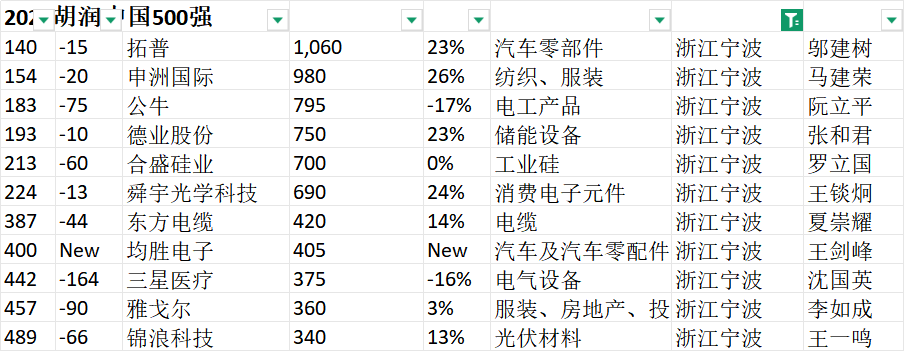
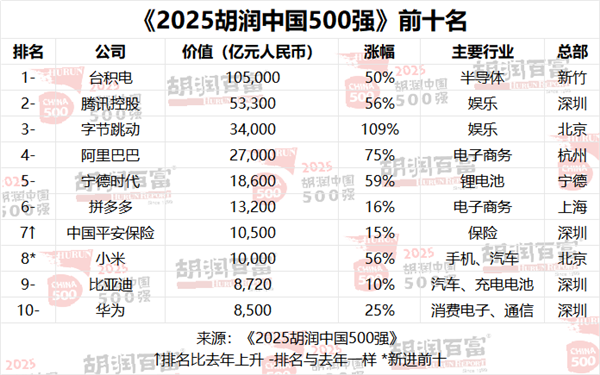
榜单显示,中国500强总价值达77万亿元,较上年增长38%;上榜门槛提升至340亿元,386家企业实现价值增长,95家新面孔入 围。 头部阵营中,台积电以10.5万亿元蝉联榜首,腾讯、字节跳动分别稳居第二、第三;字节跳动以109%价值涨幅成为黑马,小米 跻身前十。 2月5日,胡润研究院发布《2025胡润中国500强》榜单。这份聚焦中国最具价值非国有企业的权威榜单,折射出2025年民营经济 的强劲活力。 值得关注的是,本次共有11家宁波企业入围,合计市值达6875亿元。宁波入围企业数量居全国城市第10位,大陆第6位,成为长 三角民营经济的重要力量。 宁波入围企业数量居全国第十 宁波11家企业入围,数量与上年持平,位居全国第10(含港澳台)、大陆城市第7。同时,宁波也成为全国最受企业欢迎的研发 基地(第7)、制造基地(第10)。 | | 201▼ 胡润=国500强 | | ▼ | ▶ V | | レ | T: | ▲ | | --- | --- | --- | --- | --- | --- | --- | --- | --- | | 140 | -15 | 拓普 | 1,060 | 23% | 汽车零部件 | ...




中国500强最新排名来了!小米首次超越华为 但都输给了拼多多
Xin Lang Cai Jing· 2026-02-05 12:25
Core Insights - The latest "2025 Hurun China 500" list reveals that Xiaomi has entered the top ten for the first time, surpassing Huawei, while both companies fall behind Pinduoduo [1][12][13]. Group 1: Rankings and Values - Xiaomi ranks 8th with a company value of 1 trillion RMB, a significant increase from 643 billion RMB in 2024, marking a 56% growth [2][16]. - Huawei is ranked 10th with a value of 850 billion RMB, up from 680 billion RMB in 2024, reflecting a 25% increase [4][16]. - Pinduoduo holds the 6th position with a value of 1.32 trillion RMB, growing from 1.14 trillion RMB in 2024, which is a 16% increase [5][17]. Group 2: Industry Trends - The total value of the top 500 companies reached 77 trillion RMB, a 38% year-on-year growth, with an average value of 153 billion RMB per company [1][12]. - The entry of Xiaomi into the top ten indicates a shift in the competitive landscape, highlighting the vitality of China's private economy [1][13]. - Pinduoduo's strategy focuses on deepening its presence in lower-tier markets, which has proven effective in maintaining its position despite overall e-commerce sector slowdowns [6][18]. Group 3: Company Strategies - Xiaomi's growth is attributed to its dual strategy of mobile and automotive business expansion, which has enhanced its brand value and profitability [4][16]. - Pinduoduo's unique approach involves optimizing algorithms and improving supply chain efficiency, allowing for sustained profitability without relying heavily on traditional growth methods [7][18]. - Huawei continues to invest in core areas such as chip self-research and ecosystem development, maintaining resilience despite global supply chain challenges [4][16].


告别退税红利,动力电池出海硬仗开打
Xin Lang Cai Jing· 2026-02-05 12:24
新年伊始,重磅政策调整出台,给本就"内卷"的动力电池行业投下一颗"石子"。这不仅关乎企业利润, 更可能重构中国动力电池"出海"的游戏规则。 近日,财政部、国家税务总局联合发文,明确电池产品出口退税将分阶段退出:自2026年4月1日起至 2026年12月31日,将电池产品的增值税出口退税率由9%下调至6%;2027年1月1日起,取消电池产品增 值税出口退税。 这是电池增值税出口退税率继2024年11月从13%下调至9%后,政策的再一次收紧,动力电池行业"走出 去"正被推向市场驱动的新阶段。 从政策托底到市场主导 在业内人士看来,电池出口退税的政策调整是产业发展成熟后的必然抉择,也是对行业"内卷外化"乱象 的精准纠偏。在动力电池产业发展初期,出口退税扮演了托底护航的关键角色——彼时企业技术积累薄 弱、海外市场认可度低,退税带来的成本优势,成为打开国际销路、提升产能利用率的重要支撑。 如今,宁德时代、比亚迪等头部动力电池企业的市占率持续位居世界前列,技术研发投入持续加大,在 产品的能量密度、安全性、快充技术等核心领域已形成显著竞争优势,产业规模和全球影响力今非昔 比。 中国汽车动力电池产业创新联盟发布的最新统计显示 ...
全球首款钠电量产乘用车亮相
新华网财经· 2026-02-05 11:49
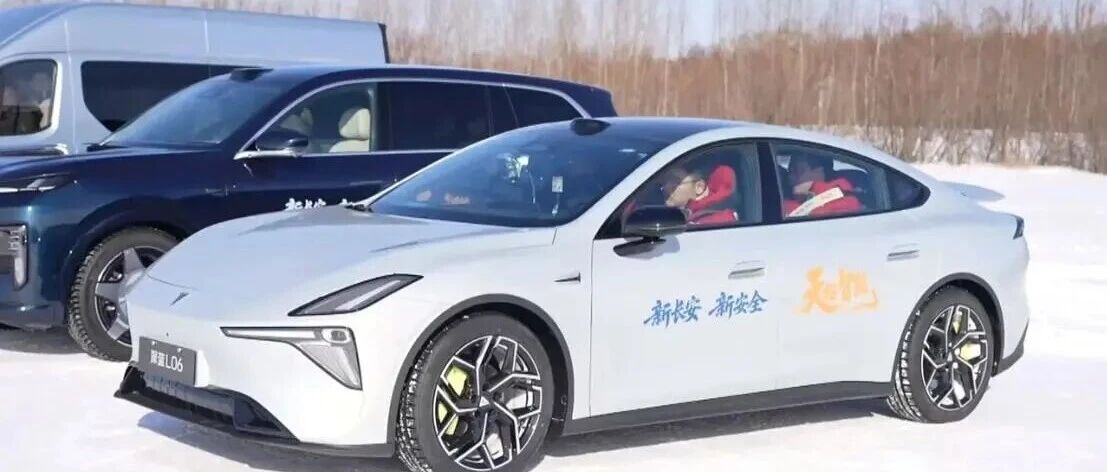
Core Viewpoint - Changan Automobile has officially launched its global sodium battery strategy and unveiled the world's first mass-produced sodium battery passenger vehicle in Yakeshi, in collaboration with CATL [1]. Group 1: Sodium Battery Technology - CATL's sodium battery cells have a maximum energy density of 175 Wh/kg, enabling pure electric range upgrades to 500 km or even 600 km, and hybrid range breakthroughs of 300 km to 400 km [3]. - In extreme cold conditions of -30℃, the vehicle equipped with CATL's sodium battery shows a discharge power nearly three times higher than conventional lithium iron phosphate models, and maintains over 90% capacity at -40℃, with stable discharge even at -50℃ [3]. Group 2: Strategic Collaboration - CATL's support for Changan's global sodium battery strategy extends beyond core technology to encompass full ecosystem and lifecycle support, allowing for deep adaptability across multiple brands while balancing flexibility and performance upgrades [3]. - Changan aims to rapidly launch multiple sodium battery models by 2026, leveraging CATL's sodium battery technology [3].
宁德时代(300750) - H股公告(截至2026年1月31日止股份发行人的证券变动月报表)
2026-02-05 11:00
FF301 股份發行人及根據《上市規則》第十九B章上市的香港預託證券發行人的證券變動月報表 截至月份: 2026年1月31日 狀態: 新提交 呈交日期: 2026年2月5日 I. 法定/註冊股本變動 | 1. 股份分類 | 普通股 | 股份類別 | H | | 於香港聯交所上市 (註1) | | 是 | | | --- | --- | --- | --- | --- | --- | --- | --- | --- | | 證券代號 (如上市) | 03750 | 說明 | | | | | | | | | | 法定/註冊股份數目 | | | 面值 | | 法定/註冊股本 | | | 上月底結存 | | | 155,915,300 | RMB | | 1 RMB | | 155,915,300 | | 增加 / 減少 (-) | | | | | | RMB | | | | 本月底結存 | | | 155,915,300 | RMB | | 1 RMB | | 155,915,300 | | 2. 股份分類 | 普通股 | 股份類別 | A | | 於香港聯交所上市 (註1) | | 否 | | | --- | - ...