Bank of America(BAC)

Search documents
每日投行/机构观点梳理(2025-06-17)
Jin Shi Shu Ju· 2025-06-18 01:40
Group 1: Commodity Market Insights - Citigroup predicts gold prices will fall below $3000 per ounce in the coming quarters, with a target range of $2500-$2700 by mid-2026 due to weakening investment demand and improved global economic outlook [1] - Citigroup expects Brent crude oil prices to trade around $70-$80 per barrel in the near term, while maintaining a long-term forecast of $60-$65 per barrel [2] - Bank of America warns of declining foreign demand for U.S. Treasury bonds, with custodial assets dropping over $60 billion since April [3] Group 2: Economic Policy and Market Impact - Morgan Stanley suggests that the "Beautiful America" bill may increase the deficit without significantly boosting economic growth, predicting a fiscal drag on GDP in the medium term [2] - Dutch Bank analysts indicate limited upside potential for the U.S. dollar, as geopolitical tensions and rising oil prices may not provide sufficient support [4] - German Bank analysts note that the recent strength of the dollar is primarily driven by rising oil prices rather than its safe-haven status [5] Group 3: Domestic Economic Outlook - CITIC Securities forecasts continued rapid economic growth in Q2, driven by strong industrial and service sector performance, with a focus on consumer demand and investment trends [8] - CITIC Securities identifies a long-term growth trend in the controllable nuclear fusion industry, supported by favorable policies and increased financing [8] - CITIC Securities anticipates that recent policy changes in drug and medical supply procurement will benefit high-quality innovative companies in the pharmaceutical sector [8] Group 4: Market Trends and Predictions - Zheshang Securities predicts a dual bull market for stocks and bonds in the second half of the year, driven by improved economic conditions and supportive policies [9] - Huatai Securities highlights the potential for a surge in oil transportation rates due to increased risks in the Strait of Hormuz, impacting global shipping supply chains [10] - Tianfeng Securities recommends focusing on high-elasticity industries such as storage and AI, anticipating optimistic growth in the semiconductor sector [10]




美股光环逐渐褪去? 美银调查:超五成基金经理押注未来五年国际股票跑赢美股
智通财经网· 2025-06-17 13:25
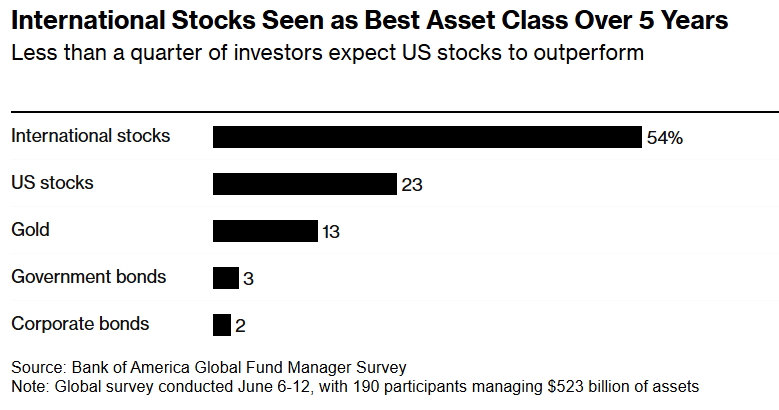
Core Insights - The Bank of America survey indicates that global stock markets, excluding the U.S., are expected to outperform the U.S. stock market over the next five years, suggesting a shift in investor sentiment away from U.S. dominance in equity markets [1][5] - 54% of fund managers believe that international stocks will be the best-performing asset class, while only 23% favor U.S. stocks [1][5] - The survey reflects a growing trend of "Sell America" trades among institutional investors, particularly in light of U.S. government policies and budget deficits [2][5] Summary by Category International Stocks - International stocks are defined as stocks outside the U.S., including developed markets (e.g., Europe, Japan) and emerging markets (e.g., China, India) [1] - The performance of international stocks is compared to U.S. stocks, with a notable shift in expectations for future returns [1][5] U.S. Market Sentiment - The survey marks the first time Bank of America has asked institutional investors to predict the best-performing asset class over a five-year horizon [2] - Historical data shows that the U.S. stock market has outperformed international stocks in 13 out of the last 15 years, but this trend is changing [5] Economic Outlook - 59% of institutional investors do not expect a boost in U.S. economic activity from the government's spending plans [8] - There is a significant negative sentiment towards the U.S. dollar and U.S. stocks, with net 31% and net 36% of investors planning to reduce their holdings, respectively [8]


美银基金经理调查:贸易战担忧缓解、“做多黄金”退热,美元低配程度20年来最极端
Hua Er Jie Jian Wen· 2025-06-17 13:22
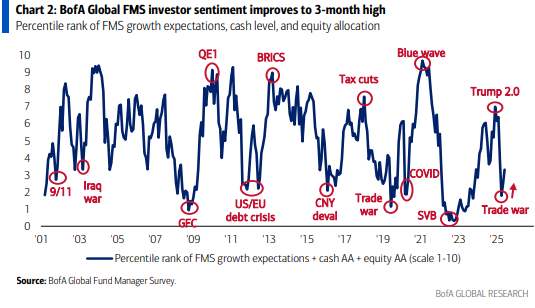
Group 1 - The core sentiment among investors has shifted from recession fears in April to a "golden girl bull market" level, indicating a significant recovery in market sentiment [2][5][12] - The cash allocation among fund managers has decreased from 4.8% in April to 4.2%, marking the lowest level in three months [4] - There is a notable improvement in global economic expectations, with a net 46% of respondents anticipating economic weakness, a significant improvement from a record net 82% in April [5][19] Group 2 - The expectation of a soft landing has risen to 66%, the highest in eight months, while hard landing expectations have dropped from 49% in April to 13% [7] - Investors' extreme aversion to the US dollar has reached a 20-year low, with 31% of respondents indicating a low allocation to the dollar [8][10] - Shorting the dollar has become the third most crowded trade, accounting for 20% of positions, reflecting deep pessimism about the dollar's outlook [12] Group 3 - In terms of asset preferences for the next five years, 54% of respondents favor international stocks, while only 23% prefer US stocks, indicating a shift in confidence away from US assets [14][17] - Fund managers have increased their allocation to emerging market stocks to 28%, the highest since August 2023, while maintaining a 34% overweight in European stocks [15] - Corporate fundamentals are improving, with a net 3% of respondents believing companies are "under-leveraged," and global earnings expectations have significantly improved [18] Group 4 - Concerns about trade wars have eased, with the level of concern dropping from 80% in April to 47%, although it remains the largest tail risk [19] - A net 21% of respondents expect bond yields to rise over the next 12 months, the highest proportion since August 2022, reflecting concerns about inflation and central bank policies [24] - In the US sector allocation, investors have increased their exposure to energy, banks, telecommunications, and industrials, while reducing allocations to defensive sectors like utilities and healthcare [25] Group 5 - Japan has regained its position as the most favored market among investors, with a net 21% expecting the Japanese economy to strengthen, a significant improvement from a net 26% expecting weakness in April [26] - In the Asia-Pacific region (excluding Japan), participants are overweighting technology stocks while avoiding energy, materials, and real estate [27] - In China, artificial intelligence remains the most favored theme, chosen by 52% of respondents, followed by healthcare [29]
机构看金市:6月17日
Xin Hua Cai Jing· 2025-06-17 03:13
Core Viewpoint - The geopolitical uncertainty in the Middle East is significantly impacting gold prices, with various analysts predicting potential fluctuations and upward trends in the coming months due to both geopolitical tensions and economic factors [1][4]. Group 1: Geopolitical Factors - New Lake Futures reported a significant drop in gold prices below $3,400 due to retreating market risk sentiment, influenced by the uncertain geopolitical situation in the Middle East [1]. - Baocan Futures noted that following Israel's airstrike on Iran, market demand for safe-haven assets increased, pushing gold prices up to $3,450 before experiencing a pullback [2]. - The ongoing geopolitical tensions are expected to keep gold prices in a volatile state, with a focus on developments between Israel and Iran [1][2]. Group 2: Economic Influences - Adrian Day Asset Management emphasized that the U.S. debt crisis, rather than Middle Eastern nuclear agreements, is a critical factor that could drive gold prices to new highs [3]. - U.S. Bank analysts indicated that while the current Middle Eastern situation may not provide sustained upward momentum for gold, the increasing investment demand suggests significant potential for price increases [4]. - The combination of rising geopolitical tensions and concerns over U.S. debt levels is likely to enhance gold's appeal as a global monetary asset, potentially leading to increased central bank purchases [4].
美银:外国投资者对美债需求出现“裂缝”
智通财经网· 2025-06-16 23:26
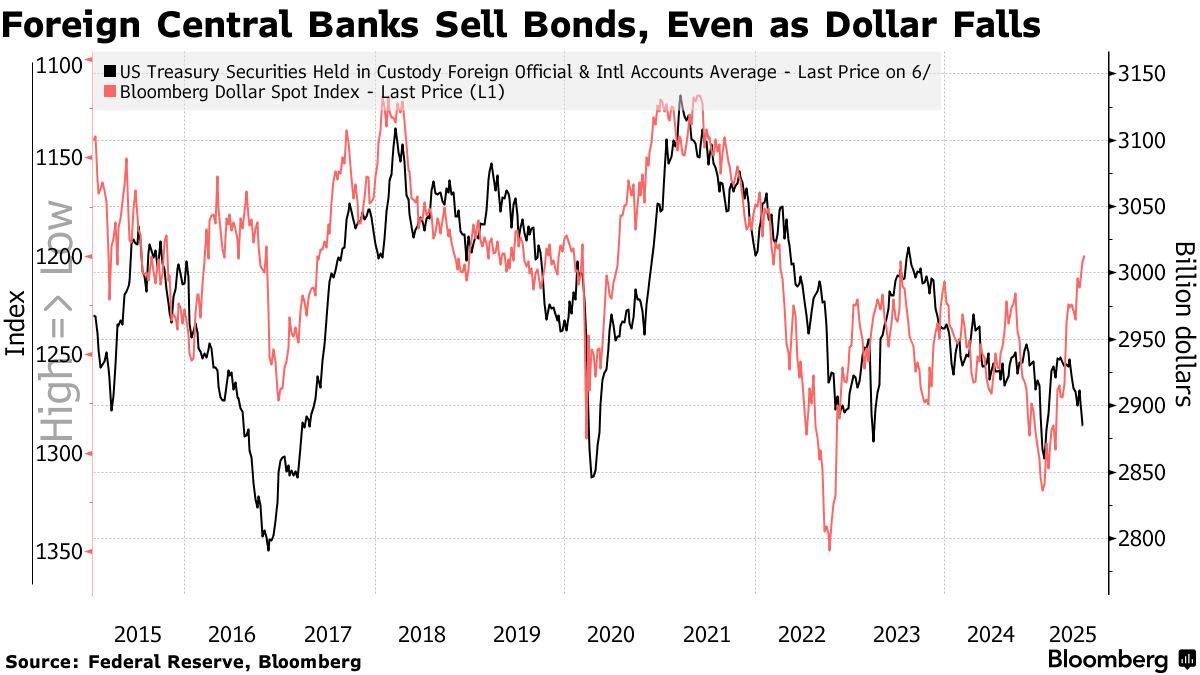
Group 1 - Central banks have been selling U.S. Treasury bonds since March, indicating a reduction in investment in dollar assets, with an average decrease of $17 billion in U.S. Treasuries held by global central banks as of June 11, totaling a cumulative decline of $48 billion since late March [1] - The decline in foreign demand for U.S. Treasuries is unusual, especially as the dollar has weakened, which typically prompts central banks to buy more Treasuries [1] - Concerns have arisen regarding international investors' interest in U.S. Treasuries, influenced by U.S. trade and fiscal policies, leading to speculation about potential avoidance of U.S. assets by overseas buyers [1] Group 2 - Foreign investors have been significant buyers of U.S. Treasuries, with nearly all demand in the first quarter of this year coming from dealers and foreign investors, highlighting a concerning trend [4] - The weakening participation of foreign investors in recent 2-year and 20-year Treasury auctions raises alarms about future foreign demand, especially as global investors seek to reduce exposure to U.S. assets [4] - The current situation reflects a potential shift in asset allocation strategies among official sectors, moving away from dollar holdings [1][4]
BAC, USB & Fifth Third Open to Stablecoins Amid Regulatory Shift
ZACKS· 2025-06-16 16:11
Group 1: Industry Sentiment on Stablecoins - Senior executives from Bank of America, Fifth Third Bancorp, and U.S. Bancorp expressed openness to adopting stablecoins due to anticipated favorable regulations [1] - The current U.S. administration is viewed as the most crypto-friendly in 16 years, contributing to optimism about stablecoin adoption [6] - Executives are engaging in discussions about potential joint stablecoin initiatives, indicating a shift in sentiment towards crypto [7] Group 2: Regulatory Developments - U.S. regulators are advancing efforts to regulate payment stablecoins, with two major bipartisan bills introduced: the GENIUS Act and the STABLE Act [2] - The GENIUS Act defines payment stablecoins, mandates one-to-one reserves, and prohibits algorithmic stablecoins, with federal oversight for issuers over $10 billion in assets [3] - The STABLE Act proposes a centralized regulatory structure, similar reserve requirements, and a two-year moratorium on algorithmic stablecoins [4] Group 3: Benefits and Opportunities - Executives highlighted transaction speed, deposit retention, and payment efficiency as key benefits of stablecoins [8] - Stablecoins are seen as a means to facilitate instantaneous international payments and collateral movement, creating efficiencies in commerce [8] - Large global banks are expected to benefit from stablecoin adoption due to their solid liquidity positions, while smaller regional banks may face challenges [10]



No Interest Rate Cuts for Now: Time to Reassess Your BAC Investment?
ZACKS· 2025-06-16 14:21
Core Insights - Bank of America (BAC) is highly sensitive to interest rate changes, benefiting from a 100 basis point rate cut by the Federal Reserve last year, which positively impacted its net interest income (NII) [1] - The company anticipates a sequential rise in NII for all quarters in 2025, with expectations of reaching $15.5-$15.7 billion in Q4 2025, driven by strong loan demand and higher interest rates [3][8] - The bank's aggressive branch expansion strategy aims to enhance customer relationships and tap into new markets, with plans to open over 150 financial centers by 2027 [7][9] Net Interest Income (NII) Outlook - NII is expected to rise 6-7% in 2025, supported by solid loan demand, robust deposit balances, and a stable economic environment [2][3] - The company projects NII growth to accelerate in the second half of 2025, with a target of $15.7 billion in Q4 [3][8] Investment Banking (IB) Performance - The investment banking sector has faced challenges, with IB fees declining over 20% in Q2 2025 due to tariff-related uncertainties affecting deal-making [14][17] - Despite a significant drop in IB fees in previous years, there was a 31.4% year-over-year increase in 2024, indicating potential recovery [14][15] Asset Quality Concerns - Bank of America has experienced a deterioration in asset quality, with provisions increasing significantly over the past few years due to a challenging macroeconomic outlook [19][20] - The company remains cautious about the impact of high interest rates on borrowers' credit profiles, which may further affect asset quality [20] Shareholder Returns and Valuation - The company has increased its quarterly dividend by 8% to 26 cents per share and has a payout ratio of 31% of earnings, reflecting a commitment to returning value to shareholders [12] - Bank of America stock is currently trading at a price-to-tangible book (P/TB) ratio of 1.66X, which is below the industry average of 2.83X, indicating it may be undervalued [24][26] Analyst Sentiment - Analysts have a positive outlook for Bank of America, with earnings estimates for 2025 and 2026 indicating growth of 12.2% and 15.6%, respectively [21][22] - The stock has outperformed the S&P 500 Index over the past three months, gaining 6.4% [27][30]

美银警告:外国对美国国债的需求正在下降
news flash· 2025-06-16 13:55
金十数据6月16日讯,美国银行警告说,外国对美国国债的兴趣可能正在减弱。上周,代表国外需求的 托管资产急剧下降,美元资产持有量自4月份以来减少了600多亿美元。尽管近期美国国债标售缓解了眼 下的担忧,但美国银行表示,随着越来越多的全球投资者减少对美国资产的敞口,长期趋势令人不安。 美银警告:外国对美国国债的需求正在下降 ...
稳定币风暴来袭!华尔街大行稳坐钓鱼台,小银行恐陷生存危机?
智通财经网· 2025-06-15 23:37
Group 1 - The increasing regulatory scrutiny on stablecoins is raising questions about how they will reshape traditional banking [1] - The proposed GENIUS Act aims to establish a regulatory framework for stablecoin issuers, which could impact bank deposits [1] - Stablecoins may shift funds from smaller, insured retail accounts to larger, uninsured institutional deposit accounts, increasing volatility and management costs for banks [1] Group 2 - The European Central Bank warns that banks absorbing deposits from stablecoin issuers are converting stable retail funds into more volatile institutional funds [2] - The panic surrounding Silicon Valley Bank in March 2023 highlighted the risks associated with stablecoin deposits, as Circle Internet Financial had significant deposits there [2] - Major financial institutions are expected to benefit from the expansion of stablecoins, as they are required to maintain high levels of liquid assets [2] Group 3 - Large banks appear prepared for the changes brought by stablecoins, but small and regional banks may face greater challenges if stablecoins become widely adopted [3]


全线大跌!利空来袭,猛烈抛售700亿!
券商中国· 2025-06-14 02:27
Core Viewpoint - The article highlights the escalating geopolitical uncertainties, particularly in the Middle East, which have triggered significant volatility in global financial markets, leading to a risk-averse behavior among investors [1][2][3]. Market Reactions - European stock markets experienced a widespread decline, with major indices in France, Germany, Spain, and Italy all dropping over 1% [6]. - The US stock market also faced substantial losses, with the Dow Jones falling by 1.79%, the Nasdaq by 1.3%, and the S&P 500 by 1.13% [7]. - A notable surge in the VIX index, which rose by 15.65% to 20.84, indicates increased market fear, with a weekly increase of 24.27% [7]. Fund Flows - Recent data from Bank of America shows that US stock funds experienced the largest outflow in nearly three months, with redemptions reaching approximately $9.8 billion (over 70 billion RMB), marking an 11-week high [5]. - European funds, which had previously outperformed US stocks, also saw a net outflow of $600 million, the first in nine weeks [5]. Investor Sentiment - Analysts suggest that current market behavior aligns with a "risk-averse" mode, indicating that this may be just the beginning of a broader market trend [3][9]. - Investors are closely monitoring developments in the Middle East, the US economic outlook, and the Federal Reserve's monetary policy trajectory [8]. Economic Outlook - Former US Treasury Secretary Janet Yellen predicts that Trump's tariff policies will lead to an increase in inflation, estimating this year's inflation rate to be at least 3% [4][18]. - Yellen also warns that these tariffs could reduce average household income by approximately $1,000, depending on the progress of the tariff plans [19]. Federal Reserve Policy - Yellen anticipates that the Federal Reserve will maintain its current stance and not make significant changes to monetary policy in the near term, as they are likely to wait for clearer inflation trends [20][21]. - Analysts from Allianz have adjusted their expectations for a potential rate cut by the Federal Reserve from October to December, citing that inflation is expected to peak in the fourth quarter [20].