BIDU(BIDU)

Search documents
Baidu's AI Assistant Reaches Milestone of 200 Million Monthly Active Users
WSJ· 2026-01-20 06:34
Group 1 - The company has integrated its artificial intelligence-powered Ernie Assistant into its flagship Baidu search-engine app and on personal computers [1]



萝卜快跑海外启动面向公众全无人驾驶出行服务 首站阿布扎比
Nan Fang Du Shi Bao· 2026-01-20 05:23
Core Insights - The launch of fully autonomous ride-hailing services by the company in Abu Dhabi marks a significant step in the commercialization and internationalization of Chinese autonomous driving technology [2] - The partnership with AutoGo aims to deploy the sixth generation of autonomous vehicles in designated areas, with plans to establish the largest fleet of fully autonomous vehicles in Abu Dhabi by 2026 [2] Group 1 - The service is now available to local residents and tourists through the AutoGo App, starting from Yas Island and planning to expand to more areas in Abu Dhabi [1] - The company has completed full autonomous testing on public roads in Abu Dhabi, validating its deployment capabilities [2] - The company received the first commercial operation license for fully autonomous services in Abu Dhabi in November [2] Group 2 - The company is also expanding its operations in the Middle East, having received the first fully autonomous testing permit from the Dubai Roads and Transport Authority [3] - Plans for Dubai include expanding the fleet of fully autonomous vehicles to over 1,000 [3] - The company has covered 22 cities globally, with a cumulative order volume exceeding 17 million [3]

AI 时代的 Super App 之战打响丨周亚辉投资笔记 AI 时代系列之二
晚点LatePost· 2026-01-20 03:26
Core Viewpoint - The article posits that ByteDance's Zhang Yiming is likely to become the richest person in China over the next decade due to his strong motivation, learning ability, execution power, and the resources of ByteDance, which are expected to drive significant growth in various sectors, including mobile, automotive, and space computing [4][5]. Industry Insights - In the mobile internet era, there were 10 apps in China with over 500 million MAU, but in the AI era, it is anticipated that only 3-4 Super Apps will achieve this milestone [4][5]. - The DAU/MAU ratio is expected to increase, with 500 million MAU likely corresponding to approximately 350 million DAU, enhancing the value of Super Apps compared to the mobile internet era [5]. - The article emphasizes that the value of Super Apps is greater than that of leading robotics companies, as Super Apps control entry points and can generate excess commercial returns [6]. Competitive Landscape - The competition for AI Native Super Apps is intensifying, with Alibaba's Qwen and ByteDance's Doubao positioned as key players. The article highlights the strategic moves of Alibaba to prevent Meituan from launching a competing Super App [8][9]. - Other companies like Tencent, Meituan, Pinduoduo, JD, and Baidu are also seen as potential contenders in the Super App battle, while smaller players may struggle to compete [9][10]. - The article suggests that Meituan's exit from community group buying is part of a broader AI strategy to position itself for the Super App market [10][11]. Future Projections - The article predicts that the AI Native Super App market could reach a revenue potential of 1 trillion RMB, urging companies to act quickly to launch their AI applications [11]. - Huawei is positioned to dominate the automotive sector but is unlikely to enter the Super App market due to its strategic focus on other areas [12]. - Tencent is recognized for its stability and product matrix, with the potential to maintain a significant role in the AI Native Super App landscape, although ByteDance's Doubao is gaining influence among younger users [12].






亚洲互联网2026 前瞻_核心稳健,边缘动态;人工智能实际应用之年-Year Ahead 2026_ Stable Core, Dynamic Edge; Year of Real AI Adoption
2026-01-20 01:50
Summary of Key Points from the Conference Call Industry Overview - **Industry**: Internet sector in Asia Pacific - **Outlook for 2026**: Stable fundamentals with reasonable valuations, driven by steady competition, improving regulatory clarity, and a focus on balancing revenue growth with profitability [1][2] Core Themes and Insights - **AI Adoption**: Transition from hype to real-world adoption of Generative AI (Gen AI) is a key theme, with companies leveraging AI expected to outperform [2][38] - **Competition**: Stable competition across most sectors, with notable exceptions in quick commerce in China and India, and pressure from ByteDance across various sub-sectors [4][9] - **Regulatory Environment**: Key regulations to monitor include the enforcement of the Mobile Software Competition Act in Japan and gig-economy regulations in India [4][10] Preferred Companies and Investment Picks - **Tencent**: Leading in AI-driven growth with stable competition and attractive valuation [3][13] - **Baidu**: Unlocking value through fast-growing cloud services and AI applications [3][13] - **Eternal**: Positioned well in the quick commerce sector in India, with potential for market share increase [3][13] - **Recruit**: Expected rise in average revenue per user (ARPU) due to AI-driven recommendations [3][13] - **Naver**: Anticipated growth in search and commerce business through AI implementation [3][13] Market Dynamics - **China**: Focus on AI deployment, with Tencent, Alibaba, and ByteDance leading the charge. E-commerce remains competitive, but online gaming is preferred for investment [32][38] - **India**: Strong fundamentals but high valuations. Quick commerce expected to rationalize in 2026, with potential consolidation [56][60] - **Australia**: Classifieds sector under pressure from Gen AI narratives, but seen as undervalued with significant moats [21][23] Financial Metrics and Projections - **Valuations**: Most companies in the sector are trading at reasonable multiples, with Tencent and Baidu highlighted for their growth potential [3][13] - **Earnings Growth**: Expected double-digit EPS growth for classifieds in Australia, with SEK projected to deliver the fastest growth [26][29] Risks and Challenges - **Competition from ByteDance**: Increasing pressure on incumbents across various sectors, particularly in e-commerce and online services [39] - **Regulatory Risks**: Potential for stricter regulations impacting profitability and operational flexibility [10][40] - **Market Sentiment**: Concerns over AI's impact on traditional business models, particularly in classifieds and online travel [21][60] Conclusion - The Asia Pacific internet sector is poised for stable growth in 2026, driven by AI adoption and a rationalization of competition in key markets. Investors are encouraged to focus on companies with strong fundamentals and growth potential, while remaining cautious of regulatory changes and competitive pressures.
大摩深度解析:中国互联网公司海外收入占比超10%,AI与出海成投资新焦点
傅里叶的猫· 2026-01-19 15:39
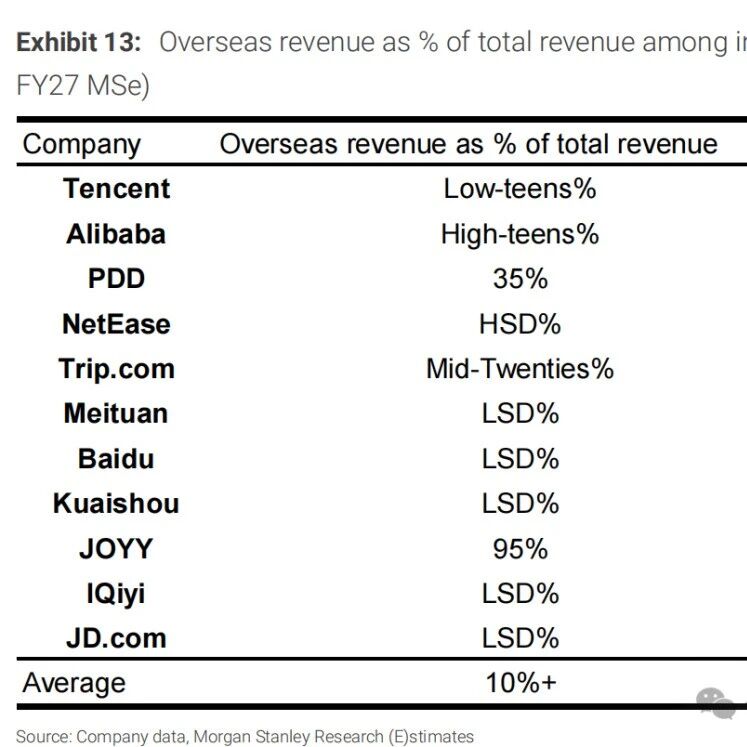
Core Insights - The article emphasizes the significance of AI in investment decisions, particularly in the context of Chinese internet companies and their overseas revenue potential [2][3]. Group 1: Overseas Revenue of Chinese Internet Companies - Chinese internet companies have an average overseas revenue exceeding 10%, with Pinduoduo leading at 35% [3]. - Companies like Tencent and Alibaba have low to high teens percentages of overseas revenue, indicating a growing trend towards international markets [3]. Group 2: Cloud Computing Sector - Alibaba Cloud and Tencent Cloud are rapidly expanding their international presence, with Alibaba planning new business regions in Brazil, France, and the Netherlands, and Tencent deploying services in 22 regions globally [4]. - Morgan Stanley projects that Alibaba Cloud's revenue growth will exceed 40% by FY2027, while Tencent's enterprise service revenue is expected to grow by 25% by FY2026 [5]. Group 3: Autonomous Driving Services - Baidu's autonomous driving service, "Luobo Kuaipao," is a leader in the sector, achieving over 250,000 weekly orders in fully autonomous mode as of Q3 2025, and has expanded to 22 cities including Dubai and Switzerland [7]. - Despite its leadership, Morgan Stanley anticipates that Baidu's revenue from this service will remain low and require continued investment [9]. Group 4: AI Models and Applications - Alibaba's Tongyi Qianwen model has gained significant traction globally, becoming the most downloaded AI model with over 700 million downloads by January 2026 [11]. - Kuaishou's Keling is expected to generate substantial revenue from overseas markets, with projections indicating an 80% year-on-year growth to reach $270 million by 2026, driven by B2B customer expansion [14].

高盛眼中的2026年中国互联网:AI超级入口争夺战全面打响,三大主题锁定阿尔法机会
Hua Er Jie Jian Wen· 2026-01-19 13:25
Core Viewpoint - Goldman Sachs predicts that 2026 will be a strategic turning point for Chinese internet giants, with increased investment in consumer-facing AI and competition around "AI super entry" while focusing on defending their core market positions [1] Group 1: Industry Transition - The industry transition in 2026 is fundamentally driven by ByteDance's comprehensive breakthroughs, which are reshaping competitive dynamics [2] - ByteDance is projected to achieve a profit of $50 billion in 2025, significantly surpassing Tencent's $36 billion and Alibaba's $15 billion [2] - In the AI sector, ByteDance's Doubao app has over 100 million daily active users and is the leading consumer-level AI application in China [2] Group 2: Strategic Responses from Giants - In response to ByteDance's advancements, Alibaba and Tencent are compelled to pivot their strategies, increasing AI investments to over $60 billion collectively by 2026 [3] - Alibaba aims to maintain its leading position in e-commerce GMV, while Tencent accelerates AI features in WeChat and explores social AI applications through QQ [3] - The competitive landscape is expected to rationalize, improving unit economics in sectors like food delivery [3] Group 3: Key AI Themes Restructuring the Industry - Six key AI themes identified by Goldman Sachs will reshape the industry ecosystem in 2026, including advertising transformation, model competition, and the emergence of consumer AI entry points [4] - The advertising budget is shifting towards ROI-driven ads, with new strategies like AEO and GEO gaining traction [4] - The competition in AI models is intensifying, focusing on long context, multi-modal, and low-cost architectures [4] Group 4: Investment Framework - The investment landscape is shifting from a "broad market rally" to an "alpha era" focused on selective stock picking, emphasizing EPS delivery/growth, AI, and globalization narratives [6] - Companies benefiting from improving order trends and rationalized competition, such as Alibaba and JD.com, are highlighted for their potential in profit growth [7] - The focus is also on AI technology breakthroughs and global business expansion, with companies like Kuaishou and Baidu identified as key players [8] Group 5: Shareholder Returns - Companies with stable cash flows and strong shareholder return capabilities are prioritized, particularly those with sufficient net cash and potential for dividend increases [9]
多家机构看好港股成长板块回撤买入机会!恒生互联网ETF(513330)连续4日净流入
Mei Ri Jing Ji Xin Wen· 2026-01-19 03:04
Group 1 - The core viewpoint of the articles suggests that institutions are recommending attention to the Hong Kong stock growth sector, which has seen relatively less increase in the current rally, indicating potential buying opportunities during suitable pullbacks [1] - Financial conditions are generally loose, with foreign capital and southbound flows returning, and earnings expectations being revised upward, making Hong Kong stocks more attractive in terms of value compared to A-shares [1][2] - The sentiment indicators for Hong Kong stocks have moved out of panic territory, with a noticeable decline in short positions, indicating a potential right-side harvesting period [1] Group 2 - As of last week, foreign net inflows into Hong Kong stocks reached $2.82 billion, compared to $1.54 billion the previous week, with active foreign funds turning into net inflows of $160 million, marking the largest weekly net inflow since September 2024 [2] - Southbound capital saw a net inflow of approximately HKD 10.05 billion last week, primarily flowing into sectors such as media, computing, and retail, with Tencent Holdings, Alibaba, Kuaishou, and Xiaomi Group receiving the most inflows [2] - The Hang Seng Internet ETF has seen net inflows for four consecutive days, being the largest ETF tracking the Hang Seng Internet Technology Index, which focuses on sectors like internet, media, and computing [2]


大摩闭门会-互联网调研纪要与中国AI发展更新
2026-01-19 02:29
Summary of Key Points from Conference Call Records Industry and Company Overview - **Companies Involved**: Alibaba, Baidu, Yunmanman, Tencent, Huya, Bilibili, Tencent Music, GDS, OTA Industry - **Industry Focus**: E-commerce, Cloud Computing, AI Technology, Data Centers, Live Streaming, Online Travel Agencies (OTA) Core Insights and Arguments Alibaba - **E-commerce Performance**: Alibaba's CMR (Customer Management Revenue) is expected to show low single-digit growth in the December quarter, down from previous expectations of mid-single-digit growth. NBS (Net Merchandise Sales) decreased by 5% in October and November, reflecting competitive pressures and high base effects. CMR is projected to decline in the March quarter but may stabilize in Q2 and recover in the second half of the year [1][2] - **Financial Outlook**: The company anticipates a full-year loss of approximately 60 billion RMB for FY2027, with cloud revenue expected to exceed 380 billion RMB, maintaining growth expectations despite supply chain considerations [1][3] - **Flash Sales Business**: Positive performance noted, but March quarter losses are not expected to decrease significantly [1] Baidu - **Kunlun Chip Development**: Baidu plans to complete the IPO of its Kunlun chip within four to five months, with an internal valuation of 40-50 billion USD, exceeding market expectations. The company will retain over 50% ownership post-IPO [4] - **Client Base**: Major clients include Tencent and China Mobile, with no supply chain disruptions reported [4] Yunmanman - **Order Growth**: The fourth-quarter order growth is at the lower end of guidance due to seasonal factors and the cleaning of low-quality orders, but this will not impact revenue or profit. The company plans to invest in autonomous driving and overseas expansion in 2026, which may negatively affect profits [5] - **Revenue Confidence**: The company is confident in achieving a 30% or higher growth in commission-based revenue [5] Tencent - **Stock Sale Impact**: Tencent's sale of Hong Kong stocks aimed to meet liquidity requirements, leading to a market overreaction and stock price decline. Current valuation is considered undervalued at a 2026 P/E ratio of 16 [6] Data Center Industry - **Growth Expectations**: GDS anticipates an increase in annual new bookings from 250-300 MW to 500 MW, reflecting ambitious growth plans. However, new large data centers face strict regulatory approvals, with only a 10% success rate for project applications [7] OTA Industry - **Regulatory Challenges**: The OTA industry faces short-term uncertainties due to regulatory scrutiny, reminiscent of Alibaba's past experiences with antitrust issues, leading to cautious investor sentiment [8] Bilibili and Tencent Music - **Bilibili's Advertising Growth**: Strong performance in advertising with over 20% growth attributed to increased traffic, despite challenges in the gaming sector [9] - **Tencent Music's Market Sentiment**: No significant changes in operations, but market disappointment over K-POP performance restrictions in China has negatively impacted stock prices [9] Huya - **Live Streaming Business**: Huya's revenue is primarily global, with compliance risks at historical lows. The company expects stable or slight revenue growth through refined operations [10][11] - **Investor Returns**: Huya commits to a 200 million USD dividend and a 100 million USD stock buyback over the next three years [12] Concert Ticketing and IP Business - **Ticketing Market Saturation**: The concert ticketing business is currently saturated, limiting revenue growth despite strong demand. The company plans to focus on content investment for overseas expansion [13][14] - **Impact of Sino-Japanese Relations**: No significant impact on sales observed post-relations events, though some projects have been delayed [15] Additional Important Insights - **AI Technology Platform**: Huya's AI platform is among the top 30 global aggregators, expected to achieve over 5% annual growth in third-party advertising revenue for 2026 and 2027 [11] - **Market Reactions**: Overall market reactions to stock sales and regulatory news have led to volatility, but some companies are viewed as having strong fundamentals and potential for recovery [6][9] This summary encapsulates the key points from the conference call records, highlighting the performance and outlook of various companies and industries involved.

网络骂战二十年,从没好好说过理
凤凰网财经· 2026-01-18 13:15
Core Viewpoint - The article discusses the evolution of online disputes in China, highlighting how they have escalated from anonymous forum arguments to public confrontations and legal battles, reflecting the growing intensity and complexity of internet culture and conflicts in the digital age [1][2][3][4][5]. Group 1: Historical Context of Online Disputes - The evolution of internet argumentation has progressed from early anonymous exchanges to real-name confrontations and live debates, indicating a shift in how disputes are handled online [3][4]. - Legal frameworks are increasingly relied upon to resolve disputes when consensus cannot be reached, marking a transition from informal to formal resolution mechanisms [5]. Group 2: Notable Disputes - The "Fang-Han War" in 2012, sparked by a blog post questioning the authenticity of writer Han Han, became a significant cultural event, showcasing the power of social media in shaping public opinion [6][7][8]. - The conflict escalated with Han Han offering a reward for evidence of ghostwriting, leading to a split in public opinion and further involvement from prominent figures like Fang Zhouzi, who intensified the scrutiny on Han Han's works [10][16][20]. - The "3Q War" between Tencent and Qihoo 360 highlighted the commercial aspects of online disputes, with both companies engaging in public and legal battles over user privacy and market dominance [21][22][31][32]. Group 3: Personal Confrontations in the Tech Industry - The 2014 live debate between Wang Ziru and Luo Yonghao over the evaluation of the Smartisan phone exemplified how personal and professional conflicts can draw massive public attention, with 2.5 million viewers tuning in [40][47]. - The debate showcased contrasting styles, with Luo presenting a prepared defense while Wang focused on clarifying his evaluation, leading to a heated public discourse [51][52][54]. Group 4: Escalation to Physical Confrontations - The incident between Wu Faitian and journalist Zhou Yan illustrates how online disputes can spill over into physical confrontations, culminating in a chaotic public altercation involving eggs and accusations of organized violence [56][68][75]. - This event reflects a concerning trend where online disagreements transition into real-world conflicts, raising questions about the societal implications of such behavior [78][81]. Group 5: Future of Online Disputes - As the internet matures, there is a movement towards more regulated and structured forms of discourse, with calls for disputes to be handled through media channels rather than public confrontations [81]. - The evolution of online conflict resolution indicates a shift towards a healthier internet ecosystem, where emotional outbursts are replaced by institutional frameworks for discussion and debate [81].


【数智周报】 谷歌DeepMind CEO:中国的AI模型仅落后美国几个月;DeepSeek开源相关记忆模块Engram;微软在人工智能上的支出将达到5...
Tai Mei Ti A P P· 2026-01-18 02:38
Group 1 - Keda Xunfei's Chairman Liu Qingfeng stated that the domestic AI infrastructure has taken initial shape, with domestic large models matching international standards despite having half the parameters [2] - Michael Burry warned that the era of tech giants earning huge profits with minimal investment is ending, primarily due to AI, and investors should focus on Return on Invested Capital (ROIC) rather than revenue growth [3] - A BlackRock survey revealed that while investors are optimistic about AI, they are shifting their investment focus towards energy and infrastructure suppliers, with only one-fifth considering large US tech companies as attractive investment opportunities [4] Group 2 - Demis Hassabis, CEO of Google DeepMind, indicated that Chinese AI models are only a few months behind those in the US and Western countries, with significant advancements made by Chinese developers [5] - DeepSeek released a new paper on conditional memory, significantly improving model performance in various tasks, and has open-sourced a related memory module [6] - Wang Xiaochuan, CEO of Baichuan Intelligent, mentioned that the company has 3 billion yuan on hand and may initiate an IPO plan in 2027 [7] Group 3 - Zhiyu and Huawei launched the first domestically trained multimodal SOTA model on local chips, achieving a full training process on the Ascend Atlas 800T A2 device [8] - Kuaishou announced that Keling AI's revenue exceeded $20 million in December 2025, with an annual recurring revenue (ARR) of $240 million [9] - Yongyou Network projected a net loss of 1.3 to 1.39 billion yuan for 2025, although it expects to reduce losses compared to the previous year [10] Group 4 - JD.com and Lenovo deepened their "hybrid AI" cooperation, launching new products at CES 2026, with a focus on strategic collaboration around smart devices and services [11] - Alibaba's Qianwen app integrated with various services, allowing users to order food and book flights through AI, marking a significant upgrade in functionality [12] - Alipay and partners released China's first AI commercial agreement, aimed at creating a universal language for AI tasks across platforms [13] Group 5 - Yunhai Medical launched the "YunJian AI Spirit," a product that reduces long-term costs for users by offering unlimited access to traditional Chinese medicine infrared algorithms [14] - Zhiyuan purchased thousands of hours of robot training data for various tasks [15] - Meituan released the open-source "ReThink" model, achieving state-of-the-art performance in several benchmarks [16] Group 6 - Teslian introduced the upgraded T-Cluster 512 super node architecture, designed for high-performance AI model training, with a total computing power exceeding 500 PFlops [17] - Keda Xunfei launched a marketing AI platform based on the "SuperAgent" framework, enhancing efficiency in marketing strategies [18] - The first domestically trained text-to-image model was released by Zhiyu and Huawei, completing the entire training process on local chips [19] Group 7 - Tencent Cloud ADP launched the first "AI-native Widget," enhancing task delivery experiences through natural language interaction [20] - Anthropic implemented stricter measures to prevent third-party tools from bypassing rate limits, affecting several developer projects [21] - Google announced a partnership with Walmart to expand AI model shopping capabilities, allowing direct transactions through its AI application [22] Group 8 - Mark Zuckerberg initiated the "Meta Compute" project, aiming to build substantial AI infrastructure by 2030, with a focus on collaboration with governments [23] - Meta plans to lay off hundreds of employees in its Reality Labs department, shifting focus from the metaverse to AI [24] - Alphabet's market value surpassed $4 trillion for the first time, joining a select group of companies [24] Group 9 - Nvidia and Eli Lilly will jointly invest $1 billion to establish an AI drug laboratory over the next five years [26] - The US relaxed export controls on Nvidia's H200 chips to China, potentially impacting the AI hardware market [27] - Microsoft announced a plan to limit the impact of data center energy costs and water usage on local communities [29] Group 10 - OpenAI is reportedly seeking US hardware suppliers for its planned consumer devices and cloud data center expansion [32] - Elon Musk's lawsuit against OpenAI is set to go to trial in late April [33] - OpenAI and Cerebras announced a partnership worth over $10 billion to deploy a large-scale AI inference platform [34] Group 11 - Zivariable Robotics completed a 1 billion yuan A++ round of financing, backed by major investors including ByteDance and Meituan [35] - Qiangnao Technology submitted a confidential IPO application in Hong Kong [36] - OpenAI agreed to acquire the AI health application Torch for approximately $100 million [37] Group 12 - K2 Lab, founded by a former DingTalk executive, secured tens of millions in seed funding to develop an AI-driven content e-commerce agent [38] - Alibaba Cloud completed a strategic investment in ZStack, achieving a controlling stake [39] - Skild AI raised nearly $1.4 billion in funding, reaching a valuation of over $14 billion [40] Group 13 - WeLab completed a $220 million D-round strategic financing, the largest single round since its inception [41] - Merge Labs, a brain-machine interface startup, raised $252 million in seed funding, with OpenAI as a major investor [42] Group 14 - A report indicated that by 2026, the Chinese tech giants index is expected to surpass the US tech giants in profitability growth for the first time since 2022 [43] - China is accelerating the establishment of a data property registration system to enhance data circulation and value [44] - Storage prices are expected to surge by 40%-50% in Q4 2025 and again in Q1 2026 due to increased demand from AI and server capacity [45] Group 15 - A new AI model developed by US researchers can predict the risk of approximately 130 diseases based on sleep data [46] - Foreign investment firms are increasingly incorporating AI into their research processes in the Chinese market [47] - UBS believes the probability of an AI bubble in China is low, with monetization relying on cloud services and advertising [48] Group 16 - The number of AI companies in China has exceeded 6,200, with applications expanding across various industries [49]