
BIDU(BIDU)

Search documents
1月16日热门中概股涨跌不一 台积电涨4.48%,腾讯音乐跌4.98%
Xin Lang Cai Jing· 2026-01-15 21:30
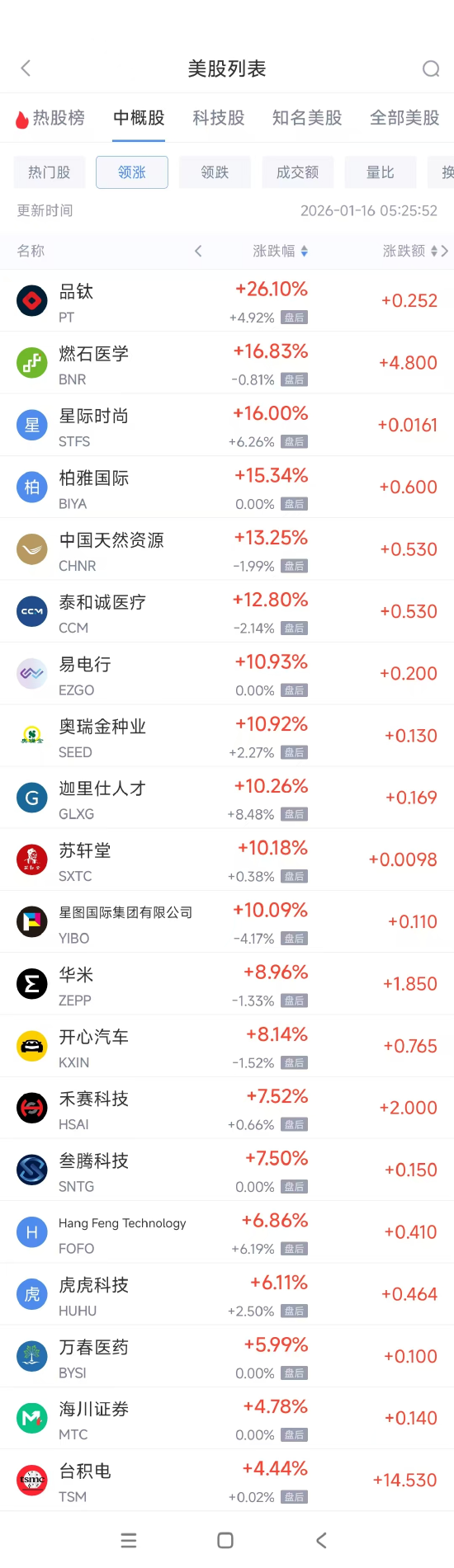
Group 1 - The Nasdaq China Golden Dragon Index (HXC) closed down by 0.60% on January 16, with mixed performance among Chinese concept stocks [1][8]. - Among the stocks that increased, TSMC rose by 4.48%, Alibaba by 0.62%, and NIO by 1.64% [1][8]. - Stocks that declined included Pinduoduo down by 0.40%, NetEase down by 2.09%, and Tencent Music down by 4.98% [1][8]. Group 2 - The US stock market saw gains on Thursday, led by the chip and banking sectors, helping major indices rebound after two days of decline [2][9]. - The Dow Jones Industrial Average increased by 292.81 points, or 0.60%, closing at 49,442.44 points; the Nasdaq rose by 58.27 points, or 0.25%, to 23,530.02 points; and the S&P 500 gained 17.87 points, or 0.26%, to 6,944.47 points [2][9]. Group 3 - A list of top-performing Chinese concept stocks includes Pintai with a rise of 26.10%, and Fuel Medical with an increase of 16.83% [3][11]. - The list of declining Chinese concept stocks features Fanhua Financial down by 14.04%, and Zhongchi Chefu down by 12.98% [6][14].


Benchmark Raises Baidu (BIDU) Price Target to $215, Citing Kunlun Spinoff and Robotaxi Value
Yahoo Finance· 2026-01-15 20:36
Baidu, Inc. (NASDAQ:BIDU) is one of the Must-Watch AI Stocks on Wall Street. On January 12, Benchmark analyst Fawne Jiang raised the price target on the stock to $215.00 (from $158.00) while maintaining a “Buy” rating. Firm analysts view the Kunlun spinoff and Robotaxi valuation reset as key catalysts for SoTP re-rating. Baidu recently announced a proposed spinoff and separate listing of Kunlunxin (Beijing) Technology Co., Ltd., a non-wholly owned subsidiary of the Company, on the Main Board of the Hong ...

汇丰上调智能眼镜市场预期 2040年规模将达2000亿美元 用户量增幅超18倍
Sou Hu Cai Jing· 2026-01-15 16:43
Core Insights - HSBC has significantly raised its growth forecast for the global smart glasses market, predicting it will reach $200 billion by 2040, making it one of the fastest-growing segments in smart devices [3] - The user base is expected to explode from 15 million in 2025 to 289 million, representing an increase of over 1800% [3] Market Growth and Trends - 2025 is identified as a pivotal year for the smart glasses market, marking a transition to large-scale growth, with global shipments expected to reach 4.065 million units in the first half of 2025, a year-on-year increase of 64.2% [4] - The domestic market shows even higher enthusiasm, with Tmall's smart glasses category sales surging by 2500% during the 2025 "Double Eleven" shopping festival, and JD.com achieving a tenfold increase in sales volume [4] Supply and Demand Dynamics - The growth is driven by coordinated efforts on both supply and demand sides, with major tech companies like Apple, Huawei, Google, and Meta investing heavily in R&D to accelerate product iterations [4] - The integration of AI features has significantly enhanced product usability, with 75.5% of consumers expressing a willingness to purchase, activating a broad first-time buyer market [4] Technological Innovations - Key technological breakthroughs in 2025 include advancements in display technology, such as improved Micro-LED brightness and full-color MicroOLED for enhanced visual experiences [5] - Weight reduction innovations, such as resin diffraction waveguide technology, have enabled some new products to weigh under 40 grams, comparable to regular sunglasses, greatly improving wearability [5] Application Scenarios - The application of smart glasses is expanding from consumer to industrial sectors, with functionalities like navigation projection, immersive entertainment, and educational visualization becoming essential tools [5] - In industrial applications, scenarios such as remote surgical guidance, industrial equipment maintenance support, and AR tourism guidance are demonstrating significant practical value [6] Competitive Landscape - The smart glasses market is entering a "hundred glasses battle" phase, with participants including tech giants, specialized hardware manufacturers, and internet companies [6] - Meta's collaboration with Ray-Ban on the Ray-Ban Meta has become a bestseller, with projected sales of 2.24 million units in 2024, validating the market viability of non-display AI glasses [6] Cost and Ecosystem Development - Increased competition is driving collaborative upgrades across the supply chain, with core optical components like waveguide modules and Micro-LEDs seeing cost reductions of 40% [6] - Future hardware costs are expected to drop below 150 yuan, while ecosystem development is becoming a competitive focus, with manufacturers partnering with navigation, payment, and music platforms to create seamless smart experiences [6] Future Outlook - The growth potential of smart glasses is not only based on the proliferation of existing functionalities but also on revolutionary changes in human-computer interaction [7] - Innovations in interaction modes, such as "spatial bookmarks" and "information layering," are anticipated to reshape business models and social governance, with smart glasses poised to replace traditional eyewear and become the next core smart terminal by 2040 [7]



百度集团副总裁平晓黎:数字人要到4.0阶段,更多场景实现“超越真人”
Xin Lang Cai Jing· 2026-01-15 11:09
Core Viewpoint - The development of digital humans is at a pivotal point, transitioning from merely mimicking human characteristics to potentially surpassing them, driven by advancements in AI technology, including visual models and large language models [1][4]. Group 1: Evolution of Digital Humans - Digital humans have evolved through several stages: - Stage 1.0 featured basic virtual human effects with stiff expressions and mechanical voices [3][6]. - Stage 2.0 introduced hyper-realistic digital humans, achieving high-precision cloning of human images and enabling complex interactions [3][6]. - Stage 3.0, led by Baidu's advancements, includes digital humans that can think, make decisions, and coordinate multiple intelligent agents [3][6]. Group 2: Future Potential - The upcoming Stage 4.0 of digital humans is expected to feature continuous self-evolution, personalized emotional interactions, and enhanced productivity across various applications, positioning them to surpass real humans in certain contexts [3][6].


百度集团副总裁平晓黎:慧播星数字人是AI时代的生产力新引擎
Xin Lang Cai Jing· 2026-01-15 10:18
Core Insights - The event "2025 Technology Wind and Cloud List" was held in Beijing, where Baidu's Vice President, Ping Xiaoli, highlighted the validation of digital human applications and technology over the years, leading to a consensus in the industry regarding digital humans as a new productive force [1][2] Group 1: Digital Human Applications - Baidu's Huibo Star digital human has been widely applied across over 30 industries, including e-commerce, automotive, marketing, finance, law, and education, with more than 100,000 clients globally in countries such as Brazil, Thailand, and Vietnam [1][2] Group 2: Technology and Capabilities - The high persuasive digital human from Baidu is characterized by multi-modal integration and a multi-agent system capable of thinking, decision-making, and execution [3][5] - The Huibo Star digital human utilizes scripts to achieve a high match of language, voice, and actions, supported by master-level scriptwriting capabilities that ensure engaging content and expressive performance [3][5] - The AI core can dynamically think and make decisions based on real-time signals from the live broadcast environment, coordinating multiple intelligent agents to execute specific tasks [3][5] Group 3: Market Growth - Huibo Star has become a comprehensive digital human platform, covering various formats such as digital human live streaming, videos, and intelligent agents, addressing the core needs of commercial clients and professional content creation institutions, experiencing explosive growth in 2025 [5]

2025「Smart Future · AI应用标杆」评选结果公布
华尔街见闻· 2026-01-15 07:56
Core Viewpoint - The year 2025 is seen as a transformative period for China's AI industry, marking a shift from being followers to establishing an independent "Chinese path" in AI technology and business [1]. Group 1: Company Developments - The AI landscape in China is characterized by both tech giants and innovative unicorns advancing simultaneously [2]. - Alibaba is investing 380 billion in cloud and AI hardware infrastructure, establishing a significant presence in the AI ecosystem [2]. - Baidu has achieved a comprehensive layout with its Wenxin 5.0 model, leading AI search with over 382 million monthly active users [2]. - ByteDance has created a national-level application, Doubao, which has penetrated the lives of millions [2]. - Tencent is integrating AI deeply into its vast social and content ecosystem [2]. - Innovative unicorns like DeepSeek and MiniMax are carving out unique paths, with DeepSeek focusing on efficient models and MiniMax demonstrating the global market potential of Chinese models [2]. - Zhiyu AI has become the first global large model stock after successfully listing on the Hong Kong Stock Exchange [2]. Group 2: Product Innovations - AI products are evolving from simple chatbots to capable assistants that can perform tasks effectively [3]. - Doubao showcases the future of system-level agents in human-computer interaction [4]. - The Qianwen App aims to be a super entrance for future AI life services, demonstrating practical model capabilities [4]. - Baidu's integration of Baidu Wenku and Baidu Netdisk has created a one-stop solution for AI content creation and consumption, with nearly 300 million monthly active users [4]. - DingTalk is extending work intelligence into the physical world through hardware and software integration [4]. - Feishu's M4-level intelligent assistant is transforming office software into a decision-making "digital employee" [4]. - Ant Financial's AI health assistant, Antifufu, is enhancing health services, while Youdao's AI pen is redefining educational guidance [4]. Group 3: Future Outlook - The best AI solutions are those that genuinely address pain points and integrate into daily life [5]. - As AI becomes as ubiquitous as water and electricity across various industries, the awarded companies and products are expected to contribute significantly to reshaping the global economy and social structure [5].
百度萝卜快跑已低调落地全国约20城
Ge Long Hui A P P· 2026-01-15 07:04
格隆汇1月15日|据蓝鲸新闻,目前,百度旗下萝卜快跑全国运营区域已低调落地约20城,仅广东省内 就已落地包括广州、佛山、东莞、深圳、江门市。在广东省投资项目在线审批监管平台上查询发现,去 年11月下旬以来,萝卜快跑通过多个备案项目,包括位于江门市、东莞市的智能网联汽车道路测试与示 范应用项目,项目总投资分别为5000万元、7000万元。其中,在江门,其计划投放不少于90台智能网联 汽车,开展智能网联汽车测试示范工作;在东莞,其计划采购1000台自动驾驶车辆在此投放,建立萝卜 快跑自动驾驶基地,包括智能网联监控指挥中心、大湾区"云车"中心等。此外,萝卜快跑华南运营总部 项目也已通过备案,项目所在地位于佛山市顺德,总投资预计1800万元。据悉,该项目计划建成依托智 能算法与车路协同技术的无人驾驶网约车示范项目总部,并规划了研学、展厅、5G云仓、办公区、运 维车间等。 ...
李彦宏的AI野心,淹没在字节和阿里的战火里
3 6 Ke· 2026-01-15 04:08
Core Insights - The AI industry is experiencing significant growth, with notable milestones such as Doubao's daily active users (DAU) surpassing 100 million and Manus being acquired by Meta, indicating a new era following the mobile internet [1][4][10] - Baidu's early investment in AI, led by CEO Li Yanhong, has not translated into sustained competitive advantages as newer players like ByteDance and Alibaba have gained ground [10][22][36] Group 1: Company Developments - Doubao achieved a DAU of over 100 million, marking it as a leading "super application" in the AI space, while Baidu's Wenxin Yiyan has seen a decline in monthly active users (MAU) from nearly 15 million to around 5 million [10][15] - Baidu's AI revenue grew over 50% year-on-year to approximately 10 billion yuan, but this growth is overshadowed by a significant drop in its core online marketing revenue, which fell by 18% to 15.3 billion yuan [31] - Baidu's capital expenditures reached 3.4 billion yuan, primarily for AI infrastructure upgrades, indicating a heavy investment in AI despite the challenges faced [31][28] Group 2: Competitive Landscape - The competitive landscape is intensifying, with Alibaba's Qianwen app achieving over 40 million MAU shortly after its launch, and ByteDance's Doubao leading the market with a strong user base and low marketing costs [11][26] - Both Alibaba and ByteDance have adopted aggressive pricing strategies, with ByteDance initiating a price war that forced Baidu to lower its model prices significantly [22][10] - The shift towards open-source models has seen Alibaba's Tongyi Qianwen downloaded over 700 million times, positioning it as a key player in the AI infrastructure market [25][24] Group 3: Strategic Challenges - Baidu's all-in-one self-research strategy has been criticized as overly ambitious, leading to operational challenges and a loss of market share to competitors [10][22] - The company's focus on revenue and profit over market share during critical growth phases has been identified as a strategic misstep, allowing competitors to gain a foothold [24][10] - Li Yanhong's vision for AI has faced scrutiny as the company struggles to maintain its early advantages, with a growing realization that the AI landscape is rapidly evolving beyond its control [21][22]

金融界财经早餐:财政部重磅!推进财政金融协同促内需一揽子政策;沪深北交易所融资保证金比例上调;换房退税政策再延两年;8天翻倍AI大牛股停牌核查(1月15日)
Jin Rong Jie· 2026-01-15 01:09
Company and Industry Highlights - Easy Point World announced a stock trading suspension starting January 15, 2026, due to significant price fluctuations, with a stock price increase exceeding 100% over the past nine trading days [8] - Sunflower received a notice from the China Securities Regulatory Commission regarding an investigation into information disclosure violations, but stated that normal operations would not be significantly affected [8] - Five Minerals Development plans a major asset swap and cash purchase of assets from Five Minerals Holdings, with the transaction expected to constitute a significant asset restructuring [8] - Unigroup Guowei intends to acquire 100% equity of Ruineng Semiconductor through a share issuance and cash payment, while also raising supporting funds from specific investors [9] - International Medicine announced that its controlling shareholder pledged 75 million shares for financing, representing 12.17% of the shares held by the shareholder and 3.35% of the total share capital [9] - WuXi AppTec proposed a conditional cash acquisition offer for Dongyao Pharmaceutical at a price of HKD 4.00 per share, representing a premium of approximately 114.67% over the average closing price [10] - Ctrip Group is under investigation by the State Administration for Market Regulation for suspected monopolistic behavior, and the company has stated it will cooperate with the investigation [10] - Alibaba is set to hold a product launch event for its Qianwen APP on January 15, 2026, showcasing new AI capabilities [11]

Robotaxi商业化进程展望
2026-01-15 01:06
Summary of Robotaxi Industry Conference Call Industry Overview - The Robotaxi industry is expected to see significant developments in 2026, particularly in major cities like Shenzhen and Shanghai, where the operational areas are projected to expand into urban districts, supported by improved legal and insurance frameworks [1][2]. Key Companies and Their Strategies - Leading domestic Robotaxi companies include Xiaoma Zhixing, Baidu's Luobo Kuaipao, and WeRide, which share similar technological routes but differ in focus: Xiaoma emphasizes stability, Luobo Kuaipao focuses on product diversity and algorithm accuracy, while WeRide excels in control systems [1][3]. - Xiaoma Zhixing is concentrating on a domestic single-vehicle profitability model, whereas WeRide is focusing on international market expansion, indicating a strategic divergence that may influence long-term competitiveness [12]. Technological Maturity and Development - The technological maturity of Robotaxi companies is categorized as follows: Waymo is at T0 level, while Xiaoma, Baidu, and WeRide are at T1 level. New entrants like XPeng and NIO are classified as T3 [4]. - The industry is approaching a plateau in technological advancement, with expectations that the gap between T0 and T1 players will diminish over the next few years [5]. Cost Structure and Future Cost Reduction - The cost of a Robotaxi is approximately 300,000 yuan, with the vehicle itself costing 120,000 to 160,000 yuan, and the remaining costs attributed to sensors and modifications [10]. - Future cost reduction strategies include using cheaper vehicle bodies, decreasing core component prices by 10%-20% annually, and reducing modification costs through increased production [10]. Regulatory and Market Dynamics - The regulatory landscape for Robotaxis is expected to become more favorable, with clearer legal frameworks and insurance policies emerging by 2026 [2]. - The transition from L2 level assisted driving to L4 level fully autonomous driving is complex and requires significant operational mileage and licensing [6]. Competitive Landscape - New entrants like Didi and Cao Cao Chuxing are currently lagging behind established players, with Didi classified in the third tier due to past regulatory setbacks [13]. - The Robotaxi industry is anticipated to shift from a technology-driven focus to an operations-driven model by 2030, where operational capabilities will become critical for success [12]. Deployment Challenges - Deploying Robotaxis in new cities typically requires at least one year, involving multiple stages such as map collection, algorithm adaptation, and road testing [15]. - Each city presents unique traffic conditions and safety requirements, necessitating tailored preparations before operational launch [16]. Future Catalysts - Significant events in 2026 may include Tesla's introduction of Robotaxis in the U.S., which could influence domestic manufacturers to follow suit, potentially altering the existing technological landscape [17][18].