
HP(HPQ)

Search documents
存储成本飙升!惠普、戴尔涨价在即,联想计划跟进
Ge Long Hui· 2025-12-01 09:06
Core Viewpoint - The ongoing "super cycle" in storage chips driven by AI is exerting significant cost pressure on global PC and mobile device manufacturers, leading to anticipated price increases across the board [1] Group 1: Company Responses - Dell Technologies (DELL.US) and HP (HPQ.US) have issued warnings about potential price hikes due to rising storage costs, with Dell's COO Jeff Clarke noting unprecedented speed in cost increases [1] - Lenovo Group (0992.HK) is also planning to raise prices to counteract the profit pressure from soaring storage prices, which have increased by 50% cumulatively since the price surge began [1] - HP's CEO Enrique Lores indicated that memory costs now account for 15% to 18% of typical PC total costs, and the company is exploring options to mitigate this pressure, including sourcing from more suppliers and potentially reducing memory capacity in some products [1] Group 2: Market Trends - The price of 512GB storage chips has risen by nearly 500 yuan since October, reflecting the broader trend of increasing storage costs [1] - Lenovo has proactively locked in production capacity for 2026 to manage rising costs, with its CFO stating that current component inventory is approximately 50% higher than usual and long-term supply agreements have been signed [1] - Market research firm Counterpoint Research predicts that memory prices will increase by another 50% by the second quarter of 2026, suggesting that price hikes for mobile and PC products are inevitable as storage prices continue to rise [1]


惠普盈利却裁员,6000人被淘汰,机器人上岗潮来临,员工前路难测
Sou Hu Cai Jing· 2025-11-29 23:16
Core Insights - HP announced significant layoffs of 4,000 to 6,000 employees despite reporting increased revenue and strong sales in personal computers, highlighting a disconnect between profitability and workforce stability [1][4] - The trend of layoffs is not isolated to HP; other tech giants like Amazon, Microsoft, and Intel are also reducing their workforce despite good financial performance, indicating a broader industry shift [4][5] - The drive for efficiency and cost-cutting is being fueled by investor pressure, leading companies to prioritize productivity over headcount [7][9] Group 1: Layoff Trends - HP's decision to cut jobs comes after previous layoffs, reflecting a growing trend in the tech industry where companies are downsizing even when they are financially healthy [1][4] - The layoffs are particularly affecting older employees who may find it challenging to adapt to the changing job market [1][2] Group 2: Impact of Technology - The rise of AI and automation is replacing many traditional roles, allowing companies to operate with fewer employees while maintaining or increasing efficiency [9][11] - Companies are increasingly relying on technology to handle tasks that previously required human labor, leading to a significant reduction in the workforce [9][11] Group 3: Employment Landscape - The job market is becoming increasingly competitive, with many individuals forced into freelance work as traditional job security diminishes [11][13] - There is a growing need for workers to acquire new skills to remain employable, as the demand for high-skilled positions rises [11][13] Group 4: Societal Implications - The rapid changes in the job market due to technological advancements are creating significant pressure on individuals and families, necessitating a collective response from government and businesses to support workforce retraining [13][16] - The challenge lies in ensuring that technology serves to enhance human capabilities rather than replace them, which is crucial for future employment stability [16]


9点1氪|北京快递外卖用车将发放专用号牌;雷军称所有产业都值得用AI再做一遍;淘宝闪购骑手超时扣款将全面取消
3 6 Ke· 2025-11-29 01:07
Group 1 - Apple Store in Beijing has officially joined the national subsidy program, offering discounts up to 2000 yuan on selected products, such as the iPhone 17 256GB, which is now priced at 5499 yuan after a 500 yuan subsidy [4] - ST Cube may face mandatory delisting due to significant violations, with reported false revenue of approximately 591.58 million yuan for 2021 and 2022, constituting 50.91% of the total reported revenue for those years [4] - WeChat's HKD wallet has launched a donation section to support fire rescue efforts in Tai Po, with no administrative fees deducted from donations, ensuring all funds go directly to charitable organizations [5] Group 2 - New regulations in Beijing require special license plates for delivery and takeaway vehicles, enhancing management of non-motorized vehicles [2] - Lei Jun, founder of Xiaomi, emphasized that all industries should leverage AI for transformation, predicting a new trillion-dollar market through deep integration of AI with traditional industries [2] - Sohu Video plans to restart its American drama procurement, citing severe piracy as a barrier for many platforms [3] Group 3 - Vanke's stock price has dropped to a nearly 10-year low, with a significant decline of 3.66% on November 28, following a downgrade in credit ratings by S&P [3] - Taobao's flash purchase service will expand the cancellation of late fees to 60 cities by December 3, aiming to improve service for delivery riders [3] - The domestic fuel surcharge for flights will increase starting December 5, with fees rising by 10 yuan for flights under 800 kilometers and 20 yuan for longer flights [7] Group 4 - Miniso's global flagship store in Shanghai has achieved sales exceeding 100 million yuan within nine months, marking a record for global stores [7] - Major tech companies are focusing on space, with Google aiming to deploy TPU in space by 2027, while Amazon's founder predicts data centers will move to space in the next 10 to 20 years [8] - A global shortage of storage chips is worsening, with predictions of a 50% price increase by mid-2026 due to rising demand from AI infrastructure [8]





IT巨头拟裁员多至6000人
Sou Hu Cai Jing· 2025-11-29 00:30
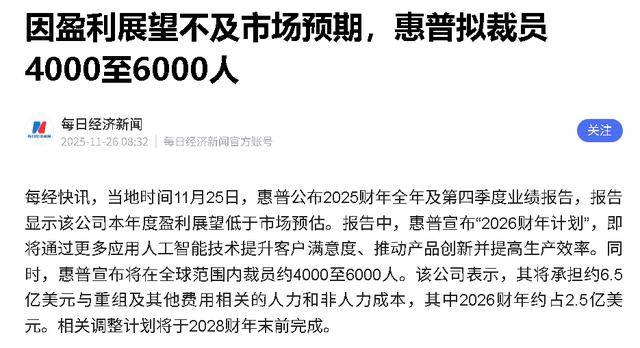
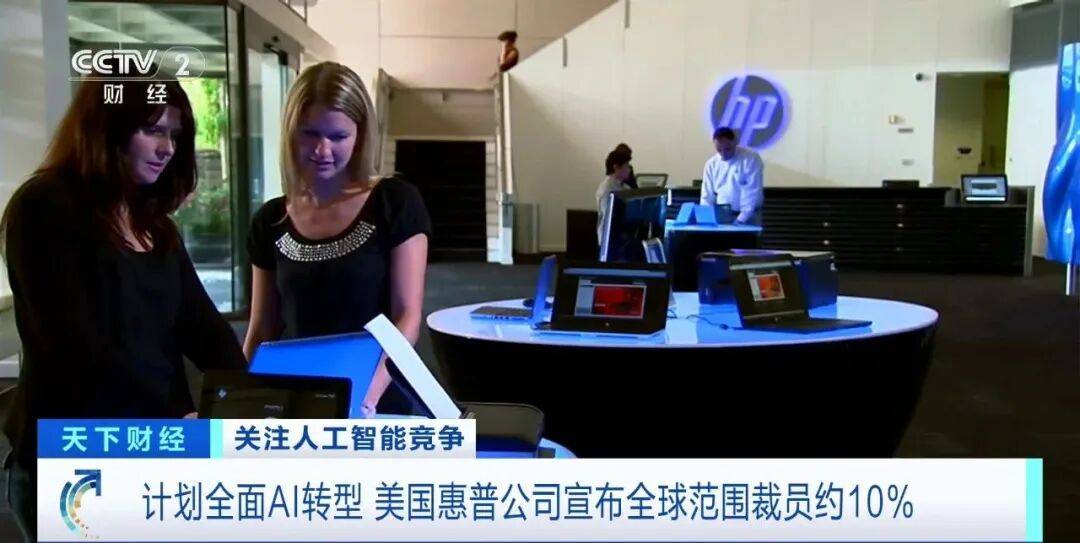
据报道,惠普股价今年已累计下跌超过25%。由AI驱动的裁员潮对白领岗位的冲击尤为深重,亚马逊等公司都因AI技术进步宣布大规模裁员。 来源:新华社、央视财经 编辑:赵静明 校对:王萃 作为此前宣布的重组计划的一部分,惠普公司今年2月已额外裁员1000至2000人。 惠普此举反映了整个科技行业的一个趋势,即企业在大力投资人工智能开发的同时,利用这项技术降低运营成本。行业分析师表示,人工智能自动化对客 户支持、内容审核、数据输入和某些计算机编程任务的影响尤其大。 美国摩根士丹利银行分析师警告,数据中心需求增长引发的全球存储芯片价格飙升,可能推高惠普和戴尔等消费电子产品制造商的成本,并挤压其利润。 洛雷斯说,惠普预计将在2026财年下半年感受到存储芯片涨价对成本的影响。不过,公司2026财年上半年仍有足够库存。 美国惠普公司11月25日说,预计到2028财年将全球裁员4000至6000人,以期精简运营、采用人工智能(AI)加速产品开发并提高生产率。 惠普首席执行官恩里克·洛雷斯说,此次裁员将集中在产品开发、内部运营和客户支持团队,预计这一举措将在三年内节省10亿美元毛运行成本。 ...
深夜,集体大涨!芯片,重大利好传来!
Zheng Quan Shi Bao Wang· 2025-11-29 00:07
Core Insights - The global DRAM market is experiencing a supply-demand imbalance, leading to rapid price increases for storage chips, particularly driven by the surge in AI infrastructure demand [1][2][3] Group 1: Market Dynamics - The price of 512GB storage has increased by nearly 500 yuan compared to the previous month, indicating significant price inflation in the storage chip market [2] - Counterpoint Research reports that memory prices have risen by 50% this year, with an expected additional 50% increase by Q2 2026 due to critical chip shortages [4][5] - Major PC manufacturers like Dell and HP are issuing warnings about potential price hikes for their products due to rising storage chip costs and supply constraints [2][3] Group 2: Company Responses - Lenovo's chairman predicts that the shortage and price increases of components, including storage, will persist throughout 2026, prompting the company to secure optimal contracts with suppliers [3] - Xiaomi has proactively signed supply agreements for 2026 to mitigate the impact of rising storage costs and may consider price adjustments and product upgrades to alleviate cost pressures [3] - SK Hynix and Micron are adjusting their production strategies in response to the increased demand for advanced memory, with expectations of significant production growth in the coming years [5][6] Group 3: Future Outlook - The semiconductor industry is entering what analysts describe as a "super cycle," with manufacturers aggressively stockpiling memory chips amid soaring demand [6] - The shift in demand from traditional LPDDR4 to advanced memory types like HBM is causing market disruptions, with significant implications for supply chains [4][5] - Analysts predict that the price of DDR5 memory modules could double by the end of 2026 due to the ongoing supply constraints and heightened demand from major players like NVIDIA [5][6]


Navigating Black Friday: Futures Halt Amid Tech Glitches, Indexes Eye Weekly Gains Despite Monthly Dip
Stock Market News· 2025-11-28 14:07
Core Insights - U.S. stock markets are experiencing early trading gains despite a technical outage at CME Group, with major indexes set for significant weekly advances but monthly declines in November [1][4][5] Premarket Activity and Futures Movements - U.S. stock futures indicated slight gains before a technical issue at CME Group halted trading, with Nasdaq 100 futures up 0.2% to 0.3%, S&P 500 futures rising 0.1% to 0.2%, and Dow futures gaining 0.1% to 0.2% [2] - ETFs tracking major indices also showed premarket gains, with SPY, QQQ, and DIA up 0.7%, 0.8%, and 0.7% respectively [2] Commodity Markets - WTI crude futures rose 0.7% to $59.10 per barrel, while gold futures increased by 0.5% to around $4,220 to $4,221 per ounce [3] - Bitcoin continued its upward trend, trading between $91,300 and $91,450, with Coinbase Global seeing a premarket jump of 2.6% to 2.7% [3] Major Market Indexes - Major U.S. equities indexes are on track for their most significant weekly gains since June, with Nasdaq Composite up 4.2%, S&P 500 up approximately 3.2%, and Dow Jones Industrial Average up about 2.6% [4] - Despite these weekly gains, all three major indexes are expected to end November in negative territory, with Nasdaq down 2.15% to 2.2%, S&P 500 down 0.4%, and Dow down 0.29% to 0.3% [5] Market Sentiment - Market sentiment is driven by optimism regarding AI stocks and expectations of a Federal Reserve interest rate cut in December, with futures pricing reflecting over 80% probability of a quarter-point cut [5] Upcoming Market Events - Key economic releases to watch include the Manufacturing Conditions ISM for November on December 1 and the Services Conditions ISM on December 3 [6] - Core Private Final Consumption Deflator inflation data and Personal Spending data for September are expected on December 5 [6] Major Stock News and Corporate Developments - CME Group shares ticked lower in premarket trading following the technical outage [12] - Robinhood Markets shares gained 1.5% in premarket trading, building on an almost 11% surge earlier in the week [12] - Alphabet shares rose 1% to 1.5% after unveiling its advanced Gemini 3 AI model, nearing a $4 trillion market capitalization [12] - Jefferies Financial Group stock edged lower after reports of an SEC investigation [12] - Deere & Co. shares tumbled 5.7% after missing earnings estimates and providing a cautious outlook [12] - HP Inc. shares fell 1.4% following fourth-quarter revenues that lagged behind estimates [12] - Nutanix Inc. shares plunged 17.8% after revenues came in below expectations [12] - Workday Inc. plummeted 7.9% after failing to meet revenue guidance [12] - Symbotic shares jumped 12.95% after analysts raised price targets [12] - Zscaler declined 13.03% following price target cuts and cautious guidance [12] - Micron Technology gained 3.24% amid continued activity in AI and semiconductor sectors [12] - Nordic American Tankers reported a net book loss but announced a consistent dividend [12] - Wipro announced a multi-year partnership to revamp its IT landscape [12] - Tata Consultancy Services signed a five-year agreement with SAP for modernization [12] - Adani Enterprises subsidiary assumed operational control of AGHPort Aviation Services [12] - Refex Industries secured a significant order worth ₹100 crore [12]






6 companies that have signaled they are replacing human employees with AI
Business Insider· 2025-11-28 13:18
Core Insights - Concerns about AI replacing human workers have escalated, with a recent MIT study indicating that AI can replace 11.7% of the US labor market [1] Company Actions - **HP**: Plans to cut 4,000 to 6,000 jobs by the end of 2028, aiming to save around $1 billion through AI initiatives and workforce reductions [6][7] - **IBM**: Has replaced hundreds of HR employees with AI and plans to cut thousands of workers by Q4 2025, while also shifting focus to hire more in AI and quantum roles [10][11][12] - **Amazon**: Announced 14,000 job cuts, with CEO stating the layoffs were not primarily driven by AI but rather cultural reasons [15][16] - **Salesforce**: Reduced customer support headcount from 9,000 to 5,000 due to AI agents, while successfully redeploying hundreds of employees to other areas [20][21] - **Klarna**: CEO indicated the company could operate with half its current staff, with AI handling the workload equivalent to 853 full-time agents, saving an estimated $58 million annually [25][26] - **Fiverr**: Slashed approximately 30% of its workforce, affecting about 250 employees, to become a leaner "AI-first company" [31][32] Industry Trends - A World Economic Forum survey found that 41% of companies globally expect to reduce their workforces over the next five years due to AI, while tech jobs in big data, fintech, and AI are projected to double by 2030 [3]




裁掉10%员工,惠普All in AI
Sou Hu Cai Jing· 2025-11-28 06:46
Core Viewpoint - HP is undergoing a significant restructuring, including a global layoff of 4,000 to 6,000 employees, to redirect $1 billion in savings towards AI research and product innovation, marking a strategic shift in response to competitive pressures in the AI landscape [1][2][3] Group 1: Layoff and Restructuring Strategy - The layoffs represent a comprehensive strategy involving personnel reduction, resource reallocation, technological advancement, and ecosystem restructuring, rather than a mere cost-cutting measure [2][3] - The restructuring will incur a one-time cost of $650 million, with a focus on product development, internal operations, and customer support [3][5] - The layoffs target three main job categories: repetitive process roles, traditional technical support positions, and inefficient management layers, with the aim of automating tasks through AI [5][6][12] Group 2: Financial Implications - The restructuring is expected to generate approximately $650 million in one-time costs, impacting the company's cash flow in the short term, while aiming for annual savings of $1 billion by the end of fiscal year 2028 [6][21] - HP's R&D investment is currently at 3.2%, significantly lower than competitors like Lenovo and Apple, highlighting the urgency of increasing AI-related investments [6][8] - The projected free cash flow for fiscal year 2026 is estimated at $2.8 to $3 billion, which will be strained by the restructuring costs [21][22] Group 3: Competitive Landscape - HP's market share in the PC segment is under pressure, with Lenovo capturing 31.1% of the global market, while HP's share stands at 18.5% [7][8] - The AI transformation is seen as essential for HP to remain competitive, as traditional hardware sales are increasingly supplemented by AI service subscriptions [8][9] - The shift in profitability models from hardware sales to "hardware + AI services" is critical, with HP needing to adapt to this new paradigm to maintain pricing power [8][9] Group 4: AI Transformation Strategy - HP's AI transformation strategy includes a three-step approach for its PC business, aiming to integrate AI capabilities into product development and customer engagement by 2028 [9][11] - The company plans to enhance its AI capabilities through partnerships with technology firms like NVIDIA and OpenAI, focusing on developing proprietary AI chips and algorithms [12][24] - The transition to AI-driven services is expected to improve customer retention and create new revenue streams, particularly in the enterprise market [13][14] Group 5: Challenges and Risks - HP faces significant challenges, including high short-term restructuring costs, the need for technological breakthroughs, and the risk of losing key talent during the transition [21][25] - The company must overcome internal resistance to change, as employee sentiment regarding the AI transition is mixed, with concerns about job security [25][26] - The competitive landscape is intensifying, with rivals like Lenovo and Dell making significant strides in AI integration, putting additional pressure on HP to accelerate its transformation [17][18]

AI赋能后,惠普计划全球最多裁员6000人
阿尔法工场研究院· 2025-11-28 00:07
Core Viewpoint - HP reported better-than-expected revenue for Q4 FY2025, but profits declined, leading to a significant drop in stock price after the announcement [3][4][6]. Financial Performance - Q4 revenue increased by 4% year-over-year to $14.639 billion, surpassing Wall Street's expectation of $14.48 billion, driven by a surge in AI PC sales and the end of Windows 10 support [6][8]. - GAAP net profit for Q4 was $795 million, down from $906 million in the same period last year, with diluted EPS at $0.84 compared to $0.93 a year ago [6][8]. - The Personal Systems segment, which includes laptops and desktops, saw an 8% revenue increase to $10.35 billion, accounting for 70% of total revenue [7][8]. Business Segment Performance - The Printing segment reported Q4 revenue of $4.27 billion, a 4% decline year-over-year, with a gross margin of 18.9% [8]. - For the entire FY2025, HP's revenue was $55.3 billion, a 3.2% increase, but GAAP diluted EPS fell to $2.65 from $2.81 the previous year [8]. Future Outlook - HP expects PC product shipments to grow by 6.6% in FY2025 but anticipates a 2.2% decline in FY2026 due to waning demand for PC upgrades [9][12]. - For Q1 FY2026, HP estimates GAAP diluted EPS between $0.58 and $0.66, which is below analyst expectations [11]. - The company faces challenges from rising storage chip prices, which are expected to continue impacting profit margins [11][12]. Restructuring and Cost-Saving Measures - HP announced a global layoff plan affecting 4,000 to 6,000 employees as part of a strategy to save approximately $1 billion in operational costs by FY2028 [13][14]. - The restructuring will involve teams in product development, internal operations, and customer support, with an estimated cost of $650 million related to these changes [14][15]. AI Integration Strategy - HP is focusing on integrating AI into its products to enhance customer satisfaction and drive innovation, with AI PCs accounting for over 30% of total PC shipments as of Q4 FY2025 [14][15].

US Markets Closed for Thanksgiving; Tech Leads Rally on Wednesday Amid Rate Cut Hopes
Stock Market News· 2025-11-27 15:07
Market Performance - U.S. stock markets experienced a robust performance on November 26, 2025, with major indexes closing higher, marking a fourth consecutive winning session. The Dow Jones Industrial Average rose by 0.67% to 47,427.12, the S&P 500 climbed 0.69% to 6,812.61, and the Nasdaq Composite increased by 0.82% to 23,214.69, achieving its strongest Thanksgiving week performance since 2008 [2][3] - The Volatility Index (VIX) fell by 7.38% to 17.19, indicating positive market sentiment [2] Economic Indicators - Heightened expectations for a Federal Reserve interest rate cut in December are driving market optimism, with traders estimating an 83% to 85% probability of a rate reduction [3] - Recent economic data, including a decline in first-time unemployment claims to 216,000, supports the notion that the Fed may have room to ease monetary policy further [3] Future Projections - JPMorgan forecasts the S&P 500 to reach 7,500 by the end of 2026, with potential growth past 8,000 if the Federal Reserve adopts a more aggressive easing policy. This outlook is based on anticipated earnings growth of 13% to 15% for U.S. companies over the next two years [4] Global Market Overview - Asian markets showed positive movement, with Japan's Nikkei 225 gaining 1.2%, Taiwan's Taiex up 0.5%, South Korea's Kospi rising 0.7%, and the Shanghai Composite climbing 0.3% [5] - European markets presented a mixed picture, with Germany's DAX up 0.2% while Britain's FTSE 100 dipped 0.2% [6] Corporate News - Whirlpool India saw its stock tumble 11.42% due to reports of a promoter considering selling up to a 7.5% stake [12] - Wipro announced a strategic alliance with the Indian Institute of Science to advance breakthroughs in AI technologies [12] - Nintendo entered a share transfer agreement to acquire Bandai Namco Studios Singapore, aiming to strengthen its development structure [12] - HP Inc. plans to cut 4,000 to 6,000 jobs globally by 2028 as part of a strategy to streamline operations and enhance productivity through AI [12] - Symbotic surged 12.95% following strong earnings results, while Zscaler dropped 13.03% due to underwhelming Q1 results [12]