LI AUTO(LI)

Search documents
9月新能源车销量:比亚迪销售39.6万,零跑超6.6万,小鹏/小米均破4万
高工锂电· 2025-10-11 10:57
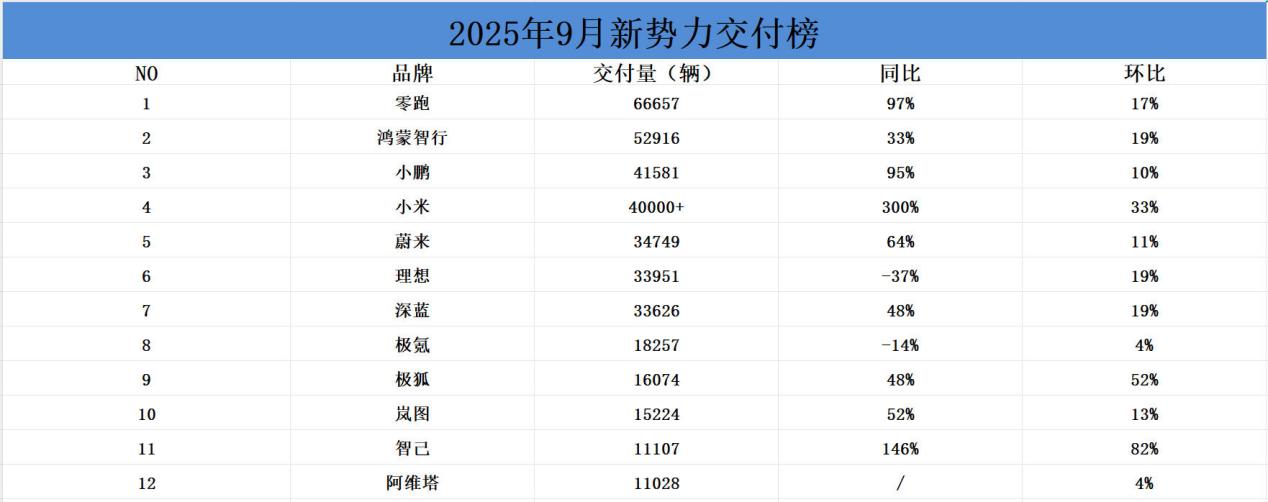
Core Viewpoint - The article highlights the significant growth in the sales of new energy vehicles (NEVs) in September 2025, with various brands achieving record sales figures, indicating a robust market trend in the NEV sector in China [4][5]. Group 1: Market Overview - The traditional sales peak season, "Golden September and Silver October," is approaching, leading to increased sales efforts from automotive manufacturers [5]. - GGII's tracking of 13 automotive brands shows positive month-on-month growth in NEV sales for September 2025 [5]. Group 2: Sales Data Summary - BYD sold 396,270 vehicles in September 2025, with a month-on-month increase of 6.1% but a year-on-year decrease of 5.5%. Cumulative sales from January to September reached approximately 3.26 million, up 18.6% year-on-year [6]. - Leap Motor achieved a record monthly sales of 66,657 vehicles in September, marking a year-on-year increase of over 97% and a cumulative sales of 395,516 vehicles for the first nine months, up 128.8% [8]. - Hongmeng Zhixing sold 52,916 vehicles in September, with an 18.7% month-on-month increase and a 32.5% year-on-year increase [10]. - XPeng Motors delivered 41,581 vehicles in September, a 95% year-on-year increase, with cumulative sales of 313,196 vehicles for the first nine months, up 218% [12]. - Xiaomi's vehicle deliveries exceeded 40,000 in September, showing over 300% year-on-year growth and over 30% month-on-month growth, with cumulative sales surpassing 250,000 [14]. - NIO delivered 34,749 vehicles in September, a 64% year-on-year increase, with cumulative deliveries reaching 872,785 [16]. - Li Auto delivered 33,951 vehicles in September, a 36.8% year-on-year decrease but a 19% month-on-month increase, with a total of 1,431,021 cumulative deliveries [20]. - Deep Blue sold 33,626 vehicles in September, with a 48.1% year-on-year increase and a cumulative sales of 232,266 for the first nine months, up 61.9% [22]. - GAC Aion sold 29,113 vehicles in September, a year-on-year decrease of 18.6% but a month-on-month increase of 7.7%, with cumulative sales of 234,978, down 17.2% [26]. - Zeekr delivered 18,257 vehicles in September, a 14.4% year-on-year decrease but a 3.6% month-on-month increase, with cumulative deliveries of 143,600, up 0.5% [28]. - Lantu delivered 15,224 vehicles in September, a 52% year-on-year increase, with cumulative sales of 96,992, up 85% [33]. - Zhiji delivered 11,107 vehicles in September, with a year-on-year increase of 145.9% and a cumulative total of 90,739, down 40.1% [35]. - Avita sold 11,028 vehicles in September, a 143.1% year-on-year increase, with cumulative sales of 90,739, up 121.8% [37].






理想说自己发布了一款突破行业壁垒让车更安全的承压部件
理想TOP2· 2025-10-11 10:56
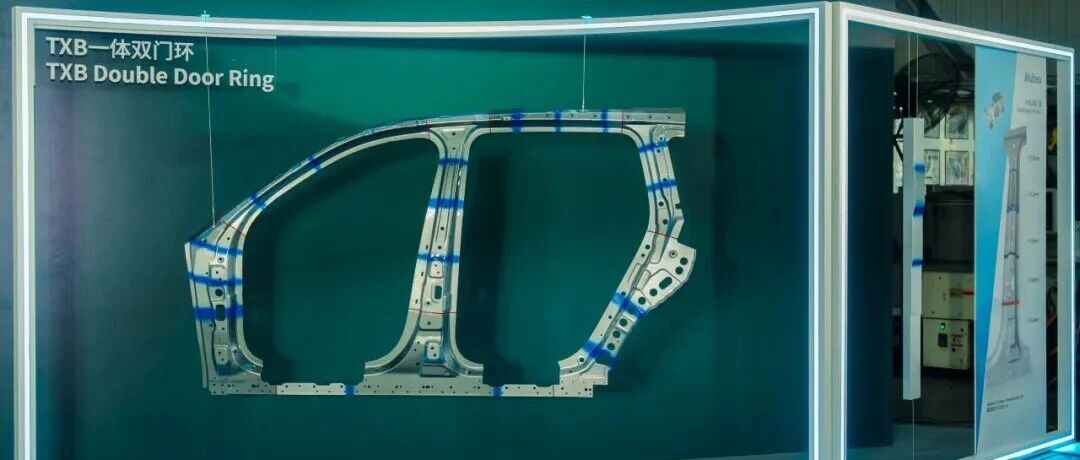
Core Viewpoint - The successful trial production of the TXB integrated double door ring, led by Li Auto in collaboration with Yanlong Technology and Mubei, represents a significant technological breakthrough in vehicle body structure design, enhancing safety while achieving lightweight and efficient energy consumption [1][8]. Group 1: TXB Integrated Double Door Ring - The TXB integrated double door ring combines Tailor Welded Blanks (TWB) and Tailor Rolled Blanks (TRB) technologies, allowing for the creation of a single blank from multiple flexible rolled steel plates of varying thicknesses, which are then formed through hot stamping [2][5]. - This innovation is the first in the industry to achieve full coverage of hot-formed non-uniform thickness plates in critical areas (A, B, C pillars), balancing performance and weight effectively [2][6]. Group 2: Technological Advantages - The TXB technology overcomes the limitations of traditional TRB and TWB methods, allowing for precise adjustment of thickness at various positions with fewer components, resulting in a weight reduction of approximately 13%-18% compared to conventional body structures [1][6]. - The design of the TXB integrated double door ring exemplifies a fusion of the advantages of both TWB and TRB, creating a lightweight yet robust structure akin to a "custom suit" for vehicles [5][6]. Group 3: Strategic Collaboration - The successful trial production took place at Yanlong Technology's Suzhou factory, marking a step forward in Li Auto's capabilities in lean body design [8][12]. - Key executives from Li Auto, Yanlong Technology, and Mubei attended the launch ceremony, highlighting the collaborative effort in advancing automotive lightweight solutions [8][10]. Group 4: Industry Impact - The TXB integrated double door ring is expected to redefine industry standards with its superior strength, energy efficiency, and sustainability, contributing to the global automotive industry's lightweight progress [12][14]. - The collaboration aims to address challenges in component structure design, material processing, and precision matching of material thickness and performance, ensuring a safe and green mobility experience for users [14].
公司问答丨精进电动:公司与理想汽车没有联合开发产品的合作关系

Ge Long Hui A P P· 2025-10-11 09:28
格隆汇10月11日|有投资者在互动平台向精进电动提问:上海精进电动工厂区内的理想汽车上海试验中 心是什么情况,联合开发相关产品么?精进电动回复称,公司于上海仅租用该地块的部分办公场所,或 因此存在与其他公司共处同一地址下的情况。此外,公司与理想汽车没有联合开发产品的合作关系。 ...
理想L系列改款分析
数说新能源· 2025-10-11 08:15
Core Viewpoint - The L series of vehicles faces several significant issues, including poor sales performance of the L8 model, lack of a true five-seat flagship, and declining sales trends for the L9 flagship model [1] Group 1: Product Issues - Among the L6789 models, the L8 has the worst sales, and the overall sales of six-seat vehicles are significantly lower than those of five-seat vehicles [1] - The L series lacks a true five-seat flagship; while the L7 is marketed as such, its configuration is more aligned with the L8, falling short of the L9's offerings [1] - The L8's starting price of over 300,000 yuan does not effectively cover the demand for six-seat vehicles priced around 250,000 yuan, placing it in a difficult sales position [1] - Sales of the L9 flagship have been in a continuous decline over the past two years, with configuration upgrades failing to reverse this trend [1] - The L series is not favored in the business vehicle market [1] Group 2: Proposed Adjustments - The L6 model is expected to be strengthened with more options and a lower starting price for the rear-wheel-drive version, while maintaining a length of under 5 meters [1] - The L7 is likely to remain in the lineup but may see its positioning elevated to cater to customers that the L6 cannot satisfy, potentially aligning it closer to the L9 in some configurations [1] - The L8 will introduce a lithium iron phosphate rear-wheel-drive version with a starting price around 250,000 yuan, aiming to compete directly with similar models like the L90 [1] - There is an expectation for the L9 to have a distinct exterior design to visually differentiate it from the L678 models, along with hopes for a five-seat executive version to explore the business market [1] Group 3: Future Model Considerations - There is speculation about whether the company will launch a new model, the LX, that is larger than the L9; if aimed at the family market, a larger SUV may not be as beneficial as a range-extended MPV for sales visibility [2] - If the new model is intended for the business market, a five-seat version of the L9 may be a more feasible option compared to a larger new product [2]

9月新势力排位洗牌:零跑断层领跑 小鹏/小米首破4万改写格局
Zhong Guo Zhi Liang Xin Wen Wang· 2025-10-11 07:52
Core Insights - The new energy vehicle market in September 2025 saw record delivery numbers, with several brands achieving historical highs, indicating a competitive landscape among leading players [1][3] Delivery Rankings - Leap Motor topped the delivery chart with 66,657 units, marking a 97% year-on-year increase and becoming the first new energy brand to exceed 60,000 monthly sales [2][5] - Hongmeng Zhixing followed with 52,916 units delivered, a 33% increase, and is nearing a cumulative delivery milestone of 950,000 units [2][7] - Xiaopeng ranked third with 41,581 units, achieving a 95% year-on-year growth and a 10% month-on-month increase [2][9] - Xiaomi made a significant entry into the top four with over 40,000 units delivered, reflecting a 300% increase [2][11] Second Tier Dynamics - NIO delivered 34,749 units, a 64% increase, with its sub-brands contributing significantly to this growth [2][13] - Li Auto's deliveries were 33,951 units, showing signs of recovery despite a year-on-year decline [2][15] - Deep Blue achieved 33,626 units, benefiting from ongoing product and technological advancements [2][17] Competitive Landscape - Zeekr's sales reached 18,257 units, showing a mixed performance with slight month-on-month growth but a year-on-year decline [2][17] - Arcfox saw a 47.74% year-on-year increase, delivering 16,074 units, supported by a diverse product lineup [2][18] - Lantu delivered 15,224 units, with a year-to-date growth of 85%, driven by product upgrades and market feedback [2][20] - ZhiMi achieved a record high of 11,107 units, with a significant contribution from the newly launched LS6 model [2][22] - Avita maintained a steady performance with 11,028 units delivered, reflecting successful market positioning [2][22] Market Outlook - The results from September indicate a deepening competitive landscape, with the upcoming October sales period being crucial for both leading and mid-tier brands to sustain growth and navigate market challenges [1][22]

车企新能源目标完成率:传统车企向好 新势力仅小鹏、零跑达标
Sou Hu Cai Jing· 2025-10-11 06:13
Core Insights - In September, 10 out of 12 new energy vehicle (NEV) companies reported sales growth, indicating a positive trend for the first three quarters of the year [2] - However, only two new energy vehicle companies achieved over 75% of their annual sales targets, with nine companies falling below 50%, highlighting significant pressure to meet targets in the fourth quarter [2][5] - Traditional automakers showed a more optimistic performance, with three companies achieving over 70% of their sales targets, suggesting a better chance of meeting annual goals [2][8] New Energy Vehicle Companies - Among new energy vehicle companies, only Xiaopeng Motors and Leap Motor reached or exceeded a 75% target completion rate, with Xiaopeng selling 313,000 units (up 218%) and Leap Motor selling 396,000 units (up 129%) in the first nine months [4][6] - Xiaomi Motors also exceeded a 70% completion rate, selling 250,000 units (up 279%) [4] - Other companies, including Hongmeng Zhixing and Li Auto, faced challenges, with Hongmeng achieving only 34% of its target despite selling 344,000 units (up 10%) [6][10] - NIO sold 201,000 units (up 35%) but only reached 45% of its annual target [6][7] Traditional Automakers - BYD led traditional automakers with 3.219 million units sold (up 18%), achieving a 70% completion rate of its annual target of 4.6 million units [10] - Geely followed with 1.168 million units sold (up 114%) and a completion rate of 78% [10][11] - Changan and SAIC-GM-Wuling also exceeded 70% completion rates, with Changan selling 724,000 units (up 60%) [10][11] - Other traditional automakers like Chery and Great Wall Motors reported significant growth, with Chery selling 588,000 units (up 77%) [10][12]


黑色星期五!特朗普突发宣布加征100%关税!全线暴跌!美股欧股原油加密无一幸免...
雪球· 2025-10-11 05:23
Group 1 - The article highlights a significant market downturn on October 10, attributed to President Trump's announcement of a 100% tariff on Chinese imports, leading to a sharp decline in major U.S. indices such as the Nasdaq and S&P 500, which fell by 3.56% and 2.71% respectively, marking their largest single-day drop since April 10 [1][15] - The VIX index, a measure of market volatility, surged over 31%, indicating heightened investor fear and uncertainty in the market [1] - Major technology stocks experienced substantial losses, with the "Big Seven" tech index dropping 3.65%, and individual stocks like Amazon and Tesla falling over 5% [15] Group 2 - The article discusses the implications of Trump's tariff announcement, which is set to take effect on November 1, 2025, as a response to stricter export controls on rare earth minerals by other countries [18] - Current tariffs on some Chinese goods are nearing 145%, although these have been temporarily suspended until November 10 while broader trade negotiations are ongoing [19] - Additional tariffs on kitchen cabinets and wooden products are scheduled to take effect soon, indicating a continued trend of increasing trade barriers [20] Group 3 - The article mentions that Federal Reserve Governor Waller supports further interest rate cuts, citing a weak labor market and the need for cautious policy adjustments [23][24] - Waller emphasizes the importance of aligning labor market recovery with GDP growth, suggesting that either the labor market must improve or GDP growth must slow down, which will influence future policy decisions [25] - The upcoming release of the Consumer Price Index (CPI) on October 24 is noted as a critical event ahead of the Federal Open Market Committee (FOMC) meeting [28][29] Group 4 - The article reports on the initiation of federal employee layoffs by the Trump administration, with a significant reduction of 200,000 federal employees already this year and an expectation of an additional 100,000 by year-end [32] - The ongoing government shutdown is projected to last longer than initially expected, with market participants increasingly anticipating a prolonged period of inactivity [33]



特朗普称或将大幅提高对华关税,美股全线大跌
Nan Fang Du Shi Bao· 2025-10-11 04:59
Market Impact - On October 10, U.S. stock indices closed down across the board, with the Dow Jones Industrial Average falling by 1.9%, the S&P 500 down by 2.71%, and the Nasdaq Composite dropping by 3.56% [2] - The decline was triggered by strong anti-China rhetoric from former President Trump, who suggested significant tariff increases on products entering the U.S. [2] Sector Performance - Major tech stocks experienced significant declines, with Tesla down 5.06%, Amazon down 4.99%, Nvidia down 4.89%, and other tech giants like META, Apple, Microsoft, and Google also seeing losses [2] - Chinese concept stocks were heavily impacted, with the Nasdaq Golden Dragon China Index falling by 6.10%, and individual stocks like NIO and Bilibili dropping over 10% [3] Global Market Reaction - European markets also faced declines, with Germany's DAX down 1.5%, France's CAC40 down 1.53%, and the UK's FTSE 100 down 0.86% [3] - Following the U.S. market close, Trump announced a 100% additional tariff on Chinese goods starting November 1, along with export controls on "all critical software" [3] Economic Outlook - Concerns over deteriorating trade relations and a prolonged U.S. government shutdown have heightened fears of an economic recession [3] - Analysts predict that the U.S. stock market's decline will negatively affect A-shares and Hong Kong stocks, particularly impacting the market opening on the following Monday [4] Investment Strategy - Investors are advised to consider reducing positions to mitigate short-term market shocks, although the overall market trend remains unchanged [4] - Despite the recent downturn, the A-share and Hong Kong markets are viewed as not being in a bubble, with valuations still below historical averages [4]



特朗普威胁100%新关税?美股遭遇“黑色星期五”
Guan Cha Zhe Wang· 2025-10-11 02:04
Core Viewpoint - The announcement by Trump regarding a 100% tariff on Chinese imports starting November 1 has triggered a significant sell-off in global capital markets, particularly affecting U.S. tech stocks and Chinese companies listed in the U.S. [1][10] Market Impact - U.S. stock markets faced their most severe challenge of the year, with the Dow Jones Industrial Average dropping 878.82 points (1.9%), the S&P 500 falling 182.6 points (2.71%), and the Nasdaq Composite plunging 3.56%, marking its largest single-day decline since April [2][4] - The Nasdaq Golden Dragon China Index fell by 6.1%, with a cumulative weekly decline of 8.37%, indicating a sharp downturn in Chinese stocks [1][8] Sector Performance - The technology sector was particularly hard hit, with major tech stocks experiencing significant declines: TSMC ADR down over 6%, Nvidia, Amazon down over 4%, and Apple, Meta down over 3% [4][7] - The Philadelphia Semiconductor Index saw a substantial drop of 6.32%, with ARM down over 9% and AMD, Qualcomm down over 7% [7] Chinese Stocks - Chinese companies listed in the U.S. faced a dual blow, with notable declines: NIO and Kingsoft Cloud down over 10%, Bilibili down over 9%, and Baidu, Alibaba, and XPeng down over 8% [1][9] - The FTSE A50 futures also suffered, dropping over 4%, suggesting potential pressure on A-shares at the upcoming opening [9] Broader Economic Context - The market turmoil is compounded by the ongoing U.S. government shutdown, which has entered its 10th day, leading to significant layoffs of federal employees, marking a departure from previous practices during government shutdowns [10]





突然变盘!美股全线跳水大跌,发生了什么?
天天基金网· 2025-10-11 01:25
Market Overview - The U.S. stock market experienced a significant decline, with the Nasdaq and S&P 500 indices recording their largest single-day drops since April 10 [5][6] - The Nasdaq index fell by 3.56% to 22,204.43 points, while the S&P 500 dropped by 2.71% to 6,552.51 points, marking a weekly decline of 2.43% for the S&P 500 and 2.53% for the Nasdaq [5][6] - Major technology stocks saw substantial losses, with the "Big Seven" tech index down by 3.65% [7] Individual Stock Performance - Notable declines in individual stocks included Tesla down over 5%, Amazon down 5.06%, and Nvidia down 4.92% [7][8] - Alibaba's stock fell by 8.45%, while other Chinese stocks like Bilibili and Baidu also experienced significant drops [9][10] Commodity Market - International oil prices saw a notable decline, with U.S. crude oil futures down 4.24% to $58.90 per barrel, and Brent crude down nearly 3.82% to $62.73 per barrel [12] - Gold prices increased by over 1%, reaching a high of $4,022.90 per ounce [13] Government Employment and Economic Outlook - The Trump administration has begun large-scale layoffs of federal employees, with 200,000 already reduced this year and an additional 100,000 expected by year-end [17][18] - There is a growing belief among traders that the U.S. government shutdown may last until the end of October or longer, with probabilities for a shutdown exceeding 30 days increasing [18] - Federal Reserve officials have indicated a willingness to consider further interest rate cuts in response to a weakening labor market and persistent inflation [18]