
Luckin Coffee(LKNCY)

Search documents
营收吊打星巴克!瑞幸翻身了
格隆汇APP· 2025-08-03 09:06
Group 1 - The core viewpoint of the article highlights that Luckin Coffee has successfully navigated the challenges posed by the fierce price wars in the coffee and tea industry, achieving significant revenue growth and market presence [2][3][8] - In Q2, Luckin Coffee reported total net revenue of 12.359 billion yuan, a year-on-year increase of 47.1%, marking the highest growth rate in the past four quarters [3][10] - The company's operating profit surged by 61.8% year-on-year to reach 1.7 billion yuan, reflecting its strong performance amidst the competitive landscape [3][10] Group 2 - Luckin Coffee's stock price has doubled over the past year, and since its lowest point in 2020, it has increased by 30 times [4][10] - The company has aggressively expanded its store count, adding 2,109 new stores in a single quarter, bringing the total to 26,206 stores by the end of Q2 [15][10] - Compared to Starbucks, which reported net revenue of 5.68 billion yuan for the same period, Luckin's performance stands out significantly [16][10] Group 3 - The article discusses the impact of the ongoing price war initiated by major delivery platforms, which has led to historically low beverage prices [9][10] - Luckin Coffee has benefited from this price war, with its gross merchandise volume (GMV) increasing by 46% year-on-year to 14.2 billion yuan [10][10] - The company has also seen a rise in same-store sales, with a 13.4% year-on-year increase in self-operated stores [10][10] Group 4 - The article notes that the coffee market in China has undergone significant changes, with Luckin Coffee surpassing Starbucks in annual revenue for the first time in 2023 [29][30] - The coffee and tea markets are increasingly converging, with brands like Luckin actively introducing tea-based products to attract a broader consumer base [31][30] - The competitive landscape is shifting towards a focus on brand differentiation and operational efficiency, as companies face rising costs and market saturation [50][51] Group 5 - The article emphasizes the challenges that Luckin Coffee and the broader beverage market will face in the future, particularly in terms of cost control and maintaining brand value [56][57] - The increase in delivery orders has created both opportunities and challenges for Luckin, as it must manage rising delivery costs while expanding its consumer base [55][56] - The need for long-term strategies to enhance brand loyalty and consumer engagement is highlighted as a critical focus for Luckin and the industry as a whole [57][56]


2025餐饮增长榜解析:慢周期里的机会点与生存法则(附有哥餐链完整榜单)
Sou Hu Cai Jing· 2025-08-02 16:13
Core Insights - The restaurant industry in 2025 is at a crossroads between "rapid expansion" and "rational cultivation," with a reported 4.3% year-on-year growth in national dining revenue from February to June 2025, indicating a shift to a "slow growth" cycle due to market saturation and intensified competition [2][25] - Despite the slow growth, brands like Mixue Ice City are rapidly expanding, adding over 10,000 stores in a year, while the coffee sector sees three brands in the top growth rankings, highlighting potential opportunities within the slow growth period [2][14] Key Data Points - The top five brands in the growth ranking added over 5,000 stores in the past year, with Mixue Ice City leading by adding 10,160 stores [4] - Coffee and tea drinks dominate the growth list with 26 brands, including 9 coffee and 17 tea brands, while other notable categories include rice noodles (11 brands), fried chicken and burgers (9 brands), and snacks (8 brands) [4] - The growth rate of the top 10 brands by new store count shows that two brands specializing in boiled beef rice noodles achieved over 90% growth [4] Growth Categories Analysis - **Coffee and Tea Drinks**: Brands like Mixue Ice City and Luckin Coffee are expanding rapidly, leveraging supply chain efficiencies to offer competitive pricing. New entrants like Grandpa Not Brewing Tea are also finding success through unique positioning [14][21] - **Snack Foods**: Brands such as Hao Xiang Lai and Zhao Yi Ming are leading the snack food segment, benefiting from direct supply chain sourcing and scale efficiencies, with Zhao Yi Ming adding 376 stores recently [16][17] - **Quick Service Restaurants**: The quick service segment is seeing rapid growth, with brands like Tasitin and Cao's Duck Neck capitalizing on standardized operations and efficient supply chains. However, traditional brands face challenges due to limited marketing and single consumption scenarios [19][21] Slow Growth Cycle Insights - The slow growth cycle presents opportunities at the intersection of supply chain efficiency and user value. Successful brands are those that enhance supply chain capabilities and differentiate through unique user value propositions [23][25] - Brands that remain stagnant often do so due to a lack of innovation and reliance on imitation rather than building competitive barriers [23][25]



瑞幸咖啡:25Q2业绩点评:营收高增+盈利能力持续增强,门店扩张与国际化布局齐头并进
Tianfeng Securities· 2025-08-02 09:24
Investment Rating - The report assigns a "Buy" rating for the stock, expecting a relative return of over 20% within the next six months [11] Core Insights - The company achieved total net revenue of 12.359 billion yuan in Q2 2025, representing a year-on-year growth of 47.1%. Product sales revenue was 9.491 billion yuan, up 44.9%, while franchise store revenue reached 2.867 billion yuan, growing by 55.0% [1][3] - The company continues to expand its store network, adding 2,109 new stores in Q2 2025, bringing the total to 26,206 stores. The average monthly transaction customer count increased by over 22 million, reaching 91.7 million, a year-on-year growth of 31.6% [2][3] - The company reported a Non-GAAP net profit of 1.399 billion yuan in Q2 2025, with a net profit margin of 11.3%. The operating profit for self-operated stores was 1.922 billion yuan, with an operating profit margin of 21.0% [4] Revenue Summary - The company’s revenue growth is driven by both self-operated and franchise stores. Self-operated store revenue reached 9.136 billion yuan, up 45.6%, while same-store sales growth was 13.4%. Franchise store revenue was 2.867 billion yuan, up 55.0% [3] - The company has launched several innovative products, contributing to increased sales, including the "Feather Light Fruit and Vegetable Tea" which sold 11.2 million cups within two weeks of launch [3] Profit Summary - The profitability of franchise stores has improved, and the company is strengthening its supply chain. A long-term procurement agreement has been signed with Brazil, and a new roasting facility is expected to increase annual roasting capacity to 155,000 tons [4] Investment Recommendations - The report suggests that the company will benefit from the growth strategy focused on scale, with a positive outlook on the coffee and new tea beverage sectors. Short-term attention is recommended on new products and supply chain optimization [5]
黎辉任瑞幸董事长后首份季报:营收124亿净利13亿,市值超百亿美元
Sou Hu Cai Jing· 2025-08-02 06:41
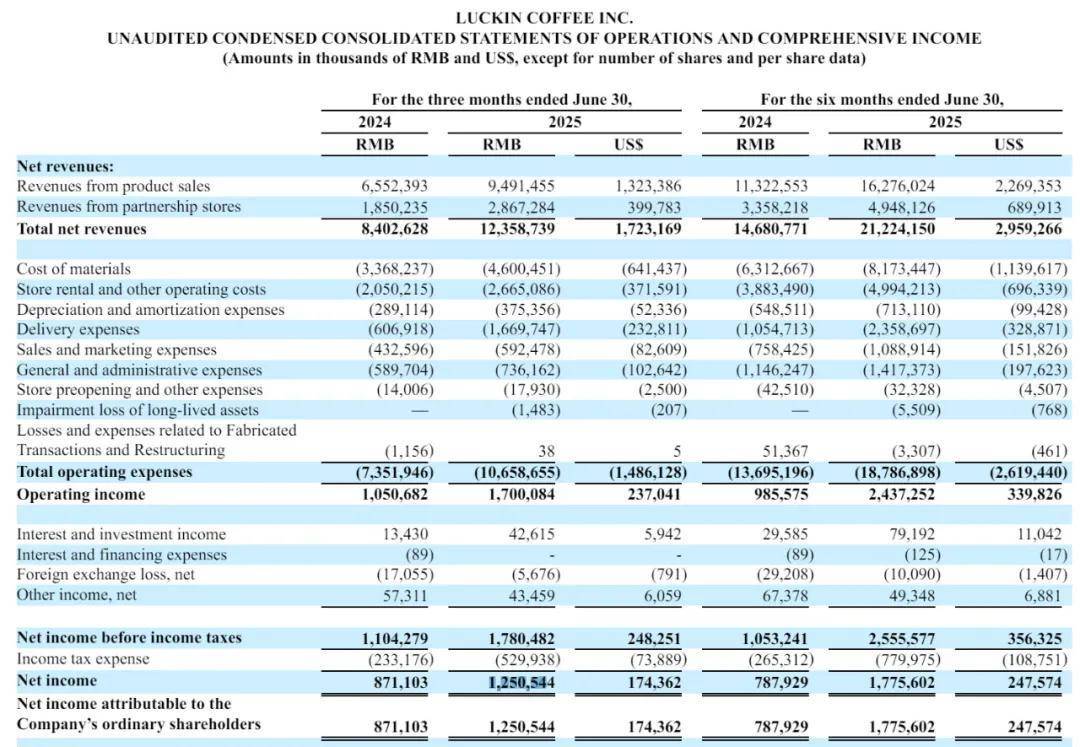
Core Insights - Luckin Coffee reported a significant increase in revenue for the first half of 2025, reaching RMB 21.224 billion (approximately USD 2.959 billion), compared to RMB 14.681 billion in the same period last year, marking a growth of 44.5% [1][2] - The company achieved an operating profit of RMB 2.437 billion (approximately USD 339.8 million) for the first half of 2025, up from RMB 985.575 million in the previous year, indicating a strong operational performance [2][8] - Net income for the first half of 2025 was RMB 1.776 billion (approximately USD 247.6 million), compared to RMB 787.929 million in the same period last year, reflecting a substantial increase [2][8] Financial Performance - For Q2 2025, total revenue was RMB 12.359 billion (approximately USD 1.723 billion), a 47.1% increase from RMB 8.402 billion in Q2 2024 [6][8] - Product sales revenue in Q2 2025 reached RMB 9.491 billion (approximately USD 1.323 billion), up 44.9% from RMB 6.552 billion in Q2 2024 [8][11] - Operating expenses for Q2 2025 totaled RMB 10.659 billion (approximately USD 1.486 billion), a 45% increase from RMB 7.352 billion in Q2 2024, primarily due to business expansion [18][19] Store Expansion and Operations - As of June 30, 2025, Luckin Coffee operated 26,206 stores, including 16,968 self-operated and 9,238 franchised stores, with a net addition of 2,109 stores in Q2 2025 [15][18] - Same-store sales for self-operated stores increased by 13.4% in Q2 2025, up from 8.1% in the previous quarter, indicating strong customer demand [11][21] - The company reported a monthly average of 91.7 million customers and a GMV of RMB 14.2 billion in Q2 2025 [15] Cost Management - Material costs in Q2 2025 were RMB 4.600 billion (approximately USD 641.4 million), a 36.6% increase from RMB 3.368 billion in Q2 2024, driven by higher sales volume [18][19] - Store rental and other operating costs rose to RMB 2.665 billion (approximately USD 371.6 million), a 30% increase from RMB 2.050 billion in Q2 2024 [18][19] - Delivery expenses surged by 175.1% to RMB 1.670 billion (approximately USD 232.8 million) in Q2 2025, reflecting increased logistics costs [18][19] Leadership Changes - In April 2025, Luckin Coffee announced a management change, with the chairman and CEO of Dazhong Capital replacing Guo Jinyi as chairman of Luckin Coffee [3] - This financial report marks the first under the new chairman, who previously exited the board during the financial scandal [5]
聊聊咖啡和大蒜,两者的演进关系
Hu Xiu· 2025-08-02 03:35
Group 1 - The article discusses the evolving relationship between coffee and garlic as metaphors for cultural and commercial value, highlighting how northern garlic comedy has gained significant influence over the years [2][6][49] - It emphasizes that the distinction between coffee and garlic is not strictly biological but rather a result of cultural and commercial evolution, where both can innovate and create value [5][6][49] - The article outlines the historical evolution of coffee, detailing its transformation from a low-end agricultural product to a high-value commodity through standardization and branding efforts, particularly by Starbucks [10][12][15][22] Group 2 - The article also examines the evolution of bookstores, particularly the example of Tsutaya in Japan, which transitioned from a rental store to a cultural space that integrates coffee, enhancing its commercial appeal [26][30][32] - It discusses the concept of "reverse garlic innovation" in the coffee industry, exemplified by brands like Luckin Coffee, which focus on low-cost offerings while sacrificing experiential value [33][34][43] - The article concludes that there is a spectrum between coffee and garlic, with both having their merits and drawbacks, and emphasizes the importance of understanding the underlying commercial values of each approach [45][48][51]
估值超350亿,星巴克中国确认要卖了
3 6 Ke· 2025-08-02 00:32
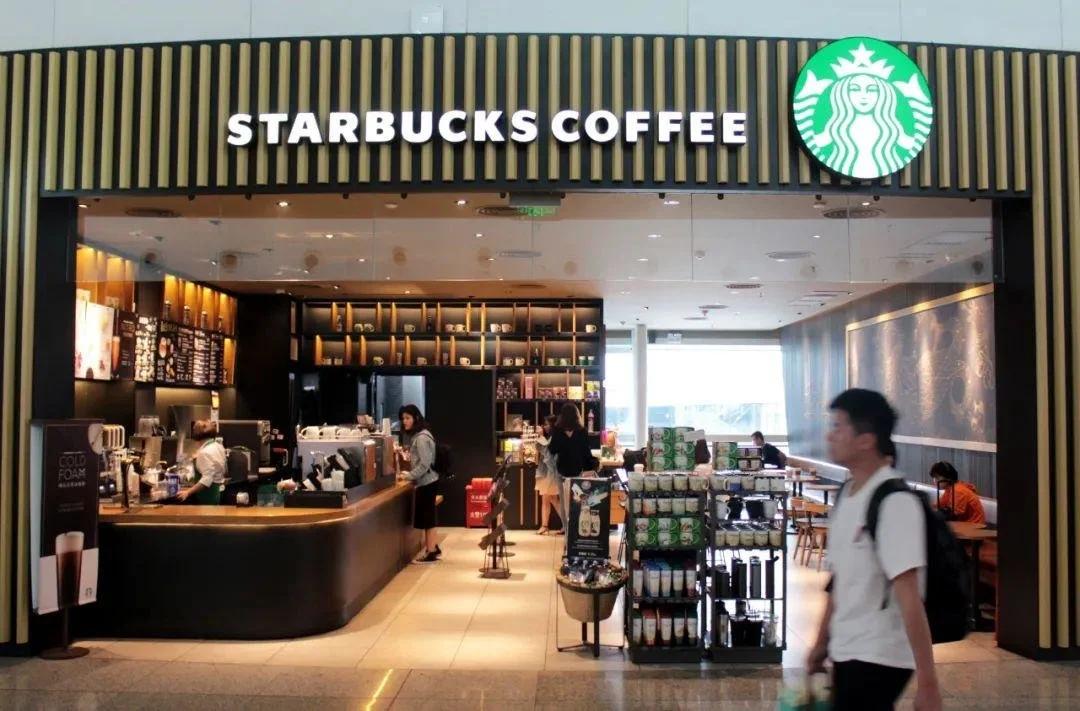
Core Insights - Starbucks reported Q3 FY2025 earnings with revenue of $8.918 billion from coffee shop operations, slightly exceeding market expectations, driven by the opening of 1,151 new stores globally, contributing $0.927 billion in incremental revenue [2] - In North America, revenue was $6.927 billion, a year-on-year increase of 1.6%, accounting for approximately 73% of total coffee shop revenue [2] - In China, revenue reached $0.790 billion, a year-on-year growth of 8%, marking one of the top three revenue performances since FY2023, supported by the opening of 522 new stores and strategic pricing adjustments [2] Group 1: Market Position and Competition - Starbucks' market share in China has declined from a peak of 42% in 2017 to 14% in 2024, despite the overall coffee market growing significantly [4][5] - Luckin Coffee's revenue for the same period was approximately $1.2359 billion, a year-on-year increase of 47.1%, indicating that its revenue is now roughly equivalent to 2.5 times that of Starbucks in China [4][5] - The shift in consumer preferences has led to a redefinition of coffee consumption, with Luckin positioning coffee as a daily beverage rather than a luxury item, challenging Starbucks' traditional "third space" concept [5][10] Group 2: Strategic Adjustments - Starbucks has introduced a "study room" concept in select locations to enhance its brand's spatial advantage, aiming to attract students and freelancers while avoiding direct price competition with lower-cost alternatives [12][13] - The company has also implemented price adjustments on key products, with average price reductions of 5 yuan, to remain competitive in a market increasingly defined by lower price points [8][9] - Starbucks is exploring strategic partnerships and potential equity sales to leverage local expertise and improve its competitive position in the Chinese market [15][17] Group 3: Financial and Operational Insights - As of June 2025, Starbucks operated 7,828 stores in China, representing nearly 20% of its total global store count of 41,097, but contributing only about 8% of total revenue [2] - The average annual revenue per store for Starbucks in China is approximately 730,000 yuan, compared to Luckin's 540,000 yuan, highlighting the disparity in operational efficiency [8] - The valuation of Starbucks' Chinese operations is estimated at $5 billion to $6 billion, significantly lower than its global market valuation, indicating a shift in perception from a key growth market to a discounted asset [18]
China's Luckin Coffee opens New York locations to rival Starbucks
NBC News· 2025-08-01 18:30
Starbucks, the once unrivaled global coffee shop king, now facing some tough competition from Lucken, a nimble Chinese startup, breaking into the US market this summer. With its first two stores in New York City, Lucken lures in customers with cheap, often colorful drinks and coupons galore. >> It's good. It's uh very affordable, quick.>> It's really cheaper than, you know, compared to the other coffee shop >> back in China. Those price points helping Lucken gain traction. That growth fueled by investors th ...
食饮吾见 | 一周消费大事件(7.28-8.1)
Cai Jing Wang· 2025-08-01 08:35
Group 1: Budweiser APAC - Budweiser APAC reported a 5.6% decrease in revenue to $3.136 billion for the first half of 2025, with normalized EBITDA down 8% to $983 million [1] - Sales volume declined by 6.1% to 4.363 billion liters, with a 7.4% drop in sales volume in the Chinese market during Q2 2025 [1] - The company focused on non-immediate consumption channels to drive premiumization, achieving growth in both sales and revenue from these channels [1] Group 2: Unilever - Unilever's revenue for the first half of 2025 was €30.1 billion, a 3.2% year-on-year decline, with ice cream business revenue growing by 0.2% [2] - The company plans to spin off its ice cream business by mid-November 2025, with operational separation already completed [2] Group 3: Daodaoquan - Daodaoquan reported a 563.15% increase in net profit to ¥181 million for the first half of 2025, with total revenue reaching ¥2.792 billion, a 1.16% increase [3] - Revenue from packaged oil increased by 20.53% to ¥1.751 billion [3] Group 4: Food Safety Issues - Taoli Bread issued an apology after a batch of its sliced bread failed quality checks, with 498 bags produced and 21 sold online [4] - The company has initiated a recall and implemented measures to enhance quality control and monitoring [4] Group 5: Regulatory Actions - The State Administration for Market Regulation reported 12,000 instances of non-compliance related to food additives in the first half of the year, with 4,727 companies penalized [5][6] - The agency emphasized the importance of strict monitoring and compliance regarding food additives to ensure food safety [5][6] Group 6: Luckin Coffee - Luckin Coffee's Q2 2025 net revenue reached ¥12.359 billion, a 47.1% year-on-year increase, with a gross merchandise volume of ¥14.179 billion [8] - The company opened 2,109 new stores, bringing the total to 26,206 globally, with significant growth in self-operated stores [8] Group 7: Starbucks China - Starbucks China reported an 8% revenue increase to $790 million for Q3 2025, marking three consecutive quarters of growth [9] - The company is evaluating partnerships with over 20 interested institutions to retain a significant equity stake in its Chinese operations [9] Group 8: L'Oréal - L'Oréal's sales for the first half of 2025 increased by 3.2% to €22.47 billion, with North Asia's skincare division maintaining double-digit growth [10][11] - The company noted strong performance from high-end brands, offsetting weaknesses in the skincare category [11] Group 9: Yonghui Supermarket - Yonghui Supermarket announced plans to raise up to ¥3.992 billion through a private placement of A-shares, with funds allocated for store upgrades and logistics improvements [13]




谁在“围猎”星巴克?
3 6 Ke· 2025-08-01 01:18
Core Insights - Starbucks' market share in China has significantly declined from a peak of 42% in 2017 to 14% in 2024, despite a strong performance in its Chinese operations with a 7% increase in store count year-over-year [3][6] - Luckin Coffee has shown remarkable growth, reporting a total net revenue of 12.36 billion yuan, a 47.1% year-over-year increase, and a GAAP operating profit growth of 61.8% to 1.7 billion yuan [3][19] - The coffee market in China is experiencing intense competition, particularly in lower-tier cities and price-sensitive segments, with various brands aggressively expanding their presence [4][12] Market Performance - Starbucks' global net profit has decreased by 47.1%, while its Chinese operations have seen a 2% increase in same-store sales and a 6% increase in transaction volume [1][3] - The number of registered coffee shops in China has surged, with nearly 30,000 new registrations, marking a 19.54% increase in the first half of the year [4][6] Competitive Landscape - Brands like Luckin Coffee and Mixue Ice City are targeting the lower-tier markets and one- to two-line cities, with Mixue aiming to exceed 10,000 stores by the end of the year [3][15] - The coffee market is shifting towards a "store-in-store" model, allowing brands to leverage existing retail spaces, which has become a common strategy among various coffee brands [9][11] Consumer Behavior - The average coffee consumption in China has increased from 9 cups per year in 2021 to approximately 22 cups in 2024, indicating significant growth potential compared to countries like the U.S. and Japan [14][18] - Price remains a critical factor in consumer decision-making, with brands competing aggressively on pricing to capture market share [18][19] Strategic Focus - Starbucks is expanding into 166 new county-level markets in China, but faces challenges due to its higher price point compared to competitors [6][12] - The coffee market is transitioning from rapid store expansion to a focus on operational efficiency and product quality, as brands seek to establish a sustainable presence [19]
蜜雪“收割”瑞幸红利 幸运咖年内万店 打通一线城市
2 1 Shi Ji Jing Ji Bao Dao· 2025-08-01 00:21
Core Insights - The company aims to expand its coffee brand, Lucky Coffee, to over 10,000 stores by early 2025, with a significant increase in new store openings and franchise inquiries in 2023 [1][4][5] Company Performance - Lucky Coffee's store count has surpassed 7,000, covering over 300 cities in China, making it the fourth-largest fresh coffee brand in the country [1] - In Q2 2023, Lucky Coffee experienced a 164% year-on-year increase in new store openings, and franchise inquiries surged over 300% since July [1][2] - The average daily revenue per store reached 5,732 yuan on July 12, with a 258% increase in takeaway orders [2] Marketing and Sales Strategy - The sales surge is attributed to aggressive marketing strategies and cautious use of takeaway subsidies, ensuring profitability for franchisees [3][19] - Lucky Coffee is focusing on high-potential cities and has optimized store sizes to reduce operational costs for franchisees [3][21] - The company has lowered franchise investment requirements from 35 million yuan to 25 million yuan and adjusted age requirements for franchisees [7][21] Supply Chain and Production - Recent investments in supply chain capabilities include a new coffee bean roasting facility with an annual capacity exceeding 20,000 tons [6] - The company has signed a 4 billion yuan procurement agreement with Brazil for coffee beans, indicating a commitment to scaling operations [9][10] Market Trends - The coffee market in China is maturing, with per capita coffee consumption increasing from 9 cups in 2016 to 16.74 cups in 2023 [12] - The market still has significant growth potential, with a low concentration of coffee chains compared to tea [17] - Competitors like Luckin Coffee and Kudi are also expanding rapidly, indicating a growing market [18][14] Brand Positioning - Lucky Coffee aims for a "high-quality, affordable" positioning, contrasting with competitors that target high-end markets [21] - The brand's strategy of expanding from lower-tier cities to higher-tier ones reflects a unique market approach [20]