
Morgan Stanley(MS)

Search documents
ETO Markets:美国12月核心CPI创新低,为何华尔街仍不买账?
Sou Hu Cai Jing· 2026-01-14 06:42
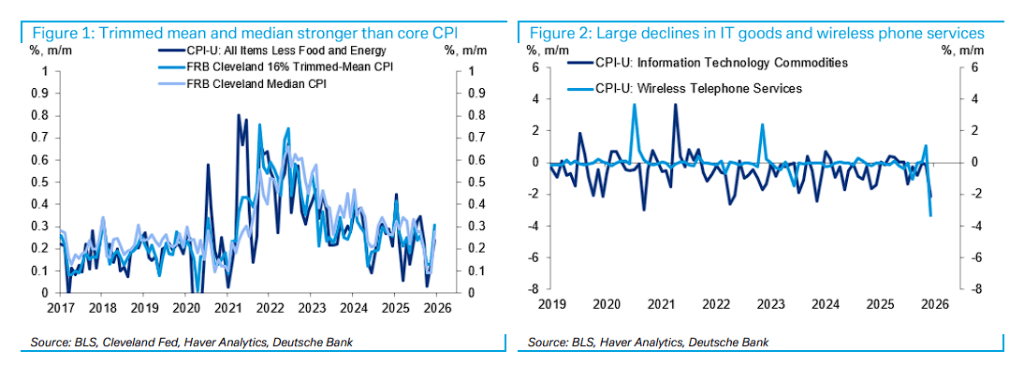
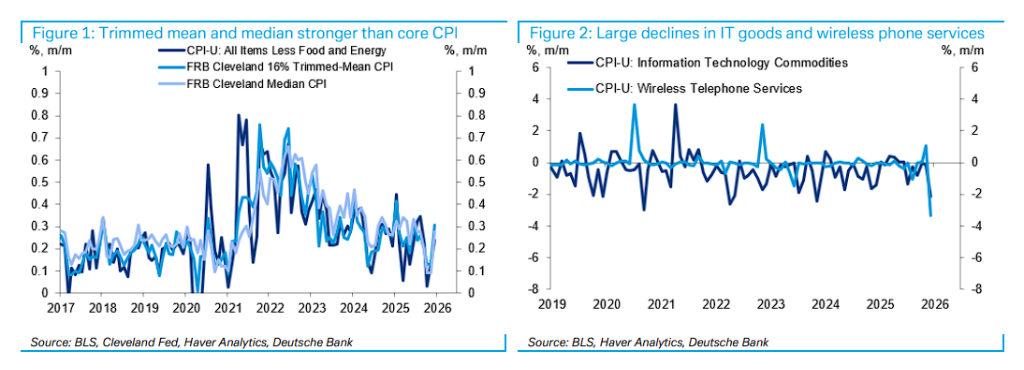
Core Viewpoint - The December CPI data released by the U.S. Bureau of Labor Statistics indicates a year-on-year increase of 2.6%, the lowest since March 2021, with a month-on-month increase of 0.2%, below the expected 0.3%. However, this report did not ignite investor optimism, as the market did not interpret it as a clear signal for the Federal Reserve to accelerate interest rate cuts [1] Group 1: CPI Analysis - Deutsche Bank and Morgan Stanley have raised concerns about the December CPI, suggesting it is filled with unsustainable statistical noise and distortions, indicating that the true inflation trend should be assessed through the upcoming core PCE price index, which the Federal Reserve pays more attention to and is expected to rebound significantly [1][3] - The December CPI's cooling is seen as a technical factor leading to a false impression, with significant data distortions masking the true inflation intensity. For instance, prices for information technology goods fell by 2.16%, and wireless telephone services dropped by 3.33%, collectively lowering the core CPI by about 6 basis points [1] Group 2: Alternative Inflation Indicators - The Cleveland Fed's trimmed-mean CPI and median CPI for December showed month-on-month increases of 0.31% and 0.28%, respectively, both higher than the core CPI, indicating that underlying inflation pressures in the U.S. are more entrenched than suggested by the core CPI [3] - Price data for specific categories supports this view, with clothing prices rising by 0.59%, the second-largest monthly increase since February 2025, and household goods prices increasing by 0.54%, the third-largest increase since November 2024 [3] Group 3: PCE Forecast Adjustments - Morgan Stanley has raised its December core PCE month-on-month forecast from 0.37% to 0.46%, contrasting sharply with the overall CPI performance. The key difference lies in the weight distribution of the two inflation indicators, with stronger price increases in higher-weighted categories in the PCE basket [4] - Notably, video media rental prices surged by 19.5% month-on-month, contributing approximately 8 basis points to the core PCE, while software prices also contributed 8 basis points. Even excluding these two items, the core PCE month-on-month rate would still reach 0.30% [4] Group 4: Tariff Impact on Inflation - Both Deutsche Bank and Morgan Stanley have observed that prices for tariff-sensitive goods rose again in December, continuing the upward trend after a brief decline in October and November. Deutsche Bank noted that while clothing prices have not yet significantly reflected tariff pressures, upstream supply chain pressures are accumulating, indicating that consumer price increases may be imminent [6] Group 5: Federal Reserve's Response - The Federal Reserve's reaction to the noisy CPI data is under scrutiny. Deutsche Bank believes that the December CPI represents a mix of distorted data recovery and genuine weakness signals, suggesting that the Fed will require more data to support further interest rate cuts [8] - Morgan Stanley assesses that the Fed can identify the "noise" in the data and may downplay the strong performance indicated in the core PCE projections, but the uncertainty in the data will likely lead the Fed to maintain a cautious stance [8]


Asian stocks today: Markets rise after Wall Street tumbles; HSI adds 180 points, Nikkei up 1%
The Times Of India· 2026-01-14 03:35
Market Performance - Hong Kong's HSI traded at 27,037, up 188 points or 0.7% [2][4] - Nikkei increased by 864 points or 1.6% to 54,413 [2][4] - Shanghai and Shenzhen indices rose by 1.11% and 1.83% respectively [2][4] - South Korea's Kospi was down 4 points around 9 am IST [2][4] US Market Influence - US stocks retreated on Tuesday, with the S&P 500 pulling back from a record high [2][4] - Losses were primarily driven by banking shares after JPMorgan Chase & Co. reported investment-banking fees below guidance [2][4] - December inflation data did not significantly alter expectations for the Federal Reserve's interest-rate cuts [2][4] Bank Earnings Outlook - A heavy slate of bank earnings is being tracked, with results from major banks like Bank of America, Wells Fargo, Citigroup, Goldman Sachs, and Morgan Stanley expected soon [3][4] - The banking group is projected to achieve its second-highest annual profit on record, aided by policy changes under the Trump administration [3][4] Tariff Ruling Risks - The potential US Supreme Court ruling on President Trump's global tariffs is a key risk factor [3][4] - An unfavorable ruling could lead to a negative market response, although the administration has alternative legal routes to enforce tariffs [3][4] Commodity Market Trends - Brent crude prices extended gains, marking the largest four-day rise since June due to heightened rhetoric around Iran [3][4] - Silver prices continued to rise, achieving the strongest three-day rally on record [3][4]



美国CPI降温,市场为何无动于衷?数据失真,关键要看下周的PCE
Hua Er Jie Jian Wen· 2026-01-14 03:07
Core Viewpoint - The December CPI data appears mild but is filled with unsustainable noise and statistical distortions, according to Deutsche Bank and Morgan Stanley. The true test will be the upcoming PCE data [1][3]. CPI Analysis - The December CPI data showed a year-over-year core CPI increase of 2.6%, the lowest since March 2021, and a month-over-month increase of 0.2%, both below expectations [1]. - Deutsche Bank highlighted that the CPI data is distorted, with significant downward pressure from abnormal declines in information technology goods and wireless phone services, which together lowered the core CPI by about 6 basis points [4][6]. - The trimmed mean CPI and median CPI, which exclude extreme values, were reported at 0.31% and 0.28% respectively, indicating stronger underlying inflation pressures [1][6]. PCE Forecast - Morgan Stanley warned that despite the lower-than-expected core CPI, their forecast for the December PCE price index suggests a month-over-month increase of 0.46%, significantly higher than the CPI performance [2][9]. - The divergence between CPI and PCE is attributed to the differing weightings of goods and services in the two indices, with PCE showing stronger price increases in categories that have higher weights [9][11]. Market Implications - The market is awaiting the PCE data to confirm the true inflation trend. If the PCE rebounds as expected, it will limit the Federal Reserve's ability to continue lowering interest rates [3]. - Deutsche Bank noted that the CPI data reflects a mix of distorted November data recovery and genuine weakness, suggesting the Fed will likely wait for more data before signaling further rate cuts [14]. Tariff Effects - Both Deutsche Bank and Morgan Stanley observed signs of tariff impacts on inflation data, with prices of tariff-sensitive goods rising again in December, indicating potential future consumer price increases [12].
Earnings Preview: Morgan Stanley to Report This Week
Schaeffers Investment Research· 2026-01-13 20:21
Big banks are kicking off earnings season this week, with JPMorgan Chase (JPM) weighing on the market today. The sector hit a snag yesterday as well, after President Donald Trump called for a 10% cap on credit card rates for one year. Morgan Stanley's (NYSE:MS) fourth-quarter report is due out before the open on Thursday, Jan. 15. Per Zacks Investment Research, analysts expect earnings of $2.41 per share on revenue of $17.32 billion, a year-over-year increase of 8.6% and 6.8%, respectively. Looking back, Mo ...
Top Wall Street Forecasters Revamp Morgan Stanley Expectations Ahead Of Q4 Earnings
Benzinga· 2026-01-13 19:09
Earnings Report - Morgan Stanley is set to release its fourth-quarter earnings on January 15, with analysts expecting earnings of $2.45 per share, an increase from $2.22 per share in the same period last year [1] - The consensus estimate for quarterly revenue is $17.75 billion, up from $16.22 billion reported last year [1] Investment Activity - Morgan Stanley's middle-market private equity arm has made a majority investment in engineering firm Olsson, Inc. [2] - Following the announcement, Morgan Stanley's shares fell by 1.7%, trading at $183.34 [2] Analyst Ratings - Wolfe Research analyst upgraded Morgan Stanley from Peer Perform to Outperform with a 71% accuracy rate [3] - JP Morgan maintained a Neutral rating but increased the price target from $122 to $157, with a 76% accuracy rate [3] - Keefe, Bruyette & Woods maintained an Outperform rating and raised the price target from $176 to $184, with a 62% accuracy rate [3] - Evercore ISI Group maintained an Outperform rating and increased the price target from $165 to $175, with a 73% accuracy rate [3] - Wells Fargo maintained an Equal-Weight rating and raised the price target from $165 to $177, with a 73% accuracy rate [3]

Navigating Midday Markets: Inflation Data, Bank Earnings, and Key Corporate Moves on January 13, 2026
Stock Market News· 2026-01-13 17:07
Market Overview - U.S. stock markets are experiencing a mixed session with major indexes showing slight pullbacks as investors assess inflation data and fourth-quarter earnings reports [1][2] - The S&P 500 Index is down less than 0.1%, the Nasdaq Composite Index has slipped 0.2%, and the Dow Jones Industrial Average has fallen 0.6% [2] Economic Indicators - The December Consumer Price Index (CPI) data shows a 2.7% year-over-year rise in headline inflation, matching expectations, while core inflation is at 2.6%, slightly below the projected 2.8% [4] - The 10-year Treasury yield has decreased to below 4.18% from 4.20% following the CPI data release, indicating potential room for Federal Reserve interest rate cuts [4] Earnings Reports - JPMorgan Chase (JPM) reported adjusted profits exceeding expectations but with slightly lower revenue, leading to a 2.5% decline in shares [7] - Delta Air Lines (DAL) shares fell nearly 6% pre-bell and 1.5% in recent trading after forecasting lower-than-expected profit growth for fiscal 2026, despite reporting operating revenue of $16.00 billion [7] - L3Harris Technologies (LHX) shares surged 3% to an all-time high following plans to spin off its Missile Solutions business, supported by a $1 billion government investment [8] Sector Movements - A sector rotation trend has been observed since late December 2025, with the Dow Jones and small-cap Russell 2000 outperforming AI-heavy mega-cap technology stocks [3] Corporate Developments - Sun Country Airlines Holdings Inc. (SNCY) shares jumped 10.6% after announcing an acquisition agreement with Allegiant Travel (ALGT) valued at $18.89 per share [10] - Posco Holdings Inc. (PKX) shares rose 12% after raising $700 million in global bond markets and providing a positive earnings outlook for 2026 [11] Political Impact - President Trump's proposal to cap credit card interest rates at 10% has negatively impacted financial stocks, with Visa (V) and Mastercard (MA) down 5%, and American Express Company (AXP) down 4.3% [9]





又有投行奖金大涨!
Xin Lang Cai Jing· 2026-01-13 16:24
Group 1 - The core point of the article is that Morgan Stanley's average bonuses in the Asia region have increased by 20%, with the company achieving a record revenue of $10 billion last year [1] - The significant revenue growth is attributed to exceptional performance in equity trading, institutional brokerage, and wealth management, with overall income for investment bankers rising by 15%-20% [1] - The best-performing managing directors (MDs) in emerging sectors, including technology, are expected to receive total compensation packages between $2 million and $2.5 million, contrasting sharply with the $1 million to $1.5 million packages in 2024 [1] Group 2 - Despite the record performance in Asia, Morgan Stanley cautions against significantly increasing bonus amounts, aiming to maintain stable compensation levels [1] - The growth of the overall bonus pool in Asia is being restrained by rising stock prices and a large number of junior employees [1]
Is MS Stock a Buy Ahead of Q4 Earnings on Favorable Industry Trends?
ZACKS· 2026-01-13 16:01
Core Viewpoint - Morgan Stanley is expected to report strong fourth-quarter and full-year 2025 earnings, driven by robust trading and investment banking performances, with a consensus revenue estimate of $17.32 billion, reflecting a 6.8% year-over-year growth [2][9]. Financial Performance - The consensus estimate for earnings for the upcoming quarter has been revised 1.3% higher to $2.41, indicating an 8.6% improvement from the prior-year quarter [3]. - Morgan Stanley has a history of earnings surprises, having outperformed the Zacks Consensus Estimate in the last four quarters with an average beat of 24.03% [5][7]. Investment Banking (IB) Income - Global mergers and acquisitions (M&As) surged in Q4 2025, contributing to increased advisory fees, with the Zacks Consensus Estimate for advisory fees at $818.2 million, a 5% year-over-year rise [8]. - The IPO activity was strong, supported by moderating inflation and lower rates, with equity and fixed-income underwriting fees projected to increase by 23% year-over-year [9][10]. Trading Revenues - Trading revenues are expected to be strong due to increased client activity and market volatility, with equity trading revenues estimated at $3.44 billion (up 3.5% year-over-year) and fixed-income trading revenues at $1.95 billion (up nearly 1%) [12][13]. Net Interest Income (NII) - NII is expected to show a modest improvement despite recent Federal Reserve interest rate cuts, with the consensus estimate at $2.53 billion, indicating a 1% year-over-year decline [14][15]. Cost Management - Overall costs are anticipated to be elevated due to investments in franchises, which may limit the effectiveness of cost reduction strategies [15]. Stock Performance and Valuation - Morgan Stanley's stock has performed well compared to its peers, trading at a forward P/E of 17.63X, above the industry average of 15.35X, indicating a stretched valuation [21][22]. - The company has strengthened its position in Japan through a partnership with Mitsubishi UFJ Financial Group, enhancing its equity research and sales capabilities [23]. Strategic Initiatives - Morgan Stanley is diversifying its revenue streams by reducing reliance on capital markets and expanding its wealth and asset management franchises through acquisitions [24][25]. - The capital markets backdrop appears constructive, supporting steady improvement in activity levels, which bodes well for future performance [26]. Risk-Reward Profile - Given the favorable market conditions and strategic initiatives, Morgan Stanley's shares are viewed as offering an attractive risk-reward profile [29].

美股开盘走平 通胀数据公布后市场料美联储短期内可从容维持利率不变
Xin Lang Cai Jing· 2026-01-13 14:59
Group 1 - The latest inflation report indicates that the core CPI in the U.S. rose by 2.6% year-on-year, which is lower than expected, failing to change market expectations regarding the Federal Reserve's pause on interest rate cuts [1][2][3] - The three major U.S. stock indices remained flat, with the S&P 500 hovering around 6,980 points, reflecting a temporary easing of price pressures that calmed investor sentiment [1][2] - The Federal Reserve has cut rates three times since September of the previous year, and the market predicts the next rate cut will not occur until mid-2026, with no cuts expected at the end of this month [1][2] Group 2 - Analysts from Principal Asset Management and eToro suggest that the lower-than-expected core CPI data is unlikely to alter the decision-making logic for the Federal Reserve's January meeting, given the low unemployment rate and higher-than-trend economic growth [3] - The inflation report, released after the government shutdown, provided much-needed macroeconomic information to the market, although its impact on stock investors is expected to be limited as attention shifts to the upcoming earnings season [3] - The earnings season for the banking sector has commenced, with major banks such as Bank of America, Wells Fargo, Citigroup, Goldman Sachs, and Morgan Stanley set to report their earnings on Wednesday and Thursday [2][3]
摩根士丹利:通胀并未升温但仍高于目标 不足以支持美联储1月降息
Sou Hu Cai Jing· 2026-01-13 14:25
Core Insights - The current inflation situation in the U.S. is not showing signs of re-acceleration, but it remains above target levels [1] - The cost transmission from tariffs is still limited, indicating that inflationary pressures are not significantly increasing [1] - There has been no improvement in housing affordability, which continues to be a concern [1] - The latest inflation report does not provide sufficient justification for the Federal Reserve to consider interest rate cuts in the near term [1]