
NIO(NIO)

Search documents
12月30日热门中概股涨跌不一 蔚来涨5.10%,阿里巴巴跌2.47%
Xin Lang Cai Jing· 2025-12-29 21:25
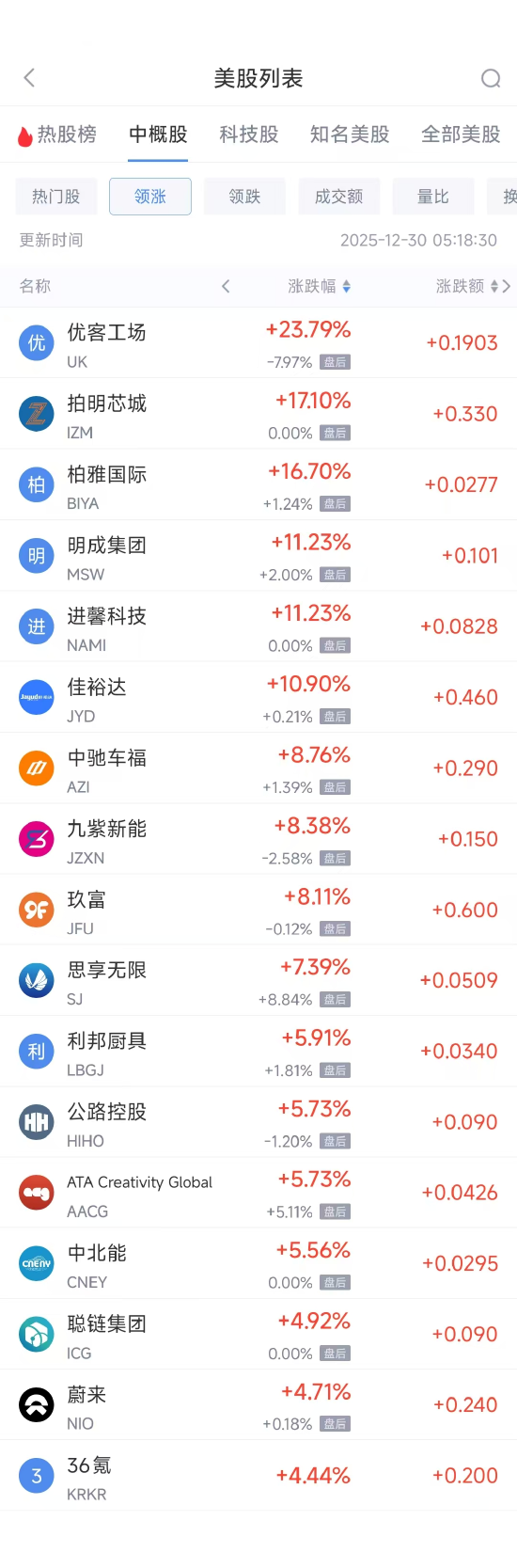
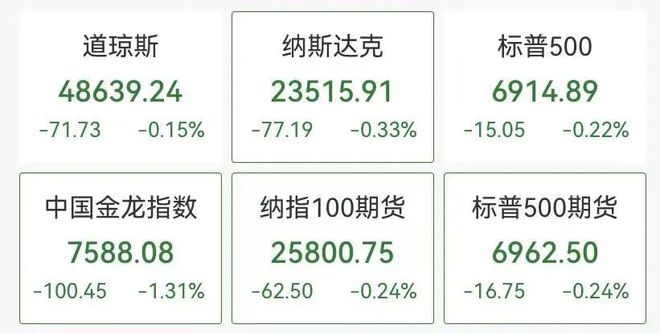
Core Viewpoint - The Nasdaq China Golden Dragon Index (HXC) experienced a decline of 0.67% on December 30, with mixed performance among Chinese concept stocks, as the U.S. stock market faced profit-taking pressures, particularly affecting AI-related stocks [1]. Group 1: Stock Performance - Among the rising stocks, Netease increased by 0.92%, Ctrip by 0.15%, Baidu by 1.61%, and NIO by 5.10% [1][8]. - Declining stocks included Alibaba, which fell by 2.47%, Pinduoduo by 0.75%, and JD.com by 0.44% [1][8]. - The Dow Jones Industrial Average dropped by 249.04 points, or 0.51%, closing at 48,461.93 points, while the Nasdaq fell by 118.75 points, or 0.50%, to 23,474.35 points [1][8]. Group 2: Notable Gainers and Losers - Leading gainers included Youke Gongchang with a rise of 23.79%, followed by Paiming Xincheng at 17.10% and Baiya International at 16.70% [9][10]. - Significant losers featured Zhengye Biology, which plummeted by 21.57%, followed by Haoxin Holdings at 18.09% and Shuhai Co., which fell by 17.35% [11][12].


纳斯达克中国金龙指数收跌0.66%,蔚来涨超5%
Mei Ri Jing Ji Xin Wen· 2025-12-29 21:14
每经AI快讯,12月30日,纳斯达克中国金龙指数收跌0.66%。蔚来涨超5%,爱奇艺、百度涨超1%;阿 里巴巴跌超2%,名创优品跌近2%,哔哩哔哩跌超1%。 ...
银铂钯深夜暴跌超10%,美股黄金股普跌,中概股多数下挫,油价走高
2 1 Shi Ji Jing Ji Bao Dao· 2025-12-29 15:56
Market Overview - US stock indices opened lower and experienced a significant drop, with technology and gold stocks declining broadly, and most Chinese concept stocks also falling [1][3] - Precious metals market saw a sharp decline, with silver, platinum, and palladium dropping over 10%, while gold fell to around $4310 [1][7] Technology Sector - Major tech stocks mostly declined, with only Apple showing a slight increase of 0.2%. Notable declines included Tesla and Nvidia, both down over 2% [3][4] - Year-to-date performance for key tech stocks showed mixed results, with Nvidia down 2.13% and Tesla down 2.61%, while Alphabet and Amazon had gains of 65.31% and 5.88% respectively [4] Chinese Concept Stocks - The Nasdaq Golden Dragon China Index fell over 1%, with significant drops in stocks like Zhengye Technology down over 11% and Dingdong down nearly 9%. Alibaba and Xpeng Motors also fell over 2% [1][3] Precious Metals - Precious metals prices faced a severe drop, with silver experiencing a dramatic fall of over 10% after initially rising more than 5%. Gold dropped nearly 5% to around $4310, while platinum and palladium saw declines of over 13% and 15% respectively [7][8] - The London silver price fell by 10.28% to $71.174, while the London gold price decreased by 4.71% to $4318.865 [8] Regulatory Actions - In response to the heightened trading activity in the precious metals market, regulators issued urgent measures advising investors to manage risks [9] - CME Group announced an increase in margin requirements for gold, silver, and lithium futures, which is expected to raise trading costs and lead to profit-taking before the new rules take effect [10] Oil Market - International oil prices continued to rise, with both WTI and Brent crude oil increasing over 2%, recovering a significant portion of previous losses [10][11]


美股异动 | 蔚来(NIO.US)涨逾3% 全新ES8交付破四万辆
智通财经网· 2025-12-29 15:10
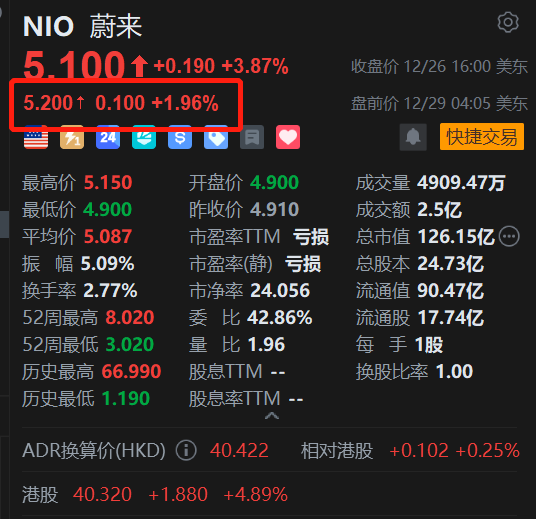
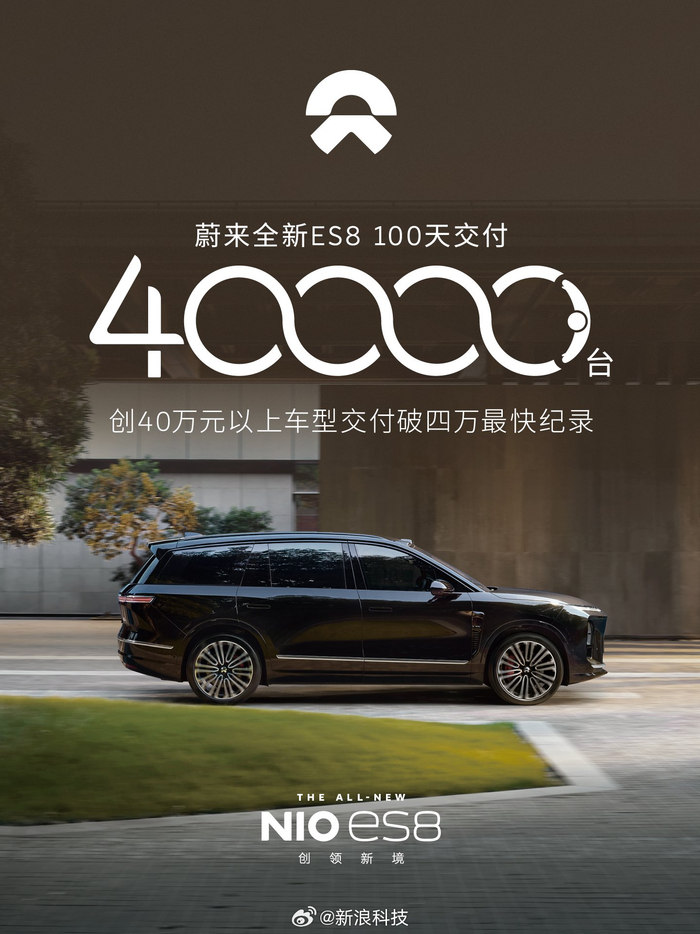
智通财经APP获悉,周一,蔚来(NIO.US)涨逾3%,报5.28美元。消息面上,蔚来汽车12月29日宣布,在 正式交付开启后的第100天,蔚来全新ES8成功实现交付破四万辆。在蔚来全新ES8和乐道L90两大爆款 车的带动下,该公司新能源车销量连创新高。最新数据显示,蔚来11月交付新车36,275台,同比增长 76.3%。自今年8月以来,公司交付量已连续四个月交付超过3万。 ...
蔚来(NIO.US)涨逾3% 全新ES8交付破四万辆
Zhi Tong Cai Jing· 2025-12-29 15:09
周一,蔚来(NIO.US)涨逾3%,报5.28美元。消息面上,蔚来汽车12月29日宣布,在正式交付开启后的 第100天,蔚来全新ES8成功实现交付破四万辆。在蔚来全新ES8和乐道L90两大爆款车的带动下,该公 司新能源车销量连创新高。最新数据显示,蔚来11月交付新车36,275台,同比增长76.3%。自今年8月以 来,公司交付量已连续四个月交付超过3万。 ...
蔚来(NIO)盘前涨超1% 全新ES8交付破四万辆
Xin Lang Cai Jing· 2025-12-29 13:44
消息面上,蔚来汽车今日宣布,在正式交付开启后的第100天蔚来全新ES8成功实现交付破四万辆。 金吾财讯 | 蔚来(NIO)盘前涨超1%,截至发稿,报5.160美元。 消息面上,蔚来汽车今日宣布,在正式交付开启后的第100天蔚来全新ES8成功实现交付破四万辆。 金吾财讯 | 蔚来(NIO)盘前涨超1%,截至发稿,报5.160美元。 ...
美股异动|多重利好叠加,蔚来盘前涨2%,H股今日收涨近5%
Ge Long Hui· 2025-12-29 09:17
Core Viewpoint - NIO has achieved significant milestones in vehicle deliveries and expansion of its battery swapping network, positively impacting its stock performance in both Hong Kong and the US markets [1]. Group 1: Vehicle Deliveries - NIO has delivered its 40,000th vehicle just 11 days after reaching the milestone of 30,000 deliveries for its third-generation ES8 [1]. Group 2: Battery Swapping Network - The company is set to complete its battery swapping route in Yunnan-Tibet, with the Deqin Meili Snow Mountain station scheduled to go live on January 1, covering over 2,700 kilometers and establishing 19 battery swapping stations [1]. Group 3: Collaboration for Battery Recycling - NIO has partnered with Shanghai Electric to repurpose retired batteries for use in energy storage stations, enhancing sustainability efforts [1].
蔚来出席联合国开发计划署年度研讨会 秦力洪发表主旨报告
Zhong Guo Zhi Liang Xin Wen Wang· 2025-12-29 07:51
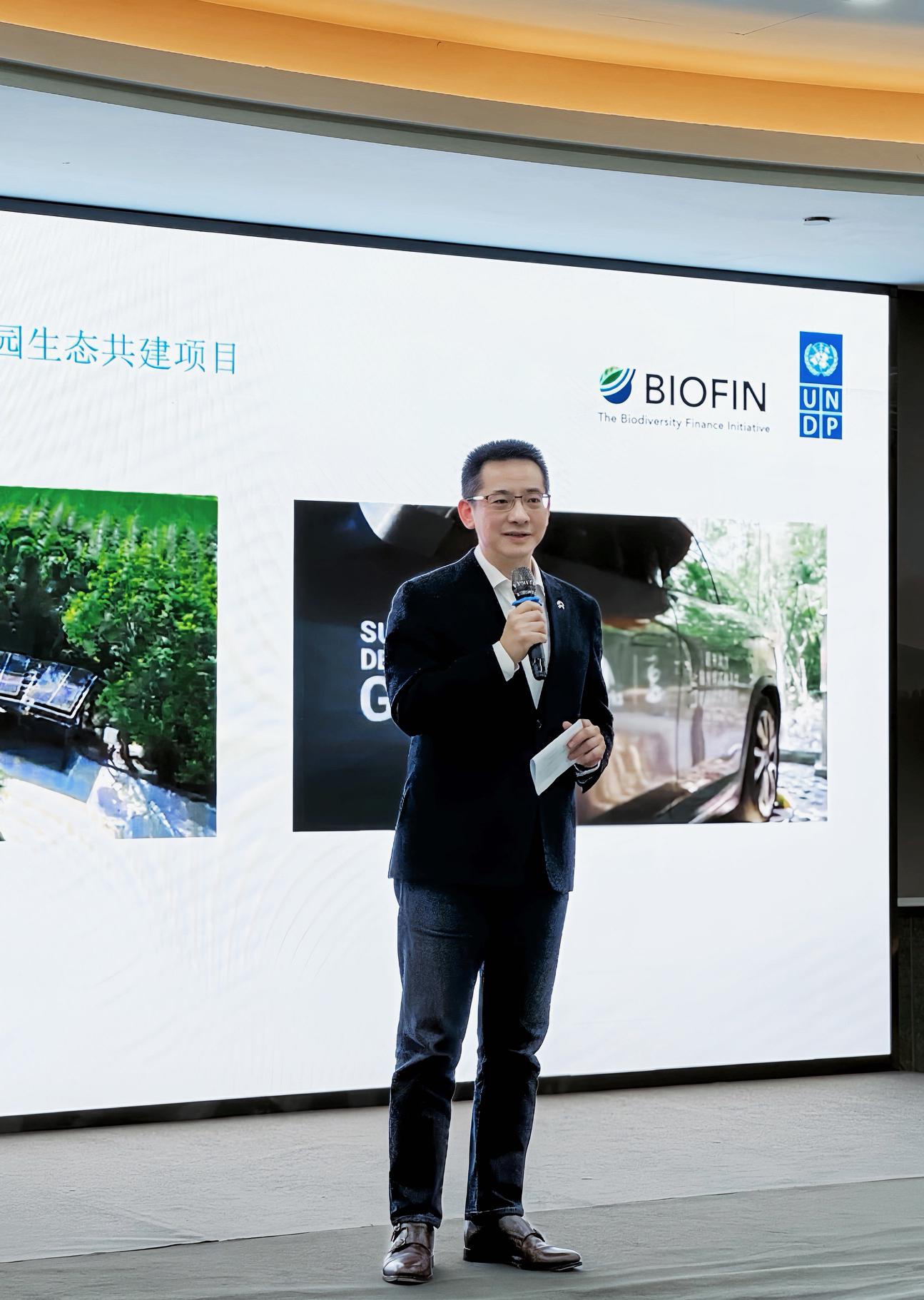
12月20日-21日,联合国开发计划署生物多样性金融倡议(UNDP BIOFIN)在北京举办年度研讨会,蔚来作为车企参加,联合创始人、总裁秦力洪在会上发 表主旨报告并参加圆桌讨论。 蔚来一直致力于与合作伙伴共同探索系列环保材料合集-- Clean+材料,包括可再生、可循环、用户健康保护等更低碳的环境友好材料。例如ET5车型所应用 的Clean+环保织物面料,原材料100%采用PET材料,减少环境污染;在ET5车型应用的Clean+聚合材料融合了天然矿物和植物纤维,与常规材料相比,生产 过程碳排放减少30%以上。 三、蔚来先进制造工厂可持续探索成果 蔚来从2017年就开始在工厂探索以地源热泵的方式保持车间恒温,同时充分利用光伏与绿电。目前蔚来先进制造合肥一工厂和蔚来先进制造新桥二工厂可再 生能源利用率占总耗电量50%以上。蔚来先进制造新桥二工厂在设计阶段就采用海绵城市理念,运用多种技术保障措施,充分开发雨水资源系统,实现可持 续水循环利用,还能防止雨季内涝。 四、供应链管理减碳实践 秦力洪介绍,蔚来以"Blue Sky Coming"为使命,从不认为气候与生物多样性是"后来附加的责任"。蔚来一直在探索实践从自身 ...
蔚来ES8百天交付4万台创40万+车型纪录
Xin Lang Ke Ji· 2025-12-29 07:23
Group 1 - NIO's ES8 achieved over 40,000 deliveries in just 100 days, setting a record for vehicles priced above 400,000 yuan [1][2] - The delivery volume increased steadily from 10,000 to 40,000 units, with the time interval for each milestone decreasing, indicating a stable delivery process [1] - In November, the new ES8 delivered 10,677 units, ranking second in overall new energy SUV sales and first in pure electric SUV sales for that month [1] Group 2 - Over 60% of the new ES8 buyers came from traditional luxury fuel vehicle brands, with nearly half being owners of German brands (BBA) [1] - The model also attracted some customers from other new energy brands, reflecting the expanding market appeal of high-end electric vehicles [1]
汽车周报:补贴落地践行渐进,看好预期修复下的交易机会-20251229
Shenwan Hongyuan Securities· 2025-12-29 07:16
Investment Rating - The report maintains a positive outlook on the automotive industry, particularly focusing on the mid-to-high-end and used car markets, as well as the impact of new subsidies [2]. Core Insights - The upcoming subsidies are expected to alleviate previous concerns regarding the total market volume for 2026, with a focus on companies like BYD and Geely, which cater primarily to mid-to-low-end demand [2]. - The report highlights the potential for significant performance improvement in parts manufacturers in the first half of 2026 due to subsidy support, recommending companies with strong fundamentals and low valuations [2]. - The report identifies new energy vehicle companies such as XPeng, NIO, and Li Auto, which have advantages in AI and robotics, as potential investment opportunities [2]. - The report notes a positive trend in the used car market and overall dealer profitability, recommending companies like Uxin [2]. - The report emphasizes the importance of state-owned enterprise reforms, particularly for SAIC and Dongfeng, as a key area to watch [2]. Industry Update - According to the China Passenger Car Association, the average daily retail sales of passenger cars in the third week of December reached 77,000 units, a year-on-year decrease of 11% but a month-on-month increase of 9% [2]. - The automotive industry recorded a total transaction value of 582.81 billion yuan for the week, with an industry index increase of 2.74%, outperforming the Shanghai Composite Index [6]. - The report indicates that 172 automotive stocks rose while 94 fell, with the largest gainers being Chaojie Co., Longi Machinery, and Zhejiang Sebao [11]. Market Conditions - The report notes that traditional and new energy raw material price indices have risen recently, with traditional vehicle raw materials increasing by 1.3% week-on-week and 1.0% month-on-month, while new energy vehicle raw materials rose by 5.6% week-on-week and 6.8% month-on-month [62]. - The automotive industry’s price-to-earnings ratio stands at 29.17, ranking 19th among all sectors, indicating a moderate valuation compared to the Shanghai Composite Index's 14.15 [8][10]. Key Events - The report highlights the optimization of toll road policies and the improvement of autonomous driving regulations as significant developments that will enhance the operational efficiency of the transportation system [3][4]. - The report mentions the launch of the first L3 autonomous driving license plate in China, awarded to Changan Automobile, marking a milestone in the industry [24][44].

