
Nissan Motor(NSANY)

Search documents
多家车企电池工厂计划生变
汽车商业评论· 2025-05-25 14:55
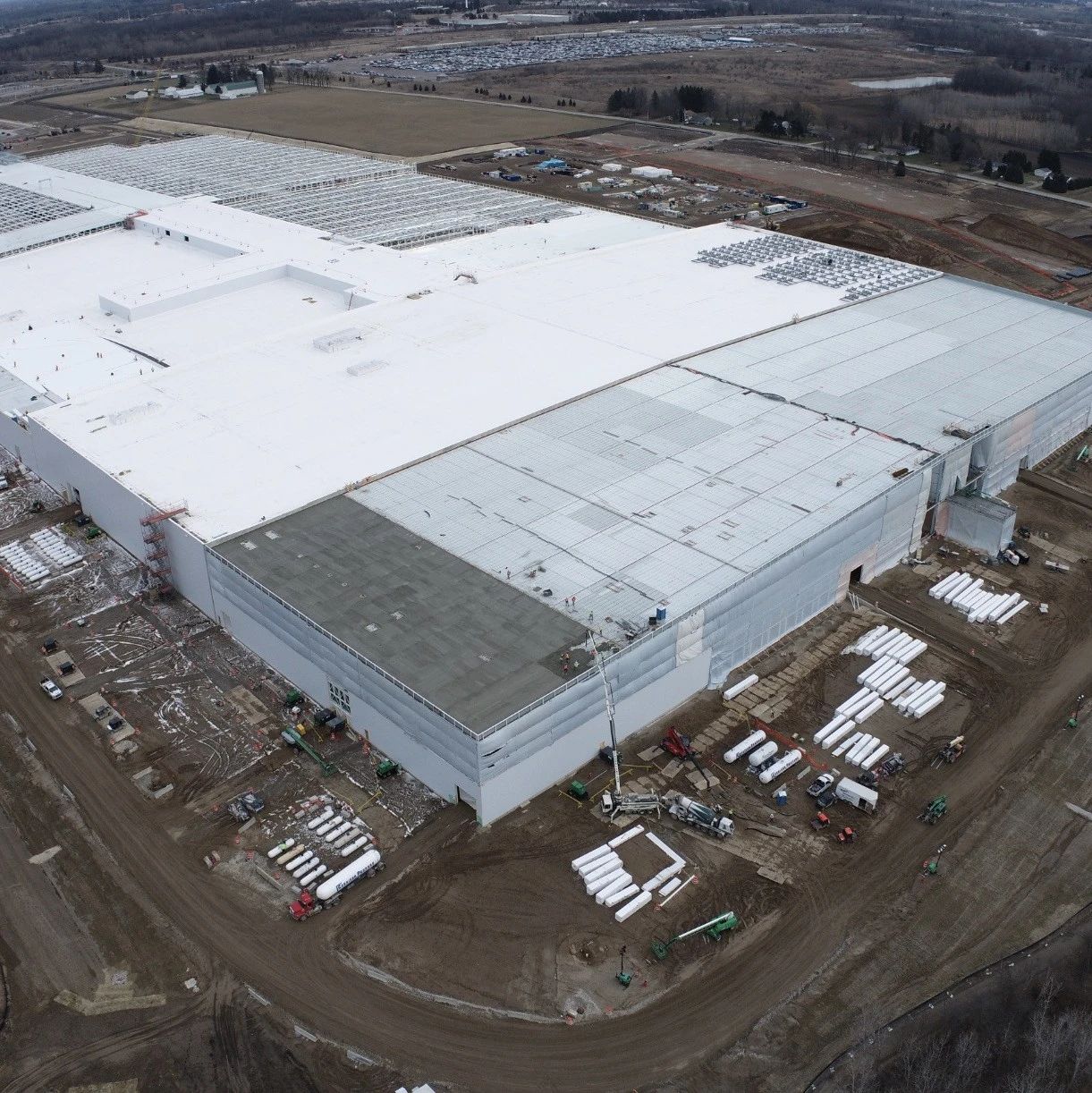
Core Viewpoint - The automotive industry is adjusting its electric vehicle (EV) strategies due to slowing demand and rising costs, leading to a more cautious outlook on EV growth compared to previous optimistic projections [4]. Group 1: Industry Adjustments - Automakers are revising their EV production plans, with Nissan utilizing Ford's battery production facility in Kentucky to mitigate tariff risks associated with importing vehicles and parts [5][7]. - General Motors (GM) has sold its stake in a Michigan battery plant to LG Energy Solution, pausing construction due to a global slowdown in EV demand [9][10]. - Honda has reduced its planned investment in EVs and software from 10 trillion yen to 7 trillion yen (approximately $484 billion), postponing its Canadian EV production facility by two years [14][15]. Group 2: Market Dynamics - Ford's Model e division reported a loss of $850 million despite an increase in EV sales from 10,000 to 31,000 units, indicating challenges in meeting growth expectations [7]. - The U.S. market for EVs is experiencing a slowdown, with potential pressures from proposed tax credit eliminations for EV purchases [7]. - Honda anticipates that by 2030, pure electric vehicles may only account for about 20% of its total sales, down from a previous target of 30% [14]. Group 3: Strategic Partnerships - The collaboration between Ford and Nissan for battery production is seen as a strategic move for both companies, allowing Nissan to avoid tariffs while Ford adjusts its EV strategy [5][7]. - LG Energy Solution's acquisition of GM's stake in the Lansing battery plant is aimed at enhancing production efficiency and meeting market demand [10][13].



高合汽车将获10亿美元重组资金及三年海外大额订单承诺;董明珠回应孟羽童是否会重回格力;字节致合作方:对腐败贿赂“零容忍”丨邦早报
创业邦· 2025-05-24 00:57
Group 1 - EV Electra plans to invest $1 billion in the restructuring of Chinese electric vehicle company HiPhi, with a commitment for at least 100,000 vehicles or $3 billion in overseas orders over the next three years [3] - ByteDance emphasizes a "zero tolerance" policy towards corruption and bribery, warning partners that any violations will result in being blacklisted from future collaborations [3] - Analyst Ming-Chi Kuo states that Apple would rather absorb a 25% import tariff than move production to the U.S., citing the high costs associated with establishing domestic manufacturing [5] Group 2 - Red Star Macalline's new chairman, Li Yupeng, expresses confidence in the company's future despite recent challenges, stating that the team is motivated to achieve significant growth [8] - Gree Electric's chairman, Dong Mingzhu, hints at the possibility of Meng Yutong returning to the company after her studies abroad, despite company policies against re-hiring former employees [8] - Xiaomi's CEO Lei Jun discusses the design philosophy of the new Xiaomi YU7, emphasizing its intuitive features and long-lasting design [11] Group 3 - The stock of Seres, a new energy vehicle company, surged amid rumors of a humanoid robot prototype being showcased on June 16, although the company has not confirmed these claims [13] - Tesla releases a video demonstrating its humanoid robot's capabilities, including household tasks and learning from online videos [13] - Yushutech announces a robot combat live broadcast event scheduled for May 25, showcasing advancements in robotics and AI [13] Group 4 - Miniso reports a 19% year-on-year revenue increase in Q1 2025, with overseas revenue growing by 30% and overseas stores exceeding 3,200 [17] - Faraday Future officially takes over a factory and operations center in Ras Al Khaimah, UAE, to support the production of its FF and FX models [17] - OpenAI's acquisition of AI startup io for nearly $6.5 billion is expected to lead to the production of new AI hardware by 2027 [17] Group 5 - Nissan anticipates an additional $418 million in restructuring costs due to a planned workforce reduction of 20,000 employees [19] - OnlyFans is reportedly in talks for a sale, with an estimated valuation of $8 billion [19] - Mirxes successfully lists on the Hong Kong Stock Exchange, focusing on miRNA technology for disease diagnostics [19] Group 6 - BMW announces the start of road testing for the first BMW i7 model equipped with solid-state batteries, marking a significant step in battery technology [20] - DeepBlue launches the S09, a family-oriented SUV featuring Huawei's HarmonyOS and advanced driver assistance technologies, with prices starting at 239,900 yuan [22] - Sensor Tower reports that Tencent's "Honor of Kings" topped the global mobile game revenue chart in April 2025, reflecting a strong performance in the gaming sector [24]






日产正在考虑出售枥木工厂的部分业务。(读卖新闻)
news flash· 2025-05-23 23:49
Group 1 - Nissan is considering selling part of its Tochigi plant operations [1]
日产据悉正在考虑出售枥木工厂的部分业务。
news flash· 2025-05-23 23:49
Core Viewpoint - Nissan is reportedly considering the sale of part of its Tochigi plant operations [1] Group 1 - The potential sale indicates Nissan's strategic shift in managing its manufacturing assets [1] - The Tochigi plant is significant for Nissan's production capabilities, and any divestiture could impact its operational efficiency [1] - This move may reflect broader trends in the automotive industry regarding asset optimization and cost management [1]
日本国产EV电池遇阻,被中国甩远
日经中文网· 2025-05-23 22:40
Core Viewpoint - The article highlights the challenges faced by Japanese automakers, particularly Nissan and Toyota, in establishing domestic EV battery production facilities, while Chinese companies continue to dominate the global EV battery market [1][2][3]. Group 1: Nissan and Toyota's Battery Plans - Nissan has announced the abandonment of its plan to build its first EV battery factory in Japan due to poor performance and the inability to make significant investments, despite having signed a site agreement just three months prior [1][2]. - Toyota has also decided to postpone the construction of its battery factory originally planned for spring 2025 in Fukuoka Prefecture, which was intended to produce batteries for next-generation EV models [2][3]. Group 2: Investment Challenges - The investment burden for EV batteries is substantial, with Nissan's planned investment amounting to approximately 153.3 billion yen, seeking a subsidy of up to 55.7 billion yen from the Japanese Ministry of Economy, Trade and Industry [2]. - The failure of Nissan and Toyota to proceed with their battery factory plans poses significant implications for the growth strategies of Japanese automakers and the Japanese government's goal of establishing a domestic battery supply chain [2]. Group 3: Market Position and Competition - In 2024, CATL, a Chinese company, is projected to hold a 37.9% share of the global automotive battery market, with six out of the top ten companies being Chinese, while Panasonic ranks sixth among Japanese firms [3]. - Japanese companies are currently lagging behind Chinese firms in the battery materials sector, with Chinese companies holding dominant market shares in key components such as cathodes (89.4%) and anodes (93.5%) [4]. Group 4: Broader Industry Implications - The Japanese government has set a target to increase domestic battery production capacity to 150 GWh by 2030, but the recent setbacks from Nissan and Toyota make achieving this goal more challenging [2]. - The article draws parallels between the current situation in the Japanese automotive industry and past struggles in the Japanese electronics sector, suggesting that prioritizing short-term gains over long-term investments could lead to similar declines [6].




据媒体报道,日产考虑在重组中出售横滨总部。
news flash· 2025-05-23 09:09
Group 1 - Nissan is considering selling its Yokohama headquarters as part of a restructuring plan [1]
从“在中国制造” 到“为中国设计” 再到“由中国定义” 合资车企转型开启“加速度”(经济聚焦)
Ren Min Ri Bao· 2025-05-22 21:47
Core Insights - The automotive industry is undergoing a transformation towards electrification and intelligence, prompting joint ventures to clarify their direction and accelerate their transition [1][2] - The shift from "manufacturing in China" to "designing for China" and "defining by China" marks the emergence of the "Automotive Joint Venture 2.0" era, emphasizing deep collaboration and ecosystem integration [1] Market Dynamics - The market environment for joint venture car manufacturers has changed significantly, with their market share in China's passenger car market dropping from 61.6% in 2014 to an estimated 31.5% in 2024 [2] - The number of joint venture brand 4S networks is projected to decline, with a total of 7,744 joint venture brand outlets in 2024, a year-on-year decrease of 13.5% [2] Pricing Strategies - Joint venture car manufacturers are breaking away from traditional pricing models, with companies like SAIC Volkswagen adopting a "one-price" marketing strategy to enhance price transparency and convenience for consumers [3] - The "one-price" model has shown positive market performance, indicating a recovery in sales [3] R&D Innovations - Joint ventures are restructuring their R&D models, moving from unilateral input to collaborative output, with increased investment in local R&D centers [4][5] - Toyota has established a dedicated electric vehicle and battery R&D center in Shanghai, emphasizing local market needs and integrating Chinese engineers into the development process [4] - Nissan plans to invest 10 billion yuan in electric vehicle R&D over the next two years, aiming to accelerate technology iteration and product launch [4] Local Ecosystem Integration - The development of a robust smart electric vehicle supply chain in China is facilitating the transition of joint ventures towards electrification and intelligence [6] - Joint ventures are increasingly collaborating with local suppliers to enhance product offerings and meet consumer demands, particularly in smart technology and user experience [6][7] Strategic Partnerships - Many joint ventures are expanding their partnerships with local suppliers to leverage their technological strengths, which helps in quickly adapting to market changes and improving product competitiveness [7] - Executives from major automotive companies express a commitment to showcasing the competitive advantages of China's electric vehicle supply chain on a global scale [7]
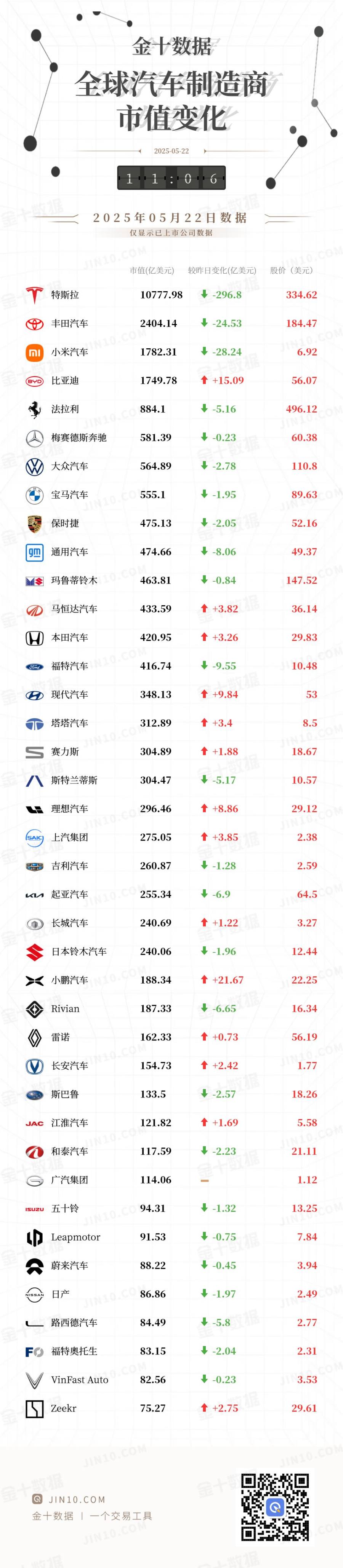
金十图示:2025年05月22日(周四)全球汽车制造商市值变化
news flash· 2025-05-22 03:12
Group 1 - The article presents the market capitalization changes of global automotive manufacturers as of May 22, 2025, highlighting significant fluctuations in their valuations [1][3][4] - BMW's market capitalization stands at $555.1 billion, experiencing a decrease of 1.95% [3] - Porsche's market capitalization is reported at $475.13 billion, with a decline of 2.05% [3] - General Motors has a market capitalization of $474.66 billion, down by 8.06% [3] - The market capitalization of Mahindra & Mahindra is $433.59 billion, showing an increase of 3.82% [3] - Honda's market capitalization is $420.95 billion, reflecting a rise of 3.26% [3] - Ford's market capitalization is $416.74 billion, with a significant drop of 9.55% [3] - Hyundai's market capitalization is $348.13 billion, up by 9.84% [3] - Tata Motors has a market capitalization of $312.89 billion, increasing by 3.4% [3] - The market capitalization of Li Auto is $296.46 billion, with a notable increase of 8.86% [3] Group 2 - The article also lists other automotive manufacturers, such as Nissan with a market capitalization of $86.86 billion, down by 1.97% [4] - Renault's market capitalization is $162.33 billion, showing a slight increase of 0.73% [4] - Changan Automobile has a market capitalization of $154.73 billion, up by 2.42% [4] - Subaru's market capitalization is $133.5 billion, reflecting a decrease of 2.57% [4] - VinFast Auto's market capitalization is $82.56 billion, with a minor decline of 0.23% [4]



生死攸关 日产“断臂”
Zhong Guo Qi Che Bao Wang· 2025-05-22 01:18
Core Viewpoint - Nissan is undergoing a significant restructuring plan called "Re:Nissan" due to severe financial losses, including a projected net loss of 670.9 billion yen (approximately 32.7 billion RMB) for the fiscal year 2024, marking the worst performance since 1999 [2][7]. Group 1: Restructuring and Cost-Cutting Measures - Nissan plans to cut 20,000 jobs globally, which is about 15% of its workforce, and close 7 factories as part of its restructuring efforts [3][4]. - The company aims to reduce its global production capacity from 3.5 million units to 2.5 million units by 2027, representing a nearly 30% reduction [4]. - Nissan intends to cut costs by 500 billion yen by the fiscal year 2026, with both fixed and variable costs reduced by 250 billion yen each [4]. Group 2: R&D and Product Development - Nissan will temporarily halt advanced development and focus on cost-cutting, reallocating 3,000 employees to these efforts [5]. - The company plans to reduce the number of vehicle platforms from 13 to 7 by the fiscal year 2035 and shorten the development time for major models to 37 months [5][6]. - In China, Nissan aims to shorten the product development cycle to under 24 months, leveraging local teams for innovation [6]. Group 3: Market Strategy and Focus - Nissan's restructuring plan emphasizes revitalizing core markets, including the U.S., China, and Japan, with differentiated strategies for each [8][9]. - In the U.S., Nissan plans to enhance its presence in the hybrid vehicle segment and revitalize the Infiniti brand [8]. - The company aims to increase the number of new energy vehicles launched in China from 8 to 10 by the summer of 2027 [8]. Group 4: Partnerships and Collaborations - Nissan is deepening collaborations with partners like Renault and Mitsubishi to enhance product offerings and market presence [10]. - Despite the collapse of merger talks with Honda, Nissan will continue to collaborate in the fields of electrification and smart technology [10]. - The company is expanding its partnerships in China with tech firms to enhance capabilities in smart cockpit and assisted driving technologies [10]. Group 5: Financial Outlook - Nissan anticipates a negative impact of 450 billion yen from U.S. tariffs in the fiscal year 2025, with no specific profit or loss forecasts provided due to the uncertainty of tariff policies [11].

日产汽车接近达成协议,从福特汽车与韩国SK公司的合资企业采购电动汽车电池。
news flash· 2025-05-21 20:15
Core Insights - Nissan is nearing an agreement to procure electric vehicle batteries from a joint venture between Ford and South Korea's SK [1] Group 1 - The collaboration aims to enhance Nissan's electric vehicle production capabilities [1] - This partnership reflects the growing trend among automakers to secure battery supply chains for electric vehicles [1] - The deal is part of Nissan's broader strategy to increase its electric vehicle offerings in response to market demand [1]