Nvidia(NVDA)

Search documents
Nvidia's Jensen Huang loves this software maker that just issued a crippling profit warning
MarketWatch· 2026-02-11 09:02
Core Insights - Dassault Systemes, a software company, experienced a significant decline in its stock value, losing 20% after issuing a profit warning [1] Company Summary - The company is recognized by Nvidia's Jensen Huang as being central to the upcoming industrial advancements in AI [1]


Nvidia and Broadcom's AI Chips Will Go Head-to-Head. How They Compare.
Barrons· 2026-02-11 08:37
Core Viewpoint - Nvidia stock has seen significant gains due to its leading position in the AI chip market, but Broadcom is emerging as a substantial competitor that could challenge Nvidia's dominance [1] Company Analysis - Nvidia is recognized as the dominant provider of AI chips, which has contributed to its stock performance [1] - Broadcom is identified as the biggest threat to Nvidia's market position, indicating a potential shift in competitive dynamics within the AI chip industry [1] Industry Implications - The competition between Nvidia and Broadcom highlights the evolving landscape of the AI chip market, where new entrants can disrupt established leaders [1] - The presence of strong competitors like Broadcom may lead to increased innovation and pricing pressures in the AI chip sector [1]

中国银河证券:北美海外电力缺口与电网更新需求持续放大 关注中国AIDC配储等出海方向
智通财经网· 2026-02-11 08:19
Group 1 - The core viewpoint of the report indicates that the AIDC sector remains buoyant, with explosive growth in electricity demand and power equipment requirements [1] - The U.S. Department of Energy predicts that AIDC electricity demand will increase from 176 TWh in 2023 to between 325-580 TWh by 2028, raising its share of total U.S. electricity demand from 4.4% to 6.7%-12% [1][8] - The aging U.S. power grid, with 70% of transformers exceeding their 25-year design life and a backup load rate of only 20%, is under pressure to meet the surging electricity demand driven by AI [1][8] Group 2 - North American tech giants are significantly increasing their capital expenditures, with Amazon planning $200 billion in 2026 (up 50% YoY), Google estimating $175-185 billion (up 91%-102% YoY), and Meta projecting $115-135 billion (up 59%-87% YoY) [1] - Domestic internet companies in China, such as Alibaba, plan to invest between 380 billion to 480 billion yuan in AI infrastructure and cloud computing over the next three years, while ByteDance expects to reach 160 billion yuan in capital expenditure by 2026 [1] Group 3 - The transition to 800V HVDC is being accelerated by companies like NVIDIA, which plans to shift to this system by 2027, while domestic manufacturers are expected to achieve initial shipments by the second half of 2026 [2] - The 800V HVDC system is anticipated to improve efficiency, reliability, and reduce copper usage by approximately 45%, addressing the high-density computing power requirements [2] Group 4 - The global liquid cooling market is projected to reach approximately $15 billion (around 105 billion yuan) by 2026, with a compound annual growth rate (CAGR) of about 30% from 2026 to 2028 [6] - The penetration rate of liquid cooling in AI data centers is expected to rise from 14% in 2024 to 40% in 2026, driven by the increasing power demands of chips like Google's TPU and NVIDIA's upcoming Rubin series [6] Group 5 - North America faces a significant electricity supply gap, with AIDC electricity demand expected to grow from 8.9 GWh in 2025 to 190 GWh by 2030, reflecting a CAGR of approximately 84% [8] - The supply gap for transformers in North America is estimated at 30%, with Chinese manufacturers holding 60% of global transformer production capacity, indicating a favorable outlook for Chinese transformer exports [9]

Taiwan Semiconductor Manufacturing (TSM) CEO C.C. Wei Just Delivered Fantastic News for Nvidia Investors
The Motley Fool· 2026-02-11 07:15
Core Viewpoint - The ongoing demand for AI technology is evidenced by TSMC's record sales, indicating robust growth in the semiconductor industry, particularly for AI-centric chips [3][10]. Group 1: TSMC's Performance - TSMC reported a record net revenue of NT$401.26 billion (approximately $12.7 billion) in January, marking a 37% year-over-year increase and a 20% rise from December [6]. - TSMC controls about 71% of the global chip market and manufactures over 90% of the most advanced semiconductors, making it a key indicator of AI demand [5]. - The strong sales figures from TSMC suggest a sustained demand for advanced processors, which has broader implications for the tech industry [7][10]. Group 2: Nvidia's Market Position - Nvidia holds a dominant 92% share of the data center GPU market, making it a crucial client for TSMC [9]. - Anticipation is high for Nvidia's fiscal 2026 fourth quarter results, with guidance for a 65% year-over-year revenue growth, an acceleration from the previous quarter [12]. - Nvidia's stock has increased by 746% over the past three years, driven by the demand for AI, and is still considered affordable at less than 25 times forward earnings [15]. Group 3: Industry Outlook - The tech industry is experiencing a data center boom, with projected spending of $3 trillion to $4 trillion by 2030, where GPUs account for approximately 39% of total costs [11]. - Analysts are optimistic about Nvidia, with 94% of 63 analysts rating it a buy or strong buy, and an average price target suggesting a potential upside of 33% [14]. - Evercore ISI analyst Mark Lipacis has a more bullish price target of $352 for Nvidia, indicating a potential upside of 85% [15].

美股科技巨头利润“霸权”告终?盈利增长正向全行业扩散
Hua Er Jie Jian Wen· 2026-02-11 06:49
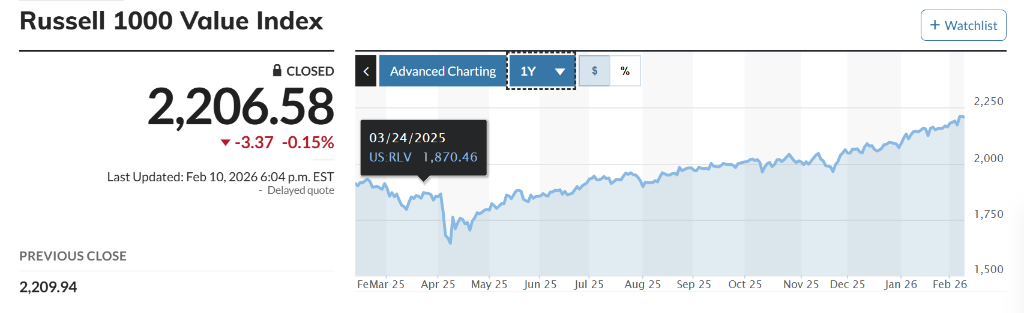
Core Insights - The dominance of a few tech giants in profits is fundamentally changing as the earnings season progresses, with the Russell 1000 Value Index outperforming growth indices since mid-December 2022 [1] - The number of sectors in the S&P 500 showing positive growth has increased from 6 to 8, with nearly half of the companies reporting double-digit growth rates, and a median growth rate close to 10%, marking a four-year high [1] Group 1: Earnings Growth and Market Dynamics - The overall earnings growth rate for the S&P 500 has risen to 14.5%, a four-year high, indicating a broadening of growth beyond just large tech stocks [3] - Market analysts suggest a style rotation is occurring, driven by cyclical factors rather than a decline in tech giants, signaling an end to the previously rare concentration of profits [3] - The current economic phase is characterized as a "robust broad expansion," which typically benefits widespread corporate profits, as confirmed by the earnings reports of S&P 500 constituents [4] Group 2: Sector Rotation and Valuation Shifts - There has been a significant rotation towards "AI-immune" sectors such as utilities, food, mining, construction, and telecommunications, reflecting a reevaluation of capital-intensive and traditional industry valuations [4] - The weakening dollar has notably impacted corporate earnings, with export-oriented S&P 500 companies experiencing higher earnings and revenue growth compared to those focused on domestic business [5] - Nvidia Corp. plays a crucial role in the earnings growth of S&P 500 companies with significant international exposure; excluding Nvidia, the blended earnings growth rate would drop from 17.7% to 12.0% [5]
Which Big Tech Stocks Have the Most Debt, and Why It Matters
The Motley Fool· 2026-02-11 06:05
AI is big business for big tech firms. But have any taken out too much debt to keep up with the competition?Last week, there was a flurry of earnings releases from "Big Tech" companies. Artificial intelligence is big business, and competition for many of them is stiff these days. The resulting spending spree, which has been coined "hyperscaling," is resulting in billions of dollars to buy semiconductor chips, build data centers, and develop the software to run AI.In a recent edition of the investment newspa ...





但斌-雪球嘉年华媒体问答
2026-02-11 05:58
Summary of Conference Call Notes Industry and Company Involvement - The discussion primarily revolves around the **Artificial Intelligence (AI)** sector and its implications for the **Chinese market** over the next decade, as well as the performance of **U.S. tech giants** like **Apple**, **NVIDIA**, and **Google** [1][2][3][6][7]. Core Insights and Arguments - **AI as a Market Driver**: AI is expected to be a significant driver of a structural bull market, with substantial advancements anticipated in China over the next ten years, supported by national efforts [1][2][3]. - **Quantum Computing and Autonomous Driving**: Breakthroughs in quantum computing are expected by 2027, with companies like NVIDIA already launching quantum chips. Autonomous driving technology is projected to see revolutionary changes by the end of 2026, presenting opportunities for domestic industries [1][4]. - **AI in Healthcare**: The application of AI in healthcare shows vast potential, as demonstrated by companies like Ant Financial. High dividend strategies and cyclical industries related to heavy metals are also worth monitoring, despite geopolitical risks [1][5]. - **Market Outlook for 2027**: Optimism is expressed regarding the A-share market in 2027, although caution is advised for the consumer and liquor sectors, which may face challenges without policy support. The S&P 500 is expected to see earnings growth surpassing that of the current year [1][6]. - **Performance of U.S. Tech Giants**: Companies like Apple, NVIDIA, and Google are noted for their strong profitability, with annual profits exceeding $100 billion. Their ability to continue investing and maintaining competitiveness is emphasized, with no bubble concerns identified [1][7]. - **NVIDIA's CUDA Platform**: NVIDIA's CUDA platform has established a strong competitive moat, capturing over 90% of the market share. Other companies face challenges in creating similar platforms due to compatibility issues [1][8]. Other Important but Potentially Overlooked Content - **Investment Strategies**: Long-term investors are encouraged to maintain their investment philosophies and not be swayed by short-term market fluctuations. The importance of finding a capable team for asset management is highlighted, as team performance is crucial for success [3][9][10][12]. - **Noise in the Market**: Various market noise factors, such as trade wars and interest rate changes, are deemed secondary to the primary trend of AI development. Investors are advised to focus on major trends rather than being distracted by these noises [14]. - **Assumptions in Investment Models**: The assumptions made in investment models significantly impact decision-making. It is essential to consider both optimistic and pessimistic scenarios when forecasting a company's growth [15][16]. This summary encapsulates the key points discussed in the conference call, providing insights into the AI sector, market outlook, and investment strategies.
半导体 - 亚太焦点:谷歌 TPU 崛起 —— 识别供应链中的赢家- Global IO Semiconductors-APAC Focus Rise of Google TPUs – identifying winners in the supply chain
2026-02-11 05:56
Summary of Key Points from the Conference Call Industry Overview - The report focuses on the semiconductor industry, particularly the competitive dynamics between Google's Tensor Processing Units (TPUs) and Nvidia's Graphics Processing Units (GPUs) in cloud-based AI computing [2][7][8]. Core Insights - **TPU Growth**: Google's TPUs are expected to grow more rapidly than Nvidia's GPUs from a smaller base, with TPUs offering superior efficiency in performance per watt and per dollar for large-scale AI workloads [2][8]. - **Internal Usage**: Google relies heavily on TPUs for its internal AI training and inference, indicating the platform's maturity and reliability [2][28]. - **Market Forecast**: TPU shipments are projected to reach 4 million units in 2026 and grow to 7.2 million units in 2027, with MediaTek's share expanding from 8% in 2026 to 28% in 2027 [3][44]. Competitive Landscape - **Dual TPU Tracks**: Google is adopting a dual-track strategy for TPU development, collaborating with both Broadcom and MediaTek. This approach allows Google to diversify its supply chain and manage costs effectively [3][36][44]. - **Cost Efficiency**: MediaTek's service fees for TPUs are over 50% lower than Broadcom's, making it a significant player in the TPU supply chain [3][37]. Key Beneficiaries - **TSMC**: As the leading-edge foundry, TSMC is expected to benefit significantly from the demand for TPUs [4]. - **Other Suppliers**: Companies like ASE, KYEC, Advantest, and Celestica are also positioned to gain from the growing TPU market [4]. Technical Advantages of TPUs - **Design Efficiency**: TPUs are specifically designed for neural network computing, offering competitive performance-per-watt and performance-per-dollar compared to general-purpose GPUs [11][14]. - **Architecture**: The TPU architecture allows for higher compute utilization and efficiency, minimizing runtime loss compared to GPUs [16]. Software Integration - **OpenXLA**: Google's development of the OpenXLA software standard facilitates easier migration for developers transitioning from Nvidia GPUs to TPUs, enhancing the appeal of TPUs for external users [20][29]. Future Outlook - **Market Position**: Google is positioned as a key player in the frontier AI model development alongside OpenAI and Anthropic, driving substantial demand for TPUs [31][35]. - **Cloud Revenue Growth**: The cloud revenue for major hyperscalers, including Google, is expected to grow at a robust 29% CAGR from 2026 to 2028, driven by the shift towards AI-centric workloads [32][33]. MediaTek's Role - **Strategic Partnership**: MediaTek's collaboration with Google is expected to significantly enhance its market position, with potential sales from TPU v8X projected between $8 billion to $17 billion in 2027 [58]. - **Technology Development**: MediaTek is also advancing its SerDes IP technology, which is crucial for the TPU v8X project, potentially positioning it for future growth in the cloud and edge AI markets [56][58]. Conclusion - The competitive dynamics between TPUs and GPUs are evolving, with Google's strategic partnerships and technological advancements positioning it favorably in the semiconductor landscape. The expected growth in TPU shipments and the increasing reliance on AI workloads underscore the significant opportunities within this sector [2][3][8][31].
全球 IO 硬件:存储对云资本开支的通胀效应;对 ODM 品牌商利润的通缩效应-Global IO Hardware-Memory's inflationary impact on cloud capex; deflationary impact on ODMbrand margins
2026-02-11 05:56
Summary of Key Points from the Conference Call Industry Overview - The conference call focuses on the **Global I/O Hardware** industry, particularly the **memory market** and its implications for **hyperscale capital expenditures (capex)** and **hardware margins** due to rising demand from AI applications and server requirements [2][8]. Core Insights and Arguments 1. **Memory Pricing Forecasts**: - UBS forecasts a **289% increase** in DRAM pricing per Gb from 2025 to 2027, surpassing the previous cycle's 89% rise [2][13]. - NAND pricing is expected to rise **144%**, exceeding the 92% rebound seen in 2024 [2][13]. 2. **Hyperscale Capex Growth**: - Hyperscale capex is projected to reach **US$827 billion** in 2026 and **US$915 billion** in 2027, reflecting increases of **43%** and **28%** respectively [3][27]. - Memory costs are estimated to add approximately **US$100 billion** annually to hyperscale capex, increasing from **US$53 billion** in 2025 to **US$155 billion** in 2026 and **US$252 billion** in 2027 [3][25]. 3. **Impact on PC and Smartphone Markets**: - PC unit forecasts for 2026 have been revised down from **267 million** to **255 million**, indicating a **4% decline** year-over-year [4]. - Smartphone unit sell-in estimates have also been reduced from **1.28 billion** to **1.20 billion**, reflecting a **5% decline** in 2026 [4]. 4. **Brand and ODM Margin Pressures**: - The rising memory costs are squeezing margins for brands and ODMs, with DRAM now accounting for **18%** of PC BOM costs and potentially **24%** for high-end smartphones by H226 [4][9]. - ODMs are forced to pass through memory costs, which boosts sales but does not enhance gross or operating profits, leading to lower margins [4][9]. 5. **Investment Preferences**: - Analysts recommend favoring AI hardware and components over traditional PC and branded companies due to the higher memory costs impacting margins [5]. Additional Important Insights 1. **Server Demand and Memory Costs**: - The demand for AI and traditional servers is strong, with server unit forecasts for 2025-26 revised up from **+6%** to **+13%** year-over-year [2][14]. - A typical data center server's memory cost is expected to rise from **46%** to **67%** of total server costs due to increased memory pricing [15]. 2. **Long-term Memory Cycle**: - The memory pricing cycle is described as the strongest in decades, with expectations of sustained under-supply into 2027 [10][13]. 3. **Capex and Cash Flow Dynamics**: - The capital intensity for internet companies is projected to rise from **10%** of capex/sales pre-AI to approximately **35%** in 2026, with a significant portion of capex financed through operating cash flow [28]. 4. **Future Outlook**: - The aggressive push for compute resources to meet growing cloud workloads and AI demands is expected to continue, although future growth rates may slow as spending becomes increasingly financed by debt and equity [28]. This summary encapsulates the critical insights and projections discussed during the conference call, highlighting the significant impact of memory pricing on the hardware industry and the strategic shifts in investment focus towards AI-related technologies.
对话华东理工曾惠丹:日本一块布,如何卡住英伟达的“脖子”?中国做不出来吗?
Sou Hu Cai Jing· 2026-02-11 03:00
曾惠丹,华东理工大学教授、博士生导师,玛丽居里学者。上海电子化学品创新研究院首席研究员、中国硅酸盐学会理事,主要研究方向为特种玻璃和电子 浆料,研究应用于光电子器件、半导体和电子元件的特种钝化材料/封装基板和电极浆料。 出品|搜狐科技 作者|张雅婷 编辑|杨锦 或许很少有人能料到,一种来自日本的布,竟会掐住全球AI芯片巨头的"咽喉"。 搜狐科技《思想大爆炸——对话科学家》栏目第148期,对话华东理工大学教授、博士生导师曾惠丹。 嘉宾简介: 高端电子玻璃纤维布,是芯片基板和印刷电路板不可或缺的核心骨架,由大概100-200 根单丝直径为4-7微米的玻璃纱股编织而成布后,再与树脂、铜箔等材 料复合,经过图形蚀刻、钻孔镀铜等精密工艺制成。 随着AI热潮带来的AI芯片需求爆发式增长,日东纺生产的高端电子玻璃纤维布供应日趋紧张,甚至陷入"一布难求"的局面。为确保供应稳定,英伟达CEO黄 仁勋近日亲自登门拜访日东纺,苹果公司也正积极向日本政府官员寻求支援。 在这场没有硝烟的供应链战争中,日东纺成为了最大赢家。这个成立于1923年的日本企业从棉纺织起家,至今已经有100多年的历史,目前在高端玻纤布市 场垄断了全球90%以上 ...