
TRIP.COM(TCOM)

Search documents
世界旅游联盟发布跨境游消费趋势研究报告 南京位列入境游客消费总额TOP10城市
Nan Jing Ri Bao· 2025-12-29 02:14
Core Insights - The report by the World Tourism Alliance, in collaboration with Mastercard and Ctrip, highlights Nanjing as one of the top 10 cities for inbound tourist spending [1] Group 1: Inbound Tourism Trends - Since the second half of last year, China's visa-free policies have been continuously optimized, leading to an expansion in coverage and longer stay durations for tourists [1] - The number of inbound tourists benefiting from visa-free policies has shown significant growth, with longer stay durations being a notable trend [1] Group 2: Tourist Preferences - "Cultural experience" tourism has emerged as a new favorite among inbound tourists, who are eager to engage with traditional Chinese culture [1] - Experiential travel remains a key driver for tourism development, with sports events and cultural performances having a particularly strong impact on tourism [1] Group 3: Spending Patterns - Inbound tourist spending is highly concentrated in first-tier and new first-tier cities, with Nanjing ranking among the top 10 cities for total inbound tourist spending [1] - There is a notable increase in spending on shopping, dining, and health-related services, indicating a trend towards diversified consumption in inbound tourism [1]

重磅:携程悄悄上线稳定币支付!打响国内企业第一枪
Xin Lang Cai Jing· 2025-12-29 01:48
Core Insights - Trip.com, a platform under Ctrip, has launched a global stablecoin payment feature supporting USDT and USDC, allowing users to save up to 18% on flight bookings in regions like Vietnam [1][46][48] - This initiative addresses the gap in traditional financial systems, providing a payment solution for over 80% of the global population who lack access to international credit cards or bank accounts [3][10][48] - Ctrip's approach is characterized by a low-profile implementation, contrasting with other companies that have made high-profile announcements without substantial progress [5][50] Payment Functionality - The stablecoin payment system allows users to book hotels and flights using multiple public blockchains, simplifying the payment process to just requiring a name and email for hotel bookings [7][8][52] - The payment gateway and settlement support are provided by Triple-A, a licensed institution in Singapore, ensuring compliance and security [8][53] Market Context - The emergence of stablecoin payments is seen as a necessary evolution, particularly for users in high-inflation countries like Turkey, Egypt, and Bolivia, where residents use stablecoins to hedge against currency devaluation [10][55][64] - The global market for stablecoins is rapidly expanding, with a current market cap of nearly $260 billion, accounting for 97% of cryptocurrency trading volume [65] Strategic Implications - Ctrip's stablecoin initiative is part of a broader financial strategy that has been in development since 2013, aiming to create a comprehensive financial ecosystem [14][59] - The choice of Singapore as a base for the payment service reflects a commitment to regulatory compliance and a favorable business environment for cryptocurrency [14][60] User Experience - The payment process is designed to be user-friendly, with minimal information required for hotel bookings, enhancing privacy and reducing data collection [35][63] - The stablecoin payment feature is currently in a testing phase, with expectations that it will lead to cheaper international travel and more innovative products in the future [68][80] Industry Impact - Ctrip's move is likely to inspire other players in the online travel agency (OTA) sector to explore similar payment solutions, potentially reshaping the industry landscape [80] - The integration of blockchain technology in travel could lead to new business models, including smart contracts for travel insurance and NFT-based products [80][82]

中国人的开房习惯,变了
虎嗅APP· 2025-12-27 02:45
Core Insights - The article highlights the shift in consumer preferences towards social and experiential accommodations, with the "hotel+" trend emerging as a new wave in the industry [5][6]. Financial Performance - In Q3 2025, the total revenue of 51 listed cultural tourism companies in A-shares reached approximately 839.93 billion yuan, with a net profit of about 226 billion yuan, while Ctrip alone generated a revenue of 183.38 billion yuan and a net profit of 198.9 billion yuan, capturing 21% of the industry's revenue and 88% of its profits [5][6]. Industry Dynamics - The Chinese hotel industry is experiencing a structural reshuffle characterized by "total growth and structural differentiation," driven by market concentration among leading hotel groups and changing consumer preferences [6][8]. - As of December 31, 2024, the total number of accommodation facilities in China reached 570,000, with a total room capacity of 19.278 million, marking historical highs for both metrics [8]. Leading Hotel Groups - Jinjiang Group, as the largest hotel brand in China, has expanded its portfolio to 43 brands through acquisitions, with a high-end hotel room share of 69.79% and over 14,000 hotels globally [9]. - Huazhu has expanded its brand matrix to over 30 brands, with a total of 12,702 operating hotels and a significant contribution from its franchise business, which accounts for approximately 64.1% of its operating profit [11]. - Shoulv Home has 29 brands and over 7,500 hotels globally, with a franchise business share increasing from 89% in 2024 to 92.5% in Q3 2025, indicating a strong shift towards a light asset model [14][16]. Market Trends - The mid-range hotel segment is becoming a key driver of industry growth, with the chain rate for mid-range hotels increasing from 21.42% in 2018 to 55.33% in 2024 [18][22]. - The demand for high-end and mid-range hotels is rising, with the chain rate for high-end hotels slightly increasing to 55.33% [20]. Consumer Behavior - There is a notable shift in consumer preferences from traditional accommodation to lifestyle experiences, with younger generations favoring unique hotel designs and experiences over conventional services [26]. - The search interest for experiential stays, such as cultural and family-oriented activities, has surged, with a 50% increase in searches for cultural experience trips during the Dragon Boat Festival [27]. Challenges in the Industry - Despite growth in the number of hotels and rooms, the industry faces challenges such as homogenization and a disconnect between scale expansion and value creation [30]. - The reliance on traditional revenue streams and high customer acquisition costs through online travel agencies (OTAs) are significant issues, with many hotels still heavily dependent on room and dining revenues [31][33]. - The industry is experiencing a talent shortage, particularly in lower-tier cities, leading to inconsistent service quality across different hotel types [33].



对话携程王韦:入境游红利,推动文旅市场三重“变革”
21世纪经济报道· 2025-12-26 14:24
Core Viewpoint - The article highlights the significant impact of visa facilitation policies on China's inbound tourism market, leading to a robust increase in foreign visitors and consumer spending, marking a transition from a "one-way flow" to a "two-way interaction" in the tourism industry [1][2]. Group 1: Inbound Tourism Growth - In 2025, the number of inbound foreign visitors reached 40.6 million, a year-on-year increase of 27.2%, with 240-hour visa-free transit visitors growing by 60.8% [1]. - In the first three quarters of 2025, visa-free inbound foreign visitors totaled 20.89 million, up over 50%, significantly boosting related project bookings by 300% [1]. - The optimization of the departure tax refund policy and the nationwide promotion of "buy and refund immediately" services have created a stimulating "golden combination" for consumer spending [1]. Group 2: Structural Changes in the Industry - Three structural "watersheds" have emerged in the tourism market: a shift in inbound tourism sources, a change in the role of platforms, and the integration of AI in demand creation [2][6]. - The engine of inbound tourism has shifted from primarily Asian markets to a rapid increase in visitors from Europe and America, indicating a broader global appeal of Chinese tourism [7]. - Platforms are evolving from mere sales channels to industry coordinators, utilizing technology to enhance operational efficiency and connect various stakeholders [8]. Group 3: Enhancing Visitor Experience - The focus has shifted from merely selling tickets and hotels to providing immersive experiences, reflecting a change in travelers' motivations [4]. - The introduction of AI in travel planning is transforming how itineraries are created, allowing for personalized and innovative travel experiences [8]. - The industry is addressing the "last mile" challenges by providing tools and support to local businesses, enabling them to better serve international tourists [9]. Group 4: Cultural and Product Innovation - The transformation of intangible cultural heritage into experiential products is crucial for attracting tourists and generating revenue [12]. - Innovative product offerings, such as immersive dining experiences that combine food, performance, and cultural elements, have proven effective in engaging global audiences [12]. - A tourism innovation fund has been established to reward successful cultural transformation cases, promoting the development of marketable cultural experiences [12]. Group 5: Global Service Integration - The trend of "Chinese tourism services going global" reflects the natural process of capability overflow, enhancing the global tourism experience for Chinese travelers [13]. - Chinese platforms are becoming co-builders of new global standards, promoting payment interoperability and service quality systems, which contribute to the overall upgrade of the tourism industry [13].

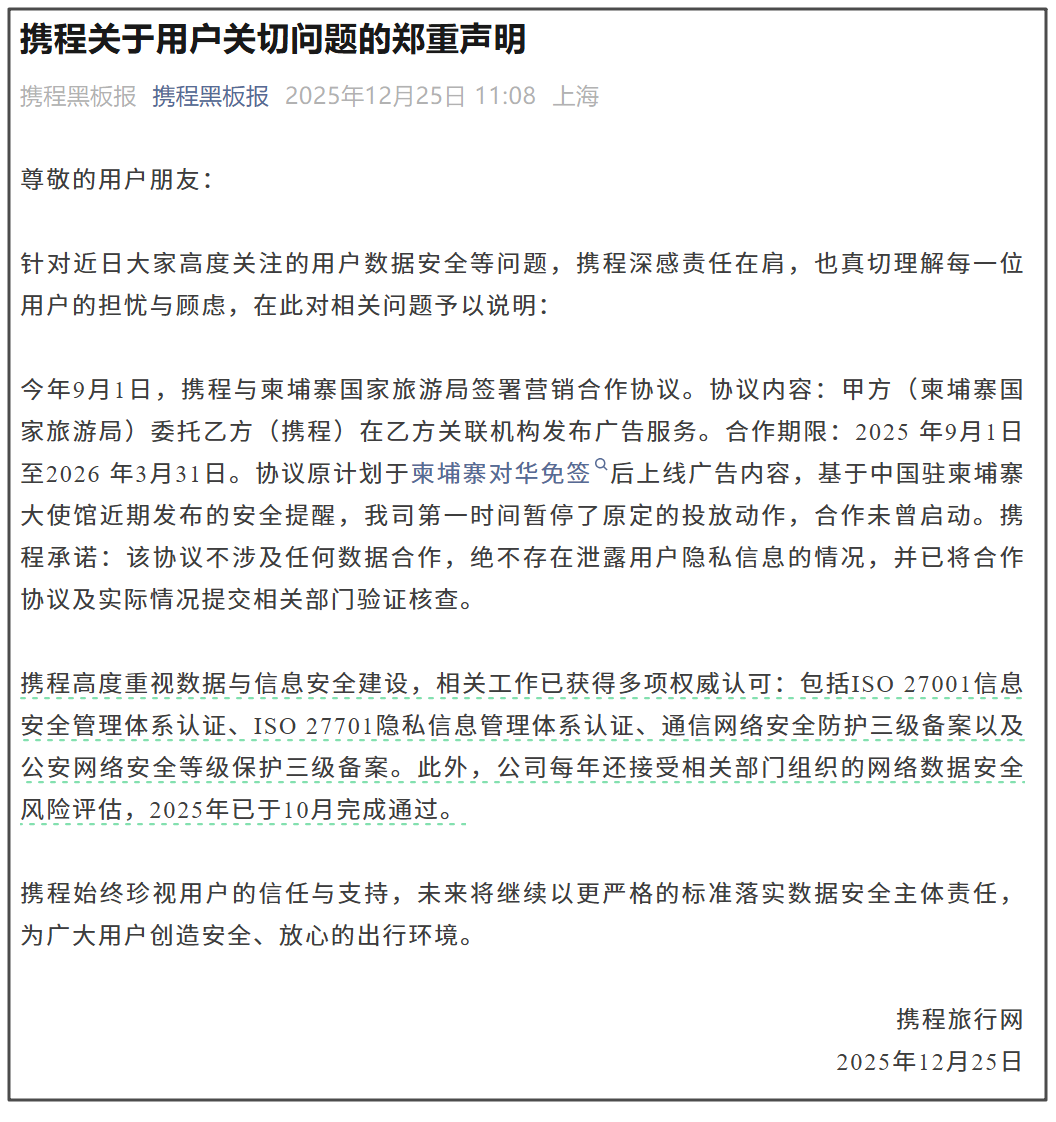
携程:与柬埔寨国家旅游局签署的营销合作未曾启动
Guan Cha Zhe Wang· 2025-12-26 09:01
Core Viewpoint - Ctrip's partnership with the Cambodian National Tourism Board has sparked significant public concern regarding user data privacy, leading to a wave of account cancellations among users [1][5]. Group 1: Partnership Details - On September 1, Ctrip signed a marketing cooperation agreement with the Cambodian National Tourism Board, which is set to run from September 1, 2025, to March 31, 2026 [2][5]. - The agreement was intended to launch advertising content following Cambodia's visa exemption for Chinese citizens, but was suspended due to safety warnings issued by the Chinese Embassy in Cambodia [2]. Group 2: User Concerns and Reactions - Following the announcement of the partnership, many users expressed their concerns on social media, leading to a significant number of account deletions, including from high-tier users [5]. - The Chinese Embassy in Cambodia has issued multiple safety alerts due to recent armed conflicts between Thailand and Cambodia, further heightening user anxiety regarding travel safety [5]. Group 3: Data Security Assurance - Ctrip has emphasized that the partnership does not involve any data sharing and has committed to user privacy, submitting the agreement for verification by relevant authorities [2]. - The company has received multiple certifications for its data and information security practices, including ISO 27001 and ISO 27701, and undergoes annual security risk assessments [2].
对话携程王韦:入境游红利 推动文旅市场三重“变革”
2 1 Shi Ji Jing Ji Bao Dao· 2025-12-26 08:45
Core Insights - The implementation of visa facilitation policies in 2025 has significantly boosted China's inbound tourism market, with a 27.2% year-on-year increase in foreign visitors, totaling 40.6 million [1] - The growth in visa-free transit has led to a 60.8% increase in travelers benefiting from the 240-hour visa exemption, with major cities like Shanghai, Beijing, and Guangzhou seeing over 55% of inbound travelers enjoying this convenience [1] - The combination of optimized departure tax refund policies and "buy and refund immediately" services has created a stimulating effect on consumption, with a 285% increase in the number of foreign travelers processing tax refunds [1] Inbound Tourism Growth - In the first three quarters of 2025, the number of foreign visitors entering China visa-free reached 20.89 million, marking a growth of over 50% [1] - The surge in inbound tourism has led to a 300% increase in bookings for related projects, indicating a strong consumer demand [1] Structural Changes in the Industry - Three structural "watersheds" have emerged in the tourism market: changes in source markets, the evolving role of platforms, and the integration of AI in demand creation [6][7] - The source of inbound tourism has shifted from primarily Asian markets to a significant increase in visitors from Europe and America, indicating a broader global appeal [7] - Platforms are transitioning from mere sales channels to industry coordinators, enhancing operational efficiency through technology and connectivity [7] Service and Experience Enhancement - The dual flow of outbound and inbound tourism is fostering a mutual enhancement of service capabilities and quality standards, improving user experiences for both Chinese tourists abroad and foreign visitors in China [5] - The industry is now required to provide immersive experiences rather than just selling tickets and accommodations, reflecting a shift in consumer expectations [4] Addressing Industry Bottlenecks - Despite the explosive growth in visitor numbers, the tourism industry faces challenges in upgrading its service capabilities, particularly among small hotels and local businesses that lack the tools to serve international tourists [8] - Efforts are being made to empower these businesses through AI-driven solutions and partnerships with airports to enhance the overall travel experience [8] Cultural and Product Innovation - The transformation of intangible cultural heritage and local culture into marketable experiences is crucial, with innovative product offerings like immersive dining experiences attracting global tourists [10] - A tourism innovation fund has been established to reward successful cultural transformation cases, promoting the development of engaging and shareable cultural products [10] Global Service Integration - The trend of "Chinese tourism services going global" reflects the natural overflow of capabilities, with Chinese platforms becoming key players in establishing new global service standards [11] - This evolution allows Chinese tourists to receive seamless services in their native language worldwide, while also contributing to the global tourism industry's upgrade [11]
对话携程王韦:入境游红利,推动文旅市场三重“变革”
2 1 Shi Ji Jing Ji Bao Dao· 2025-12-26 08:21
Core Insights - The implementation of visa facilitation policies in 2025 has significantly boosted China's inbound tourism market, with a 27.2% year-on-year increase in foreign visitors, totaling 40.6 million [1] - The influx of visa-free travelers has led to a substantial increase in consumer spending, with a 300% rise in related project bookings and a 50% increase in the number of foreign visitors entering China in the first three quarters of 2025 [1] - The combination of optimized departure tax refund policies and "buy and refund immediately" services has created a stimulating effect on consumption [1] Group 1: Inbound Tourism Growth - The number of foreign visitors benefiting from 240-hour visa-free transit has increased by 60.8%, with major cities like Shanghai, Beijing, and Guangzhou seeing over 55% of inbound travelers enjoying this convenience [1] - By November 2025, over 12,000 departure tax refund stores were established, with a 285% increase in the number of foreign travelers processing refunds and nearly doubling the sales of tax refund products [1] Group 2: Structural Changes in the Industry - Three structural "watersheds" have emerged in the tourism market: a shift in inbound tourism sources, a change in the role of platforms, and the evolution of AI in demand creation [2][6] - The engine of inbound tourism has shifted from primarily Asian markets to a rapid increase in visitors from Europe and America, indicating a broader global appeal of Chinese tourism [6] - Platforms are evolving from mere sales channels to industry coordinators, utilizing technology to optimize operational efficiency across the tourism sector [6] Group 3: Service and Experience Enhancement - The dual flow of outbound and inbound tourism is enhancing service capabilities and quality standards, with a 15-point increase in user satisfaction for products adhering to new quality standards [5] - The industry is now required to provide immersive experiences rather than just selling tickets and accommodations, reflecting a shift in consumer expectations [4] Group 4: Addressing Industry Bottlenecks - The rapid growth in visitor numbers has outpaced the upgrade of the tourism supply chain, particularly affecting small hotels and local businesses that lack the tools to serve international tourists [8] - Initiatives are being implemented to empower local businesses, such as providing AI translation tools and optimizing transfer services at airports to enhance the overall travel experience [8] Group 5: Cultural and Product Innovation - The transformation of intangible cultural heritage into marketable experiences is crucial, with innovative product offerings like immersive dining experiences attracting global visitors [10] - A tourism innovation fund of 1 billion yuan has been established to reward successful cultural transformation cases, promoting the development of experiential and shareable cultural products [11] Group 6: Global Service Integration - The trend of "Chinese tourism services going global" reflects the natural process of capability overflow, enhancing the global experience for Chinese tourists and contributing to international tourism industry standards [11] - Chinese platforms are becoming co-builders of new global rules, promoting payment interoperability and service quality systems, which is essential for transitioning from a "tourism powerhouse" to a "service powerhouse" [11]
中端酒店投资的“稳赢”新答案:丽呈安屹酒店(REZEN ANYI HOTEL)重磅启幕,以“赭色坐标”深耕存量市场
Sou Hu Cai Jing· 2025-12-26 05:40
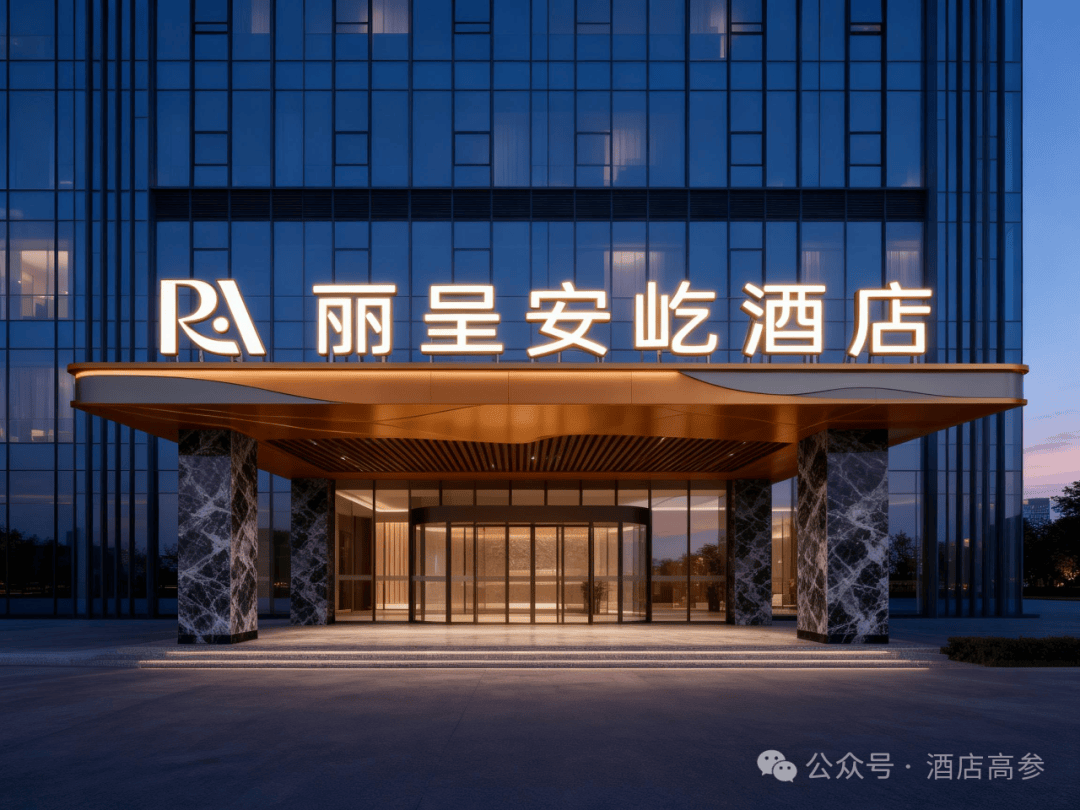
Core Insights - The Chinese hotel industry is transitioning from a "growth era" to a "refinement era," where efficiency and stability are becoming the new benchmarks for investment success [1] - Shenzhen Apolo Hotel Management Co., Ltd. and Ctrip's Lisheng Group have announced a strategic partnership to launch the mid-range hotel brand REZEN ANYI HOTEL, focusing on the value reconfiguration of existing assets [1][3] - The REZEN ANYI brand aims to address the challenges of upgrading existing hotels by combining "international standard quality" with "local efficient operations," creating a robust investment model for investors seeking stable returns [1][4] Industry Challenges - The mid-range hotel market in China is facing structural challenges, with over 60% of the 350,000 existing hotels having been in operation for more than five years, leading to issues such as outdated designs and declining profitability [3] - Investors often face a dilemma between choosing internationally recognized hotel brands, which come with high costs and long payback periods, and local brands, which may lack maturity and brand influence, resulting in unstable occupancy and profitability [3] REZEN ANYI Hotel's Value Proposition - REZEN ANYI Hotel is designed to tackle the structural challenges in the market by integrating Apolo's operational expertise with Lisheng Group's digital capabilities [4] - The brand's mission is to unlock a new investment model that combines "international brand quality," "local team flexibility," and "stable financial returns," creating a "winning" model for investors [4] Four Core Foundations of REZEN ANYI - **Team Foundation**: The core operational team consists of industry veterans with an average of over 20 years of experience, ensuring practical support throughout the project lifecycle [7] - **Cost and Efficiency Foundation**: The brand has optimized its investment return model, reducing room costs by approximately 30% compared to traditional mid-range brands and aiming for a payback period of 3 to 3.5 years [8] - **Digital Foundation**: Leveraging Lisheng Group's digital platform, the hotel utilizes data-driven decision-making to enhance operational efficiency and maximize revenue [10][11] - **Membership and Traffic Foundation**: With a membership base of 30 million, REZEN ANYI can ensure strong initial customer flow and enhance brand loyalty through targeted marketing strategies [12] Strategic Significance - The launch of REZEN ANYI Hotel represents a significant upgrade in mid-range hotel investment philosophy, providing a lower-risk, more stable return option for investors in an uncertain market [13] - The brand aims to lead the industry from scale competition to value competition, promoting a long-term, stable investment approach [13]
字节跳动通报:120名员工被辞退;郑州中原保时捷中心疑似闭店跑路,保时捷回应;广汽人事变动!郑衡辞去副总经理职务,原因披露
雷峰网· 2025-12-26 00:25
Key Points - The article discusses various significant events in the automotive and technology sectors, highlighting issues such as dealership closures, personnel changes, and employee terminations in major companies [5][10][12][31]. Group 1: Automotive Industry - Zhengzhou Zhongyuan Porsche Center is suspected of closing down, leaving customers unable to retrieve their vehicles, with Porsche China investigating the situation [5][6]. - GAC Group announced the resignation of Vice President Zheng Heng due to personal health reasons, with no impact on the company's operations [10]. - BYD's off-road brand Fangchengbao achieved its 2025 sales target ahead of schedule, with a total of 183,769 vehicles sold from January to November 2025, marking a significant year-on-year increase [34]. Group 2: Technology Sector - ByteDance reported the termination of 120 employees for violating company policies, with some cases involving criminal activities [12]. - JD.com announced its 2025 year-end bonus plan, with over 92% of employees eligible for full or above bonuses, and some departments achieving up to 25 months' salary [14]. - Xiaomi celebrated its 15th anniversary, highlighting achievements such as the launch of its self-developed 3nm chip and the opening of a new factory [33]. Group 3: Market Developments - TikTok plans to establish a joint venture in the U.S. to ensure its continued operation, with a focus on data security and compliance with U.S. laws [44][45]. - Meta has initiated the development of the Quest 4 headset while delaying the release of the lightweight Quest Air headset to refine its features [47][48]. - Waymo explained the operational issues faced by its autonomous taxis during a power outage, emphasizing the need for software updates to improve decision-making in such scenarios [49].



携程海外版 Tripcom 已开通稳定币支付功能,支持使用 USDT 和 USDC
Xin Lang Cai Jing· 2025-12-25 14:16
Core Insights - Tripcom, the overseas version of Ctrip, has launched a stablecoin payment feature that supports USDT and USDC for booking hotels and flights [1] Group 1 - The stablecoin payment functionality is supported by Triple-A, a licensed crypto payment institution based in Singapore [1] - The payment feature encompasses multiple public chains including Ethereum, Tron, Polygon, Solana, Arbitrum One, and TON [1]