
TRIP.COM(TCOM)

Search documents
年终盘点|2025年出境游Z世代消费增长,免签入境游订单增幅达153%
Di Yi Cai Jing· 2025-12-31 11:59
Group 1 - The outbound tourism market in 2025 is experiencing high-quality growth, with significant increases in orders for various travel products, including tours, local experiences, and cruise services, showing double-digit growth year-on-year [1] - Inbound tourism is witnessing explosive growth, with overseas flight bookings to China more than doubling compared to last year, particularly for flights to Shanghai, which have increased nearly sixfold [1] - The trend of personalized and diversified travel consumption is evident, with families preferring comfortable services like cruises, while Gen Z consumers are spending more on unique experiences [2] Group 2 - The demand for small group tours is rising, with a notable increase in the proportion of small group products in the overall outbound tour market, appealing to consumers seeking better experiences and more free time [2] - Instant group day tours are gaining popularity, and new long-haul destinations like Sweden and Iceland are emerging, indicating a shift in travel preferences [3] - Inbound tourism is experiencing a robust recovery, with a 100% increase in bookings in the first three quarters of 2025, and a remarkable 153% growth in orders from visa-exempt countries [5] Group 3 - International visitors are increasingly exploring inland cities in China, with Chongqing seeing a 170% increase in inbound traffic, and Datong experiencing a sevenfold increase in ticket sales due to its cultural attractions [6] - The potential market for inbound tourism in China is significant, with the current contribution to GDP being less than 0.5%, compared to over 10% in Thailand, suggesting a potential market increase of 1 to 2 trillion yuan if it reaches comparable international levels [7] - The upcoming New Year and Spring Festival holidays are expected to further boost both outbound and inbound tourism, with many popular long-haul outbound tours already sold out [7]



携程发布《2025中国入境游年度报告》:免签国家订单增幅达153% “深度中国游”开启黄金时代
Zhong Guo Min Hang Wang· 2025-12-31 07:41
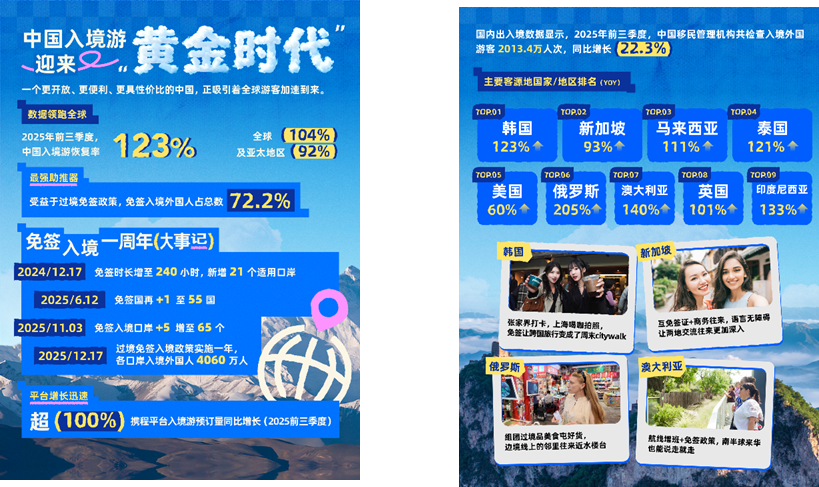
12月31日,携程发布《2025中国入境游年度报告》(以下简称"报告"),数据显示,2025年前三季度入境游预订已经实现了100%的增长,来自免签国家的 订单增幅平均高达153%。这一系列数据不仅标志着行业全面复苏,更显示出中国正加速向"十五五"规划建议中提出的"旅游强国"目标迈进。 此外,报告基于携程平台数据,进一步洞察了入境游客的行为偏好。地理距离成为影响停留时长的核心变量,亚洲等临近客源地的游客多以4-7天的中短途 旅行为主,而来自大洋洲等南半球的旅客则更倾向于7天以上的深度游。 气候、特定国际长假、国际大型会展和演出赛事等,是决定何时来华的关键。春季(4月)与秋季(10月)是海外游客最偏爱的到访窗口,其中10月更是各 大热门客源国的入境高峰。在行程规划上,"提前囤货"特征明显,亚洲、欧洲及澳新地区的游客普遍习惯提前半个月以上预订入境行程。 从"打卡地标"到"极致体验" 海外游客来中国玩什么?去什么城市玩?2025年的答案更加多元和深入。报告揭示了目的地"下沉"和"半径扩大"的新趋势。除了北京、上海、广州等传统门 户城市外,海外游客开始深入中国内陆,寻找独特的文化体验。 在宏观大盘强劲复苏的背景下,作为 ...
“请3休8”拼假点燃元旦旅游热,“冰雪游、避寒游”成主流
Nan Fang Du Shi Bao· 2025-12-31 03:39
Core Insights - The New Year's holiday in 2026 is expected to significantly boost tourism demand, driven by the "take 3 days off and rest for 8" strategy, which has ignited consumer enthusiasm for travel [1][3] - The tourism market is experiencing unprecedented activity, with trends showing deeper, personalized, and quality-focused travel experiences [1][3] Travel Trends - The "take 3 days off and rest for 8" strategy has extended the holiday period, creating opportunities for long-distance travel and deep vacations, leading to a surge in market activity [3] - Tourists are increasingly opting for both short trips within a 100-300 km radius and longer international trips, reflecting a blend of domestic and international travel patterns [1][3] Market Dynamics - The travel market has seen a 10% increase in average spending per customer and a 9% increase in the number of items purchased compared to last year [3] - The proportion of cross-province hotel bookings is expected to exceed 50%, indicating a shift towards longer stays and immersive vacation experiences [4] Transportation Insights - Train and flight bookings have surged, with train ticket searches increasing by 303% compared to the same period last year, highlighting the pressure on transportation systems [4][5] - Air travel demand has more than doubled compared to last year, with popular routes reflecting a strong north-south travel pattern [5] Destination Highlights - Northern destinations like Harbin are experiencing a boom in winter tourism, with significant interest in ice and snow activities [7][9] - Southern cities such as Sanya and Guangzhou are popular among northern tourists seeking warmer climates, with flight bookings to these destinations increasing by 36% [10][12] Emerging Destinations - New and unique destinations are gaining popularity, such as Kaifeng and Jingdezhen, which attract visitors with immersive cultural experiences [13] - Cities like Qingyuan and Meishan are becoming ideal choices for short getaways due to their proximity to major urban centers and rich natural resources [13] Consumer Behavior - The desire for "ceremonial" experiences during the New Year is driving diverse consumption patterns, with events like New Year's concerts significantly boosting local tourism [15][16] - Younger generations, particularly those born after 2005, are showing the fastest growth in travel bookings, indicating a strong potential market [17]

科技焕新 超越增长
2 1 Shi Ji Jing Ji Bao Dao· 2025-12-31 00:18
Group 1 - The article discusses the new global positioning of China, emphasizing the competitive landscape and the opportunities for Chinese companies to expand internationally [1] - Key leaders from various industries, such as TCL and GCL Group, highlight the importance of leveraging China's manufacturing advantages to break through domestic competition and achieve global influence [1] - The article also mentions the awakening of consumer demand in China, with experts suggesting measures to stabilize income growth and boost consumption [1] Group 2 - The article outlines the transformation of traditional and emerging industries in China, with leaders from companies like UBTECH and CloudWalk discussing advancements in robotics and technology [1] - It highlights the anticipated growth in commercial aerospace and the automotive market, indicating a shift away from previous trends [1] - The focus on innovation in the pharmaceutical sector is noted, with a transition from explosive growth to sustained development in authorized drug transactions [2]


对话携程集团高级副总裁王韦:入境游红利,推动文旅市场三重“变革”
2 1 Shi Ji Jing Ji Bao Dao· 2025-12-30 23:15
Core Insights - The implementation of visa facilitation policies in 2025 has significantly boosted China's inbound tourism market, with a 27.2% year-on-year increase in foreign visitors, totaling 40.6 million [1] - The growth in visa-free transit has seen a 60.8% increase in passenger flow, with major cities like Shanghai, Beijing, and Guangzhou benefiting from over 55% of inbound travelers enjoying visa-free access [1] - The influx of foreign visitors has led to a substantial increase in consumer spending, with a 300% rise in related project bookings and over 20.89 million foreign visitors recorded in the first three quarters of 2025, marking a growth of over 50% [1] Group 1: Structural Changes in the Tourism Industry - Three structural "watersheds" have emerged in the tourism market, indicating a shift towards a service-oriented economy, moving from a "tourism powerhouse" to a "service powerhouse" [2] - The engine for inbound tourism has shifted from primarily relying on nearby Asian markets to a rapid increase in visitors from Europe and America, creating a new dynamic of "Asian base + European and American new engine" [7] - The role of platforms has evolved from merely selling products to acting as industry coordinators, connecting various stakeholders in the tourism ecosystem [7] Group 2: Experience and Standards - The concept of "dual-directional travel" reflects a change in travel motivations, where travelers seek immersive experiences rather than just sightseeing, indicating a shift in consumer behavior [3] - The demand for high-quality experiences has led to the establishment of stringent quality standards, such as "Trip Select," which has improved user satisfaction by 15 percentage points [5] - The industry is now required to provide immersive experiences rather than just basic services like flight and hotel bookings [4] Group 3: Addressing Industry Bottlenecks - The rapid growth in tourist numbers has outpaced the industry's ability to upgrade, particularly affecting smaller hotels and local businesses that lack the capacity to serve international visitors [8] - Solutions include providing AI-powered tools for real-time translation and enhancing the capabilities of local businesses to cater to foreign tourists [8] - Initiatives like one-stop service counters at major airports aim to streamline the arrival experience for international visitors, addressing payment and communication challenges [9] Group 4: Cultural and Product Innovation - Transforming intangible cultural heritage and local culture into marketable experiences requires innovative product development, as demonstrated by immersive dining experiences that combine food, performance, and cultural elements [10] - Innovative marketing strategies, including social media engagement and incentive mechanisms, are crucial for promoting cultural products and attracting global audiences [10] - A tourism innovation fund has been established to support successful cultural transformation projects, highlighting the importance of creativity in the tourism sector [10]
2025年前三季度携程入境游预订量同比增长超100%
Bei Jing Shang Bao· 2025-12-30 13:49
Core Insights - Ctrip Group has launched innovative services such as "free city inbound tours" and "Taste of China" immersive dining experiences to enhance the arrival and experience quality for overseas tourists, with inbound travel bookings increasing by over 100% year-on-year in the first three quarters of 2025 [1] Group 1 - Ctrip aims to improve the quality of inbound tourism experiences for international visitors [1] - The company has implemented a hybrid work policy, allowing 630,000 employees to work from home, saving 1.25 million commuting hours [1] - Ctrip continues to support frontline customer service staff with a work-from-home policy during the Spring Festival, allowing employees to choose their remote work schedule [1] Group 2 - Ctrip has established a 1 billion yuan tourism innovation fund to support global industry innovation projects [1] - In 2025, the fund awarded 10 million yuan to 20 global innovation projects, which led to an average increase of 51% in destination orders and a 42% increase in search volume [1] - These initiatives are designed to stimulate market vitality and foster collaboration with industry partners [1]
携程报告:旅行决策进入“双引擎”时代 多维数据诠释“友好”力量
Zheng Quan Ri Bao Wang· 2025-12-30 10:15
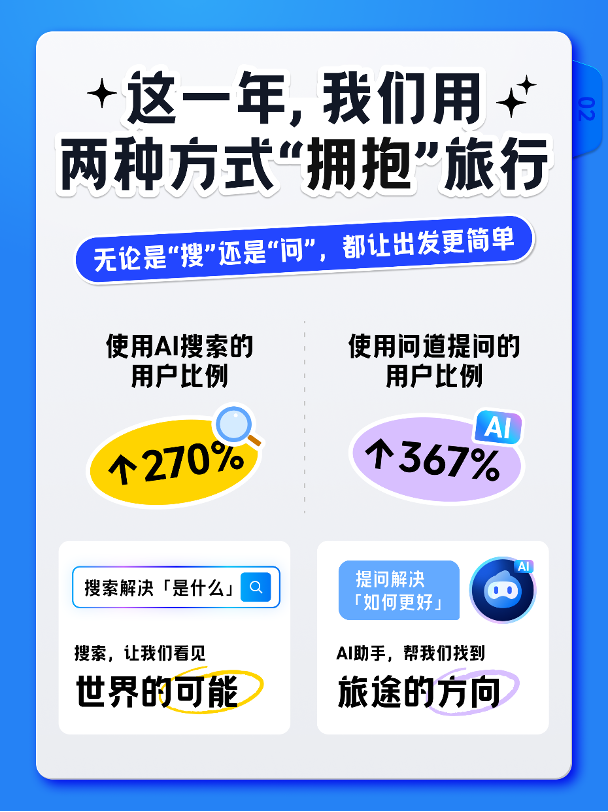
Core Insights - The core trend in travel decision-making is shifting from geographical coordinates to emotional needs, driven by a dual engine of "search engine + AI dialogue" [1] Group 1: AI and User Engagement - In 2025, the proportion of users utilizing AI for travel planning in searches is expected to increase by 270% year-on-year [2] - The user base for the AI Q&A product "Wenda" has seen a staggering growth of 367% year-on-year [2] - Travel is evolving from mere information retrieval to an important means of emotional regulation and life extension [2] Group 2: Cultural and Emotional Drivers - Concerts, events, and film IPs are emerging as new travel triggers, with searches for locations related to the film "Nezha 2" increasing by over 70% [3] - The release of "Zootopia 2" led to a 50% rise in search interest for Disney, while searches for the filming location of "Detective Chinatown 1900" surged by 473% within a week [3] - The analysis of dialogues on the "Wenda" platform reveals a strong emotional healing demand behind travel motivations [3] Group 3: Corporate Social Responsibility and Employee Welfare - The "2025 Annual Friendly Report" highlights Ctrip's achievements in promoting global cultural integration, industry innovation, ESG sustainability, and a friendly workplace environment [3] - Ctrip has made significant progress in low-carbon strategies and building a diverse and inclusive workplace [3] - The "Spring Festival Return to Work Policy," in place for three years, will expand in 2026 to include nearly a thousand employees in first-tier suburban customer service roles, offering two months of remote work benefits [3] Group 4: Leadership Vision - Ctrip's CEO emphasizes the importance of creating a friendly work environment and providing tangible support for employees' family and career development [4] - The company aims to continuously listen to employee feedback and translate consensus into actionable steps [4]
美国人的消费是义务,中国人的消费是权利
3 6 Ke· 2025-12-30 01:58
Core Insights - The financial structure of American consumers is under significant strain, with 37% unable to handle a $400 emergency, indicating a precarious financial situation despite seemingly high incomes [2][8] - In contrast, Chinese consumers exhibit a more flexible spending structure, with a higher proportion of disposable income available for discretionary spending, leading to different consumption behaviors [7][13] Group 1: American Consumer Spending - In the U.S., consumer spending is largely driven by obligations, with essential expenses like housing, transportation, and healthcare consuming over 70% of income, leaving little room for discretionary spending [5][6] - The rising costs of healthcare are particularly burdensome, with average family insurance premiums reaching $26,993 annually, which can significantly impact disposable income [5][6] - The perception of strong consumer spending in the U.S. is misleading, as much of it is tied to rigid expenses rather than discretionary choices [6][8] Group 2: Chinese Consumer Spending - Chinese consumers have a more balanced spending structure, with only 50-55% of income tied to essential expenses, allowing for greater flexibility in discretionary spending [7][8] - Recent data shows that while physical goods consumption is weakening, service consumption is on the rise, indicating a shift in consumer priorities towards experiences rather than ownership [9][12] - The high savings rate in China, estimated at 32.4%, provides a buffer for consumers, allowing them to wait for compelling reasons to spend rather than being forced to spend due to obligations [8][15] Group 3: Investment Implications - Companies reliant on impulsive spending may face challenges as consumers become more budget-conscious, while those with stable cash flows and strong user engagement may be undervalued in the current market [10][11] - Certain sectors, such as experience-based consumption and value-driven products, are likely to benefit from the current consumer behavior shift, as consumers prioritize spending on experiences and affordable options [11][12] - The distinction between passive market declines and active consumer retrenchment is crucial for investment strategies, as the latter may indicate potential for recovery given the substantial savings available [9][13]





Trip.com tests stablecoin payments overseas, offering USDT and USDC for prepaid bookings
Yahoo Finance· 2025-12-29 09:30
Core Insights - Trip.com has begun allowing overseas users to pay for prepaid hotel and flight bookings using stablecoins USDT and USDC, indicating a growing acceptance of these dollar-pegged tokens [1][5] - This development occurs despite the Chinese government's strict stance on cryptocurrency activities [2][5] Group 1: Company Actions - The stablecoin payment option was enabled on October 9, and is available to users in specific regions when booking through Trip.com's international platform [1] - A Foresight reporter successfully booked a hotel and flight using USDT in Vietnam, noting that these bookings were cheaper than those on Trip.com's mainland China app [3] Group 2: Market Context - The People's Bank of China stated that stablecoins do not meet the mainland's anti-money-laundering requirements, which may limit their use in certain markets [4] - Trip.com does not offer stablecoin payments to users in mainland China and some other regions, with the availability of the option determined by the user's IP address [5] - In August, over US$10 billion worth of stablecoins were used for payments, more than double the US$4.3 billion from the previous year, with business-to-business transfers making up most of this total [6] Group 3: Industry Trends - Several Chinese tech firms, including Ant Group and JD.com, are exploring stablecoin initiatives in Hong Kong, which is establishing a licensing regime for stablecoin issuers to become a digital asset hub [7]
夜经济成消费新蓝海 携程点亮30万亿元“夜经济”
Zheng Quan Ri Bao Wang· 2025-12-29 07:10
"机场、火车站、地铁枢纽站附近,凌晨房的搜索量一直很高"。携程"午夜房"产品负责人表示,凌晨落 地、早班机出行、航班中转的客人,存在巨量临时过夜需求。赶在国庆节之前上线"午夜房",也是让旅 客能在出行中实现最低3折安睡。 艾媒咨询发布的《2019-2022年中国夜间经济产业发展趋势与消费行为研究报告》指出,夜间经济涉及 餐饮、文化、游览、购物等多元化的商业形态,线上及线下的夜间消费需求逐渐丰富,夜间消费比例约 占总体零售消费的六成,预计2020年中国夜间经济规模将突破30万亿元。 9月初,携程上线"午夜房",在线点亮30万亿元"夜经济市场",为夜游、国庆中转客人提供闭环体验。 携程方面表示,数天内,重庆、广州、成都、北京、大理市、深圳、丽江、西安、杭州、上海、武汉、 长沙、昆明、厦门、贵阳、天津、苏州、郑州、南宁、三亚多家高星酒店开通"午夜房",夜间订单平均 提升67%。25岁至35岁的年轻人,成"午夜房"消费主力军。机场、高铁站、KTV、酒吧街、美食街、医 院、CBD、大学校园、互联网公司周边,成为"午夜房"热搜商圈。(刘斯会) 夜经济已成消费新蓝海。携程数据显示,每天有30万人在凌晨搜当日酒店。加上国庆出 ...