Toyota(TM)

Search documents
Three
Prnewswire· 2025-05-21 01:00
Core Insights - Toyota Motor North America has unveiled the all-new 2026 RAV4, marking the sixth generation of America's best-selling compact SUV, which will be available in three distinct designs: Core, Rugged, and Sport [1][6][8] - The 2026 RAV4 will feature a fully electrified lineup, offering both Hybrid Electric Vehicle (HEV) and Plug-in Hybrid Electric Vehicle (PHEV) powertrains, with the introduction of the first-ever RAV4 GR SPORT model [1][6][7] Design and Features - The Core design includes a modern aesthetic with a paint-matched grille and various wheel sizes ranging from 17 to 20 inches, available in well-equipped grades such as LE, XLE, and Limited [2][6] - The Rugged design is exemplified by the Woodland model, which features an adventurous look with raised roof rails, standard All-Terrain tires, and a higher ride height, available in both HEV and PHEV configurations [3][6] - The Sport designs, particularly the RAV4 GR SPORT, emphasize performance with a GR-tuned suspension, enhanced body rigidity, and exclusive PHEV powertrain options [4][6] Powertrain and Performance - The new PHEV models will feature a high-capacity drive battery and a newly developed Plug-in Hybrid System, achieving up to 320 combined system net horsepower, an increase of 18 hp over the previous generation [5][7] - The HEV system has been upgraded to deliver 236 combined system net horsepower on AWD models, a 23 hp improvement over the previous generation [5][6] Technology and Safety - The 2026 RAV4 will introduce the Arene software development platform, enhancing safety, security, and connectivity features, including the latest version of the Toyota Audio Multimedia system [20][21][23] - The new Toyota Safety Sense 4.0 system will debut with the 2026 RAV4, featuring improved hardware and detection capabilities [23] Interior and Comfort - The interior design focuses on functionality and user-friendly technology, featuring a new 10.5-inch or optional 12.9-inch touchscreen and a standard 12.3-inch digital gauge cluster [15][16] - Various seating options and interior colors will be available, with the Woodland grade offering unique outdoor-inspired touches [18][19] Availability and Pricing - The 2026 RAV4 models are expected to arrive at Toyota dealerships across the U.S. later in the year, with pricing details to be announced closer to the on-sale date [8]



丰田、本田、日产频传“绯闻”,加码中国市场行动一致
Zhong Guo Jing Ji Wang· 2025-05-20 10:40
Core Insights - Toyota is seeking deeper collaboration with Nissan following the breakdown of merger talks between Nissan and Honda, proposing a support plan [1] - The financial results for the fiscal year 2024 show Toyota's stability, while Honda and Nissan are in urgent need of transformation [1][2] Group 1: Financial Performance - Toyota and Lexus combined global production for fiscal year 2024 was 9.67 million units, a decrease of 2.9%, with global sales at 10.27 million units, a slight decline of 0.3% [1] - Toyota's revenue for fiscal year 2024 reached 4.804 trillion yen, a year-on-year increase of 6.5%, while net profit was 477 billion yen, down 3.6% [1] - Honda's revenue for fiscal year 2024 was 2.169 trillion yen, up 6.2%, but net profit fell by 24.5% to 835.84 billion yen [1][2] - Nissan reported an operating profit of 69.8 billion yen, down 87.6%, and a net loss of 671 billion yen, a decline of 257.3% [2] Group 2: Strategic Initiatives - Toyota is heavily investing in the Chinese market, showcasing multiple electric vehicle models at the 2025 Shanghai Auto Show and establishing a wholly-owned Lexus entity in Shanghai for integrated electric vehicle operations [2] - Honda is accelerating partnerships with local Chinese companies to enhance its electric and intelligent vehicle development, announcing collaborations with Momenta, DeepSeek, and CATL [3] - Nissan views China as crucial for reversing its global downturn, planning to launch 10 new electric vehicle models by summer 2027 as part of its strategy to strengthen R&D and product offerings [3]


丰田重建在美EV战略,特斯拉失速带来良机
3 6 Ke· 2025-05-20 09:38
Core Points - Toyota is restructuring its electric vehicle (EV) strategy in the U.S., planning to expand its product lineup from 2 to 5 models by 2025, indicating a strong commitment to the U.S. market [2][3] - The new branding strategy will involve renaming its EV models to "bZ" in the U.S. to enhance market recognition and simplify marketing efforts [3][5] - The introduction of the "bZ Woodland," a four-wheel-drive EV developed in collaboration with Subaru, is part of Toyota's strategy to cater to the American market [5] Product Expansion - Toyota will launch 5 EV models in the U.S. by 2025, doubling its current offerings, and will also introduce a small SUV EV "C-HR" that has already been released in Europe [3][5] - The luxury brand Lexus will add 2 new EV models starting in the second half of 2025, with pricing to be announced at launch [5] - New EVs will feature advanced lithium-ion batteries with a range increase of up to 25% and improved charging convenience, including compatibility with Tesla's charging standard [5] Market Context - The U.S. EV market is currently growing slowly, with EVs accounting for only 8% of new car sales, despite previous government plans to increase this to 50% by 2030 [6] - Tesla's market share has declined from 80% to below 50%, creating opportunities for other automakers like Toyota [8] - Toyota's EV sales share in the U.S. is currently only 3%, lagging behind competitors like General Motors and Hyundai [8] Production Challenges - Currently, Toyota does not produce EVs in the U.S., with plans to start local production only after 2026, which raises concerns about tariffs and supply chain logistics [9] - The new "bZ" models will be produced in Japan, with battery exports also coming from Japan [9] - Toyota aims to develop and produce products suited for local consumers in the U.S. in the long term, which could mitigate tariff risks [9] Long-term Outlook - Despite the slow adoption of EVs in the U.S., there is a consensus that EVs will become mainstream globally, with projections of 31.76 million EVs sold worldwide by 2030 [9] - Toyota plans to launch approximately 15 self-developed EVs globally by 2027 and diversify its production bases outside of Japan and China [9]


丰田重建在美EV战略,特斯拉失速带来良机
日经中文网· 2025-05-20 07:19
Core Viewpoint - Toyota is restructuring its electric vehicle (EV) strategy in the U.S. market, planning to expand its EV lineup from 2 to 5 models by 2025, while adopting a unique branding strategy for the American market [1][3][4]. Group 1: Expansion of EV Lineup - Currently, Toyota sells only 2 EV models in the U.S., but plans to double this number to 5 by 2025, including improvements to existing models [3][4]. - The new models will be branded as "bZ" in the U.S., differing from the names used in Japan and Europe, to enhance market recognition and marketing effectiveness [3][4]. Group 2: New Model Launches - The "bZ Woodland," a four-wheel-drive EV developed in collaboration with Subaru, will be launched in the U.S. in 2026, targeting the long-distance off-road driving market [4]. - Additionally, a small SUV EV model "C-HR" will be introduced, along with 2 new EVs under the luxury brand Lexus starting in the second half of 2025 [4]. Group 3: Technological Enhancements - The new EVs will feature advanced lithium-ion batteries, with a range improvement of up to 25%, and enhanced charging convenience, including compatibility with Tesla's charging standard [4][6]. - Fast charging capabilities will allow the battery to charge from 10% to 80% in just 30 minutes [4]. Group 4: Market Context and Competition - The U.S. EV market is currently growing slowly, with EVs accounting for only 8% of new car sales, despite previous government plans to increase this to 50% by 2030 [6]. - Tesla's market share has declined from 80% to below 50%, creating opportunities for other automakers like Toyota [6]. Group 5: Local Production Challenges - Currently, Toyota does not produce EVs in the U.S., with plans to start local production only after 2026, which raises concerns about tariffs and supply chain risks [7]. - The company aims to develop products suitable for local consumers and establish local production, including battery manufacturing in North Carolina [7].

丰田支持日产,市场竞争的“三国杀”越来越有看头了?
Zhong Guo Qi Che Bao Wang· 2025-05-20 03:33
Core Insights - Nissan, previously in talks with Honda, has attracted interest from Toyota for potential collaboration after negotiations with Honda stalled [2][3] - Toyota's approach aims to support Nissan by providing technological advancements in electrification and smart systems, while integrating Nissan into its global supply chain [6][8] Group 1: Toyota's Proposal - A Toyota executive reached out to Nissan, offering assistance, although the outcome remains uncertain as both companies have not publicly commented on the matter [3] - Toyota has a history of investing in other Japanese automakers and forming loose alliances, holding stakes in Subaru, Mazda, Suzuki, and Isuzu, as well as a majority stake in Hino Motors [3] Group 2: Nissan's Challenges - Following the breakdown of talks with Honda, Nissan is under pressure to find new partnerships and has recently appointed a new CEO, Ivan Espinosa [5] - Nissan announced plans to cut 20,000 jobs and close 7 out of 17 factories globally, aiming to collaborate with Mitsubishi and Renault for new product development [5] Group 3: Market Dynamics - The failed merger discussions between Nissan and Honda were primarily hindered by disagreements over management control and shareholding structures [4] - Despite the collapse of the merger, Nissan, Honda, and Mitsubishi continue to collaborate in key areas such as electric vehicle technology and supply chain management [7] Group 4: Industry Evolution - The potential collaboration between Toyota and Nissan signifies a shift in the Japanese automotive industry towards more integrated partnerships, focusing on technology sharing and supply chain cooperation [8] - The evolving landscape suggests that Japanese automakers must unite to navigate challenges in electrification and smart technology, enhancing their global competitiveness [8]

丰田所有车型将实现后加装功能
日经中文网· 2025-05-20 03:07
Core Viewpoint - Toyota is enhancing consumer choice and revenue by allowing post-installation of advanced safety features in vehicles, starting with new models launched after fall 2025 [1][2]. Group 1: Post-Installation Features - Consumers can pay extra to install advanced safety devices after vehicle delivery, increasing options and revenue per vehicle [1]. - The new models will support this practice, addressing the shrinking domestic market in Japan due to population decline [1]. Group 2: Comparison with Competitors - Tesla, as a software-defined vehicle (SDV) provider, offers paid updates for autonomous driving features, which Toyota aims to emulate while also enhancing hardware capabilities [1]. Group 3: Types of Optional Features - There are two types of optional features in Japanese cars: manufacturer-installed options and dealer-installed options, with the former being limited to new vehicles due to electrical system considerations [1]. Group 4: Future Upgrades - Toyota plans to allow post-installation of systems that utilize high-performance cameras and radar for obstacle detection, with designs accommodating future upgrades [1].
日系车企三强电动化突围:丰田稳健、本田阵痛、日产生死局
2 1 Shi Ji Jing Ji Bao Dao· 2025-05-19 12:15
在2024财年(2024年4月1日~2025年3月31日),丰田、本田、日产三大日系车企集体面临盈利下滑压力,被迫加速电动化与智能化转型。 尽管日系三强已吹响反攻的号角,但他们的"大象转身"速度仍需进一步加快。 财务表现:分化加剧 在一片对日系车企的质疑声中,丰田称得上"安稳着陆"。 财报显示,2024财年丰田营业利润为 4.79 万亿日元,同比下降 10.4%;净利润为4.77 万亿日元,同比下滑 3.6%。不过,其全年营收达到48.03 万亿 日元,较上一财年的45.1万亿日元同比增长 6.5%,稳居全球车企龙头。 丰田以48.03万亿日元营收(同比增长6.5%)和4.77万亿日元净利润(同比微降3.6%),稳坐全球车企利润榜首。但亮眼数据背后,日本本土市场营 业利润减少3275亿日元、中国市场缩水1148亿日元、北美市场暴跌4205亿日元的隐忧已现。 本田的财报则暴露出更深的危机:21.69万亿日元营收虽同比增长6.2%,但净利润同比骤降24.5%至8358.4亿日元,第四季度单季净利更是同比暴跌 87%。 日产则以6709亿日元净亏损(同比下滑257.3%)创历史第三大年度亏损。 曾经,日系车凭借可靠 ...
日媒哀叹:工厂建不动,日本国产电池被中国甩远
Guan Cha Zhe Wang· 2025-05-19 11:09
【文/观察者网 潘昱辰 编辑/高莘】"对于事情在短时间内变成这样,我感到非常抱歉。"据《日本经济新 闻》报道,由于业绩不佳,日产汽车于5月9日宣布将放弃在日本国内建设首座动力电池工厂的计划;因 此,日产执行董事平田祯治同日前往福冈县向地方政府汇报情况时表示了歉意。 日本经济产业省曾设定一个雄心勃勃的目标:到2030年将国内电池生产能力提升至150GWh/年,并为约 30个相关项目提供补贴。经济产业省曾估计,当前承诺可确保120GWh的年产能,但日产的退出使这一 目标备受威胁。 在《日本经济新闻》看来,日本汽车制造商优先考虑短期利润而非长期投资,将使其重蹈在半导体和液 晶显示器领域的覆辙,最终在电动汽车和电池领域将市场完全让给中国。 日产汽车 路透社 特别是在新任CEO伊万·埃斯皮诺萨于4月上任后,日产开始了大刀阔斧的降本计划,目标降低5000亿日 元(约合人民币243.9亿元)的成本。 具体来看,到2027财年,日产将在全球范围内把制造工厂从17个减少至10个,年产能降至250万辆,并 备用50万辆产能的冗余及裁员2万人,而北九州磷酸铁锂工厂的暂停自然也包括其中。 业绩坍塌的后果 就在今年1月,日产才宣布将在 ...

固态电池专利“暗战”:这三年,中日格局发生了哪些变化
Di Yi Cai Jing Zi Xun· 2025-05-19 10:12
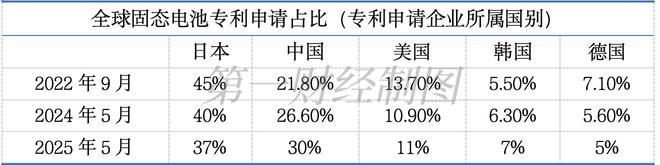
在全球动力电池份额占比日渐式微的当下,日本曾寄希望于在下一代的固态电池上打一场"翻身仗",在 固态电池上投入巨大,但如今中国正在加速迎头追赶。 第一财经记者从智慧芽数据获悉,截至2025年5月16日,全球固态电池领域的专利申请已超过4.6万件, 其中从技术来源(专利申请企业所属国别)看,全球固态电池领域的专利申请中,近37%来自日本,近 30%来自中国,两者差距进一步缩小;而从布局市场(专利申请所在国别)来看,中国已经赶超日本, 是全球固态电池专利布局最多的市场,约占35%。 中日固态电池之争 作为最早布局电池的国家之一,日本早在20世纪90年代便有了松下、三洋和索尼组成的初代"三巨头"。 到了21世纪初,日本企业生产的锂电池占到世界近9成的份额,几乎形成垄断。 | | | 全球固态电池专利申请占比(专利申请企业所属国别) | | | | | --- | --- | --- | --- | --- | --- | | | 日本 | 中国 | 美国 | 韩国 | 德国 | | 2022年9月 | 45% | | 21.80% - 13.70% | 5.50% | 7.10% | | 2024年5月 | 40% ...


“一口价”让大众、丰田回来了?靠降价竞争能有用吗?
3 6 Ke· 2025-05-19 08:35
Core Viewpoint - Joint venture car companies are struggling against the rise of domestic brands, leading to a shift towards a "one-price" strategy to regain market share [1][3]. Group 1: Impact of "One-Price" Strategy - Major joint venture brands like FAW-Volkswagen and Toyota have seen a resurgence in sales, with FAW-Volkswagen delivering over 380,000 vehicles in Q1 2025, ranking fifth among traditional car manufacturers [3]. - The "one-price" strategy, primarily applied to family cars priced between 100,000 to 250,000 yuan, has led to a noticeable recovery in sales for many joint venture and luxury brands [3]. - Promotions for traditional fuel vehicles reached 22.1% in March, while luxury vehicles saw promotions at 26.1%, and joint venture fuel vehicles at 21.5%, indicating a trend towards aggressive pricing [3]. Group 2: Effectiveness of Price Competition - Historically, joint venture brands enjoyed high brand equity and consumer loyalty, allowing them to command premium prices. However, this advantage is diminishing due to the rise of domestic brands with improved technology and quality [5]. - Price remains a critical factor in consumer purchasing decisions, and a reduction in price can stimulate demand, especially among price-sensitive consumers [5][7]. - While the "one-price" strategy can attract consumers in the short term, it raises questions about its long-term viability as a competitive strategy [5][8]. Group 3: Long-Term Sustainability of Price Cuts - Continuous price reductions may compress profit margins, impacting research and development investments and overall product quality [8]. - Relying on price cuts could alter consumer perceptions of brands like Volkswagen and Toyota, potentially shifting their market positioning from mid-to-high-end to mid-to-low-end [8]. - The automotive market is undergoing significant changes with the rise of electric vehicles and smart technology, necessitating joint venture companies to innovate and adapt to maintain competitiveness [10]. Group 4: Need for Innovation - Joint venture companies must invest in research and development for electric vehicles and explore advancements in smart connectivity to meet evolving consumer demands [10]. - Enhancing user experience through improved after-sales service and customer relationship management is essential for retaining market relevance [10].