XPENG(XPEV)

Search documents
【新能源】2026年1月新能源乘用车厂商批发销量快讯
乘联分会· 2026-02-04 08:31
Core Viewpoint - The article predicts a 25% growth in sales for Chinese new energy passenger vehicle manufacturers by 2025, aligning with the growth expectations set for the "14th Five-Year Plan" period [2]. Group 1: Market Predictions - The end of the new energy vehicle purchase tax exemption policy in December 2025 is expected to lead to a recovery period in January 2026, with some consumers likely to make purchases in December to benefit from the policy [2]. - January 2023 saw a decline of 8% in new energy vehicle sales due to the withdrawal of subsidies, while January 2024 experienced a positive growth despite the anticipated policy changes [2]. - The late timing of the 2026 Spring Festival and contributions from exports have positively influenced January's sales performance [2]. Group 2: Sales Data - According to the latest data from the Passenger Car Association, manufacturers with sales exceeding 10,000 units in December accounted for 93% of the total new energy passenger vehicle wholesale sales for that month [3]. - Preliminary data for January indicates that these manufacturers achieved sales of 830,000 units, leading to an estimated total of 900,000 new energy passenger vehicles sold nationwide in January, reflecting a 1% year-on-year growth [4][3]. Group 3: Leading Manufacturers - Key manufacturers such as GAC Aion, XPeng Motors, and Great Wall Motors reported significant sales figures in January, with GAC Aion leading at 21,635 units sold [8]. - Other notable performances include XPeng Motors with 20,011 units, Great Wall Motors with 18,019 units, and FAW Hongqi with 8,265 units [8]. - The total estimated sales for manufacturers exceeding 10,000 units in January amounted to 832,461, representing 93% of the total market share for that month [8].







登春晚、进工厂!车企“造人”从技术演示进入量产冲刺阶段
Xin Lang Cai Jing· 2026-02-04 08:29
Group 1 - The automotive industry is undergoing a transformation with the integration of "vehicles, people, and machines," leading to a significant shift towards intelligent robotics [1] - The "Wuyou" AI traffic management robot by Moja Robotics has officially started operations, collaborating with traffic police to manage traffic and identify violations [1] - Xiaopeng Motors has merged its autonomous driving and smart cockpit departments into a new General Intelligence Center, indicating a strategic focus on AI in automotive and robotics [1][2] Group 2 - Tesla's third-generation humanoid robot, Optimus V3, is set to be mass-produced, with an expected annual output of one million units, showcasing a shift from demonstration to production in the humanoid robot race [2] - Over twenty automotive companies globally are investing in humanoid robotics, with some already integrating these robots into their factories [2] - Li Auto has confirmed a leadership change to focus on humanoid robotics, with new job postings indicating a push for expertise in embedded software and motor development [2] Group 3 - Seres has established a new company focused on intelligent robotics and AI software development, marking its entry into the "automotive + AI + robotics" ecosystem [3] - Morgan Stanley has significantly raised its forecast for humanoid robot sales in China, predicting a 133% year-on-year increase to 28,000 units in 2023, with long-term projections reaching 260,000 units by 2035 [3] Group 4 - The automotive manufacturing sector is seen as a key area for the application of embodied robots due to its large scale and established automation [4] - Challenges remain for the integration of embodied robots in automotive manufacturing, including the maturity of core technologies and high operational costs [4] - The application of embodied robots in the automotive sector is expected to accelerate, driven by policy, market demand, and technological advancements [4]


2026中国车企欧洲本土化动真格
Zhong Guo Qi Che Bao Wang· 2026-02-04 08:04
中欧围绕纯电动汽车进口的价格承诺机制刚刚敲定,新的风波似乎又起苗头。近日,据欧洲媒体 Euractiv报道,欧盟委员会内部正在讨论一个可能显著影响中欧贸易的举动,即考虑将目前针对中国产 纯电动汽车的反补贴关税政策,扩大至自中国进口的混动车(包括插混车)。 欧洲销量快速增长以及关税壁垒的倒逼,正在加速中国车企欧洲本土化生产的实质性落地。除了奇瑞、 小鹏、广汽已经实现欧洲本土化生产组装外,按计划,比亚迪匈牙利乘用车工厂将于2026年第一季度试 生产,第二季度正式量产;零跑旗下车型同样将于2026年第三季度在Stellantis的西班牙工厂投产。再加 上供应链、研发、售后等环节的本土化布局,2026年中国车企在欧洲将从"产品出海"加速迈向"生态扎 根"。 插混车在欧销量激增 传出欧盟加税风声 据Euractiv报道,有欧盟官员向该媒体透露,欧盟委员会执行副主席、欧盟工业战略专员塞茹尔内多次 对中国产混动\插混车在欧洲销量激增表达担忧。塞茹尔内质疑,中国产混动\插混车与纯电动汽车并 无差别,为保障欧洲本土竞争者获得同等保护、维护公平的市场竞争环境,对纯电动汽车加征的反补贴 税也应延伸至混动\插混车。 2026年1月1 ...

重仓新能源的车厂们
投中网· 2026-02-04 07:13
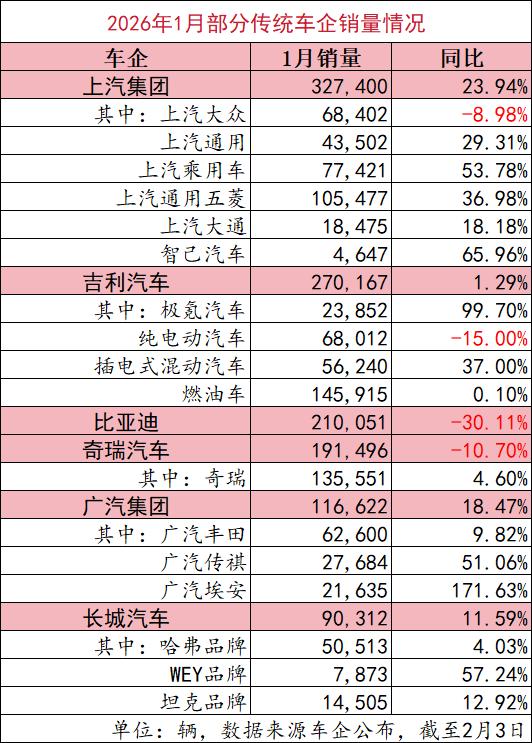
Core Viewpoint - The Chinese automotive market in January 2026 is characterized by a stark contrast, with most automakers experiencing negative growth, particularly in the new energy vehicle (NEV) sector, highlighting the importance of having a diversified product lineup that includes both fuel and electric vehicles [5][6][7]. Sales Performance Summary - In January, the retail sales of passenger cars are expected to reach 1.8 million units, a month-on-month decline of 20.4%, with NEV sales around 800,000 units, marking a penetration rate drop to 44.4%, nearly 10 percentage points lower than the peak at the end of 2025 [6][7]. - Traditional automakers like SAIC, Geely, and GAC Toyota reported stable sales due to their dual strategy of offering both fuel and NEVs, with SAIC's total sales reaching 327,400 units, a year-on-year increase of 23.94% [10][11]. - Geely's total sales were 270,167 units, with fuel vehicles contributing significantly to its performance, while BYD faced a 30.11% decline in NEV sales, indicating the challenges faced by companies heavily reliant on NEVs [12][15]. Market Dynamics - The differentiation in sales performance among automakers is attributed to their strategic choices, particularly the presence of a fuel vehicle base, which enhances resilience against market fluctuations [9][19]. - The demand for fuel vehicles surged during the pre-Spring Festival period, as consumers preferred mature technology and the convenience of fuel vehicles for long-distance travel, further supported by the limited impact of policy changes on fuel vehicles [19][20]. Export Growth - Exports have become a crucial support for many leading automakers, with companies like Chery and SAIC reporting significant increases in overseas sales, indicating a dual strategy of maintaining domestic stability while expanding globally [17][18]. Future Outlook - The current market conditions signal a shift from policy-driven growth to market-driven dynamics, emphasizing the need for automakers to maintain a balanced portfolio of fuel and NEVs to navigate future uncertainties [22]. - Companies that can effectively manage their fuel vehicle base while rapidly advancing in the NEV sector are likely to emerge as market leaders, while those focusing solely on NEVs may face greater risks during market fluctuations [21][22].



小鹏汽车:天玑AIOS 6.0 OTA开启推送,行业首个主动服务座舱落地
Xin Lang Cai Jing· 2026-02-04 05:27
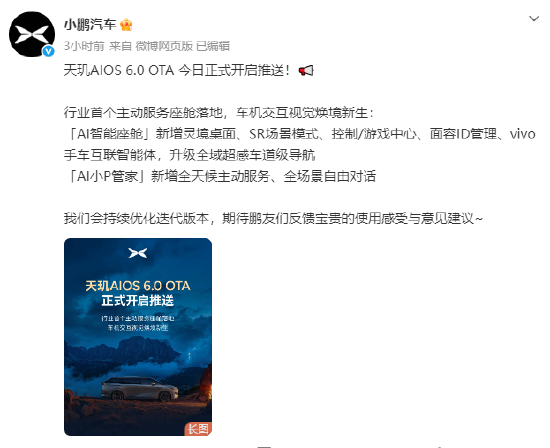
Core Viewpoint - Xpeng Motors announced the launch of the Dimensity AIOS 6.0 OTA on February 4, marking the introduction of the industry's first proactive service cockpit and a refreshed vehicle interaction visual experience [1][3]. Group 1: Product Features - The AI smart cockpit includes new features such as the Lingjing desktop, SR scene mode, control/game center, facial ID management, and vivo vehicle interconnection intelligent agent [1][3]. - The upgrade enhances the all-domain super-sensing lane-level navigation capabilities [1][3]. - The AI Xiaop P assistant now offers all-weather proactive services and free dialogue across all scenarios [1][3].
胡润发布2025汽车品牌价值榜:特斯拉居首,问界进前三
Feng Huang Wang· 2026-02-04 02:43
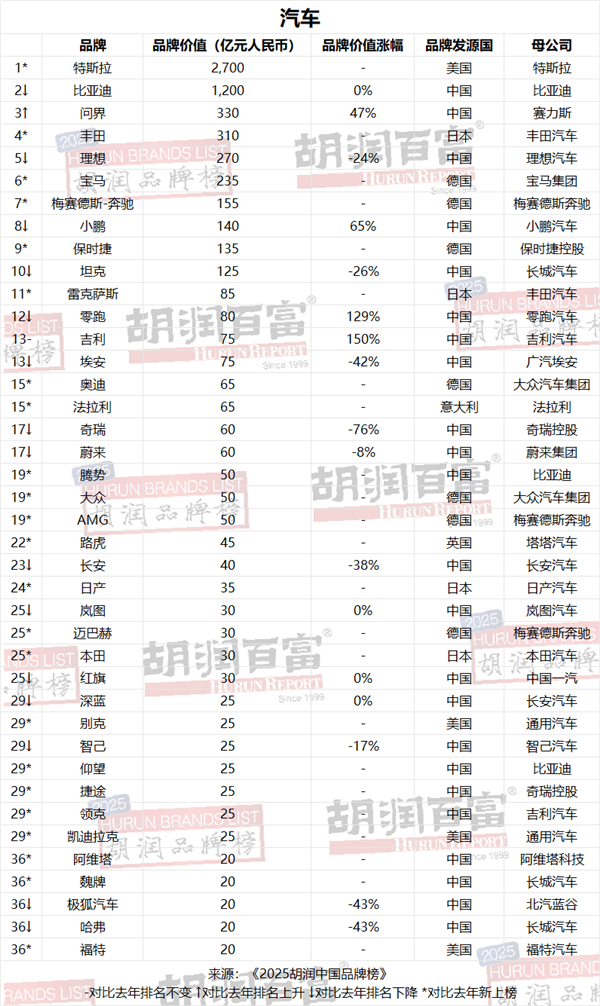
在本次榜单中,零跑汽车以129%的涨幅成为价值上升最快的品牌,其品牌价值为80亿元。奇瑞品牌价 值则出现76%的下降,为跌幅最显著品牌。 榜单第四、五位为丰田与理想,品牌价值分别为310亿元与270亿元。排名第六至十位的品牌依次是:宝 马、梅赛德斯-奔驰、小鹏汽车、保时捷以及坦克。其中,小鹏汽车品牌价值增长65%。 | | | | | 汽车 | | | | --- | --- | --- | --- | --- | --- | --- | | | 品牌 | | 品牌价值 (亿元人民币) | 品牌价值涨幅 | 品牌发源国 | 母公司 | | 1* | 特斯拉 | | 2,700 | | 美国 | 特斯拉 | | 21 | 比亚迪 | | 1,200 | 0% | 中国 | 比如⁄迪 | | 31 | 问界 | | 330 | 47% | 中国 | 塞力斯 | | 4* | 0 #田 | | 310 | | 日本 | 丰田汽车 | | ਟੀ | 一理想 N | RANDS | 270 | -24% | 中国 | 理想汽车 | | રિં | 宝马 王 | 52 128 | 1-235 | | 德国 | 宝马集团 ...
中国汽车与共享出行:“观望”策略持续
Morgan Stanley· 2026-02-04 02:00
Investment Rating - The report maintains an "In-Line" investment rating for the China Autos & Shared Mobility industry [4]. Core Insights - The report indicates a "wait and see" strategy among automakers as they navigate a challenging market environment, with many companies preparing for significant product launches post-Chinese New Year (CNY) while monitoring demand trends closely [54]. - Weekly order trends from January 26 to February 1 show a decline in demand for major electric vehicle (EV) manufacturers, with notable decreases in order volumes compared to previous weeks [2][3]. - The anticipated pre-CNY buying rush is expected to be less impactful this year, as original equipment manufacturers (OEMs) adopt a cautious approach until demand shows signs of recovery [54]. - Approximately 25 localities began accepting applications for trade-in subsidies in January, but the effectiveness of these subsidies is expected to be clearer only after the CNY break [54]. Summary by Relevant Sections Order Trends - BYD: 41-42k orders (down 8% week-over-week, down 41% month-over-month) [2] - NIO: 3.9-4.1k orders (down 5% week-over-week, down 49% month-over-month) [2] - XPeng: 7.5-7.7k orders (down 9% week-over-week, down 15% month-over-month) [2] - Tesla China: 9.5-9.7k orders (down 3% week-over-week, down 4% month-over-month) [2] - Aito: 5.2-5.4k orders (down 7% week-over-week, down 32% month-over-month) [3] - Geely Galaxy: 15-15.2k orders (down 6% week-over-week, down 32% month-over-month) [3] Market Environment - The report highlights that despite some seasonal promotions, the overall market remains tough, leading to a cautious outlook from manufacturers [54]. - The report suggests that the industry is in a transitional phase, with companies waiting for clearer signals of demand recovery before making significant moves [54].
重仓新能源的车厂,1月大多数都很惨
3 6 Ke· 2026-02-04 01:48
2026年开年1月的中国车市,用"冰火两重天"形容再贴切不过。 过去三天,不少车企都发布了1月份的销量业绩,可以说绝大多数车企都挂上了负增长的标签,特别是一些头部新能源车企,其1月销量波动更 为严峻。 乘联会数据显示,全月乘用车零售预计180万辆,环比下滑20.4%,同比仅微增;新能源零售销量可能达80万辆左右,渗透率降至44.4%,较 2025年底的峰值跌落近10个百分点。 在这场开年"寒流"中,车企阵营分化彻底拉满,拥有庞大燃油车基盘的大多数车企稳如泰山,而绝大多数单押新能源的品牌集体承压,新势力 内部更是有人狂欢有人落寞。 透过这份成绩单,我们似乎可以发现中国市场越来越明显的竞争逻辑,那就是即便新能源是未来发展的大趋势,但"双腿走路才稳"的路径愈加 清晰。 燃油车托底者稳,单押新能源者惨,出口是重要支撑 1月的销量数据,像一面放大镜,照出了不同车企战略选择的最终结果。核心分化点清晰明了,即是否拥有燃油车基本盘,直接决定了企业在市 场波动中的抗风险能力。 以吉利、上汽、广汽丰田为代表的传统车企,凭借"燃油+新能源"双线布局,在1月交出了最稳健的答卷。 上汽集团1月销量32.74万辆,同比增长23.94%, ...
销量环比下滑超20%,单车成本激增7000元:2026车市开局承压
Xin Hua Cai Jing· 2026-02-04 01:16
Core Viewpoint - The automotive market in China experienced a significant month-on-month decline in January 2026, influenced by changes in tax policies and early consumer demand, while year-on-year sales remained relatively stable [1]. Group 1: Market Performance - In January 2026, the retail sales of narrow passenger vehicles in China were approximately 1.8 million units, representing a month-on-month decrease of 20.4% and a slight year-on-year increase of 0.3% [1]. - The retail sales of new energy vehicles (NEVs) in January were around 800,000 units, showing a year-on-year decline of 40.2%, but a month-on-month growth of 7.5% [1]. - Major traditional automakers like SAIC and Geely surpassed BYD in sales, with SAIC selling 327,000 units (up 23.9% year-on-year) and Geely selling 270,200 units (up 1.3% year-on-year) [2]. Group 2: New Energy Vehicle Segment - In the new energy vehicle sector, brands like Xiaomi, Hongmeng Zhixing, and NIO saw significant year-on-year growth, with Xiaomi's sales increasing by 95% to over 39,000 units [3][4]. - NIO delivered 27,200 units in January, marking a 96% year-on-year increase, driven by the new ES8 model [4]. - Conversely, companies like XPeng and Li Auto experienced declines, with XPeng's deliveries down 47% month-on-month and 34% year-on-year [4]. Group 3: Cost Pressures - The automotive industry is facing rising costs, with single-vehicle costs increasing by 4,000 to 7,000 yuan due to surging prices of key materials like lithium, aluminum, and DRAM [5][6]. - The price of battery-grade lithium carbonate rose from 75,700 yuan per ton at the beginning of 2025 to 146,600 yuan per ton by February 3, 2026, a nearly 94% increase [5]. - UBS reported that the cost increases in metals and chips could compress profit margins significantly, with potential reductions of 33% to 93% for vehicles priced at 150,000 yuan [6]. Group 4: Strategic Directions - To counteract rising costs and stagnant market demand, automakers are focusing on international expansion, with Chery exporting 119,600 units in January, accounting for nearly 60% of its total sales [7]. - BYD's overseas sales exceeded 100,000 units, a year-on-year increase of 43.3%, while Geely's exports grew by over 120% [7]. - Companies are also targeting the high-end market, with Great Wall Motors launching the WEY brand's flagship V9X, indicating a competitive push in the premium segment [9]. Group 5: Market Outlook - The automotive consumption index for January 2026 was reported at 31.1, reflecting a cautious consumer sentiment influenced by various factors, including the upcoming Spring Festival and changes in tax policies [10]. - Industry experts suggest that the market may not see a clear recovery until March or the end of the first quarter [10].
纳指收跌1.43%,沃尔玛市值首次突破1万亿美元,中概指数跌0.94%
Ge Long Hui· 2026-02-04 00:33
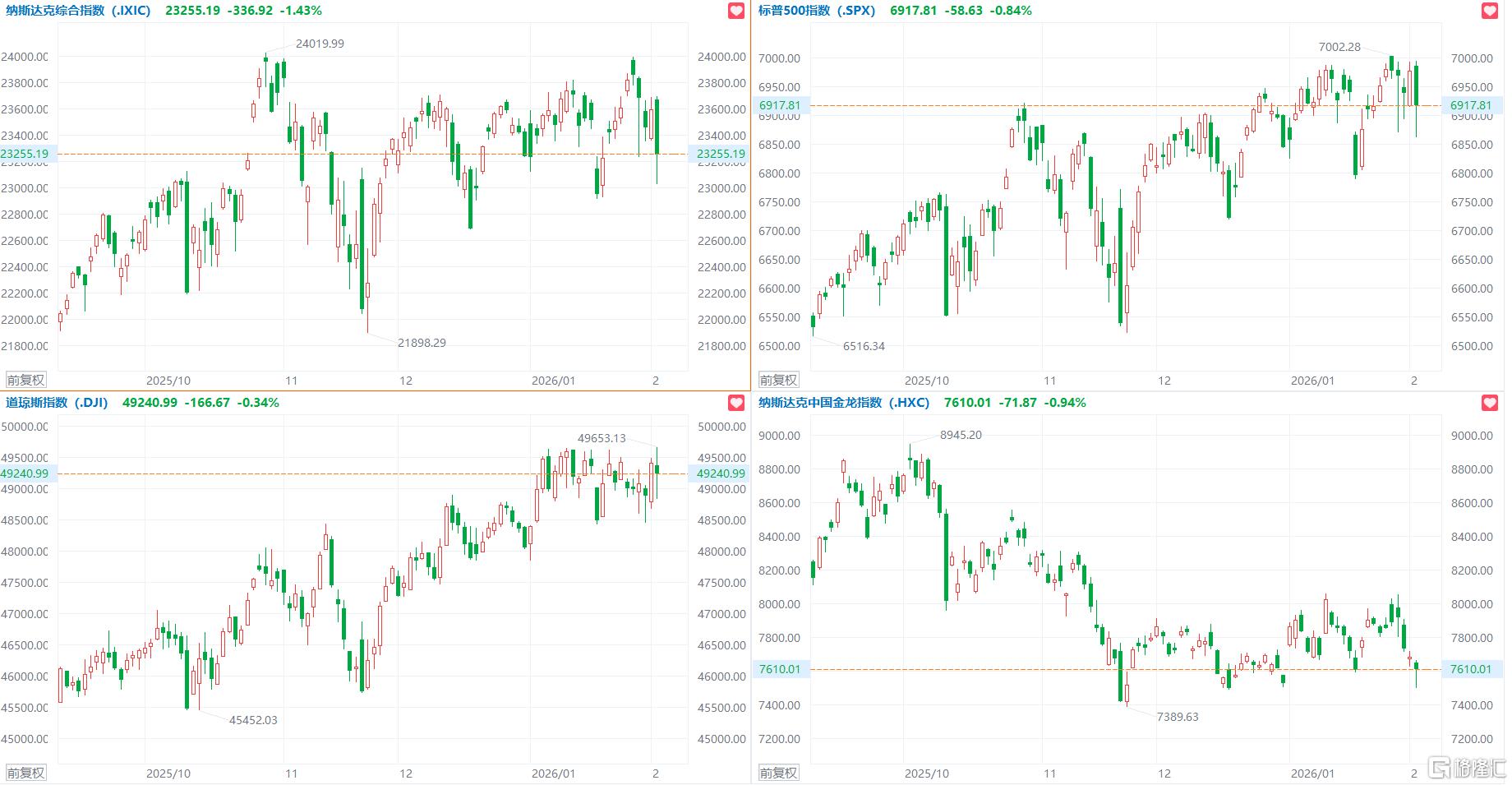
Market Overview - The three major U.S. stock indices closed lower, with the Dow Jones down 0.34%, the Nasdaq down 1.43%, and the S&P 500 down 0.83% [1] - Popular technology stocks experienced declines, with Broadcom falling over 3%, and Microsoft, Nvidia, and Meta each dropping over 2% [1] Sector Performance - The rare earth, non-ferrous metals, and precious metals sectors saw significant gains, with gold resources rising over 20%, Southern Copper up over 11%, Americas Silver up over 8%, and Pan American Silver up over 5% [1] - Conversely, application software, cryptocurrency, and weight loss drug stocks faced notable declines, with Novo Nordisk down over 14%, Coinbase and Circle each down over 4%, and Eli Lilly and Pfizer each down over 3% [1] Notable Company Movements - Walmart's stock increased by 2.94%, marking its market capitalization surpassing the $1 trillion milestone for the first time [1] - The Nasdaq Golden Dragon China Index fell by 0.94%, with significant declines in popular Chinese stocks such as Daqo New Energy down 5.6%, Bilibili down 4%, and Kingsoft Cloud down 3.5% [1] - Alibaba dropped 2.9%, while NIO rose 0.8%, Pony.ai increased by 2%, Huazhu up 2.2%, New Oriental up 2.3%, Li Auto up 2.7%, Canadian Solar up 4.1%, and Xpeng up 4.3% [1]