洋河股份

Search documents
当贵州茅台也失去增长
Sou Hu Cai Jing· 2025-11-04 11:48
Core Insights - The Chinese liquor industry is facing a significant downturn, with major brands like Kweichow Moutai and Shanxi Fenjiu losing growth momentum, indicating a broader crisis in the sector [5][6][10] - The inventory crisis has been exacerbated by a shift in consumer demand and market dynamics, leading to a situation where even top brands are struggling to maintain sales [4][7][8] Industry Overview - The liquor industry began a recovery phase in 2016, characterized by a trend towards high-end products, which led to increased sales but also created underlying risks due to unsustainable consumption levels [1][2] - The 2023 Chengdu Sugar and Wine Fair highlighted the industry's inventory crisis, with insiders suggesting that current stock levels could take three years to deplete without production [1][5] Company Performance - Kweichow Moutai reported a slight revenue increase of 0.56% to 39.064 billion yuan in Q3 2025, but its growth has stagnated, reflecting broader industry challenges [5] - Shanxi Fenjiu's Q3 revenue grew by 4.05% to 8.960 billion yuan, but its net profit declined by 1.38% [5] - Gujing Gongjiu experienced a dramatic revenue drop of 51.65% to 2.545 billion yuan in Q3 2025, with net profit falling by 74.56% [5] - Jiangsu-based brand Jinshiyuan saw its revenue decline by 10.66% to 8.881 billion yuan, with net profit down 17.39% [6] - Laobaigan Liquor, which had previously shown growth, reported a 18.53% revenue decline to 3.330 billion yuan, with net profit down 28.04% [7] Market Dynamics - The traditional sales model in the liquor industry has extended the supply chain's impact, leading to uncertainty in how quickly products reach consumers [4] - The market is currently experiencing a convergence of inventory cycles, industry driving forces, and shifts in consumer preferences, creating a complex environment for brands [7][8] Strategic Recommendations - Companies need to abandon outdated operational models and focus on consumer-driven demand rather than relying on inventory pressure [9] - Embracing new market directions, such as the growth of low-cost liquor segments, is essential for survival in the current climate [11][12] - Historical context suggests that while the current downturn is severe, recovery is possible if companies adapt and innovate in response to market needs [12][15]



11月4日深证国企股东回报R(470064)指数跌1.32%,成份股山金国际(000975)领跌
Sou Hu Cai Jing· 2025-11-04 10:27
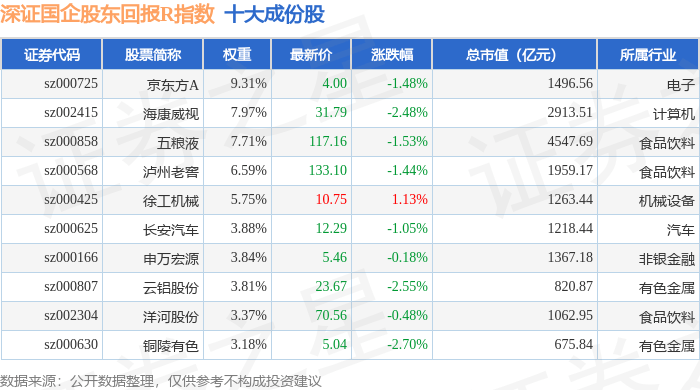
Core Points - The Shenzhen State-Owned Enterprises Shareholder Return Index (470064) closed at 2264.6 points, down 1.32% with a trading volume of 27.876 billion yuan and a turnover rate of 1.09% [1] - Among the index constituents, 14 stocks rose while 34 stocks fell, with Guangdong Expressway A leading the gainers at 3.31% and Shanjin International leading the decliners at 3.9% [1] Index Constituents Summary - The top ten constituents of the Shenzhen State-Owned Enterprises Shareholder Return Index are as follows: - BOE Technology Group (sz000725) has a weight of 9.31%, latest price of 4.00 yuan, down 1.48%, and a market cap of 149.656 billion yuan [1] - Hikvision (sz002415) has a weight of 7.97%, latest price of 31.79 yuan, down 2.48%, and a market cap of 291.351 billion yuan [1] - Wuliangye Yibin (sz000858) has a weight of 7.71%, latest price of 117.16 yuan, down 1.53%, and a market cap of 454.769 billion yuan [1] - Luzhou Laojiao (sz000568) has a weight of 6.59%, latest price of 133.10 yuan, down 1.44%, and a market cap of 195.917 billion yuan [1] - XCMG Machinery (sz000425) has a weight of 5.75%, latest price of 10.75 yuan, up 1.13%, and a market cap of 126.344 billion yuan [1] - Changan Automobile (sz000625) has a weight of 3.88%, latest price of 12.29 yuan, down 1.05%, and a market cap of 121.844 billion yuan [1] - Shenwan Hongyuan (sz000166) has a weight of 3.84%, latest price of 5.46 yuan, down 0.18%, and a market cap of 136.718 billion yuan [1] - Yunnan Aluminum (sz000807) has a weight of 3.81%, latest price of 23.67 yuan, down 2.55%, and a market cap of 82.087 billion yuan [1] - Yanghe Brewery (sz002304) has a weight of 3.37%, latest price of 70.56 yuan, down 0.48%, and a market cap of 106.295 billion yuan [1] - Tongling Nonferrous Metals (sz000630) has a weight of 3.18%, latest price of 5.04 yuan, down 2.70%, and a market cap of 67.584 billion yuan [1] Capital Flow Analysis - The index constituents experienced a net outflow of 2.414 billion yuan from institutional investors, while retail investors saw a net inflow of 1.911 billion yuan [1] - The detailed capital flow for selected stocks includes: - XCMG Machinery had a net inflow of 64.0524 million yuan from institutional investors [2] - Guangdong Expressway A had a net inflow of 21.2567 million yuan from retail investors [2] - Other stocks like Huazhu Group and New Media Group also showed varying net inflows and outflows [2]

洋河三季报出炉,蓄力调整长期发展
Hua Er Jie Jian Wen· 2025-11-04 09:49
Core Insights - The liquor industry is experiencing a "bottoming out" phase in 2025, as reflected in the performance reports of companies like Yanghe, which reported a revenue of 18.09 billion yuan and a net profit of 3.975 billion yuan for the first three quarters [1][2]. Group 1: Industry Trends - The liquor industry is undergoing a significant performance downturn, with nearly 80% of liquor companies facing market challenges, leading to high channel inventory and price inversions [2]. - The focus of leading liquor companies has shifted from "seeking growth" to "ensuring quality" amid changing macro consumption environments and industry policy guidance [2][4]. - Yanghe's strategy emphasizes "de-stocking, enhancing momentum, and stabilizing prices," with a focus on reducing channel inventory through various promotional measures [2][4]. Group 2: Company Strategy - Yanghe is adopting a unique approach to de-stocking by promoting sales rather than imposing sales targets, utilizing strategies like QR code red envelopes and tasting events to engage high-net-worth consumers [4]. - The company's digital infrastructure is enhancing efficiency by enabling direct promotion policies to terminals and using data analysis to match demand accurately, which is more sustainable than short-term volume increases [4]. - Yanghe maintains a commitment to product quality despite short-term revenue pressures, with a robust product matrix covering all price ranges and a significant reserve of 700,000 tons of raw liquor [5][7]. Group 3: Product Development - In 2025, Yanghe continues its "dual famous liquor, multi-brand, multi-category" strategy, adapting to consumer segmentation trends and enhancing its risk resilience [5]. - The company has launched six new products this year, including upgraded versions of existing brands, which are expected to generate excitement in the market [7]. - Yanghe's substantial raw liquor reserves and innovative product capabilities position it well for future growth, making it an attractive option for long-term investors [7].

白酒 2025 年三季报总结:25Q3 基本面加速探底,板块进入战略配置期
Shenwan Hongyuan Securities· 2025-11-04 08:35
Investment Rating - The report indicates that the white liquor sector has entered a strategic allocation period, with a focus on high-quality companies for long-term investment [3][8]. Core Viewpoints - The white liquor industry experienced significant declines in revenue and profit in Q3 2025, with major companies like Wuliangye reporting substantial drops. Public fund holdings in the food and beverage sector have returned to levels seen in Q1 2017 [3][8]. - Despite the current challenges, the report suggests that it is possible to predict a bottoming out of the market in the near future, allowing for long-term pricing of quality enterprises [3][8]. - The report emphasizes the need for patience regarding fundamental improvements, as the performance of individual stocks may vary during this adjustment phase [3][8]. Summary by Sections 1. Fundamental Analysis - In the first three quarters of 2025, the white liquor industry achieved revenue of 310.28 billion yuan, a year-on-year decline of 5.48%, and a net profit of 122.69 billion yuan, down 6.63% [4][14]. - In Q3 2025, the industry reported revenue of 76.31 billion yuan, a decrease of 18.4% year-on-year, and a net profit of 28.21 billion yuan, down 22.0% [17][19]. - The net profit margin for the industry in Q3 2025 was 38.0%, a decline of 1.7 percentage points year-on-year, primarily due to decreased gross margins and increased tax rates [24][27]. 2. Valuation Analysis - As of October 31, 2025, the absolute PE level for the white liquor sector was 18.7x, below the historical average of 27.6x since 2011. The relative PE multiple compared to the Shanghai Composite Index was 1.14x, also below the historical average of 2.01x [5][11]. - The report indicates that the current valuations of leading companies reflect market expectations of mid-term demand pressure, suggesting potential for recovery if demand improves [5][11]. 3. Company Recommendations - The report recommends focusing on high-quality companies such as Luzhou Laojiao, Shanxi Fenjiu, Guizhou Moutai, and Wuliangye, while also keeping an eye on companies like Yingjia Gongjiu and Jinhuijiu [3][8].



白酒的漫长凛冬
雪球· 2025-11-04 08:27
Core Viewpoint - The Chinese liquor industry is facing a severe downturn, with high inventory levels and weak consumer demand leading to a vicious cycle of price declines and industry consolidation, contradicting previous expectations of a rebound [3][5]. Financial Performance - By Q3 2025, the liquor industry has seen a significant divergence, with only a few leading companies maintaining growth while most mid-tier and regional brands experience declines in both revenue and profit [7]. - Kweichow Moutai reported a revenue of 130.9 billion yuan, a year-on-year increase of 6.32%, but its growth momentum has weakened significantly compared to previous years [8]. - Second-tier brands like Wuliangye and Luzhou Laojiao are under pressure, with Wuliangye's revenue down 10.26% and Luzhou Laojiao's down 4.84% year-on-year [9][10]. - Lower-tier and regional brands are facing severe losses, with companies like Yanghe and Jiu Gui reporting significant declines in revenue and profits [10]. Industry Dynamics - As of November 1, 2025, the industry dynamics continue to worsen, with no progress in inventory reduction and a collapsing price system [13]. - The price of high-end liquor has dropped significantly, with Moutai's price falling over 28% since the beginning of the year [14]. - Inventory levels are high, with Moutai's inventory turnover days reaching 995 days, indicating a prolonged inventory clearance period [11][15]. - Demand remains weak, with traditional consumption scenarios shrinking and younger consumers shifting towards lower-alcohol beverages [16]. Bottoming Indicators - The industry is far from confirming a bottom, with significant gaps in inventory reduction, price stabilization, demand transformation, competitive landscape, policy support, and valuation [18]. - Current inventory turnover days exceed 900 days, far above the target of 300 days, indicating a lengthy clearance process ahead [19]. - Price stabilization signals are absent, with Moutai's price still significantly below the target [20]. - Demand transformation is lacking, with the share of young consumers and low-alcohol products not meeting necessary thresholds [22]. Historical Context - The liquor industry has experienced two major crises in the past 30 years, both characterized by demand shrinkage, inventory buildup, price declines, and industry consolidation [27]. - The first crisis (1998-2004) was driven by external shocks and resulted in a prolonged adjustment period, while the second crisis (2012-2015) was more structural, leading to a quicker recovery [30]. - Current conditions suggest that the ongoing crisis is deeper and more complex than previous ones, with a projected bottoming period extending to around 2027 [31]. International Comparisons - Global spirits industries have faced similar crises, with recovery paths providing valuable insights for the Chinese liquor sector [34]. - The Scottish whisky industry, for example, successfully managed inventory through production cuts and market expansion, contrasting with the current reliance on price cuts in the Chinese market [36]. - Japanese sake underwent significant transformation through product innovation and cultural integration, highlighting the need for the Chinese liquor industry to adapt to changing consumer preferences [39][41]. Future Outlook - The Chinese liquor industry must meet specific conditions to confirm a bottom, including reducing inventory turnover to below 300 days and increasing the share of low-alcohol products to 30% [48]. - A successful transformation will require a focus on product innovation, digital channel development, and cultural engagement to attract younger consumers [49]. - The industry must avoid the pitfalls of prioritizing scale over value, as past strategies of simple expansion and price cuts have proven unsustainable [50].


研报掘金丨华鑫证券:维持洋河股份“买入”评级,业绩持续出清,推进库存去化
Ge Long Hui· 2025-11-04 08:05
Core Viewpoint - Yanghe Co., Ltd. is experiencing a decline in key financial metrics due to strategic adjustments aimed at inventory reduction and price stabilization, leading to short-term performance challenges [1] Financial Performance - Gross margin decreased by 13 percentage points to 53.52% primarily due to changes in product mix [1] - Sales and management expense ratios increased by 10 percentage points and 3 percentage points to 37.99% and 13.02% respectively, driven by aggressive inventory clearance and promotional efforts [1] - Net profit margin fell by 25 percentage points to -11.32%, with sales receipts declining by 27% to 4.66 billion yuan [1] Strategic Adjustments - The company is actively focusing on inventory reduction, enhancing operational efficiency, and stabilizing prices, which has resulted in short-term performance pain [1] - Contract liabilities increased by 29% to 6.42 billion yuan, indicating a proactive approach to strategic adjustments [1] - The overall market inventory has achieved double-digit reduction, alleviating channel pressure and improving distributor confidence [1] Future Outlook - The company continues to deepen its strategies for inventory reduction and operational enhancement, focusing on terminal sales and effective promotional combinations [1] - There is a noticeable improvement in channel inventory clearance and a rebound in distributor confidence [1] - The investment rating is maintained at "Buy" [1]
20只白酒股下跌 贵州茅台1429.00元/股收盘
Bei Jing Shang Bao· 2025-11-04 07:50
Core Viewpoint - The overall market experienced a decline, with the Shanghai Composite Index dropping by 0.41% to 3960.19 points, and the liquor sector also faced a downturn, closing down 0.53% at 2283.52 points, with 20 liquor stocks declining [1] Company Performance - Kweichow Moutai closed at 1429.00 CNY per share, down 0.42% - Wuliangye closed at 117.16 CNY per share, down 1.53% - Shanxi Fenjiu closed at 188.90 CNY per share, down 2.18% - Luzhou Laojiao closed at 133.10 CNY per share, down 1.44% - Yanghe Brewery closed at 70.56 CNY per share, down 0.48% [1] Supply and Demand Analysis - On the supply side, liquor companies are continuing to optimize supply through inventory reduction and price stabilization, with Q3 reports showing accelerated clearing and ongoing risk release - On the demand side, liquor wholesale prices and sales are stabilizing at low levels [1] Valuation Insights - The valuation of the liquor sector, market expectations, and institutional holdings are at historical lows - Leading companies like Moutai, Wuliangye, Luzhou Laojiao, and Yanghe have set benchmarks in dividends, with low valuations and high dividend yields supporting absolute return opportunities in the liquor sector [1]
白酒板块午盘微跌 贵州茅台下跌0.56%
Bei Jing Shang Bao· 2025-11-04 07:50
Core Viewpoint - The overall market experienced a decline, with the Shanghai Composite Index dropping by 0.19% to 3969.05 points, and the liquor sector, particularly baijiu stocks, also faced downward pressure, indicating a challenging environment for the industry [1] Industry Summary - The baijiu sector saw a collective decline, with 19 out of 20 baijiu stocks falling, reflecting broader market trends [1] - Major baijiu brands reported the following closing prices: Kweichow Moutai at 1426.92 CNY per share (down 0.56%), Wuliangye at 117.68 CNY (down 1.09%), Shanxi Fenjiu at 189.34 CNY (down 1.95%), Luzhou Laojiao at 134.10 CNY (down 0.70%), and Yanghe at 71.08 CNY (up 0.25%) [1] Company Insights - According to Guosheng Securities, since Q3, there has been a sequential improvement in baijiu sales, with Kweichow Moutai stabilizing in July, warming up in August, and improving in September [1] - The demand from weddings and family banquets has positively impacted the sales of mid-range priced baijiu, indicating a recovery in consumer demand [1] - Major liquor companies are focusing on price stability and market maintenance, leveraging product and channel innovations to cater to new scenarios and demands, suggesting a strategic shift in response to industry pressures [1] - The most significant sales pressure for the baijiu sector appears to have passed, with expectations for further stabilization and recovery in demand moving forward [1]
国泰海通:25Q3基本面加速探底 白酒板块进入战略配置期
Zhi Tong Cai Jing· 2025-11-04 06:41
Core Viewpoint - The report from Guotai Junan indicates that while improvements in the fundamentals of the liquor industry are still awaited, the third-quarter performance shows a significant decline in revenue for major liquor companies, with high-end liquor prices continuing to drop, leading the market to seek a balance between volume and price [1] Group 1: Fundamental Analysis - In the first three quarters of 2025, the liquor industry achieved operating revenue of 310.28 billion, a year-on-year decrease of 5.48%, and a net profit of 122.69 billion, down 6.63% [2] - In Q3 2025, the liquor industry reported operating revenue of 76.31 billion, a year-on-year decline of 18.4%, and a net profit of 28.21 billion, down 22.0% [2] - The net profit margin for the liquor industry in the first three quarters of 2025 was 40.6%, a decrease of 0.5 percentage points year-on-year, primarily due to increased tax rates and declining gross margins [2] - The operating cash flow net amount for the liquor industry in Q3 2025 was 21.39 billion, a year-on-year decrease of 54.2% [2] Group 2: Valuation Analysis - As of October 31, 2025, the absolute PE level for the liquor sector was 18.7x, below the average level of 27.6x from 2011 to present [4] - The relative PE multiple of the liquor sector compared to the Shanghai Composite Index was 1.14x, also below the historical average of 2.01x [4] - The current valuations of the sector and leading companies partially reflect market expectations of mid-term demand pressure, with potential for improvement if demand recovers [4] Group 3: Recommended Stocks - Key recommendations include Luzhou Laojiao (000568), Shanxi Fenjiu (600809), Kweichow Moutai (600519), and Wuliangye (000858) [5] - Other stocks to watch include Yingjia Gongjiu (603198), Jinhui Liquor (603919), Gujing Gongjiu (000596), Jianshiyuan (603369), and Yanghe Brewery (002304) [5]

从茅台换帅到全行业转型,2025酒业变局解析
Sou Hu Cai Jing· 2025-11-04 06:15
Core Viewpoint - The recent leadership change at Kweichow Moutai, with Chen Hua replacing Zhang Deqin as chairman, has sparked discussions about the future strategic direction of the company and the broader implications for the liquor industry during a period of significant adjustment [1][3]. Group 1: Leadership Changes in the Industry - Kweichow Moutai's leadership change is part of a broader trend in the liquor industry, where high-level personnel changes have accelerated, with over 50 companies reporting leadership shifts in 2025 alone [5][6]. - Other notable changes include the management transition at Zhenjiu Li Du, where former CEO Yan Tao became vice chairman, and the appointment of Tang Xiangyang as the new CEO [3][4]. - The leadership reshuffles are not limited to major players; regional brands are also experiencing urgent changes, such as the resignation of Yang Weiguo from Yanghe and the appointment of Gu Yu as chairman [3][4]. Group 2: Industry Challenges and Responses - The liquor industry is facing significant challenges, transitioning from a "golden era" of growth to a period characterized by declining volumes and profits, with Kweichow Moutai's revenue growth slowing to 7.28% and net profit growth to 5.25% in Q2 2025 [6][8]. - Other companies, such as Yanghe, reported a 35.32% decline in revenue and a 45.34% drop in net profit, highlighting the widespread pressure across the sector [8]. - Companies are increasingly focusing on transformation strategies, with Kweichow Moutai emphasizing a shift from selling liquor to selling lifestyle, while Yanghe pursues a dual strategy of high-end and national expansion [8][10]. Group 3: Market Dynamics and Inventory Issues - The liquor industry is grappling with high inventory levels, with 58.1% of distributors reporting increased stock compared to the previous year, leading to a challenging sales environment [10]. - The phenomenon of price inversion, where retail prices fall below factory prices, is exacerbating the difficulties for distributors, resulting in a "vicious cycle" of price cuts and unsold inventory [10]. - As distributors face cash flow issues and some withdraw from networks, companies are compelled to adjust their management teams to meet sales targets [10]. Group 4: Strategic Innovations and Consumer Adaptation - The industry is shifting from reactive measures to proactive strategies, focusing on governance innovation and adapting to changing consumer demands [11][13]. - Companies are exploring new product offerings and marketing strategies to cater to younger consumers, such as Kweichow Moutai's introduction of blueberry sparkling wine and Wuliangye's lower-alcohol products [13][15]. - The transformation reflects a broader trend towards personalized and diverse drinking experiences, moving away from traditional consumption patterns [15].