
华菱钢铁

Search documents
华菱钢铁(000932) - 2025年6月18日投资者关系活动记录表
2025-06-20 08:20
Financial Performance - The company's income tax expenses increased year-on-year in Q1 2025 due to profit growth and tax reconciliation, while other income decreased, impacting overall profitability [2] - The effective corporate income tax rate remains at 15% for high-tech enterprises, with expectations for Q2 tax expenses and VAT deductions to stabilize [2] Market Strategy - The subsidiary Yangchun New Steel maintains a low-cost operational strategy, achieving a leading market share and sales price in Guangdong despite the downturn in the real estate sector [2][3] - The company has no immediate strategic adjustments planned, focusing on maintaining profitability in the rebar market [3] Export and Trade Impact - The company's export volume to the U.S. is minimal, accounting for only 0.8% of total exports in 2024, with overseas revenue making up about 7% of total income [4] - The company continues to monitor international trade policies and adjust its export strategies accordingly [4] Environmental Initiatives - The company is on track to complete ultra-low emission upgrades by the end of June 2025, aiming for an environmental performance rating of A by year-end [5] - Capital expenditures for 2025 are projected at 5.467 billion yuan, focusing on product structure upgrades and digital transformation [5] Product Development - The first phase of the silicon steel project has reached full production capacity, contributing positively to the company's performance [6][7] - The automotive sheet joint venture has achieved full production, with plans for further development and product certification [7] Financial Returns - For 2024, the company plans to distribute a cash dividend of 1.00 yuan per 10 shares, representing 34% of net profit, an increase of 2.7 percentage points from the previous year [5] - The total planned share buyback and dividend payout will account for 44%-54% of the company's net profit for 2024 [5]

银行估值修复逻辑有望持续,国企红利ETF(159515)回调蓄势
Sou Hu Cai Jing· 2025-06-19 05:57
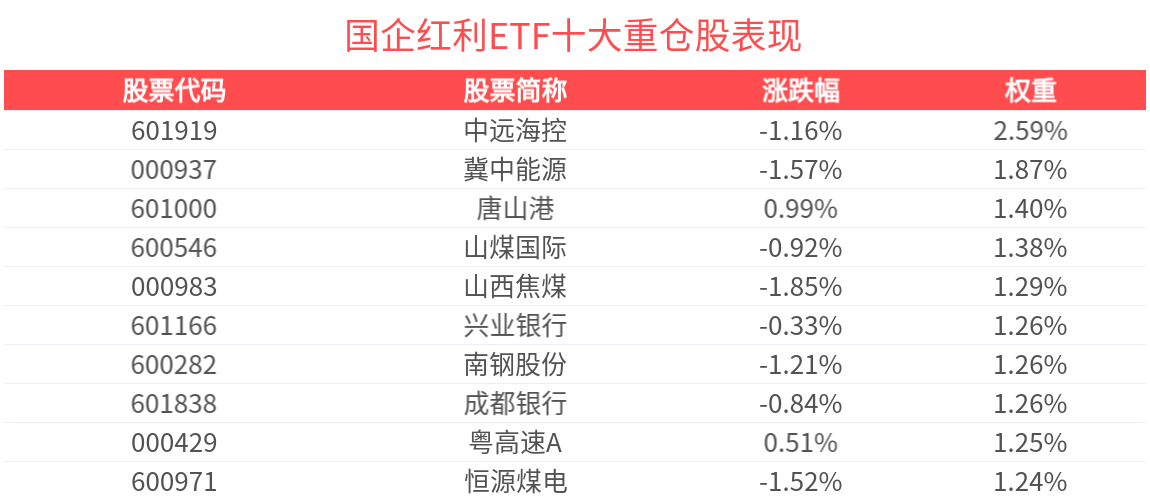
Group 1 - The China Securities State-Owned Enterprises Dividend Index (000824) decreased by 0.67% as of June 19, 2025, with mixed performance among constituent stocks [1] - The top-performing stocks included Furan Energy (002911) up 1.76%, Zhongnan Media (601098) up 1.69%, and Changjiang Media (600757) up 1.65% [1] - The worst-performing stocks were China Steel International (000928) down 2.74%, Hualing Steel (000932) down 2.67%, and Jinkong Coal Industry (601001) down 2.09% [1] Group 2 - The National State-Owned Enterprises Dividend ETF (159515) fell by 0.82%, with the latest price at 1.09 yuan [1] - The index reflects the overall performance of 100 listed companies selected for high cash dividend yields, stable dividends, and certain scale and liquidity [1] - The top five industries represented in the index are banking, coal, transportation, real estate, and media [1] Group 3 - At the 2025 Lujiazui Forum, eight significant financial opening policies were announced, focusing on promoting digital finance, expanding financial openness, and advancing the internationalization of the Renminbi [2] - Current policies are expected to have a greater impact on the funding side of banks rather than the investment side, leading to a more favorable outlook for interest margins in 2025 compared to 2024 [2] - The top ten weighted stocks in the China Securities State-Owned Enterprises Dividend Index as of May 30, 2025, include COSCO Shipping Holdings (601919) and Jizhong Energy (000937), with a combined weight of 15.83% [2]

嘉实稳盛债券连续5个交易日下跌,区间累计跌幅0.14%
Sou Hu Cai Jing· 2025-06-18 16:19
据了解,嘉实稳盛债券成立于2016年6月,基金规模0.48亿元,成立来累计收益率18.53%。从持有人结 构来看,截至2024年末,嘉实稳盛债券的基金机构持有0.16亿份,占总份额的46.67%,个人投资者持有 0.18亿份,占总份额的53.33%。 公开信息显示,现任基金经理李曈先生:中国国籍,硕士研究生,具有基金从业资格。曾任中国建设银行金 融市场部、机构业务部业务经理。2014年12月加入嘉实基金管理有限公司,现任固收投研体系基金经 理。2015年5月14日至2018年11月2日任嘉实理财宝7天债券型证券投资基金基金经理、2015年5月14日至 2020年6月4日任嘉实安心货币市场基金基金经理、2016年1月28日至2020年6月11日任嘉实货币市场基金 基金经理、2016年1月28日至2020年5月29日任嘉实活期宝货币市场基金基金经理、2016年4月21日至 2020年5月29日任嘉实快线货币市场基金基金经理、2016年12月22日至2020年6月4日任嘉实现金宝货币 市场基金基金经理、2017年5月24日至2022年3月29日任嘉实超短债证券投资基金基金经理、2017年5月 25日至2020年6月 ...
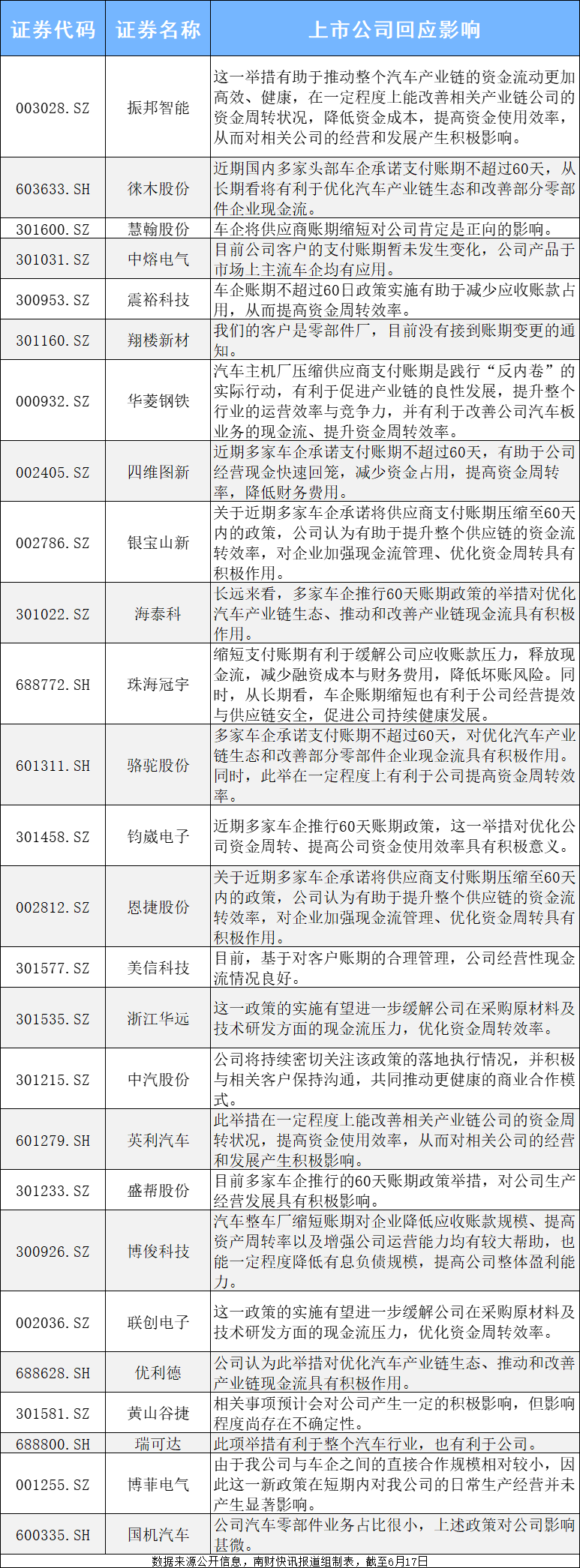
车企承诺支付账期不超60天!多家上市公司回应影响
2 1 Shi Ji Jing Ji Bao Dao· 2025-06-17 13:46
Core Viewpoint - Major automotive companies in China have committed to a payment term of no more than 60 days for suppliers, which is expected to enhance the cash flow of small and medium-sized enterprises in the supply chain and promote a healthier industry ecosystem [1][2]. Group 1: Industry Impact - The commitment to a 60-day payment term is seen as crucial for building a collaborative and win-win development ecosystem between vehicle manufacturers and parts suppliers, which is essential for sustainable industry growth [1]. - The automotive industry has historically faced long payment terms, with an average accounts payable turnover of 182 days, significantly exceeding the international standard of 90 days, leading to cash flow challenges for suppliers [2][7]. - Shortening payment terms is anticipated to alleviate financial pressure on suppliers, allowing them to invest more in research and development, thus driving industry innovation and upgrading the supply chain [2][3]. Group 2: Company Responses - Companies such as Huahan Co. and Yuli Technology have expressed that the reduction in payment terms will positively impact their cash flow and operational efficiency [3][4]. - Several listed companies have reported that the new policy will enhance the efficiency of capital flow within the supply chain, reduce financial costs, and improve overall business operations [4][5]. - Some companies, however, indicated that their exposure to the automotive parts business is minimal, and thus the impact of the new policy may be limited [4][6]. Group 3: Challenges Ahead - Analysts have pointed out that breaking the inertia of long-standing payment practices will be challenging, as some companies previously maintained payment terms exceeding 170 days [7]. - The complexity of payment models and the lack of a robust credit system in the industry may hinder the effective implementation of the new payment terms [7]. - There may be discrepancies in understanding the new payment terms between suppliers and automotive companies, particularly regarding the timing of when the 60-day period begins [7].
湖南:合规经营助力税企“双向奔赴”
Sou Hu Cai Jing· 2025-06-17 06:42
Group 1: Compliance and Business Development - Compliance is the cornerstone of stable business development and a key factor in building core competitiveness [1] - As of March 2023, Hunan has 7.6132 million operating entities, a year-on-year increase of 6.04%, ranking in the top ten nationwide [1] - The tax authorities in Hunan are leveraging digital transformation to guide enterprises towards proactive compliance through policy guidance, tax inspections, and risk warnings [1] Group 2: Case Study - Henggang Steel - Henggang Steel aims to become a world-class specialized seamless steel pipe enterprise, emphasizing integrity and quality in its operations [2] - The company has achieved a 95% automation rate in its production processes and has invested significantly in digital transformation [2][3] - Over the past three years, Henggang Steel has benefited from nearly 600 million yuan in tax reductions through VAT refunds and R&D expense deductions [3] Group 3: Case Study - Bamboo Technology - The bamboo industry in Yiyang, Hunan, is projected to exceed 21 billion yuan in comprehensive output value by 2024 [4] - Bamboo Technology has developed advanced bamboo composite materials with superior mechanical properties, thanks to collaborative R&D efforts [4] - The company has received over 19 million yuan in R&D expense deductions in the past three years, enhancing its market competitiveness [4][5] Group 4: Case Study - Butian Pharmaceutical - Butian Pharmaceutical has maintained a strong focus on tax credit, achieving over 90 million yuan in total tax payments over the past five years [6] - The company has leveraged its A-level tax credit status to secure over 24 million yuan in credit loans through the silver-tax interaction mechanism [6][7] - Good tax credit has facilitated the inclusion of its products in over 40 provincial hospitals' prescriptions [6] Group 5: Tax Credit System - A-level tax credit is a direct reflection of a company's compliance in financial accounting and tax reporting [7] - Hunan Province has over 60,000 enterprises rated as A-level taxpayers, with more than 40,000 enterprises benefiting from credit repair mechanisms [7] - The tax authorities are focused on enhancing compliance through targeted policy guidance and risk management initiatives [7]
华创证券:季节性淡季特征显现 钢价底部仍有支撑
Zhi Tong Cai Jing· 2025-06-16 08:47
Core Viewpoint - The steel market is experiencing weak demand and supply, leading to a bottoming out of steel prices with weak fluctuations [1][2][3] Supply and Demand Analysis - Demand has weakened significantly entering June, with steel mills reducing production intensity through increased maintenance, resulting in a decline in pig iron and finished steel output [1] - As of June 13, the prices for five major steel products were reported at 3208 CNY/ton for rebar, 3544 CNY/ton for wire rod, 3198 CNY/ton for hot-rolled, 3623 CNY/ton for cold-rolled, and 3421 CNY/ton for medium plate, showing week-on-week changes of -0.33%, -0.40%, -0.80%, -0.64%, and -0.87% respectively [1] - Total steel production last week was 8.5885 million tons, a decrease of 215,300 tons week-on-week [1] Inventory and Consumption - Total steel inventory was 13.5456 million tons, down by 92,500 tons week-on-week, with social inventory decreasing by 35,300 tons to 9.2748 million tons and steel mill inventory down by 57,200 tons to 4.2708 million tons [2] - The apparent consumption of the five major steel products last week was 8.681 million tons, a decrease of 140,700 tons week-on-week [2] Cost and Profitability - The average pig iron cost for 114 steel mills was reported at 2321 CNY/ton, down by 41 CNY/ton week-on-week [2] - As of June 13, the gross profit per ton for high furnace rebar, hot-rolled coil, and cold-rolled coil was +135 CNY/ton, +60 CNY/ton, and -65 CNY/ton respectively, with week-on-week changes of +36 CNY/ton, +27 CNY/ton, and -3 CNY/ton [2] - 58.44% of sampled steel companies were profitable last week, a decrease of 0.43 percentage points week-on-week [2] Market Outlook - The current decline in raw material prices has provided some cost relief for steel mills, supporting profit recovery, although demand remains weak [3] - If crude steel regulation is effectively implemented, supply may decrease, potentially improving the supply-demand relationship and supporting steel prices [3] Investment Recommendations - The steel sector is currently undervalued, with some quality steel companies trading at low price-to-book (PB) ratios compared to 2022 levels [4] - The industry is in a profit recovery phase, with potential for further improvement if industry conflicts are resolved [4] - Recommended stocks include: Hualing Steel (000932), Shougang Co. (000959), Sangang Minmetals (002110), Xinsteel Co. (600782), and Xinxing Ductile Iron Pipes (000778) for low PB; and Zhongnan Co. (000717) and Bayi Steel (600581) for regional advantages [4]
研判2025!中国螺旋板换热器行业概述、产业链、发展现状、竞争格局及发展趋势分析:节能减排需求增加,螺旋板换热器行业迎来发展机遇[图]
Chan Ye Xin Xi Wang· 2025-06-16 01:18
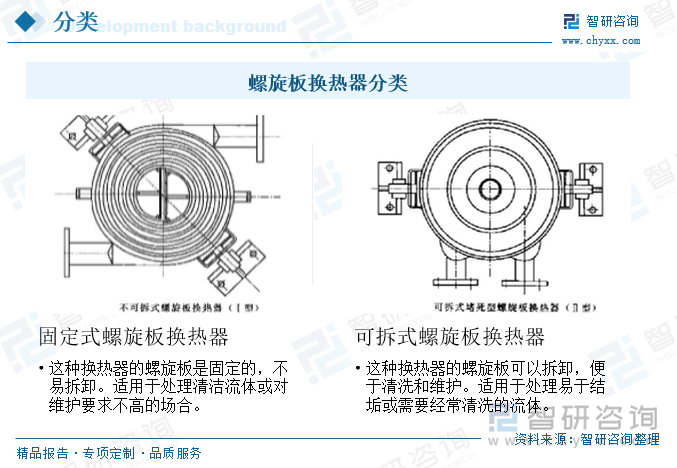
内容概要:随着全球能源危机和环境问题的日益严峻,节能降耗已成为企业发展的重要方向。螺旋板换 热器凭借其高效的热交换能力和较低的运行成本,正逐步取代传统热交换设备,市场需求持续增长。近 年来,我国对节能减排的重视程度不断提高,相关政策法规的出台以及环保要求的提高,为螺旋板换热 器行业带来前所未有的机遇。一方面,传统行业对能源利用效率的要求不断提高,促使企业加大了对螺 旋板换热器的研发和应用;另一方面,新兴行业如新能源、新材料等领域的发展,也为螺旋板换热器行 业带来了的新的市场空间。数据显示,2015年中国螺旋板换热器市场规模为86亿元,到了2024年行业市 场规模增长至126.1亿元,年复合增长率为4.3%。 相关上市企业:宝钢股份(600019)、中信特钢(000708)、华菱钢铁(000932)、河钢股份 (000709)、首钢股份(000959)、鞍钢股份(000898)、中国石油(601857)、中国石化 (600028)、恒力石化(600346)、上海石化(600688)等。 相关企业:无锡东进化工设备制造有限公司、无锡市华宝药化设备有限公司、无锡一成化工装备有限公 司、广州赛唯热工设备有限公司、无锡 ...
周期论剑|冲突与波动,周期复盘研究
2025-06-15 16:03
Summary of Key Points from Conference Call Records Industry Overview - The conference call primarily discusses the **Chinese stock market** and its dynamics, including internal trends, external influences, and future expectations for various sectors. Core Insights and Arguments 1. **Market Stability and Internal Dynamics** The stability of the Chinese stock market is based on reduced internal uncertainties, positive economic structural changes, and emerging new business opportunities. Lower interest rates have decreased the opportunity cost of investing in stocks, while economic policies and capital market reforms have also contributed to a favorable market environment [1][2][4]. 2. **Economic Pressure and Stock Market Expectations** Current economic pressures are reflected in stock market pricing, which is viewed as a range rather than a single point. The market has already priced in various pressures over the past three years, indicating that expectations may stabilize or improve despite potential EPS declines [5][7]. 3. **External Shocks as Buying Opportunities** External shocks, while causing market disturbances, may present buying opportunities for quality assets. The Chinese stock market is primarily driven by internal logic, and external fluctuations can provide chances to acquire undervalued assets [6][13]. 4. **Long-term Economic Trends** By 2025, the Chinese economy is expected to undergo systematic changes, particularly in defense technology and consumer sectors. Companies like Suning.com are thriving, and there is a notable divergence in capital expenditures between old and new economies, with new economy investments on the rise [8][9]. 5. **Renminbi Stability and Asset Revaluation** The stability of the Renminbi is a significant driver for the revaluation of Chinese assets. With a weakening dollar cycle, China's strengthened national power and stable policies are prompting overseas capital to reassess Chinese assets [10][15]. 6. **Investment Recommendations** Long-term logical sectors and companies are expected to outperform the market. Recommendations include financial sectors and high-dividend stocks such as banks, brokerages, and infrastructure operators, as well as sectors like internet, media, innovative pharmaceuticals, military, and robotics [11][12]. 7. **Geopolitical Risks and Commodity Prices** Geopolitical tensions, such as conflicts involving Iran, are influencing commodity prices, particularly oil. However, the potential for sustained price increases is limited due to various factors, including OPEC's production capabilities and the global economic environment [16][19]. 8. **Coal Market Dynamics** In May, coal imports decreased by 17.7% year-on-year, with expectations of continued contraction. However, prices are anticipated to rebound by the end of June due to seasonal demand and reduced supply pressures [40][41]. 9. **Airline and Shipping Industry Outlook** The airline and shipping sectors are expected to perform well, with strong demand anticipated during the summer travel season. The oil shipping market is also projected to benefit from geopolitical tensions, leading to increased demand and higher freight rates [24][25][26]. Other Important but Potentially Overlooked Content - The ongoing reforms in the capital market are shifting investor attitudes from conservative to optimistic, which may enhance market stability and investor returns [4]. - The differentiation in capital expenditures between old and new economies indicates a significant shift in investment focus, which could shape future market dynamics [9][14]. - The potential for a style switch in investment is unlikely; instead, existing trends will be reinforced, favoring companies with long-term investment logic [11]. This summary encapsulates the key points discussed in the conference call, providing insights into the current state and future expectations of the Chinese stock market and related industries.
钢铁行业周报(20250609-20250613):季节性淡季特征显现,钢价底部仍有支撑-20250615
Huachuang Securities· 2025-06-15 13:46
Investment Rating - The report maintains a "Recommendation" rating for the steel industry [5] Core Viewpoints - The steel industry is experiencing weak supply and demand, leading to a bottoming out of steel prices with some support [1][2] - The demand has weakened due to seasonal factors, and steel prices are expected to remain under pressure in the short term [2] - The overall valuation of the steel sector is low, with potential for profit recovery and valuation improvement if structural industry issues are resolved [10] Summary by Sections 1. Market Review - As of June 13, 2025, the prices for five major steel products are as follows: rebar at 3,208 CNY/ton, wire rod at 3,544 CNY/ton, hot-rolled coil at 3,198 CNY/ton, cold-rolled coil at 3,623 CNY/ton, and medium plate at 3,421 CNY/ton, with weekly changes of -0.33%, -0.40%, -0.80%, -0.64%, and -0.87% respectively [1] - The total output of the five major products is 8.5885 million tons, a decrease of 215,300 tons week-on-week [1] - The average daily molten iron output from 247 steel enterprises is 2.4161 million tons, with a slight decrease of 1,900 tons week-on-week [1] 2. Key Industry Data Tracking (a) Production Data - The capacity utilization rate for blast furnaces is 90.58%, down 0.07 percentage points week-on-week [1] - The electric arc furnace capacity utilization rate is 56.73%, down 1.97 percentage points week-on-week [1] (b) Consumption Volume of Major Steel Products - The total consumption of the five major products is 8.681 million tons, a decrease of 140,700 tons week-on-week [1] - The apparent consumption of rebar, wire rod, hot-rolled, cold-rolled, and medium plate has decreased by 90,600 tons, 19,500 tons, 10,400 tons, 2,700 tons, and 17,500 tons respectively [1] (c) Inventory Situation - The total steel inventory is 13.5456 million tons, a decrease of 92,500 tons week-on-week [1] - Social inventory decreased by 35,300 tons to 9.2748 million tons, while steel mill inventory decreased by 57,200 tons to 4.2708 million tons [1] (d) Profitability Situation - The average cost of molten iron for 114 steel mills is 2,321 CNY/ton, down 41 CNY/ton week-on-week [1] - The gross profit per ton for high furnace rebar, hot-rolled coil, and cold-rolled coil is +135 CNY/ton, +60 CNY/ton, and -65 CNY/ton respectively, with week-on-week changes of +36 CNY/ton, +27 CNY/ton, and -3 CNY/ton [1] - 58.44% of sampled steel enterprises are profitable, a decrease of 0.43 percentage points week-on-week [1]
钢材供需博弈激烈,短期行情或震荡为主
Xinda Securities· 2025-06-15 07:53
Investment Rating - The investment rating for the steel industry is "Positive" [2] Core Viewpoints - The steel market is currently experiencing intense supply and demand dynamics, with short-term fluctuations expected [3] - Despite the challenges in the steel industry, including prominent supply-demand conflicts and overall profit decline, the implementation of "stabilization growth" policies is anticipated to support steel demand, particularly in real estate and infrastructure sectors [4] - The industry is expected to maintain a stable supply-demand situation, benefiting from high-end steel products and companies with strong cost control and scale effects [4] Supply Summary - As of June 13, 2025, the average daily pig iron production was 2.4161 million tons, showing a week-on-week decrease of 0.19 thousand tons, but a year-on-year increase of 5.86 thousand tons [26] - The capacity utilization rate for blast furnaces was 90.6%, down 0.07 percentage points week-on-week [26] - The total production of five major steel products was 7.486 million tons, a week-on-week decrease of 225.2 thousand tons, or 2.92% [26] Demand Summary - The consumption of five major steel products was 8.681 million tons as of June 13, 2025, reflecting a week-on-week decrease of 140.7 thousand tons, or 1.59% [35] - The transaction volume of construction steel by mainstream traders was 100 thousand tons, down 6.18% week-on-week [35] - The transaction area of commercial housing in 30 major cities was 148.3 million square meters, a week-on-week decrease of 66.1 million square meters [35] Inventory Summary - The social inventory of five major steel products was 9.275 million tons as of June 13, 2025, down 3.53 thousand tons week-on-week, or 0.38% [43] - The factory inventory of five major steel products was 4.271 million tons, down 5.72 thousand tons week-on-week, or 1.32% [43] Price Summary - The comprehensive index for ordinary steel was 3,364.8 yuan/ton as of June 13, 2025, down 19.23 yuan/ton week-on-week, or 0.57% [48] - The comprehensive index for special steel was 6,616.8 yuan/ton, down 7.72 yuan/ton week-on-week, or 0.12% [48] Profit Summary - The profit for rebar produced in blast furnaces was 135 yuan/ton as of June 13, 2025, an increase of 36.0 yuan/ton week-on-week, or 36.36% [56] - The average profit margin for 247 steel enterprises was 58.44% as of June 13, 2025, a decrease of 0.4 percentage points week-on-week [56] Investment Recommendations - The report suggests focusing on regional leading enterprises with advanced equipment and environmental standards, such as Shandong Steel and Hualing Steel [4] - Companies with excellent growth potential and restructuring capabilities, such as Baosteel and Maanshan Steel, are also recommended [4] - Special steel enterprises benefiting from the new energy cycle, such as Jiuli Special Materials and Fangda Special Steel, are highlighted as potential investment opportunities [4]