泸州老窖

Search documents
白酒行业专题报告:茅五亮牌,剑向何方?
Huachuang Securities· 2025-12-15 11:18
Investment Rating - The report maintains a "Recommendation" rating for the liquor industry, specifically highlighting the brands Moutai and Wuliangye as key players [2][33]. Core Insights - The recent decline in high-end liquor prices has raised concerns in the market, with the liquor sector experiencing a 7% drop in December. Moutai's price fell from 1575 yuan to around 1500 yuan, while Wuliangye's price decreased from 800-810 yuan to 780 yuan [8][11]. - Moutai is implementing measures to restore channel confidence, with prices rebounding to around 1600 yuan after a significant drop. The company plans to control supply to stabilize prices and support distributor profits [15][20]. - Wuliangye is enhancing subsidies and adjusting pricing strategies to support distributors, including a significant discount on its products to reduce financial pressure on channels [29][30]. - The report anticipates that the liquor industry will prioritize volume over price in the coming year, with sales performance being crucial for recovery [32][33]. Summary by Sections Industry Supply and Demand - The industry is facing a critical need for supply and demand rebalancing, with Moutai's price drop signaling significant market pressures. The report notes that the supply-demand mismatch has persisted, leading to a comprehensive imbalance [11][15]. Moutai's Strategy - Moutai is focusing on controlling supply to alleviate pressure on distributors, with plans to halt the release of unfulfilled quotas for 2025. The company aims to stabilize market order and ensure healthy operations [20][24]. - The report highlights that Moutai's pricing strategy is crucial for maintaining industry standards, with expectations of a gradual decline in performance metrics due to market conditions [28][29]. Wuliangye's Approach - Wuliangye is actively implementing multiple strategies to support channel profits, including significant discounts and promotional rewards for distributors. The company is also enhancing digital management to improve terminal control [29][30]. - The report emphasizes that Wuliangye's willingness to adapt and reduce prices is a positive step in addressing current market challenges [29]. Investment Recommendations - The report suggests capitalizing on the pre-holiday recovery in the liquor market, recommending Moutai as a priority for investment due to its lower risk of performance decline. Other companies to watch include Gujing and Wuliangye, which are expected to confirm performance bottoms and drive growth through market share [33].


食品饮料行业12月ETF策略:加速筑底,重视内需配置价值
金融街证券· 2025-12-15 09:46
Market Review - The food and beverage sector's ETFs showed significant divergence in November, with the wine ETF (512690.SH) and consumer ETF (159928.SZ) declining by -0.85% and -0.24% respectively, while the Hang Seng Consumer ETF (513970.SH) and another Hang Seng Consumer ETF (159699.SZ) increased by +1.78% and +1.45% respectively [2][12] - The Shanghai Composite Index fell by 1.67% in November, while the food and beverage sector rose by 0.84%, outperforming the Shanghai Composite by 2.52 percentage points [3][22] - The retail sales growth in October was 2.90%, marking a decline since May, with the food and beverage sector showing signs of recovery in certain sub-segments [4][32] Industry Dynamics - The white wine sector is currently in a downturn, with prices continuing to decline due to increased e-commerce platform subsidies and weak channel confidence, indicating a need for careful observation of inventory and pricing trends as the market approaches the 2026 Spring Festival [4][36] - The beer sector is also entering a slow season, with a focus on raw material pricing and new channel developments that could impact product structure [4][35] - The snack sector is highlighted as having strong supply chains that can optimize products and resonate with channels, making it a key area for potential growth [4][35] Investment Recommendations - The report maintains a "stronger than the market" outlook, emphasizing the food and beverage sector's importance in domestic demand recovery, supported by improving policy expectations [5][7] - Specific ETFs such as the Hang Seng Consumer ETF (159699.SZ) and the wine ETF (512690.SH) are recommended for capturing new consumption trends and potential rebounds in the sector [7][5] Sub-sector Performance - The processed food sub-sector saw the highest increase in November at +9.11%, while the soft drink sub-sector experienced the largest decline at -4.07% [25][22] - Year-to-date, the health products sub-sector has shown the highest growth at +10.80%, while the beer sub-sector has the largest decline at -11.18% [25][22] Macro Data Tracking - Retail sales in urban areas showed a year-on-year growth of 2.70% in October, while rural areas saw a growth of 4.10%, indicating a divergence in consumer spending trends [32][33] - The consumer confidence index fell to 89.40 in October, reflecting a decrease in consumer sentiment [33][34]



泸州老窖:公司将按《2024-2026年度股东分红回报规划》落实分红政策
Zheng Quan Ri Bao Wang· 2025-12-15 09:40
证券日报网讯12月15日,泸州老窖(000568)在互动平台回答投资者提问时表示,公司将按照《2024- 2026年度股东分红回报规划》落实相关分红政策。 ...
16只白酒股上涨 贵州茅台1426元/股收盘
Bei Jing Shang Bao· 2025-12-15 09:20
从个股来看,贵州茅台收盘价达1426.00元/股,上涨0.38%;五粮液收盘价达112.45元/股,上涨0.76%; 山西汾酒收盘价达179.56元/股,下跌0.30%;泸州老窖收盘价达122.81元/股,下跌0.14%;洋河股份收 盘价达62.32元/股,下跌0.21%。 招商证券在其研报中指出,对比上轮周期,12Q3-13Q3渠道煎熬期期间报表仍在高歌猛进,但申万白酒 股价腰斩,跑输大盘。13Q2-14Q4企业煎熬期酒企业绩出现大幅下滑,股价先跌后涨,在业绩二阶导转 正后,开始触底回升,期间整体微涨。本轮企业煎熬期行业股价持续调整,但当下进程过半,当业绩二 阶导转正后,股价有望触底回升。 北京商报讯(记者 刘一博 冯若男)12月15日尾盘,三大指数集体下跌,沪指3867.92点下跌0.55%。白 酒板块2206.51点收盘上涨0.95%,其中16只白酒股上涨。 ...
啤酒概念涨1.70%,主力资金净流入这些股
Zheng Quan Shi Bao Wang· 2025-12-15 09:08
Group 1 - The beer concept sector rose by 1.70%, ranking second among concept sectors, with 26 stocks increasing in value, including Huangshi Group and Zhongyao Holdings hitting the daily limit, while stocks like ST Xifa and Zhuhai Zhongfu saw declines [1][2] - The main inflow of funds into the beer concept sector was 526 million yuan, with 20 stocks receiving net inflows, and five stocks exceeding 10 million yuan in net inflows, led by Zhongyao Holdings with a net inflow of 300 million yuan [2][3] - The top three stocks by net inflow ratio were Huangshi Group at 54.94%, Zhongyao Holdings at 22.23%, and Liziyuan at 12.27% [3] Group 2 - The top gainers in the beer concept included Huangshi Group and Zhongyao Holdings, both increasing by 10.05%, while stocks like Liziyuan and Jinzongzi Wine rose by 4.64% and 4.11% respectively [3][4] - The stocks with the largest declines included ST Xifa, which fell by 5.00%, and Zhuhai Zhongfu, which decreased by 1.80% [1][4] - The trading volume and turnover rates varied, with stocks like Huangshi Group and Zhongyao Holdings showing significant turnover rates of 12.31% and 9.89% respectively [3][4]




茅台失去的十年
投中网· 2025-12-15 07:06
Core Viewpoint - The article discusses the long-term decline in Chinese liquor consumption, particularly in the context of the aging population and changing consumer demographics, emphasizing the need for high-end liquor producers to adapt their strategies to capture profits in a shrinking market [6][20][41]. Group 1: Market Trends - The slowdown in Chinese liquor consumption has been ongoing for over a decade, with national liquor sales dropping by at least 50% [10][11]. - The global whiskey market, as a reference, has seen sales stagnate around 2.8 billion liters for the past ten years, struggling to recover post-pandemic [8]. - The aging population in developed societies is leading to a decline in liquor consumption among older demographics, while the younger consumer base is shrinking due to low birth rates [16][19]. Group 2: High-End Liquor Performance - Despite the overall decline in liquor sales, high-end brands like Moutai, Wuliangye, and Luzhou Laojiao have seen their sales increase by over 200% in the past decade, reaching 100,000 tons [26]. - The profits of the top six Chinese liquor companies surged from 31 billion in 2015 to 160.7 billion in 2024, with their revenue share rising from 15.7% to 48.1% [27]. - High-end whiskey brands have similarly experienced growth, with revenue contributions from high-end segments increasing from 33% to around 50% [27]. Group 3: Consumer Demographics - Young consumers are increasingly important for the liquor market, with Diageo reporting that young consumers contribute 48% of high-end liquor revenue, compared to 35% across the entire liquor market [31]. - The share of young women in the whiskey market has grown from 15% in 2019 to 35% in 2024, indicating a shift in consumer demographics [31]. - In contrast, the share of young consumers in Chinese liquor has declined from 25% in 2015 to just 13% today, highlighting a significant demographic challenge for brands like Moutai [36]. Group 4: Strategic Responses - International liquor giants have proactively targeted younger consumers to mitigate the risks associated with an aging customer base, while Chinese liquor brands have been slower to adapt [30][34]. - The article suggests that Chinese liquor companies need to embrace high-end positioning and innovate to attract younger consumers, as evidenced by the financial strategies of companies like Wuliangye, which recently announced a 10 billion dividend [43]. - The long-term solution for Chinese high-end liquor brands may involve financial engineering, such as accelerated dividends and share buybacks, to enhance shareholder value amidst declining consumer engagement [42].


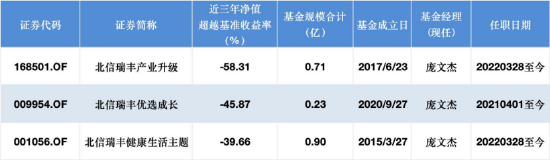
薪酬新规透视 | 华银基金庞文杰在管规模不足2亿,业绩全线告急,在管3产品近三年合计跑输基准超143%
Xin Lang Ji Jin· 2025-12-15 06:55
Core Viewpoint - The recent reform in the fund industry emphasizes performance, leading to significant salary reductions for nearly a thousand fund managers if their products underperform by over 10 percentage points compared to benchmarks over the past three years and have negative profit margins [1]. Fund Performance and Management - According to Wind data, the three funds managed by Pang Wenjie have shown substantial negative returns over the past three years, with the North Trust Ruifeng Industrial Upgrade fund underperforming its benchmark by 58.31% and managing a scale of 0.71 billion [2][4]. - The North Trust Ruifeng Preferred Growth fund has underperformed by 45.87% with a scale of 0.23 billion, while the North Trust Ruifeng Health Life Theme fund has underperformed by 39.66% with a scale of 0.90 billion, totaling a management scale of only 1.84 billion [2][4]. Investment Focus and Market Conditions - The funds managed by Pang Wenjie focus on specific themes that have faced industry adjustments, including the new energy sector, consumer goods, and the medical innovation industry [4][5]. - The North Trust Ruifeng Industrial Upgrade fund heavily invests in the new energy supply chain, with major holdings in leading photovoltaic and wind power companies, which have recently experienced significant declines [4]. - The North Trust Ruifeng Preferred Growth fund focuses on the consumer sector, particularly in liquor and food and beverage industries, which have shown mixed performance recently [4][5]. - The North Trust Ruifeng Health Life Theme fund targets the medical innovation sector, which is also facing challenges, with major holdings in medical device companies that have seen declines [4]. Manager's Outlook and Strategy - Pang Wenjie maintains a relatively optimistic outlook for the market, emphasizing the potential recovery of the consumer sector and the benefits of monetary policy changes [5][6]. - He highlights the importance of adapting investment strategies to navigate market style changes and improve fund performance in light of the new salary regulations [6].
食品饮料周报(25年第46周):消费场景平稳修复,茅台释放稳价预期-20251215
Guoxin Securities· 2025-12-15 06:23
Investment Rating - The report maintains an "Outperform the Market" rating for the food and beverage sector [4][5][10]. Core Views - The food and beverage sector is expected to see a recovery in consumer scenarios, with a stable price expectation for Moutai [1][3]. - The sector is entering a left-side layout phase, with high-quality companies expected to gain greater growth potential [2][10]. - The report highlights the differentiation in the fundamentals of various categories, with beverages outperforming food and alcohol [2][10]. Summary by Relevant Sections 1. Sector Overview - The food and beverage sector experienced a cumulative decline of 1.52% this week, with A-shares down 1.63% and H-shares up 0.07% [1]. - The top five gainers in the food and beverage sector this week were Yanjinpuzi (5.11%), Huikaishan (4.85%), New Dairy (3.22%), Chenguang Biological (3.09%), and Anji Food (3.08%) [1]. 2. Alcohol Sector - In the liquor segment, the report recommends focusing on leading companies like Luzhou Laojiao, Shanxi Fenjiu, Guizhou Moutai, and Yingjia Gongjiu, while also monitoring the reform pace of Wuliangye and Yanghe [2][10]. - The report notes that the current market is in a left-side layout phase, with positive signals expected from both demand and supply sides [10]. 3. Beverage Sector - The beverage industry is experiencing a sustained boom, with leading companies significantly outperforming the market [14]. - Recommendations include Nongfu Spring and Dongpeng Beverage, which are accelerating their national and platform expansion [14]. 4. Food Sector - The snack segment is advised to focus on strong alpha stocks, particularly in the konjac snack category, where leading companies like Weilong and Yanjinpuzi show strong competitive advantages [11][12]. - The restaurant supply chain is showing signs of stabilization, with recommendations for leading companies like Yihai International and Haitian Flavoring [12]. 5. Earnings Forecasts and Investment Ratings - Key companies such as Guizhou Moutai, Nongfu Spring, Wuliangye, Shanxi Fenjiu, and Luzhou Laojiao are rated as "Outperform the Market" with projected earnings per share (EPS) growth for 2025 and 2026 [4][10]. - The report provides detailed earnings forecasts for these companies, indicating a positive outlook for the sector [4][15].


直线拉升!涨停潮,来了
Zhong Guo Ji Jin Bao· 2025-12-15 05:19
Market Overview - On December 15, the A-share market saw all three major indices decline, with the Shanghai Composite Index down 0.11%, the Shenzhen Component down 0.71%, and the ChiNext Index down 1.29% [1] - The total trading volume in the Shanghai and Shenzhen markets was 1.18 trillion yuan, a decrease of 529 billion yuan from the previous trading day [2] Financial Sector Performance - The financial sector experienced a broad rally, particularly in the insurance segment, which rose over 4% [2] - Notable individual stock performances included China Ping An up nearly 5%, China Pacific Insurance up 4%, and New China Life and China Life both up over 2% [4][5] - Several brokerage stocks also saw gains, with Huatai Securities and Dongfang Securities rising over 3% [6][7] Consumer Sector Activity - The consumer sector showed strong performance, with food and beverage stocks, as well as retail, experiencing significant gains [9] - A surge in individual stocks was noted, with companies like Huanlejia and Huangshi Group hitting the daily limit up [9][10] - The Ministry of Commerce and other regulatory bodies announced new policies aimed at boosting consumption, which contributed to the positive sentiment in the consumer sector [10] Alcohol Industry Insights - The liquor sector rebounded, with Kweichow Moutai rising 0.49% to a market value of 1.7878 trillion yuan [11][12] - Moutai's recent policy to control supply has led to a significant increase in wholesale prices for its products [11] Aerospace and Technology Sector - The aerospace sector saw a notable increase, with stocks like Aerospace Electromechanical and Aerospace Technology rising significantly [13][14] - Aerospace Electromechanical achieved a 10% increase, marking a strong performance in the sector [14]






直线拉升!涨停潮,来了
中国基金报· 2025-12-15 05:13
Market Overview - The A-share market experienced a collective decline in the morning session, with the Shanghai Composite Index down by 0.11%, the Shenzhen Component down by 0.71%, and the ChiNext Index down by 1.29% [1] - The total trading volume in the Shanghai and Shenzhen markets reached 1.18 trillion yuan, a decrease of 529 billion yuan compared to the previous trading day [4] Financial Sector Performance - The financial sector saw a broad increase, with the insurance sector leading the market with a rise of over 4% [4] - Notable individual stock performances included China Ping An rising nearly 5%, China Pacific Insurance up 4%, and New China Life and China Life both increasing by over 2% [8][9] - The recent adjustment by the financial regulatory authority to lower risk factors for insurance companies investing in certain indices has positively impacted the sector [9] Consumer Sector Dynamics - The consumer sector showed significant gains, particularly in food and beverage and commercial retail, with many stocks hitting the daily limit [12] - The Ministry of Commerce and other regulatory bodies announced measures to boost consumption, which contributed to the rally in consumer stocks [13] Alcohol Industry Insights - The liquor sector rebounded, with Kweichow Moutai increasing by 0.49% to a market value of 1.7878 trillion yuan [16][19] - Moutai's recent policy to control supply has led to a rise in wholesale prices for its products [18] Aerospace and Technology Sector - The aerospace sector saw a surge, with stocks like Aerospace Electromechanical and Aerospace Technology rising significantly, with some stocks hitting the daily limit [21][22] - The performance of commercial aerospace stocks remains active, reflecting ongoing interest in the sector [21]