
美的集团

Search documents
沪深300ETF中金(510320)涨1.28%,半日成交额326.07万元




Xin Lang Cai Jing· 2026-01-05 03:44
来源:新浪基金∞工作室 沪深300ETF中金(510320)业绩比较基准为沪深300指数收益率,管理人为中金基金管理有限公司,基 金经理为刘重晋,成立(2025-04-16)以来回报为24.56%,近一个月回报为2.38%。 风险提示:市场有风险,投资需谨慎。本文为AI大模型自动发布,任何在本文出现的信息(包括但不 限于个股、评论、预测、图表、指标、理论、任何形式的表述等)均只作为参考,不构成个人投资建 议。 1月5日,截止午间收盘,沪深300ETF中金(510320)涨1.28%,报1.263元,成交额326.07万元。沪深 300ETF中金(510320)重仓股方面,宁德时代截止午盘涨1.68%,贵州茅台涨2.72%,中国平安涨 5.56%,招商银行涨0.64%,紫金矿业涨1.91%,新易盛跌0.51%,中际旭创涨1.97%,美的集团涨 0.88%,东方财富涨1.81%,长江电力涨0.11%。 ...
华西证券:国补政策收紧推动行业产品升级 品类补贴范围更加聚焦
智通财经网· 2026-01-05 03:00
Core Viewpoint - The current round of national subsidies is more focused compared to 2025, with stricter energy efficiency standards, which will help promote product structure upgrades in the industry, benefiting leading companies with a more complete layout of mid-to-high-end products [1]. Group 1: Policy Announcement - On December 29, 2025, the National Development and Reform Commission (NDRC) announced the implementation of a large-scale equipment update and consumer goods replacement policy for 2026, explicitly supporting the replacement of old home appliances [2]. - On December 30, 2025, the NDRC announced that the first batch of 625 billion yuan in ultra-long-term special government bonds to support consumer goods replacement has been allocated in advance [2]. Group 2: Funding and Subsidy Details - The first batch of 625 billion yuan in support funds for the replacement program has been allocated, with the subsidy categories being more focused compared to 2025. The scale is slightly reduced from the 810 billion yuan allocated in the first batch for 2025 [3]. - The total scale of special government bonds for consumer goods replacement in 2025 was 3000 billion yuan, distributed in four batches, with the first batch accounting for approximately 27%. The estimated total subsidy scale for 2026 is around 2300 billion yuan [3]. Group 3: Subsidy Categories and Standards - The subsidy categories for 2026 have been narrowed from 12 categories in 2025 to 6 categories, focusing on essential appliances such as refrigerators, washing machines, televisions, air conditioners, computers, and water heaters [3]. - The subsidy for 2026 is limited to first-level energy efficiency products, with a uniform subsidy rate of 15%. Each consumer can receive a subsidy for one unit of each product category, with a maximum subsidy of 1500 yuan per unit [4]. - In comparison, the 2025 subsidy standards allowed for second-level energy efficiency products with a subsidy of 15% of the sales price, and first-level products with a 20% subsidy, capped at 2000 yuan per unit [4]. Group 4: Investment Recommendations - Recommendations include leading white goods companies such as Midea Group, Hisense Home Appliances, and Haier Smart Home; and leading black goods companies such as Hisense Home Appliances and TCL Electronics [4].



铜价飙涨超40%,格力电器:家用空调不涨价,暂无“铝代铜”计划
2 1 Shi Ji Jing Ji Bao Dao· 2026-01-05 02:58
1月5日,格力电器通过官方渠道发布《关于近期市场关切问题的说明》,承诺"格力家用空调不涨价",并再次重申公司暂无"铝代 铜"相关计划。 格力的表态并非无的放矢,背后是铜价创纪录上涨带来的全行业成本焦虑。国际市场上,LME铜价2025年全年涨幅达42.52%, 2025年12月29日盘中更是触及12960.9美元/吨的历史高位。 国内市场同样呈现强劲涨势,据生意社监测数据,2025年12月29日现货铜报价101053.33元/吨,单日上涨3.24%,首次突破10万元 关口,较年初的73830元/吨上涨36.87%,较2015年的周期低点涨幅接近2倍。 公开资料显示,中国是全球最大的空调生产与消费国,但约80%的铜依赖进口;与之形成鲜明对比的是,中国电解铝产量占全球 60%,原材料供应可控性更强。 从成本维度看,铜占空调原材料成本约21%,而当前LME铜价已突破每吨1万美元,而LME铝价仅3000美元/吨左右,铝的成本优 势显著,"铝代铜"因此被认为是降低生产成本的有效路径之一。 | W | | | | LME铝 | | | | | | | --- | --- | --- | --- | --- | --- | ...


空调涨价?格力紧急回应
Zhong Guo Ji Jin Bao· 2026-01-05 01:42
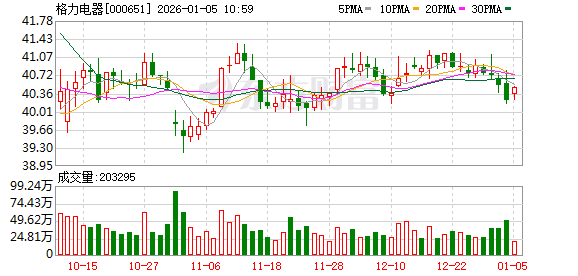
2026年1月5日上午,格力电器(000651)发布声明回应市场关切问题时表示,家用空调不涨价,且暂无"铝代铜"相关计划。 【导读】格力最新回应:家用空调不涨价,且暂无"铝代铜"相关计划 近期,格力电器陆续收到投资者及媒体就部分企业推出空调涨价和"铝代铜"计划等相关问题的咨询,询问公司的态度和计划。 格力电器表示,格力积极响应2026年家电国家补贴政策,切实让利消费者,并承诺格力家用空调不涨价。同时,为满足格力家用空调十年免费包修服务标 准,格力暂无"铝代铜"相关计划。未来若相关研究能完全满足格力质量和技术标准要求并正式应用,格力将予以明确标注,充分保障消费者的知情权与选 择权。 董明珠多次回应"铝代铜"问题 近年来,随着铜价大幅上涨,用成本较低的铝替代铜被认为是降低生产成本的有效方式之一。 作为行业龙头,格力与美的、海尔、奥克斯、小米等共同参与了《房间空气调节器用热交换器》国家标准的修订,不过未参与《空调铝强化应用研究工作 组自律公约》的联合发声。 早在2023年度股东大会上,董明珠就表示,已经有部分空调企业开始用铝代替铜作为原材料。目前来看,铝作为替代,其耐久性和稳定性无法得到保证。 所以,在没有百分之百 ...
空调涨价?格力紧急回应
中国基金报· 2026-01-05 01:39
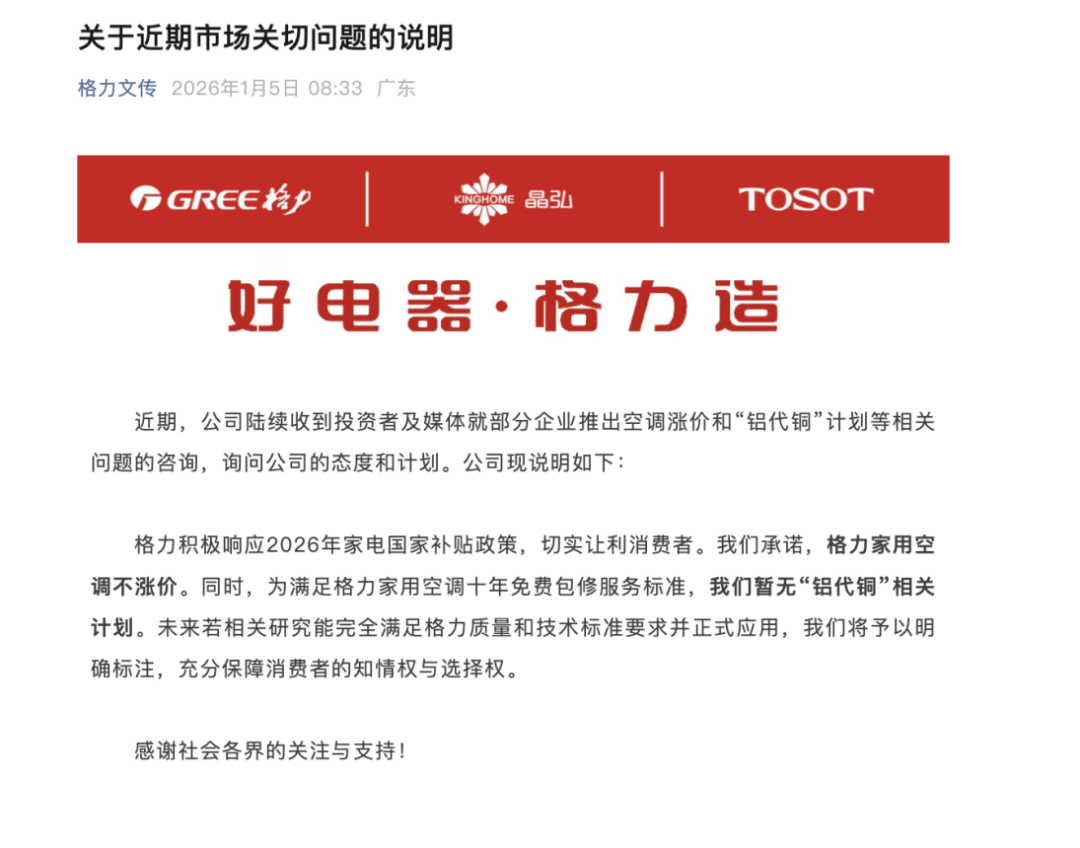
【导读】格力最新回应:家用空调不涨价,且暂无 " 铝代铜 " 相关计划 中国基金报记者 忆山 2026 年 1 月 5 日上午,格力电器发布声明回应市场关切问题时表示,家用空调不涨价,且 暂无 " 铝代铜 " 相关计划。 编辑:格林 校对:纪元 编辑:舰长 审核:木鱼 近年来,随着铜价大幅上涨,用成本较低的铝替代铜被认为是降低生产成本的有效方式之 一。 作为行业龙头,格力与美的、海尔、奥克斯、小米等共同参与了《房间空气调节器用热交换 器》国家标准的修订,不过未参与《空调铝强化应用研究工作组自律公约》的联合发声。 早在 2023 年度股东大会上,董明珠就表示,已经有部分空调企业开始用铝代替铜作为原材 料。目前来看,铝作为替代,其耐久性和稳定性无法得到保证。所以,在没有百分之百的把 握之前,格力就绝对不会使用铝代铜。 2025 年 12 月,董明珠再次表示, " 铝代铜 " 能不能代?可以代,因为铝的技术格力也研 究了很年,但是格力依然坚持不用 " 铝代铜 " 的原因是,它还没有达到与铜同等的技术条件 和保障。 董明珠指出: " 我们一定研究,直到铝能够完全替代铜,我一定上铝。 " 近期,格力电器陆续收到投资者及 ...

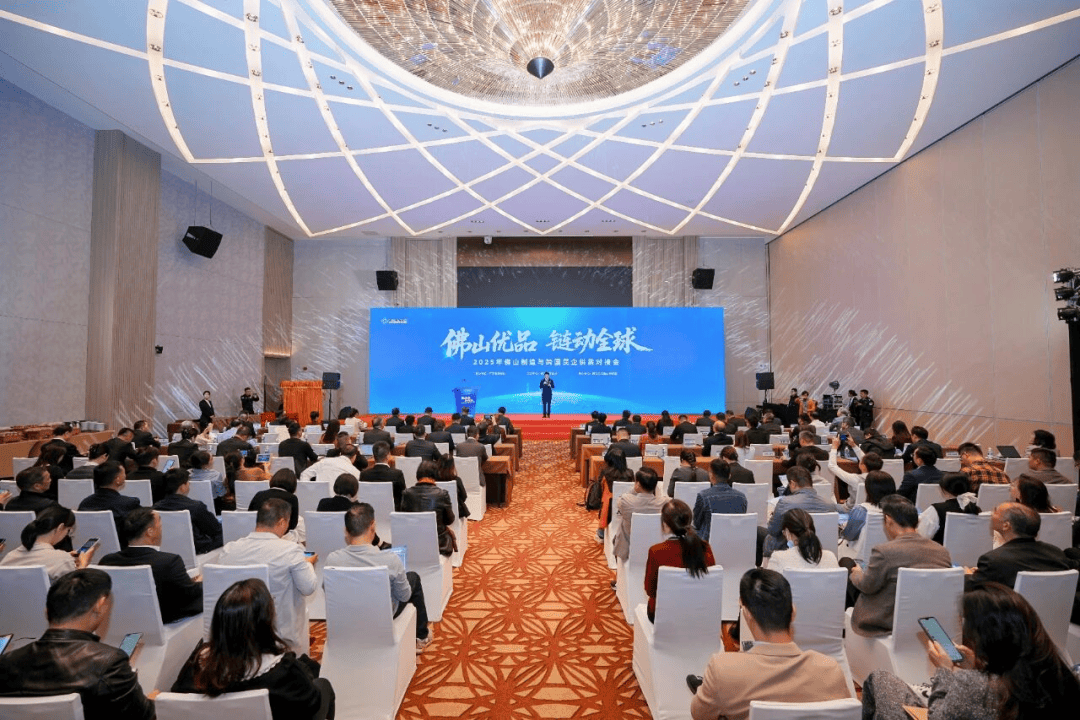
“佛山优品 链动全球”,抱团出海模式2.0上线
Sou Hu Cai Jing· 2026-01-05 01:07
Manufacturing Industry - Global manufacturing companies are actively releasing information regarding equity operations, strategic partnerships, technological innovations, and capacity planning [1] - The "Foshan Quality Products Linking Global" event on December 17, 2025, aimed to promote collaboration among Foshan manufacturing enterprises and attracted over 100 local suppliers and nearly 20 multinational companies for resource matching [3] - The establishment of the Foshan Enterprises Going Global Comprehensive Service Center marks the first city-level platform providing all-encompassing services for companies venturing abroad, covering policy consultation, market expansion, cross-border finance, foreign legal matters, and overseas rights [3] Electronic Information Manufacturing - Mingpu Optoelectronics engaged in discussions with multiple institutions regarding business integration, product development, and international network expansion [5] - Following the completion of a 60% equity transfer of Shenzhen ABB, the company plans to enhance collaboration in cost efficiency, technology R&D, and market channels [5] - The company has established multiple production bases in Dongguan, Henan, Jiangxi, Wuhan, and Vietnam to improve capacity flexibility and has set up sales branches in North America and Southeast Asia [5] Comprehensive Manufacturing Services - Boda Technology, a pioneer in the African market, aims to deepen cooperation with Foshan manufacturers, leveraging its resources in 10 African countries [6] - Guangdong Weijing Group participated in the Foshan event, emphasizing the importance of effective communication with multinational companies to facilitate substantial cooperation and reduce overseas costs [7] Textile Equipment Industry - Zhuolang Intelligent signed a cooperation agreement with Huawei to promote digital textile upgrades [8] - Changling Textile Electric announced a significant increase in jet loom sales [8] - China Textile Holdings plans to invest $4.74 million in the procurement of 12 spinning machines [9] - Rifa Precision Machinery intends to sell part of its assets for 155 million yuan [9] - Jinggong Technology won a bid for a high-performance carbon fiber production base project in Wuhan worth 729 million yuan [10] Sewing Equipment Industry - The 2025 China Sewing Machinery Industry Conference will be held on December 3, 2025, in Guangzhou [17] Apparel Industry - Li Hua Holdings Group's subsidiary LeverStyle Limited plans to acquire Active Apparel Group's sportswear business assets for an initial price of $130 million [19] - The third batch of apparel equipment procurement by Anhui Wuying Garment Co., Ltd. has a budget of 721,200 yuan [21] Footwear Equipment and Materials Industry - The "Innovation Driven, Intelligent Manufacturing Future" global footwear leaders summit will take place on December 12, 2025, featuring major domestic and international footwear companies [20]
武汉经开区招商引资实现“开门红”,11个重点项目集中签约,投资额超百亿元
Chang Jiang Ri Bao· 2026-01-05 01:01
Core Insights - Wuhan Economic Development Zone successfully signed 11 key industrial projects with a total investment of 10.7 billion yuan, marking a strong start to the year [1] - The signed projects focus on automotive manufacturing, new energy, and semiconductor new materials, characterized by large investment scale, high technological content, and strong industrial driving force [1] - The projects aim to build a modern industrial system and cultivate new productive forces in the Wuhan Economic Development Zone [1] Investment Highlights - Ditoong Industrial Holdings will invest 2 billion yuan to establish a production and R&D base for automotive components in Wuhan Economic Development Zone, highlighting the area's strong industrial foundation and complete supply chain [1] - The project will adopt a flexible model of "leasing first, then self-building, and phased production," achieving a record project implementation speed of 43 days from factory entry to product delivery [1] - Other projects include Baida Optoelectronics' high-voltage connection system smart manufacturing base and Sunshine New Energy's Hubei operation headquarters, focusing on the electrification and intelligence of new energy vehicles and home appliances [1] Strategic Development - The Wuhan Economic Development Zone is enhancing its industrial chain through precise investment attraction, transitioning from "China's Auto Valley" to "World's Auto Valley" [2] - Key expansion and follow-up projects, such as Dinglong Holdings' second research institute and semiconductor new material expansion, are being actively promoted to build a new industrial ecosystem [2]
银河证券:元旦客流引领复苏 关注消费各细分赛道中有阿尔法的公司
Zhi Tong Cai Jing· 2026-01-05 00:45
Group 1 - The core viewpoint of the report emphasizes the recovery of service consumption driven by the resurgence of travel during the New Year holiday, which has become the main force for domestic demand recovery [1] - The report highlights the optimistic outlook for the development of overseas business in the consumer sector by 2026, alongside a focus on high-dividend quality companies during market style shifts [1] - The report notes that the 2026 policy direction will significantly boost consumption, with a particular emphasis on experiential service consumption as a key growth area [1] Group 2 - During the New Year holiday, transportation data indicates a total of 590 million people traveled across regions, with an average of 198 million daily, marking a 19.5% year-on-year increase [1] - Railway passenger volume is expected to reach 48.22 million, a 53.1% increase year-on-year, while road travel is projected at 540 million, up 15.5% [1] - The report mentions that inbound tourism is continuing to grow, with ticket bookings for inbound travel during the New Year holiday increasing by 110% year-on-year [2] Group 3 - The first batch of national subsidies for 2026 has been issued, with 62.5 billion yuan allocated to support the replacement of consumer goods, benefiting categories such as air conditioners and refrigerators [3] - Midea has initiated a price increase for air conditioners, implementing a tiered pricing strategy with a 2% increase on January 3 and an additional 4% on January 5 [3] - The report indicates that Midea's price increase is a response to rising copper costs and aims to improve the competitive landscape in the air conditioning industry [3] Group 4 - CES 2026 is set to take place from January 6 to 9, 2026, in Las Vegas, showcasing Chinese technology consumer products transitioning from innovative to mainstream [4] - The focus will be on smart home devices, electric vehicles, and various consumer electronics, with particular attention to stair-climbing vacuum cleaners for the European and American markets [4]

2026大消费:看不清的市场,藏不住的增长
Tai Mei Ti A P P· 2026-01-05 00:40
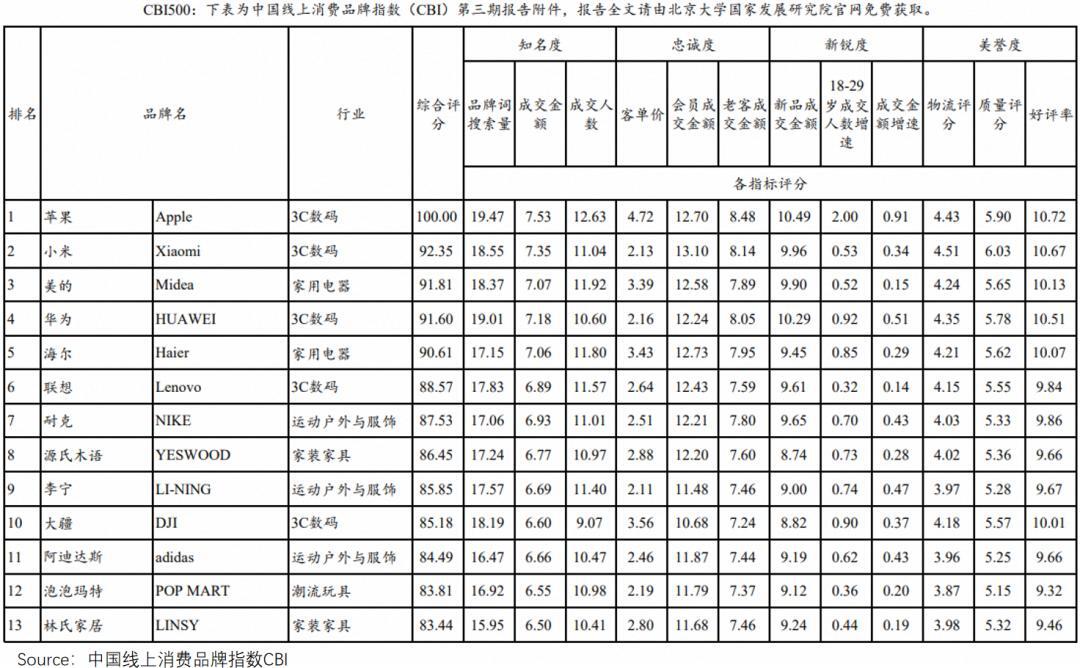
Group 1 - The consumer market in China is viewed as one of the biggest investment opportunities by 2026, but there are differing opinions on where and how to invest [1] - Traditional consumption sectors like liquor, apparel, and beauty have faced challenges, yet some brands have managed to achieve stock price increases of 30% to 50% [2] - The complexity of the consumer market requires investors to connect macro trends with micro behaviors to identify structural opportunities [3] Group 2 - The "China Online Consumption Brand Index" (CBI) and the "Global Brand China Online 500" list reveal significant shifts in consumer preferences, with traditional liquor brands like Moutai and Wuliangye declining while newer brands like Pop Mart are rising [3][4] - The CBI index reflects the performance of brands based on real consumer behavior, including sales, price, search volume, and reputation [4] - The liquor industry is undergoing a transformation, with brands like Jian Nan Chun and Shanxi Fenjiu adapting to new consumer preferences, particularly among younger demographics [6][7][13] Group 3 - The outdoor apparel market is shifting from niche enthusiasts to mainstream consumers, with brands like Berghaus gaining traction due to their stylish and affordable offerings [17] - Emerging brands in the cosmetics sector, such as Huazhi Xiao, are capitalizing on specific consumer trends and achieving significant growth in brand rankings [20][22] - The CBI index serves as a lens to identify changes in consumer demand and potential growth opportunities across various sectors [24] Group 4 - Pop Mart's financial performance shows a significant increase in overseas revenue, yet the stock has faced volatility due to market sentiment rather than fundamentals [26][28] - The brand maintains a leading position in the industry despite short-term fluctuations, indicating strong brand loyalty and potential for future growth [29][30] - The luxury gold market is experiencing challenges as competition increases, impacting customer loyalty and market positioning for brands like Laopufeng [40][35] Group 5 - The beauty industry is witnessing a resurgence for brands like Chanel and YSL as they adapt to new marketing channels and consumer preferences [22] - The investment landscape is influenced by varying investor strategies, with short-term traders reacting differently than long-term investors to market signals [34][41] - The Chinese consumer market is complex and requires a multifaceted approach to uncover hidden opportunities [42]

以后的空调制冷都不行了?铝代铜到底是升级还是减配?
36氪· 2026-01-04 23:59
Core Viewpoint - The article discusses the ongoing debate in the air conditioning industry regarding the use of aluminum instead of copper in key components, particularly heat exchangers, and the implications for performance and cost [5][12][31]. Group 1: Industry Trends - Major air conditioning brands, including Haier, Midea, and TCL, have formed an alliance to promote the use of aluminum in place of copper, while Gree has explicitly stated it will not adopt this practice due to concerns over quality and reliability [6][10][11]. - The shift to aluminum is driven by rising copper prices, which have surged to over $12,000 per ton, making copper increasingly expensive for manufacturers [38][59]. Group 2: Technical Considerations - The transition to aluminum involves replacing copper pipes in heat exchangers, which are critical for the cooling and heating functions of air conditioners [12][15]. - Aluminum has lower thermal conductivity (about 60% of copper's) and poorer corrosion resistance, which raises concerns about long-term reliability and performance [17][18]. - Innovations such as microchannel technology and specialized coatings are being developed to mitigate the disadvantages of aluminum [19][20][21]. Group 3: Economic Factors - The cost of copper constitutes approximately 30-40% of the total cost of air conditioning units, prompting manufacturers to seek alternatives like aluminum, which is significantly cheaper (1/12 the cost of copper) [36][62]. - The global demand for copper is increasing due to the expansion of AI data centers and electric vehicle production, further straining supply and driving prices up [47][52]. Group 4: Market Dynamics - The article highlights that the trend of replacing copper with aluminum is not unique to China; it is a global phenomenon across various industries, including home appliances and electrical sectors [27][29]. - Companies are under pressure to adapt to market conditions, including potential tariffs on copper imports, which could further escalate costs [55][58]. Group 5: Consumer Concerns - Consumers are primarily concerned about whether the switch to aluminum will compromise the performance of air conditioning units, particularly in terms of cooling efficiency and reliability [64][65]. - The article suggests that manufacturers should consider passing on cost savings to consumers through lower prices or extended warranties to build trust in the new technology [65].
